

Automated 835 and 277 Processing
Eligible API integration automatically retrieves remittance advice and submission statuses, while batch processing applies payment tiers, offsets, status rules, and payer updates directly to claim records.

Streamlined behavioral health billing with cloud-based RCM software, AI-driven claims management, and real-time insurance integration.

The healthcare claims and patient management platform was developed to streamline revenue cycle operations for organizations managing high volumes of patient, facility, and payer data. The solution automates 835 and 277 EDI processing, centralizes claims oversight, and supports Verification of Benefits, utilization review, invoicing, and patient management workflows. Through payer integrations, multi-facility aggregation, role-based permissions, Google Sign-In, and controlled maintenance capabilities, the platform helps internal and external users manage complex billing activities with greater accuracy, visibility, and operational control.
Discover how a cloud-based RCM platform resolved critical inefficiencies in behavioral health billing, transforming fragmented, error-prone workflows into a centralized, scalable, and collaborative digital system.

Billing teams relied on manual processing of 835 remittance files, creating significant administrative effort while increasing the possibility of delayed claim updates and data entry errors.

Without automated payer data ingestion, facilities lacked timely visibility into payment updates, offsets, and claim statuses, making it difficult to maintain accurate revenue cycle information.

Managing claims, patients, and billing activities across multiple facilities required a centralized approach that could aggregate information while still supporting facility-specific operational workflows and controls.

Multiple insurance policies, VOB forms, member identifiers, policy-specific submissions, and electronic benefit verification created complex data management requirements across patient verification and billing workflows.

Internal and external users required different permissions, screens, and operational capabilities, creating a need for granular role-based access that could adapt dynamically to user responsibilities.
Critical platform updates required controlled system access to prevent concurrent record modifications while still allowing authorized engineering and executive users to validate deployments and system health.
We developed an integrated healthcare operations platform that automates payer data ingestion, centralizes claims and patient management, supports complex verification workflows, enforces role-based permissions, and protects data integrity during system updates.

An automated pipeline pulls 835 payment advice and 277 claim status data through the Eligible API, routing information into reports and updating claim records through batch processing.

A unified claims console provides search, filtering, sorting, editing, bulk updates, column customization, and CSV operations, helping billing teams manage high volumes of claim information efficiently.

Facilities of the same type can be grouped into a centralized dashboard, enabling users to review combined operational data and perform conditional claim activities across facility networks.

Multi-policy Verification of Benefits workflows manage distinct VOB identifiers, member information, policy-specific submissions, status updates, electronic verification, and document generation within structured patient management processes.

Google Sign-In and granular RBAC dynamically control screens, data, and platform actions according to active user roles while supporting internal, external, engineering, and executive access requirements.

A centralized maintenance mode prevents standard users from modifying data during deployments while allowing designated engineers and executives to retain platform access for rollout monitoring and validation.
The platform combines automated claims processing, patient management, payer integrations, benefit verification, invoicing, multi-facility visibility, and role-based controls to support complex healthcare billing and operational workflows.
Eligible API integration automatically retrieves remittance advice and submission statuses, while batch processing applies payment tiers, offsets, status rules, and payer updates directly to claim records.

Users can search, filter, sort, customize columns, edit individual claims, perform bulk modifications, and import or export CSV files through a centralized claims management interface.

Split-panel patient views organize notes, files, VOB information, and utilization review details while expandable rows provide faster access to nested patient and billing information.

Users can combine multiple facilities of the same type into a unified view, providing consolidated oversight and enabling conditional claims operations across broader facility networks.

Smart VOB forms support multiple policies, unique VOB identifiers, dynamic member information, policy-specific submissions, and automatic status updates whenever benefit verification information changes.
Users can generate electronic VOB PDF documents directly from benefit verification workflows, automatically route documents to patient files, and enforce eligibility-related refresh rules through configured business logic.
Scheduled processes reset invoice fields, generate Excel-based reports, identify claim errors, and automatically update invoice statuses according to payment information and validation requirements.
RBAC and Google Sign-In control access for internal and external users, while role switching dynamically determines available dashboards, facilities, claims, patient views, and assignment screens.
Care teams can manage admit and discharge dates, filter authorization information, and trigger real-time patient list updates to maintain current visibility into utilization review status.
See the real-world impact of a digital RCM platform—from faster workflows and reduced errors to enhanced collaboration and revenue recovery across 140+ behavioral health facilities.
Automated ingestion and batch processing of payer remittance data reduced dependence on manual 835 reconciliation, helping billing teams manage claim updates with greater consistency and efficiency.
Direct payer integrations enabled claim payment advice and submission statuses to flow into the platform more systematically, giving users more current visibility into billing and payment activity.
Centralized facility aggregation allowed healthcare teams to oversee claims and patient information across multiple locations without relying on separate operational views for each participating facility.
Granular role-based permissions, authenticated access, and controlled maintenance workflows helped protect sensitive healthcare information while restricting platform functionality according to defined organizational responsibilities.
Policy-specific VOB handling, eVOB generation, automated status updates, and targeted discard controls created a more structured process for managing complex patient insurance and benefit verification information.
Maintenance mode allowed critical system updates to proceed without standard-user data changes while preserving access for authorized engineering and executive users responsible for deployment validation.

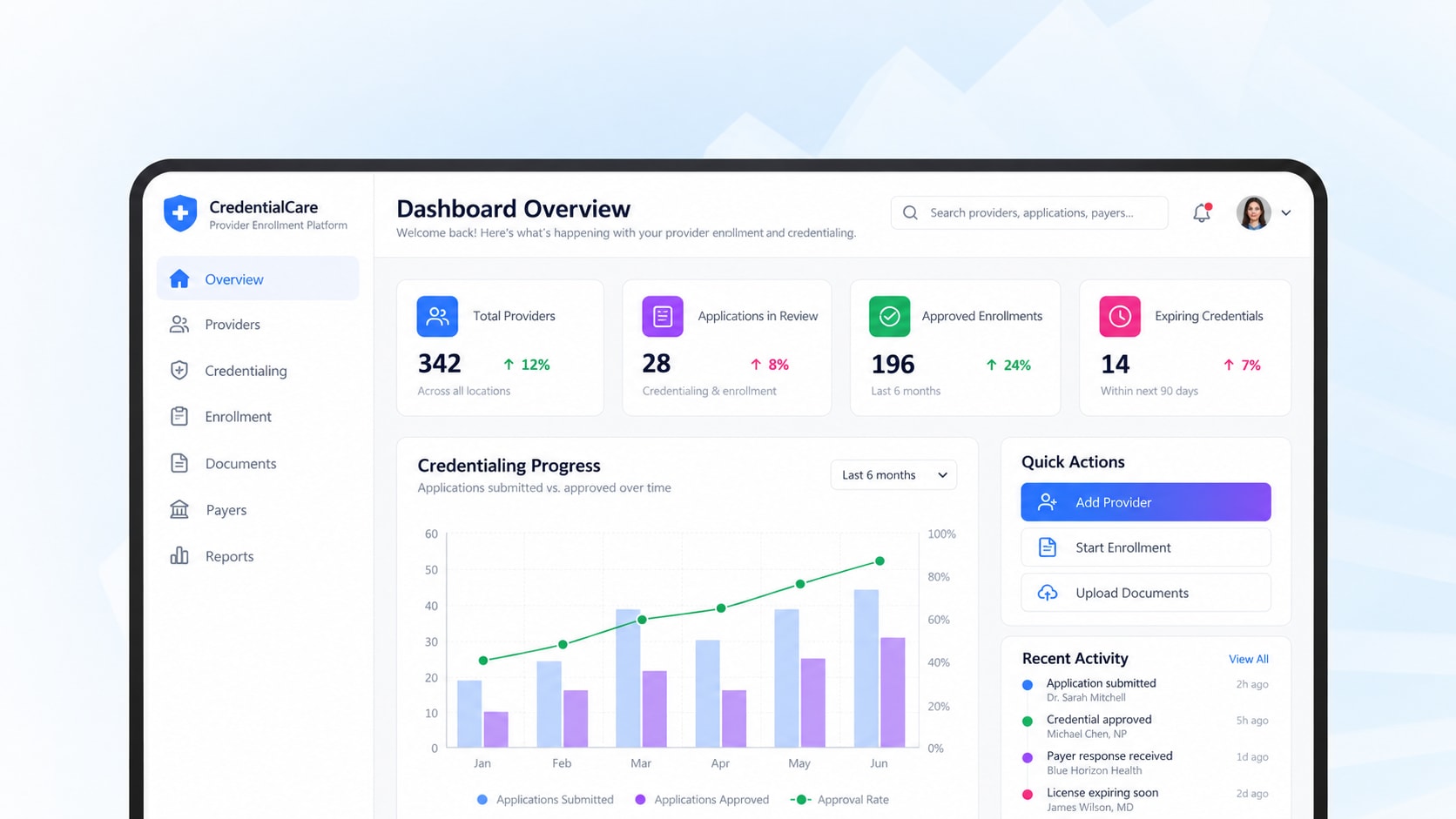
See how we built a healthcare credentialing software platform to streamline provider enrollment, payer workflows, compliance, and revenue cycle visibility.
View Project