Legacy Platforms Restrict Change
Core administration and claims environments can become difficult to extend as business rules, integrations, batch processes, and technical dependencies accumulate over time.
We help health plans, TPAs, Medicare Advantage organizations, and insurance technology businesses improve fragmented payer operations through health insurance software built around real workflows. Our payer technology solutions connect claims, enrollment, eligibility, members, data, integrations, and health insurance automation to improve operational control, scalability, and service delivery.
Assess Your Payer Technology LandscapePayer transformation rarely starts because an organization simply wants different technology. Health insurance software becomes a priority when claims, member service, onboarding, reporting, integration, or operational cost starts limiting performance. We identify those business constraints before recommending new payer technology solutions.
Core administration and claims environments can become difficult to extend as business rules, integrations, batch processes, and technical dependencies accumulate over time.
Employees may move between queues, spreadsheets, portals, documents, and disconnected applications simply to process, validate, reconcile, or investigate a claim.
Service representatives may need to search multiple systems for eligibility, claims, benefits, payments, correspondence, or prior interactions before answering a member question.
Enrollment, eligibility, claims, billing, provider, finance, member, and partner information may move through systems that were never designed to operate as one environment.
Repeated configuration, testing, mapping, integration, and manual setup can turn growth initiatives into long implementation programmes.
Leadership loses operational visibility when teams still compile KPIs manually or wait for batch processing before understanding what happened.
Individual scripts or bots may reduce one manual step while the wider workflow remains fragmented, creating another layer that employees have to manage.
Payers increasingly need technology environments capable of supporting secure data exchange, API-driven interoperability, traceability, and changing administrative workflows.
Strong payer technology solutions should do more than digitize existing processes. We connect architecture, workflow, data, integration, and health insurance automation so technology can improve how payer teams process work, respond to members, manage exceptions, onboard partners, and scale operations.
Automate predictable validation, routing, matching, updates, reconciliation, notification, and data-processing activities while preserving human review where judgment is required.
Give operations and leadership clearer views into queues, claims status, exceptions, turnaround times, member activity, partner performance, and workflow bottlenecks.
Create reusable configuration and integration patterns that make new products, plans, clients, employer groups, providers, or partners easier to onboard.
Connect member-facing experiences with claims, eligibility, plan, billing, document, and communication information instead of creating another standalone portal.
Modern APIs and integration layers make it easier to connect payer cores with providers, clearinghouses, financial systems, digital products, analytics, and healthcare ecosystems.
Modernization should make future business requirements easier to implement rather than simply replacing one difficult-to-change system with another.
Once workflows, integration, and data are reliable, payer organizations can introduce AI-assisted capabilities where they solve a validated operational or decision problem.
A DITS engagement involved a claims-administration platform serving TPAs, insurers, and Medicare Advantage plans. The existing AS/400 environment relied on batch processing, fragmented back-office systems, manual reporting, and lengthy onboarding cycles. New payer onboarding took approximately 14–16 months, while batch-driven systems restricted real-time claims and eligibility visibility.
View Portfolio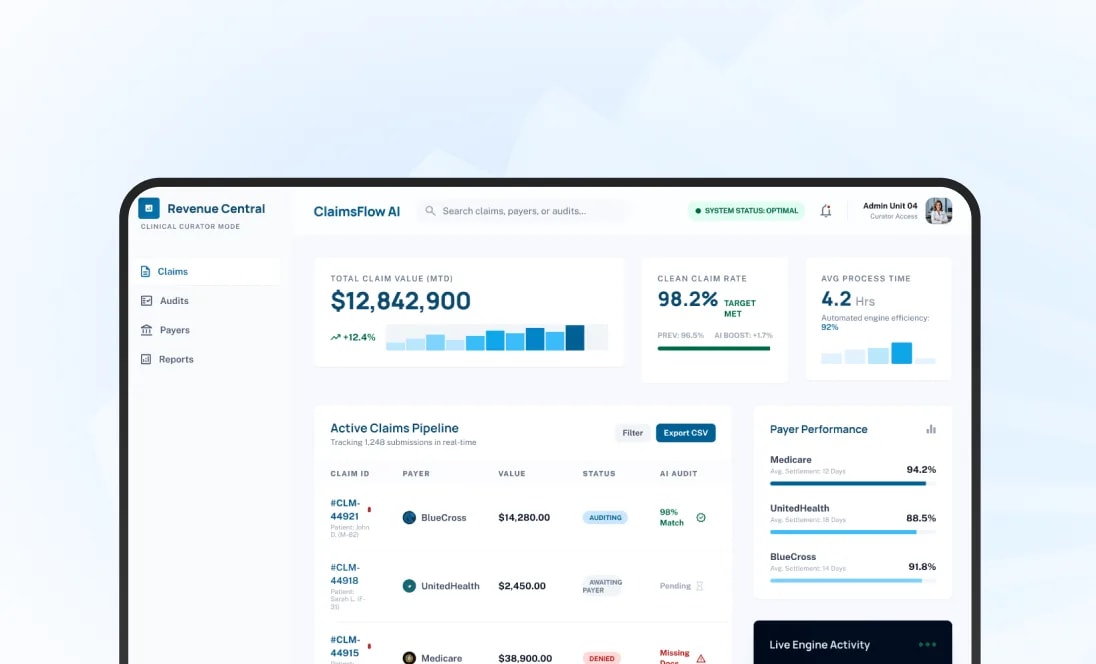
We replaced spreadsheet-heavy behavioral-health billing workflows with centralized claims management, payer integrations, dashboards, mobile access, and automated EDI processing across more than 140 facilities. The solution connected 277, 835, 837, and 270 workflows to automate claim status, payment, submission, and eligibility information. The published portfolio reports more than 60% faster reconciliation within this engagement.
Read Full Portfolio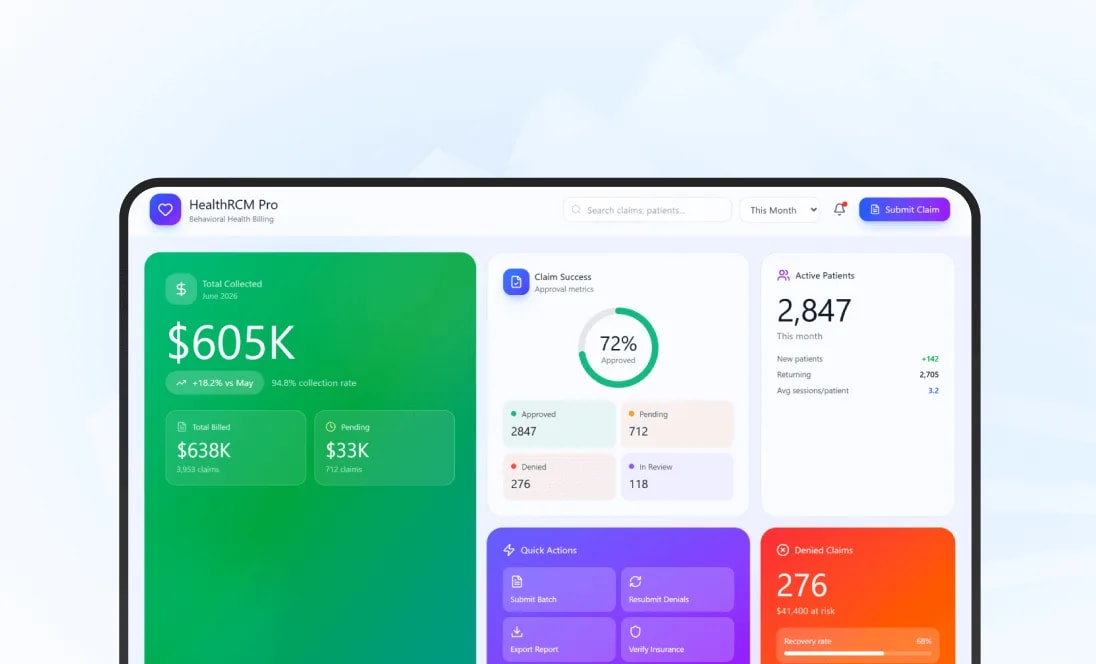
Effective health insurance automation starts by determining what kind of intervention the payer actually needs. DITS evaluates the workflow, systems, rules, data, exceptions, and economics before deciding whether the answer is automation, modernization, payer system integration, product engineering, or a combination.
Remove redundant steps, duplicate approvals, unnecessary data entry, or outdated operating rules before automating them.
Integrate systems and data when fragmentation, not lack of functionality, is the main cause of operational friction.
Automate predictable, repeatable workflow activity where rules and expected outcomes are clearly defined.
Improve applications, architecture, data, infrastructure, or user experience when aging platforms restrict business change.
Add new member, partner, analytics, mobile, or administrative capabilities around a core system that still provides business value.
Engineer new platform capability when existing applications cannot economically support the required operating model.
Introduce intelligent document processing, prioritization, summarization, or decision support only where data, governance, and workflow conditions justify AI.
Retain people in decisions involving policy interpretation, exceptions, financial impact, risk, or situations where context matters more than deterministic rules.
Our health insurance software capabilities can address a targeted process or a wider payer transformation. We combine product engineering, modernization, automation, data, and integration so each capability works within the wider operating environment.
Support claims intake, validation, adjudication, status, exceptions, payments, remittance, reconciliation, and reporting in a connected operational workflow.
Connect member enrollment and eligibility information with downstream claims, billing, plan, member, and reporting processes.
Support configurable plan structures, premiums, benefits, rules, product information, and administrative workflows around the payer operating model.
Connect premium schedules, invoices, payment status, reconciliation, banking workflows, and relevant financial information.
Create unified member records, digital identification, documents, correspondence, account activity, and service workflows.
Replace delayed spreadsheet reporting with role-based dashboards, operational metrics, workflow visibility, and governed reporting.
Build repeatable processes for onboarding payers, providers, employer groups, vendors, clearinghouses, or other ecosystem participants.
Effective member engagement solutions should help people complete useful activities without creating another disconnected front end. We connect member experiences with health insurance software so service, claims, eligibility, documents, notifications, and account actions remain tied to the underlying payer workflow.
Give members secure access to relevant plan, account, claims, benefit, payment, and document information.
Extend important self-service and communication capabilities to mobile environments where convenience can reduce service friction.
Help members understand where a claim sits in the process without requiring routine calls to service teams.
Provide appropriate digital access to member identification and relevant plan details.
Send useful updates around claims, premiums, enrollment, documents, or other workflow events instead of disconnected promotional communication.
Allow digital member requests to become structured tasks, cases, or follow-up activities for the appropriate operational team.
Connect past interactions with relevant member context so service employees are not rebuilding the story every time a member contacts the organization.

Payer system integration often creates value before a core replacement does. We connect legacy platforms, claims engines, provider environments, EDI services, banking systems, CRM, analytics, identity, documents, and new digital products so payer technology solutions work across the wider healthcare ecosystem.
Integrate claims, remittance, eligibility, claim-status, enrollment, and other established healthcare transactions.
Connect provider portals, directories, data exchange, claims information, and other operational interfaces where payer-provider workflows depend on shared information.
Create controlled data exchange between claims platforms and external clearinghouses while maintaining validation, monitoring, and exception handling.
Connect remittance, reconciliation, banking, payments, premiums, and financial systems where payer workflows cross into finance.
Connect member or partner interaction systems with operational data so customer-service teams work with current context.
Move operational data into governed reporting and analytics environments without relying on repeated spreadsheet extraction.
Where payer requirements apply, architectures can incorporate modern FHIR-based interoperability alongside established EDI infrastructure.
Payer operations become difficult to scale when enrollment and eligibility sit separately from claims, billing, member experiences, and reporting. Our payer technology solutions connect these workflows so downstream systems can work from more consistent information.
Support digital enrollment, member creation, group assignment, plan selection, and structured onboarding activity.
Maintain eligibility status and make appropriate information available to the workflows that depend on it.
Support employer-group structures, plan configurations, member relationships, and relevant administrative activity.
Manage plan information, product structures, benefit-related configuration, premium schedules, and relevant business rules.
Support applicable enrollment and maintenance transactions across connected payer environments.
Process additions, terminations, plan changes, dependent changes, effective dates, and related updates through controlled workflows.
Modernizing health insurance software does not automatically mean replacing every core platform. We assess the role of each system and determine whether payer system integration, cloud, APIs, refactoring, re-platforming, workflow redesign, or selective rebuilding provides a stronger path.
Keep systems or components that continue to perform their business role effectively.
Address security, reliability, performance, testing, documentation, or operational issues that create immediate risk.
Expose useful capabilities through governed interfaces rather than rewriting stable business logic unnecessarily.
Improve member, employee, partner, and administrative workflows without always replacing the complete backend.
Move specific applications or workloads to more suitable environments when infrastructure or platform limitations are restricting change.
Improve modules that create disproportionate maintenance, performance, integration, or scalability constraints.
Consider replacement when the value of retaining or modernizing the current system no longer justifies the investment and operational complexity.
Health insurance automation should reduce unnecessary work rather than add another layer of technology. We combine deterministic automation with AI-assisted capabilities where the workflow, data, risk, and governance model support them.
Automate validation, matching, routing, status updates, reconciliation, notifications, and standardized rule checks.
Extract, classify, validate, and route information from forms, correspondence, attachments, or other document-heavy administrative workflows.
Use workflow rules or analytics to help teams identify which queues and exceptions need attention first.
Use AI selectively to prepare context or summarize information where employees currently spend significant time assembling it manually.
Assist employees with knowledge retrieval, workflow guidance, case preparation, or repetitive administrative steps.
Keep people accountable for judgment-heavy exceptions, policy interpretation, material financial decisions, and sensitive member situations.
Frontend

Greater claims workflow automation increases the importance of visibility, ownership, controls, and exception handling. We design automation so operational teams can understand what happened, why work was routed, and where people remain accountable.
Control who can access, change, approve, review, or override information based on operational responsibility.
Maintain appropriate records of claims activity, workflow changes, status updates, approvals, and user actions.
Ensure unresolved or non-standard work has an accountable owner instead of remaining hidden inside automated processing.
Keep important adjudication and workflow rules configurable, reviewable, and subject to controlled change.
Protect member, claims, provider, financial, and operational information through appropriate security controls.
Define when automation stops and operational specialists need to review a case.
Track system, integration, transaction, and workflow behaviour so failures can be detected before they become invisible operational problems.
We use the DITS transformation methodology to keep the payer business problem ahead of engineering. The wider DITS 2.0 approach moves from understanding and mapping through prioritization, validation, engineering, adoption, measurement, and evolution.
Clarify the payer model, business priorities, users, cost pressures, operating constraints, growth requirements, and intended outcomes.
Understand claims, member, enrollment, billing, provider, data, integration, and partner workflows across systems and teams.
Identify the workflows creating the greatest cost, delay, risk, service friction, or growth constraint.
Test architecture, integrations, workflows, prototypes, automation assumptions, or technical approaches before larger investment.
Build, modernize, integrate, automate, or extend the selected health insurance software capability.
Support workflow ownership, user transition, governance, operating procedures, and organizational adoption.
Compare business, operational, member, product, and technical outcomes against the agreed starting point.
Continue improving automation, architecture, integration, analytics, experiences, and product capability as payer requirements change.
We do not evaluate health insurance automation by the number of workflows or bots deployed. Success should reflect whether the intervention changes efficiency, member experience, scalability, product performance, risk, and the organization's ability to evolve.
Track unnecessary touches, reconciliation effort, rework, repeated data entry, and processing steps.
Measure cycle time, queue aging, exception volume, status visibility, and workflow progression where relevant.
Evaluate digital completion, response times, self-service adoption, service friction, and the number of interactions required to resolve common needs.
Measure the effort and elapsed time required to configure and connect new clients, products, plans, or partners.
Assess whether operational and executive information becomes more current, trustworthy, and accessible.
Track reliability, latency, scalability, defects, releases, integrations, and other appropriate product measures.
Evaluate whether modernization reduces reliance on specialist skills, manual processes, fragile integrations, or outdated platforms.
Assess whether new products, partnerships, geographies, integrations, or operating models become easier to support.
We combine payer workflow understanding with consulting, engineering, modernization, cloud, data, AI, and payer system integration so clients can move from identifying the operational problem to implementing and evolving the right solution.
Our first question is not what software should be built. It is what is limiting payer performance and why.
DITS has practical delivery experience across claims administration, EDI, eligibility, billing, payer integrations, member experiences, analytics, and healthcare financial workflows.
The team defining the intervention can carry the same reasoning into architecture, implementation, integration, quality, and rollout.
Existing platforms can be retained, integrated, API-enabled, refactored, or progressively modernized where that creates stronger business value.
Applications, APIs, EDI, data, partners, member experiences, and operational workflows are considered as one payer ecosystem.
We introduce intelligence where the workflow and data support it rather than adding AI because the market expects the label.
The payer environment will continue changing. Architecture and operating models should support ongoing products, integrations, regulatory requirements, and workflow improvements.
You do not need to decide whether the answer is new health insurance software, payer technology solutions, modernization, health insurance automation, or integration before speaking with us. Bring the claims, member, onboarding, data, or operational challenge, and we will assess what should change before defining the roadmap.
Discuss Your Payer Transformation
