How to Build Medical Billing Software for Billing Companies
Table Of Content
Published Date :
10 Aug 2026
Key Takeaways
- Custom medical billing software helps billing companies automate day to day operations and speed up reimbursement cycles.
- A well-planned development process lowers project risks, and it also supports long term business growth.
- Claims management, denial tracking, reporting, and system integrations tends to bring the biggest gains for operational efficiency.
- Development costs vary a lot depending on customization levels, integrations, AI capabilities, and the overall project complexity involved.
- Starting with an MVP lets businesses launch faster and then expand the platform later as requirements shift.
- Selecting an experienced technology partner like DITS can help ensure the solution fits your workflows, your business goals, and that future growth angle too.
- AI powered development plus automation can improve software quality reduce manual effort, and overall increase platform performance in practice.
Introduction
Medical billing has become more demanding than it was a few years back. Billing companies now deal with thousands of claims every month, while also coping with payer rules, compliance requirements, and increasing denial rates. According to a research healthcare providers lose an estimated $125 billion annually due to poor billing practices and claim denials.
This is where medical billing software for billing companies helps address all these issues for businesses offering services to healthcare providers.
For businesses that support multiple healthcare providers, using medical billing software has a direct impact on cash flow, client satisfaction, and profitability. This blog walks through how to build a scalable billing platform, features that matter, cost estimate and how the right technology partner like DITS can help.
Ready to Build a Billing Platform That Scales?
Automate billing workflows, streamline claims, and connect your systems with a purpose-built platform designed around your business.
Why Billing Companies need Custom Medical Billing Software?
Billing companies have different business requirements. One team might handle claims for multiple clinics; another one manages hundreds of providers across different locations. When they rely on a generic software solution, they end up changing their day-to-day workflows. This is when they need custom medical billing software that helps them shape their services to fulfil their client requirements.
With a tailored setup, billing companies can:
- Automate claim creation, submission, and follow ups.
- Handle multiple providers, specialties, and customers from one dashboard.
- Reduce coding mistakes and boost first pass claim acceptance rates.
- Work denials through built in workflows that help speed up fixes and resubmissions.
- Produce client specific financial and operational reports.
- Scale operations without hiring more billing staff.
- Integrate smoothly with existing payer systems, EHRs, and other medical billing software.
A custom platform provides companies full control over its processes, reporting, and future expansion.
Also Read: SaaS-Based Cloud RCM Software for Behavioral Health Billing
Step-By-Step Process to Build Medical Billing Software for Billing Companies
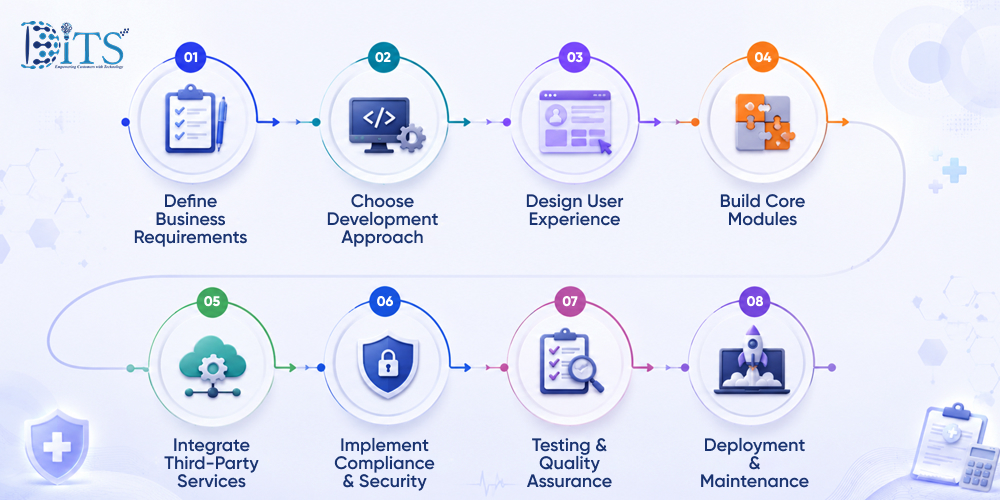
Building a successful billing platform means building a system that reduces claim mistakes, helps maintain compliance, and still grows smoothly. Let us explore the step-by-step process to build medical billing software for billing companies.
Step 1: Define Business Requirements
Most projects start by looking at how the billing company works right now and ask how it will be working in the next three to five years.
Target Audience
First, list who is going to use the software. Usually it’s billing specialists, account managers, coders, finance teams, healthcare providers, and administrators. Every one of these groups will need different levels of permission, and different sets of functions too.
Workflow Mapping
When you document how claims get submitted, and payment posting process, plus denial management, and what reporting looks like, you get an answer about what the software can automate, and what still needs to be done manually.
User Roles
Role-based access is important, for security and for everyday operations. Billing teams should only view what they need, while administrators should have a wider perspective across clients, plus broader access to financial data.
Business Objectives
Billing companies want results like low denial rates, more claims per employee, faster reimbursement, or improved client retention. Without these goals, it’s easy to build features that don’t really move the needle.
Step 2: Choose Development Approach
The development strategy directly affects cost, flexibility, and future scalability.
Custom Development
A custom-built software solutions gives you full control over how the workflows run, how integrations connect, and how security is handled. This option tends to fit growing billing companies, especially when there are unusual operational requirements that just don’t match a generic setup.
White-Label Solution
A white-label product can really cut down on the upfront spend, and also helps teams launch faster, sometimes within weeks. However, it usually offers limited customization. As the business grows or its needs change, these limitations can make it harder to adapt and scale.
MVP Strategy
Organizations kick things off with a minimum viable product (MVP), meaning the core billing functions only, at the beginning. Then, once users share feedback, extra modules can be added in stages.
This keeps the risk lower and also helps confirm what the business really needs before they put money into a bigger build or expansion.
So, for companies looking at long term growth, a phased development roadmap usually ends up working better than trying to craft every capability all at once, because it lets them learn as they go and adjust.
Still Managing Billing Workflows Manually?
Build a custom platform to automate claims, reduce manual work, and improve operational efficiency.
Step 3: Design User Experience
Even strong software can fall apart if people can’t find what they need fast enough. Billing teams are usually on tight timelines, and each extra click, drags down productivity.
Dashboard Layout
Users should be able to spot claim status, work that is still pending, denial metrics, and revenue performance from basically one view. When teams get clear visibility, they can triage priorities faster and move on.
Navigation
Keep navigation simple. It lowers training time and reduces that everyday frustration. Staff should move between patient records, claims, payments and reports without extra friction.
Accessibility
The platform should fit different user situations while still meeting compliance and usability expectations. It should support a wide range of user needs, not just the minimum standards.
Mobile Responsiveness
Managers are expecting access to key business metrics even when they are away from the office. Responsive layouts help support decisions from any device, so nothing feels disconnected.
Organizations that invest in modern healthcare software development often realize user experience has a direct effect on employee productivity, and also on whether the software gets adopted.
Step 4: Build Core Modules
This stage makes the basis of the platform, and it also decides how well it actually backs up the daily operations.
Patient Management
Keep demographic information, insurance details, eligibility records, and even communication history all in one centralized place, so nobody is digging around later.
Claims Engine
The claims engine does a lot: claim creation, validation, submission, tracking, and status updates. In many cases it becomes the most crucial component in any medical software billing platform for small practices.
Billing Workflows
Automated workflows cut down on the repetitive paperwork tasks, and they help claims processing easier without too much delay or confusion. For businesses looking to automate their workflows, DITS offers business workflow automation services to enhance their employee productivity and operational efficiency.
Reporting
Executives usually need to see what’s happening with collections, reimbursements, denial patterns, and overall client performance. Solid reporting capabilities often turn into a real competitive edge for billing companies.
So, when you’re evaluating medical billing software features, reporting along with workflow automation tends to deliver the biggest effect on operational efficiency, and profitability too.
Also Read: Cloud-Based Healthcare Workforce & Revenue Cycle Platform
Step 5: Integrate Third-Party Services
Medical billing platforms rarely operate in isolation. They must communicate with multiple external systems.
Clearinghouses
Clearinghouse integration enables electronic claim submission and status tracking, reducing processing delays.
Insurance Verification
Real-time eligibility verification helps identify coverage issues before claims are submitted.
Payment Gateways
Integrated payment processing improves collection management and simplifies financial operations.
Accounting Software
Connecting accounting systems eliminates duplicate entries and provides more accurate financial reporting.
Many of the most effective medical billing software solutions succeed because they create a seamless flow of information across the healthcare ecosystem rather than functioning as standalone applications.
Step 6: Implement Compliance & Security
Healthcare data is highly sensitive, making security a business requirement rather than a technical feature.
HIPAA Safeguards
The platform must include administrative, physical, and technical safeguards to protect patient information.
Data Encryption
Encryption should protect information both during transmission and while stored within the system.
User Authentication
Strong authentication mechanisms help prevent unauthorized access and reduce security risks.
Security should be incorporated during development. Retrofitting compliance controls often increases costs and project timelines.
At DITS, compliance and security planning begin at the architecture stage to help clients avoid costly remediation efforts after deployment.
Step 7: Testing & Quality Assurance
Even minor defects can create significant billing issues. Thorough testing protects both revenue and reputation.
Functional Testing
Functional testing helps verify that claims, payments, reporting, and workflow functions perform as expected.
Security Testing
Security testing helps identify vulnerabilities before the system goes live.
Performance Testing
Evaluates how the software performs under heavy workloads and large claim volumes.
User Acceptance Testing
Real users validate functionality and ensure workflows align with business operations.
One area where DITS delivers additional value is through the use of AI in healthcare software projects. We use AI-driven tools for software development, quality assurance, code quality monitoring, and customization, helping accelerate delivery while maintaining high development standards.
Step 8: Deployment & Maintenance
Software development does not end when the platform launches.
Cloud Deployment
Cloud environments provide flexibility, scalability, and easier infrastructure management.
Monitoring
Continuous monitoring helps identify performance issues before they affect users.
Regular Updates
Payer requirements, compliance regulations, and business needs evolve constantly. The platform must evolve as well.
Customer Support
Fast support minimizes disruptions and ensures users continue working efficiently.
The best medical billing software platforms are the systems that continue adapting as business requirements change. That long-term flexibility separates market leaders from companies struggling with outdated technology.
Turn Billing Complexity Into Operational Efficiency
Streamline workflows, reduce repetitive tasks, and give your team better visibility across billing operations.
Cost To Build Medical Billing Software
One of the first questions that business owners ask is "How much will it cost to build a custom billing platform?" The honest answer is, there isn't a fixed price. Two companies may both need billing software, yet their budgets can be totally different because their business models, client volumes, compliance needs, and integration requirements are different.
A simple platform, for a small billing firm will usually cost less than an enterprise solution that supports hundreds of providers across multiple specialties. The overall scope of the project is what really moves the needle on both cost and development time.
| Cost Factor | How It Affects Development Cost |
| Feature complexity | Advanced automation, analytics, and custom workflows increase development effort. |
| Team size | Larger projects require business analysts, designers, developers, QA engineers, and project managers. |
| Compliance requirements | HIPAA implementation, audit logs, encryption, and security testing add to the overall scope. |
| Third-party integrations | Connecting with clearinghouses, insurance providers, payment gateways, and existing business systems requires additional development. |
| AI capabilities | AI-powered coding assistance, claim validation, intelligent reporting, and workflow automation require specialized implementation. |
| Testing | Functional, security, performance, and user acceptance testing ensure software reliability before launch. |
| Maintenance | Ongoing updates, security patches, feature enhancements, and technical support should be considered part of the long-term investment. |
Many businesses initially focus only on development expenses, but in practice, it is not just what you pay upfront. It is how much inefficient software costs, every year, through delayed reimbursements, extra manual work, and avoidable claim mistakes. A thoughtfully built platform often pays for itself, by boosting day to day efficiency and improving collections.
Estimated Development Phases of Medical Billing Software for Billing Companies
When it comes to developing software for medical billing, organizations go with a phased approach. It spreads the spend over time, while still letting the business start pulling real value sooner.
MVP
A minimum viable product comes with the main capabilities you need to begin day-to-day operations, like patient management, claim submission, payment posting, user management, and basic reporting. This stage is really meant to test workflows, before jumping into broader, more expensive platform expansion.
Typical timeline: 4 to 6 months
Mid-Level Platform
After the base is stable, you can start adding more modules. Usually, that means denial management, advanced reporting, insurance verification, workflow automation, and connections to outside systems.
Typical timeline: 7 to 10 months
Enterprise-Grade Solution
Enterprise-grade platforms are made for big billing organizations handling several clients, specialties, and locations. They tend to offer enhanced analytics, high-volume processing, custom dashboards, stronger enterprise security, plus integration with a healthcare revenue cycle management platform so you get full, end-to-end financial operations support.
Typical timeline: 10 to 15 months or more, depending on how wide the project scope really is.
Also, choosing the absolute lowest development quote does not necessarily give best business results. A wiser route is to invest in software that will back your business for years, rather than replacing it right after the first phase of growth.
At DITS, we help billing teams shape a realistic roadmap before beginning the development for balancing functionality budget and long-term scalability. With this route businesses can launch faster, expand conveniently, and pay for features that produce real business value.
Conclusion
Building custom medical billing software for billing companies is about, how efficiently teams move, claims get processed, and how comfortable you can add new clients.
A purpose-built medical billing software pulls automation, compliance, reporting, and integrations into one operating environment. It makes daily operations convenient for staff, and leadership gets a more grounded view of what’s really happening with performance
At DITS, we’ve noticed the best billing platforms are the ones designed around real billing workflows and the specific rhythms of the business. We collaborate with billing companies to create secure, scalable solutions that support what you need right now and still flex as you grow. In other words, the software doesn’t only keep up with your operations, it pushes them ahead.
Frequently Asked Questions
What is medical billing software?
Medical billing software is a digital platform that basically helps with automating claim creation, insurance confirmation, payment posting, denial handling, reporting, and a bunch of other billing tasks. It’s used so healthcare organizations, and billing companies can speed up reimbursement, while keeping day to day operations more efficient, and less chaotic.
Why should billing companies choose custom software instead of off the shelf solutions?
Because custom software is shaped around your current workflows, your clients' requirements, and those growth plans you have. It lets your business automate internal processes, connect with your existing systems, and scale smoothly.
What features are essential in medical billing software?
Key features usually cover patient records and provider profiles, claims processing, insurance verification, payment posting, denial management, reporting dashboards, role-based access controls, compliance guardrails, and integrations with clearinghouses and EHR systems.
How long does it take to build medical billing software?
For a basic MVP it’s often around 4 to 6 months. But a more advanced enterprise style platform can take roughly 10 to 15 months, depending on how complex the project is, what integrations you need, and how much customization is required.
How much does medical billing software development cost?
Well, it really depends on a bunch of things like, what features you need, which integrations you want to connect, how strict your compliance requirements are, whether you want AI capabilities or not, how wide the project scope is, and of course the long-term maintenance.
Why choose DITS for medical billing software development?
DITS builds secure, scalable and fully customized medical billing platforms. We align the product with your actual business workflows, not the other way around where you must adapt to a generic solution. In our team you get deep healthcare domain know how, plus AI driven development, quality assurance, code quality management, and smart customization. That combination helps you ship something reliable that supports long term business growth.
What medical billing software development services does DITS offer?
DITS offers end to end medical billing software development services, including business analysis, UI/UX design, custom software development, third party integrations, HIPAA compliant architecture, cloud deployment, modernization for legacy systems, ongoing maintenance, and post launch support too. The goal is simple, help billing companies improve day to day operational efficiency and maximize revenue overall.

Nidhi Thakur
With more than 19 years of experience - I represent a team of professionals that specializes in the healthcare and business and workflow automation domains. The team consists of experienced full-stack developers supported by senior system analysts who have developed multiple bespoke applications for Healthcare, Business Automation, Retail, IOT, Ed-tech domains for startups and Enterprise Level clients.
Recent Posts

AI triage in healthcare helps prioritize patients, improve access, streamline care decisions, and enhance patient engagement with smarter workflows.

AI-powered dispatch scheduling reduces transportation costs by optimizing routes, vehicle utilization, driver schedules, and delivery operations for greater efficiency.

AI integration connects AI with existing systems and workflows, while AI adoption focuses on using AI effectively to drive measurable business outcomes.