How Do AI-Powered Dispatch Scheduling Reduces Operational Costs in Transportation?
Table Of Content
Published Date :
23 Sep 2026
Key Takeaways
- AI-powered dispatch scheduling software ensures the lower operational costs with respect to routes, drivers, vehicles, loads, and timely dispatch decision-making.
- Transportation dispatch solutions assist in resource allocation by assigning vehicles and drivers regarding their availability, location, capacity, schedules, qualifications, and delivery requirements.
- Better workload distribution makes it possible to avoid overuse of vehicles, improve efficiency of a fleet, and manage the use of available resources in the transportation sector more effectively.
- To evaluate the ROI of dispatching solutions, transportation businesses need to evaluate KPIs such as cost of fuel per mile, cost per delivery, percentage of empty miles, overtime hours of drivers, and on-time delivery rate.
What if the real reason behind rising transportation costs is not fuel prices alone, but inefficient dispatch operations? Transport companies incur rising costs due to inefficient dispatch operations. Manual dispatching burdens dispatchers, whereas inefficient routing increases fuel usage. Empty miles reduce fleet efficiency, and uneven driver allocation typically results in overtime.
Delays and last-minute changes affect deliveries, and vehicle utilization adds to the cost per trip. Visibility issues make resource management challenging. AI-powered dispatch scheduling software helps organizations better manage their resources.
Key Dispatch Pain Points Transportation Businesses Face
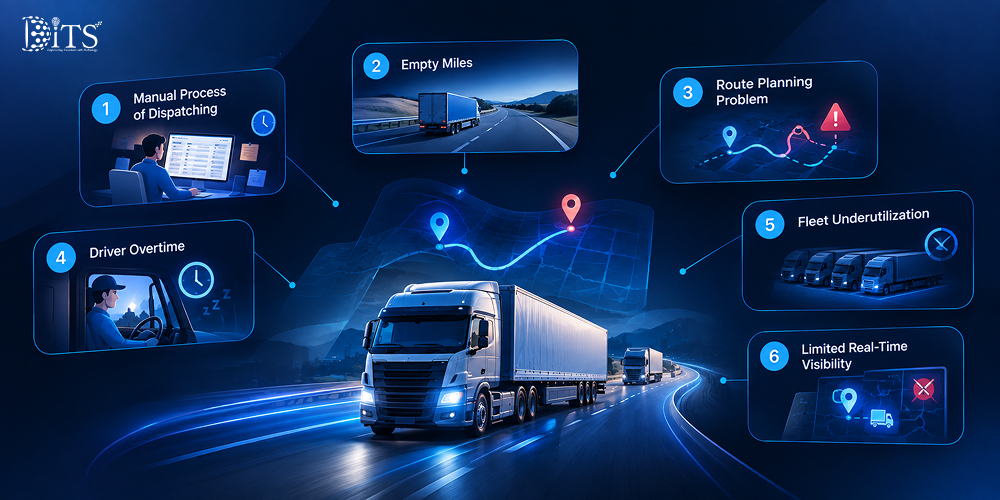
There are various inefficiencies in transportation dispatching processes that lead to lost money due to the high volume of trips that businesses perform daily. Slow decision-making, poor route selection, poor workload distribution, and a lack of transparency increase expenses for fuel, manpower, and the fleet. Here we have enlisted the business pain points as under;
Manual Process of Dispatching
Operational Problem
Many dispatchers use spreadsheets, telephone communication, and their own experience to schedule drivers, trucks, and routes. The more deliveries companies make, the more difficult such operations become.
Business Impact
- Increased dispatching period
- Higher workload of administration
- Risks of wrong assignments
- Communication problems with drivers
Empty Miles
Operational Problem
It is quite common that vehicles are empty when they return or take too much distance between one assignment to another because of lack of proper backhaul management and coordination.
Business Impact
- Expense on fuel and labor without income
- Earnings on a per-trip basis are smaller
- Wear and tear of the vehicles
- Fleet profitability is reduced
Route Planning Problem
Operational Problem
Pre-set routes do not always consider traffic situations, roadblocks, weather, or shifting of priorities in deliveries, and drivers have to drive extra miles.
Business Impact
- More fuel is consumed
- Delivery time is increased
- Late delivery
- Bad customer experience
- Driver Overtime
Manual Scheduling
Operational Problem
Manual scheduling of shifts can result in unbalanced workload where some drivers will get excessive assignments while others will not be utilized.
Business Impact
- Higher labor costs
- Driver exhaustion and stress
- Increased non-compliance
- Higher employee turnover rate
Fleet Underutilization
Operational Problem
Some units will stand idle whereas others will have excessive load or will be loaded with wrong orders. The mismatch between vehicle capacity, loads, and route demand leads to inefficiency.
Business Impact
- Higher transportation cost
- Poor ROI from fleet acquisition
- Purchasing of unnecessary vehicles
- Reduced operational capability
Limited Real-Time Visibility
Operational Problem
With inadequate knowledge of the vehicle's location, the driver's availability, and delivery progress, dispatchers are unable to respond promptly to problems.
Business Impact
- Slower response to disruptions
- Delivery delays
- Customer complaints
- Costly operations
How Transportation Dispatch Software Improves Resource Allocation?
Resource allocation using transportation dispatch software is performed with the specific requirements in mind. Efficient resource allocation reduces resource idleness, averts scheduling issues, and makes travel cost-effective.
Effective Driver Assignment
It helps allocate drivers based on their location, availability, work schedule, qualifications, and delivery requirements. This prevents unnecessary travel and ensures that the job is completed with the right resources.
Vehicle Matching to Load
Vehicle allocation is based on factors like vehicle capacity, cargo to be transported, and delivery requirements.
Avoids Scheduling Overlaps
The centralized process helps avoid overlaps and duplicate scheduling, preventing problems related to driver unavailability for scheduling tasks.
Saves Time Through Coordination
Coordination among all deliveries improves the movement of drivers and vehicles between scheduled tasks, reducing idle time.
Balances Fleet Workloads
Assignments can be evenly distributed among drivers and vehicles. Thus, there will be better workload balancing with avoidable overtime, overutilization of vehicles, and any avoidable vehicle wear.
Improves Multi-Route Planning
Transportation businesses with multiple routes and locations can schedule their operations from a single central location.
How AI Dispatch Capabilities Lower Transportation Costs
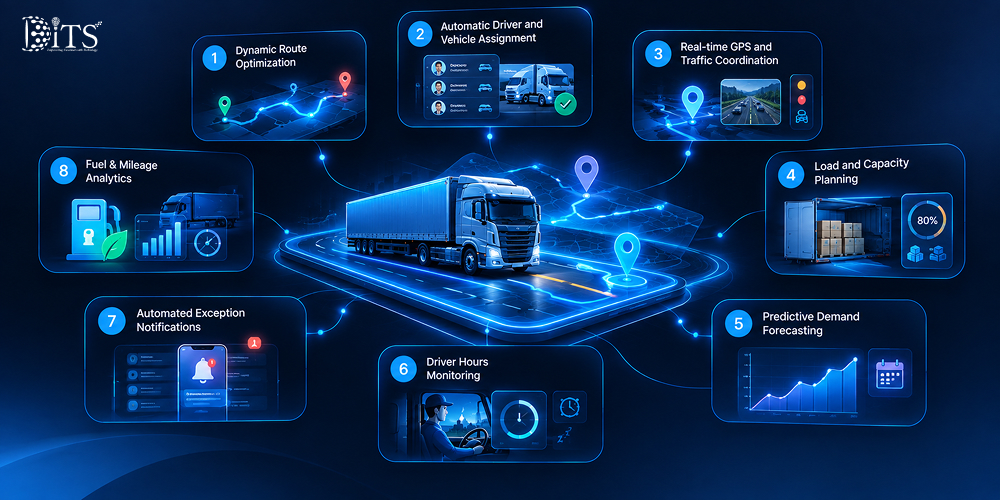
AI integration into the existing dispatch scheduling software helps in dynamic load matching, automated route optimization all while mitigating fuel costs and delivery delays.
Dynamic Route Optimization
Routes may be made inefficient due to traffic, road closures, changes in delivery plans, or urgent requests. AI helps constantly replan routes based on current conditions, making transportation more efficient.
Business Value
- Less travel time
- More efficient fuel consumption
- Minimized delivery delays
- Less idle time for vehicles
Automatic Driver and Vehicle Assignment
Manual allocation of available drivers and vehicles for delivery is time-consuming and prone to incompatibilities. Automatic planning involves consideration of availability, location, capacity, work schedule, and other factors.
Business Value
- Faster planning
- Greater productivity of dispatchers
- Increased efficiency of resources
- Minimized assignment mistakes
Real-time GPS and Traffic Coordination
There could be many changes to traffic conditions, and the pre-designed routes could become obsolete. Real-time data would enable the dispatcher to detect potential delays and change routes without impacting operations.
Business value
- Fewer avoidable delays
- Less fuel consumption
- Faster disruption management
- Increased delivery transparency
Load and Capacity Planning
Ineffective load planning may lead to vehicles being either underloaded, over-loaded, or loaded with inappropriate loads. Capacity planning enables the appropriate matching of each load to a corresponding vehicle and route.
Business Value
- Improved utilization of vehicles
- Fewer unnecessary trips
- Reduced cost per shipment
- Productive trips
Predictive Demand Forecasting
Inevitable variations in demand can result in driver shortages, overtime work, or idle capacity in the fleet. Predictive forecasting allows companies to plan ahead for upcoming trends.
Business value
- Optimized staffing
- Enhanced fleet availability
- Reduced need for overtime work
- Earlier identification of capacity shortages
Driver Hours Monitoring
Lack of visibility on driver hours can be a source of driver fatigue and compliance issues. It supports scheduling decisions based on applicable hours-of-service rules, but legal compliance still requires correct configuration, accurate records, operational controls, and management oversight.
Business Value
- Decreased risk of non-compliance
- Reduced driver fatigue
- Efficient scheduling
- Reduced need for overtime work
Automated Exception Notifications
Any breakdowns, routing exceptions, missed stops, or delays can remain undetected until they impact the customer. Automated notifications inform dispatchers when any problem needs to be addressed.
Business value
- Quick reaction
- Cost savings due to less disruption
- Less missed deliveries
- Improved customer communication
Fuel & Mileage Analytics
Transportation providers might not be aware of why their operating costs are increasing, nor which routes, vehicles, or behaviors are causing the problem. Fuel and mileage analytics help identify where waste is occurring.
Business Value
- Cost awareness
- Well-informed decision making
- Ability to detect waste
- Better control over fuel expenditures
Are Inefficient Dispatch Operations Increasing Your Costs?
Identify cost leakage from empty miles, overtime, inefficient routes, and underutilized vehicles.
How to Track ROI From Dispatch Scheduling Software?
It is pivotal for transport businesses to set initial benchmarks before software deployment and compare them with the same indicators after software deployment.
| KPIs | What It Measures | Why It Matters |
| Fuel Cost Per Mile | The amount of money spent on fuel per mile | Assesses whether optimization efforts have decreased fuel cost |
| Cost per Trip/Delivery | The cost of delivering a package or cargo | Helps to see if dispatch optimization led to reduced fuel, labor, and administrative costs |
| Empty-Mile Percentage | The distance covered without revenue generation | Allows estimating load planning efficiency, backhauling, and vehicle utilization |
| Driver Overtime Hours | Number of hours of work more than regular | Assesses if workload balancing and scheduling have led to reduced labor cost |
| Vehicle Utilization Rate | The use of existing vehicle capacity | Determines if the company makes better use of its vehicles |
| On-Time Delivery Rate | Delivery made on schedule | Helps to assess schedule reliability and possible cost reductions in penalties and customer complaints |
Such benchmarking in transportation dispatch software helps calculate cost savings, efficiency, and returns on investments.
Why Does Custom Dispatch Software Become the Right Choice?
Traditional dispatch software systems function effectively in simple workflows but may become too rigid as transportation processes get more complicated. With custom dispatch software, a company has greater freedom to manage dispatch rules, drivers' shifts, vehicle fleets, integrations, and reporting.
The need for custom dispatch software arises when the transportation business:
- Has complicated dispatch and scheduling rules
- Works with several fleets, locations, or regions
- Requires specific kinds of vehicles or loads
- Needs special driver assignment rules
- Has legacy systems which need to be integrated
- Deals with industry-specific compliance issues
- Lacks operational data in one place
- Has limited flexibility with existing software
A trusted transportation software development company audits existing workflows, identify gaps in current systems, and determine whether the software should be configured, updated, or replaced with a custom-built solution.
Ready to Make Dispatch Scheduling More Efficient?
Explore AI-powered scheduling for smarter driver assignment, route optimization, load planning, and fleet utilization.
How Ditstek Supports Transportation Dispatch Modernization?
We help businesses by helping them identify the prime reason behind the inefficiencies related to the delays, resources availability, and untimely delays. Instead of pitching for a technology, our focus is on assessing the already existing workflows, fleet structure, system limitations and much more.
Among our consulting and engineering services are:
- Dispatch workflow and cost-leakage assessment
- Technology and readiness assessment
- Solutions feasibility and requirement advisory
- Build-vs.-buy-vs.-integrate assessment
- Legacy software modernization
- Features prioritization and implementation roadmap
- Custom dispatch scheduling software development
- Transportation and logistics software development
- GPS, TMS, ERP, and telematics integration
- Existing legacy dispatch software modernization
- Performance measurement and optimization
As an IT consulting firm, Ditstek will help you make the right technology choices, prioritize critical changes, and implement dispatch solutions that meet your fleet management needs.
Is Your Dispatch Software Ready for Your Growing Fleet?
Assess your current systems, integrations, and workflows to identify opportunities for modernization or custom dispatch software.
FAQs
1. How does AI-powered dispatch scheduling software decrease transportation costs?
The software enables better optimization of routing, assignment of drivers, load planning, and vehicle utilization. All that results in lower consumption of fuel, less empty miles traveled, fewer costs related to overtime and delivery delays, etc.
2. Is it possible to reduce empty miles using transportation dispatch software?
Yes. The software is capable of matching vehicles and loads based on proximity and other factors which will increase the revenue from deliveries.
3. How does dispatch scheduling software increase the productivity of drivers?
The software assigns drivers depending on their location, availability, working hours, skills, and requirements for delivery. With optimal workload distribution drivers spend less time idle and do not have to perform unnecessary trips.
4. What KPIs should businesses measure after implementing dispatch software?
Some of the most important KPIs are fuel cost per mile, empty miles ratio, driver overtime, vehicle utilization rate, cost of delivery per delivery, and on-time delivery rate.
5. Can dispatch scheduling software integrate into transportation systems?
Yes. It can be integrated into GPS, TMS, ERP, telematics, fleet management, and accounting systems.

Dinesh Thakur
21+ years of IT software development experience in different domains like Business Automation, Healthcare, Retail, Workflow automation, Transportation and logistics, Compliance, Risk Mitigation, POS, etc. Hands-on experience in dealing with overseas clients and providing them with an apt solution to their business needs.
Recent Posts
AI integration connects AI with existing systems and workflows, while AI adoption focuses on using AI effectively to drive measurable business outcomes.
Automated document processing helps reduce cargo insurance claim delays by streamlining document handling, validation, and claims workflows.
Automated document processing helps reduce cargo insurance claim delays by streamlining document handling, validation, and claims workflows.