AI Integration vs AI Adoption: Which Approach Drives Better Business Outcomes?
Table Of Content
Published Date :
21 Sep 2026
Key Takeaways
- AI adoption and AI integration serve different purposes. AI adoption is well-suited to standardized, out-of-the-box AI use cases, whereas AI integration is better suited to use cases that require proprietary data, current applications, and greater customization.
- Picking the right approach to AI depends on the business problem and cannot be done based on technology considerations alone. Decision criteria should include expected outcomes, workflow complexity, current systems, data availability, security needs, and scalability.
- Being ready for AI implementation is at least as important as being able to implement AI. Even a great AI solution might not prove its value if enterprise data is scattered; integrations are insufficient, and/or workflows are not AI-ready.
- Adopting, integrating, and building an AI solution are not competing approaches. Enterprises may simultaneously adopt AI solutions for general needs, integrate AI into their business processes, and create a unique AI solution if needed.
Investing in AI alone cannot ensure business success. Rather, the crucial question is how such an innovation will integrate with an organization's existing processes and technologies. Thus, the choice between AI integration and AI adoption comes down to whether to implement AI capabilities as it is or integrate them into existing processes and the enterprise environment.
AI adoption works well when businesses need quick and ready-to-use AI without much customization. Meanwhile, AI integration is more relevant when companies need AI to integrate with their proprietary data, applications, and processes.
Choosing between the two means looking beyond technological possibilities. Businesses should evaluate their goals, the technology they are using at that moment, their ability to use the data, the level of integration required, and the possible results of the chosen option.
AI Integration vs AI Adoption: Stating the Difference
Beyond the buzzwords, the distinction becomes clear in the implementation, integration, and use of the technology throughout the business. See the table below for a breakdown of the differences between AI adoption and AI integration.
| Aspect | AI Adoption | AI Integration |
| Description | Bringing AI-driven tools, platforms, copilots, or even SaaS into the business. | Integration of AI functionalities into the current applications, systems, and data ecosystems. |
| Primary objective | Aiming at rapid deployment of AI capabilities to address certain cases. | Embedding AI into the existing business processes. |
| Technological adjustments | Normally implies minimal adjustments to the current technological infrastructure. | Often implies integration with current systems, APIs, applications, and enterprise data. |
| Customization | Possesses limitations to the capabilities that the platform offers. | Offers customization around particular workflows and business rules. |
| Enterprise data usage | Often limited by the capacity of the platform itself. | Can be designed to work with proprietary business data. |
| Control | More dependence on the vendor of the AI product or platform. | Creates more control over the architecture and functioning of the AI within the business. |
| Scalability | Depends mainly on the chosen platform and licensing arrangement. | Built to accommodate future business needs and scalability. |
| Best suited for | Standard use cases, where there are AI solutions ready to fulfill the requirement. | More complex use cases, where AI needs to tightly collaborate with proprietary data or workflows. |
However, when it comes to AI enablement vs integration, organizations need to move away from focusing on deployment speed. The key consideration is actually how much interaction there is between AI and existing operations.
How Should Businesses Decide Between AI Adoption and AI Integration?
The decision of whether to go for either AI adoption or AI integration must be made based on business problems rather than technology itself. Businesses will find AI adoption more favorable when the requirement is simple, and a mature AI product suffices. AI adoption gives businesses a way to bring in AI technology quickly, with proof of value, while avoiding unnecessary development or integration effort.
AI integration becomes more relevant in the latter case when requirements are complex. AI may need to interwork with existing workflow systems, access proprietary data, sync with other ERP or CRM systems, or support processes that conventional tools cannot handle. For such cases, AI adoption would not suffice.
Hence, choosing between AI Adoption and Integration ultimately depends on the level of compatibility, management, and connectivity the business requires. AI Adoption works best for standardized needs, while Integration works best when AI is integrated into the organization's existing technology.
In most cases, businesses do not limit themselves to one form of AI application. They can adopt tried-and-true AI solutions to meet general needs and then apply integrated AI more extensively, particularly when their operations, data, or competitive edge require a more specialized solution.
Not Sure Whether to Adopt or Integrate AI?
Evaluate your business goals, existing systems, data readiness, and workflow complexity to identify the right AI approach.
What Do Businesses Need to Consider Before Selecting Either AI Adoption or AI Integration?
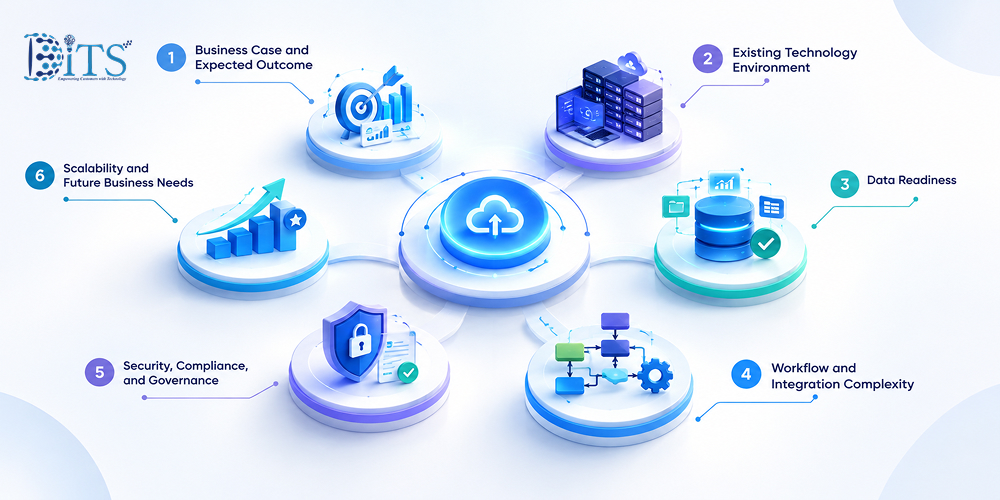
Selection of AI adoption vs integration should not be solely based on comparison of features or cost of implementation. The businesses should consider whether their processes, systems, data, and business environment are ready for AI use.
Business Case and Expected Outcome
Consider:
- The exact business problem AI is supposed to solve.
- Whether the intention is cost saving, increased efficiency, improved user experience, speed of operations, faster decision making, or increased revenue.
- How will the effectiveness be measured in terms of business KPIs.
- Whether the need can be met by using existing AI applications or requires more integration.
Existing Technology Environment
Consider:
- ERP and CRM software solutions.
- Legacy software applications.
- SaaS solutions.
- Internal business applications.
- Integration capabilities and APIs.
Data Readiness
Consider:
- Accessible in the right systems.
- Reliable and accurate for the proposed use case.
- Accessible to AI.
- Secured and managed properly.
- Structured in such a way that AI can work with it.
- Consistent across different systems and data sources.
Workflow and Integration Complexity
Consider
- If the AI will be used independently or within the current workflow.
- How many different systems and applications it will have to integrate with.
- The involvement of several teams or approval processes.
- Whether action must be taken based on AI outputs.
- Process changes that may have to be made.
Security, Compliance, and Governance
Consider:
- Data privacy policies
- Access rights for users and systems
- Regulatory issues in your industry
- Model management and monitoring
- Auditability of the AI’s decisions or output
- The necessity of human decision-making and approval.
Scalability and Future Business Needs
Consider
- The possibility of extending the current use case to other teams or departments.
- How the current use case fits into the overall plan of enterprise AI adoption.
- Whether the architecture can handle more data and users.
- Possibility of integrating additional systems without adding new technology silos.
What Should Be the Strategy of Firms for Adopting, Integrating, or Building?
AI adoption vs integration doesn’t always have to be a binary choice. It should depend on how standardized the requirement is, the need for the AI to collaborate with other systems, and the level of control or customization the business requires.
Adopt
- A pre-existing AI product could be the best choice where:
- There is a standardized business requirement.
- Mature/pre-existing AI products can meet the needs.
- Very little customization is required.
- Faster implementation and minimal effort upfront are important.
Integration
- Integration of AI can be justified when:
- AI has access to enterprise or proprietary data.
- Automation or intelligence is needed in current workflows.
- There is a need for communication between multiple applications or systems.
- The AI software solution must integrate into an existing product, platform, or process.
- There is a need for more control of AI interactions with the company’s technology stack.
Development
- Custom development of AI solutions is appropriate when:
- A special need exists that is specific to the business.
- No existing AI platform adequately addresses the needs.
- The capability is differentiating.
- You need more control over models, data, workflows, security, or user experience.
- The company requires an AI capability aligned with their business goals.
However, the best strategy for many organizations would be a mix of all three. Standard capabilities could be implemented, AI could be added where greater integration is needed, and custom-built applications could be used where there is strategic value.
Ready to Integrate AI Into Your Business Workflows?
Connect AI with your existing applications, APIs, enterprise data, and processes to build scalable AI capabilities.
How Can Businesses Measure the Value of Their AI Strategy?
The worth of an AI strategy must be determined by the business benefit it can deliver, not just the technical benefits. Depending upon the use case scenario, the business can measure:
| Business metric | What It Helps Measure |
| Process cycle time | Whether AI shortens the time taken to perform workflows, transactions, or services. |
| Cost savings | Savings due to reduction in manual labor, overheads, or efficient utilization of resources. |
| Employee productivity | Whether employees can get more done while spending less time on tasks. |
| Automation percentage | How much of the process can be automated. |
| Error savings | Reduction in errors and rework. |
| Customer response time | Whether AI helps with quick support, issue resolution, or service delivery. |
| Revenue impact | Whether AI helps in increasing conversion rates, better retention rates, or generating new revenues. |
| Decision-making speed | The amount of time required to gain insights from relevant information. |
| User adoption | The consistent use of AI by employees or customers |
| Operational scalability | Whether the solution scales with increasing users, workload, or data volume, with cost and effort increasing proportionately. |
Whichever path is chosen, whether AI adoption or deeper AI integration, the following KPIs must be aligned with the initial business goal. Technical metrics such as accuracy, latency, and system performance are important, but they must help measure business success.
AI Integration or AI Adoption: Which Approach Should Your Business Choose?
The adoption clearly depends on business urgency, case complexity, and how well the AI solution fits current systems and processes.
AI Adoption Is Preferred Where:
- The requirement is clear and known.
- Deployment speed is important.
- Current AI solutions can address business needs.
- Customization is not needed.
- There is a desire to prove the value first.
Consider AI Integration When:
- AI needs to be incorporated into business processes.
- You need to integrate proprietary or enterprise-level data into the process.
- Multiple systems, applications, or data sources must collaborate.
- Customization, control, or governance is needed.
- The capability should be scalable.
- For many businesses, AI Integration and AI Adoption cannot be an either-or choice. One approach is to adopt AI tools tested against standardized requirements while integrating or building AI into processes that matter to the organizations.
Turn AI Potential Into Measurable Business Outcomes
Move beyond isolated AI tools with a practical strategy aligned to your workflows, technology environment, and business goals.
AI Adoption and Integration in Focus at HIMSS
As organizations shift their focus from experimenting with the technology to utilizing it properly, the attention on issues such as data readiness, interoperability, policy, integration, and scalability has grown significantly.
These issues will also be central to discussions at HIMSS AI in Healthcare Forum in San Diego, where the health and technology professionals will pilot the process of implementing AI and connected technologies in healthcare systems.
DITS will be present at HIMSS in San Diego to participate in these discussions and therefore gain more relevant insight on how healthcare organizations can decide whether to adopt existing AI solutions, embed artificial intelligence in current systems or custom solutions tailored to their particular requirements.
How DITS Helps Businesses Determine the Right AI Approach?
DITS helps entrepreneurs evaluate AI based on both business and technology factors before choosing a solution. It focuses on assessing where AI will add value, the existing environment, and how feasible implementation will be for the organization.
The consulting-driven process begins by identifying business needs, the technology environment, data readiness, and the potential benefits of applying AI. Based on the results of this analysis, we can evaluate whether an existing solution meets the requirements or whether additional actions are required.
As part of AI integration planning, we identify ways to connect AI with existing technologies, applications, APIs, and enterprise data. When an existing platform does not meet certain business needs, custom AI development becomes relevant. Moreover, we help our clients to implement AI scaling and modernization, helping businesses move successful AI initiatives beyond isolated pilots and build scalable, governed, enterprise-ready capabilities.
FAQs
How do I identify whether my business requires AI adoption or AI integration?
Look at the use case first. If the use case can be met with existing AI solutions and only minor adaptation is required, then adoption is probably enough. But if AI needs to interface with proprietary data, existing processes, or multiple systems, integration is probably the way to go.
Can a business embark on AI adoption and subsequently start using AI integration?
Yes. Many firms start with ready-made tools to add value for users and see whether it works. Once they establish that the use case is worthwhile, firms can integrate AI into their core processes and systems.
Is AI integration always more costly than AI adoption?
Not necessarily. While integration is usually more complex initially, it can ultimately be more profitable if AI is required in complex processes, company data, or multiple applications.
What should be evaluated before making an investment in AI?
The business problem, expected outcomes, technology already in place, readiness of data, complexity of the workflow, security requirements, and need for integration and scalability should be assessed and then the best approach chosen.

Dinesh Thakur
21+ years of IT software development experience in different domains like Business Automation, Healthcare, Retail, Workflow automation, Transportation and logistics, Compliance, Risk Mitigation, POS, etc. Hands-on experience in dealing with overseas clients and providing them with an apt solution to their business needs.
Recent Posts
Automated document processing helps reduce cargo insurance claim delays by streamlining document handling, validation, and claims workflows.

Automated document processing helps reduce cargo insurance claim delays by streamlining document handling, validation, and claims workflows.
Discover how chronic care management software uses algorithmic triage to identify patient risk, prioritize care, and improve care team efficiency.