AI Triage in Healthcare: Improving Access, and Patient Engagement
Table Of Content
Published Date :
24 Sep 2026
Key Takeaways
- AI triage facilitates better patient access by sorting out the requests, prioritizing their needs, and routing them appropriately.
- Automating standard queries lessens the burden of administrative tasks and helps health professionals devote their attention to situations requiring human abilities.
- AI triage helps with scheduling, admission, medication, billing questions, portal communication, follow-ups, and communication after hours.
- For successful AI triage, good EHR integration, data quality, rules for directing requests, escalation procedures, governance, and clinical oversight should be implemented.
- It is essential for healthcare organizations to understand bottlenecks within their work processes and determine what can be automated before implementation of AI.
- Metrics such as response time, staffing time, routing, time taken to escalate issues, patient experience, and cost will help measure value in AI triage.
What happens when rising patient inquiries begin to overwhelm already stretched clinical and administrative teams? Scheduling requests, drug-related queries, standard worries, and urgent announcements come through the same channels, resulting in delays, manual work, and needless handoffs.
AI triage is a solution for identifying patient intent, prioritizing requests, and directing them to the correct workflow or care teams. However, the importance of AI triage is not limited to its benefits. Healthcare authorities should analyze workflow compatibility, system integration, escalation protocols, clinical supervision, and anticipated ROI prior to determining whether to employ, customize, or develop an AI triage solution.
Why Patient Triage Is Becoming an Operational Challenge
With the rising number of requests, there will be an increasing amount of manual effort put into reviewing the queries and assigning them to relevant departments or care teams. This might cause delays in answering the patient's queries, repetitive tasks by the staff members, and difficulties in separating urgent queries from regular ones.
Challenges in operations include:
- Rising patient inquiry volumes in several communication channels
- Increasing response and waiting times
- Manual processing of incoming queries
- Repetitive tasks by the staff members
- Regular and urgent queries being routed into one queue
- Delay in directing patients to the right service or care team
These challenges impact patient access, efficiency of the staff members, routing consistency, and the patient experience in general.
Make Patient Access Smarter with AI Triage
Improve patient access, streamline request routing, reduce administrative workload, and create more responsive healthcare experiences.
How AI Triage Works in Healthcare?
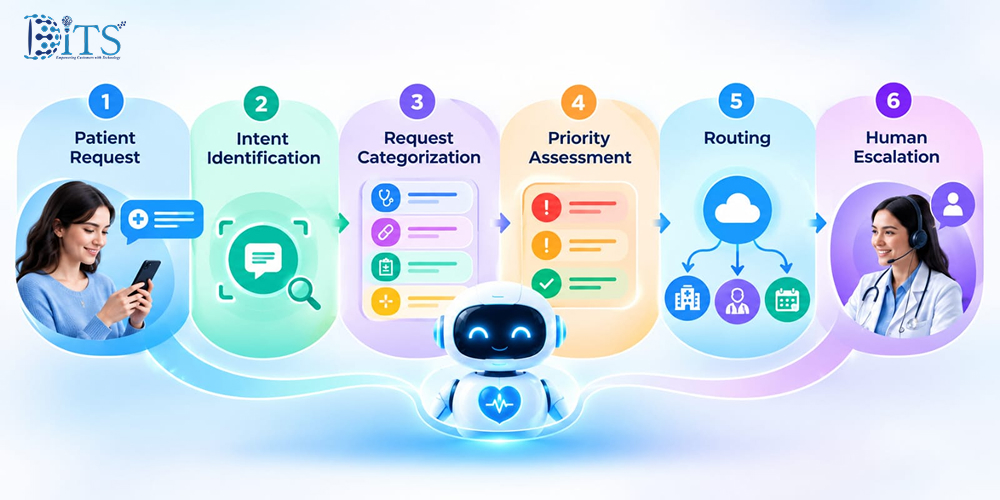
AI triage involves analyzing patient requests for assistance and routing patients through the appropriate workflow of a health care facility. As opposed to the need for a person to go through all messages sent by the patient and assess their nature and content manually, the AI system is able to analyze the purpose of the request, evaluate its context, and categorize and route it according to predefined rules.
Here’s how AI triage typically works across the patient journey:
- Patient Request: The patient sends his or her query through a portal, chatbot, messenger, call center or other digital means.
- Intent Identification: AI analyzes the purpose of the patient request, whether he or she asks to schedule an appointment, to refill some medication, to address some billing issues or to notify any clinical problems.
- Request Categorization: The request is put into the corresponding administrative or clinical category.
- Priority Assessment: Patient-reported information, clinical data, predefined rules, and criteria for escalation might help in identifying the requests that need to be reviewed faster.
- Routing: The request is routed into the appropriate workflow/team/system.
- Human Escalation: Issues that are complex, sensitive, uncertain, or that need clinical expertise are escalated to the right healthcare professionals.
AI helps with this by utilizing patient information, requesting details, information from previous patients, operational guidelines, and routing guidelines. The use of AI in healthcare will assist in making the process faster and more consistent, while clinical decisions are left for humans to make.
How AI Triage Improves Patient Access and Engagement
Patients interact with healthcare organizations for various reasons ranging from scheduling an appointment to requesting medication refills or even asking questions about the care they need. Manual review of all such interactions could lead to delays in providing a response to the patient or even multiple transfers from one department to another before reaching the right resource.
Triage with AI technology can solve this problem by identifying the type of request a patient makes and then routing it to the right place or person for further handling.
Specifically, AI triage can help in improving patient access and engagement in the following ways:
Faster response time: Simple and routine requests will be either resolved or routed immediately instead of having to go through a manual process.
Routing the request to the right person: Requests can be properly sorted and routed to the relevant administrative or clinical workflows.
Reduced number of handovers: With proper sorting and routing, less frequent transfers will happen between departments.
24/7 availability for handling routine requests: Digital triage will help handle requests outside of working hours as well.
Efficient scheduling and communications: It is possible for patients to be directed to pertinent scheduling, messaging, or self-service processes.
Clarity of next action: The patients get direction on where to direct their request or when they may require human intervention.
Consistency in interactions: Consistency can be achieved by having clear processes to route requests or respond to requests from patients.
Easy human intervention: Requests requiring a clinical decision or any kind of personal attention can easily be referred to relevant individuals.
Patient compliance: Step-by-step directions help patients fulfill their appointment referrals and follow-up procedures.
Prompt communication: More prompt replies can cut down the uncertainty and keep the patients interested.
Continuity: The information collected from triage facilitates smoother transitions between care providers.
Convenience: Patients are able to take advantage of digital media for their regular communications without relying solely on calls and office hours.
Through faster turnaround time in getting a patient request to its destination point, it is possible to make the process of access easier and more efficient.
Improve Patient Access with AI-Powered Triage
Automate routine requests, improve routing, and help healthcare teams respond faster to patient needs.
How AI Triage Reduces Administrative Burden on Healthcare Teams
Challenges in patient access put pressure on healthcare personnel from an operational standpoint. The administrative and clinical teams may spend substantial time examining messages, addressing repetitive inquiries, figuring out where the requests should be sent, and forwarding the information manually to other departments.
AI triage can assist with these tasks by performing the repeatable sorting and routing activities and raising the issues for human intervention.
The technology assists healthcare teams with:
- Addressing routine inquiries with the help of predefined automation flows.
- Sorting the incoming messages based on patients' intent and inquiry type.
- Routinely routing the requests to schedule, billing, medication, administrative, or clinical flows.
- Organizing communication queues for teams to address requests that need human attention.
- Cutting down the time spent on repetitive examination of frequent patient inquiries.
- Escalating the exceptions and more complex cases that require human intervention.
This will help healthcare professionals save time on routine communication and focus on addressing inquiries that demand their attention.
How AI Triage Helps Prioritize Patients Requiring Faster Attention
Not all patient requests require the same level of attention. While some of them may only have routine queries in them, some of them may have symptoms or other information that makes their review essential before others.
AI triage assists in analyzing the information available in the patient request and applying appropriate routing and prioritization rules so that higher-priority requests get the attention of the clinical team earlier than others.
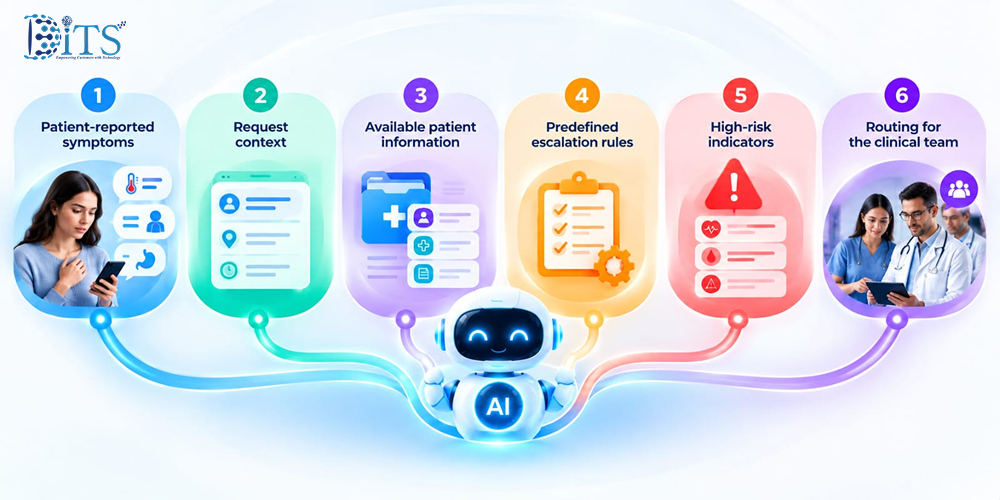
AI-based prioritization and routing take into consideration the following factors:
Patient-reported symptoms: This will help in identifying those patient requests that need to be reviewed.
Request context: This will include the nature, phrasing, and purpose of the request.
Available patient information: Relevant information can be drawn out of connected patient records if applicable.
Predefined escalation rules: These rules help in defining when certain requests must be escalated.
High-risk indicators: Symptoms or combinations of information in the requests may result in faster human review depending on pre-configured rules.
Routing for the clinical team: The request may be forwarded to the right nurse, doctor, specialty team, or any other healthcare professional as appropriate.
AI does not make clinical judgments or diagnoses on its own. Its function is to assist in routing such requests for proper handling by healthcare professionals.
Where AI Triage Can Be Used Across the Patient Journey
An AI triaging application may fit into various phases of the patient journey by detecting what kind of request is made and where it should be redirected. It can be applied not only at the point of intake, but also to improve administrative and clinical communications across the healthcare organization.
Some of the most common applications are mentioned below;
Appointment scheduling: Depending on the type of request, patients may be guided to scheduling, rescheduling, or canceling workflows.
Patient intake: AI can help to gather some basic patient information before the request reaches the staff members.
General inquiries: Inquiries regarding services, locations, opening hours, and processes can be handled automatically.
Medication requests: Medication refills or other medication requests may be identified and routed to appropriate workflows.
Billing/administrative requests: Requests that are related to payments, insurance, and administrative processes can be directed to appropriate teams.
Patient portal messages: Depending on the intent and urgency of patient messages, they can be categorized and routed.
Clinical requests: Depending on the severity of symptoms or any care-related issues that have been stated in the request, patients can be guided accordingly.
Communication post-triage: Patients can be pointed to instructions for follow-ups, scheduling appointments, or care flows.
Post-hours requests: Digital triage can help with preliminary instructions when staff is not available.
AI in triage saves a lot of time at all these interaction points, providing a better experience for patients in their journey to various stages of care.
Build Smarter Patient Triage Workflows with AI
Identify workflow bottlenecks and use AI to streamline patient requests, routing, and timely escalation.
Why AI Triage Can Fail Without the Right Healthcare Workflow
AI triage is unlikely to be effective when used without consideration of its interaction with existing healthcare processes, patient information, routing, and workflows. The introduction of an effective AI model into the existing technology landscape may introduce extra complexity when it is isolated from systems and processes currently used by healthcare providers.
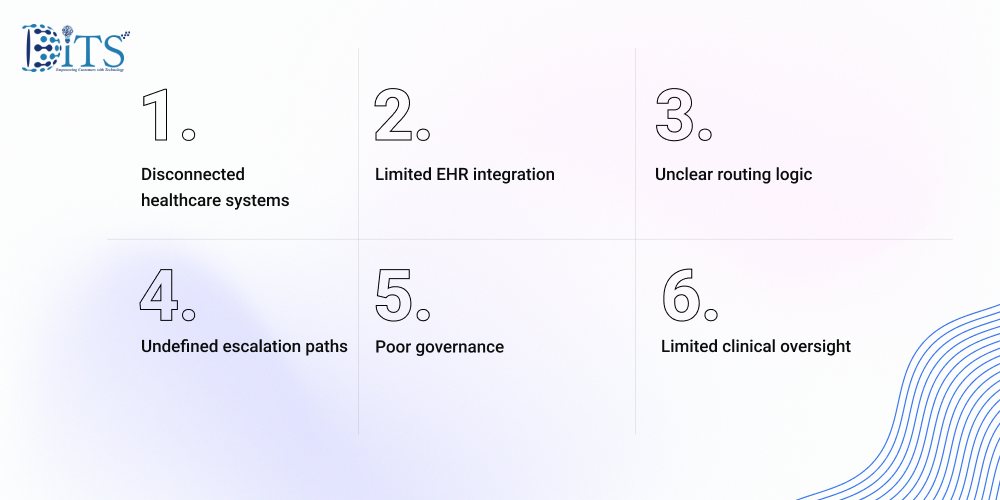
Typical barriers include:
Disconnected healthcare systems: Ineffective integration between various platforms can limit the ability of the technology to access or exchange data necessary for efficient routing of requests.
Limited EHR integration: The absence of proper data access can limit the context in which the system works during categorization and escalation.
Unclear routing logic: If the responsibilities or destination workflows of different kinds of requests are not clear, automation may just transfer existing inefficiency to the digital format.
Undefined escalation paths: Clear policies are necessary when the request should escalate from automation to administrators or clinicians.
Poor governance: Policies are needed for such aspects as data access, privacy, monitoring, accountability, and proper AI use.
Limited clinical oversight: Healthcare practitioners need to be involved in making decisions in cases requiring clinical reasoning and individual assessment.
Without these foundations, the AI-based triage will become yet another layer in the technological landscape, resulting in inefficient workflows, non-compliance by employees, poor patient experience, and a lack of ROI.
Key Considerations for Healthcare Organizations Before Introducing AI Triage
Implementing AI in triage is more than just choosing a tech vendor. Healthcare organizations have to first determine how current workflows create delays, identify which transactions should be automated, and how AI would integrate with the current systems in place for administrative and clinical processes.
Important considerations include:
Identify the current bottlenecks: Find out where exactly delays are happening, whether at patient intake, scheduling, response, routing, or escalation.
Define what can be automated: Differentiate routine and repeatable transactions from those that involve clinical judgment and intervention by employees.
Evaluate integration needs: Identify the systems that require integration with triage processes, including electronic health records (EHR), scheduling systems, billing systems, customer relationship management (CRM) systems, communication tools, etc.
Determine when human intervention is necessary: Define cases when routing is required and determine who should be responsible for reviewing exceptions, as well as where clinical roles will be required.
Evaluate data availability: Check whether data needed for the triage is accessible, accurate, secure, interoperable, and used according to applicable regulations.
Define how the results will be measured: Develop measurable indicators including response time, patient waiting time, routing process efficiency, time taken for escalation, patient satisfaction, and operational expenditures.
DITS’ Approach to Responsible AI Triage in Healthcare
DITS' approach to AI starts with understanding areas of patient access and workflow frictions. It entails understanding which tasks can be automated, which tasks require human intervention, and which areas of existing workflows AI can assist in without making things complicated.
It is also important to analyze the level of readiness of the data, integrations, governance, escalation strategies, and scalability to determine which option will be chosen: to integrate an existing product, customize it, or develop a custom product.
The same priorities are being discussed at the HIMSS AI in Healthcare Forum in San Diego, where healthcare and technology experts will discuss issues related to responsible adoption of AI, interoperability, AI integration, governance, and moving from experimentation to scalable adoption. DITS will attend this event and take the discussed points into consideration while making its decisions regarding healthcare technology.
FAQs
What is AI triage in healthcare?
AI triage leverages patient requests, information at hand, and a set of criteria to triage patients' requests to understand their intent and route them into the right workflow for administrative and/or clinical needs.
What kind of patient interactions can AI triage support?
AI triage can assist in appointment scheduling, patient intake, medication requests, billing inquiries, messages sent via patient portal, other general questions, follow-ups, and after-hours requests.
Is EHR integration necessary for the AI triage solution?
Integration with EHR can provide additional context that will help AI-powered workflows route or escalate.
What should be evaluated by healthcare organizations prior to implementing AI triage?
The following factors should be taken into account: existing bottlenecks, automation possibilities, integration possibilities, data readiness, governance, escalation criteria, human intervention, and scalability.
How should healthcare organizations measure the value of AI triage?
The following factors could serve as performance measures for AI triage: response time, patient waiting time, staffing, routing, escalation time, patient experience, and cost.

Nidhi Thakur
With more than 19 years of experience - I represent a team of professionals that specializes in the healthcare and business and workflow automation domains. The team consists of experienced full-stack developers supported by senior system analysts who have developed multiple bespoke applications for Healthcare, Business Automation, Retail, IOT, Ed-tech domains for startups and Enterprise Level clients.
Recent Posts
AI-powered dispatch scheduling reduces transportation costs by optimizing routes, vehicle utilization, driver schedules, and delivery operations for greater efficiency.
AI integration connects AI with existing systems and workflows, while AI adoption focuses on using AI effectively to drive measurable business outcomes.
Automated document processing helps reduce cargo insurance claim delays by streamlining document handling, validation, and claims workflows.