Mental Health Medical Billing Software: Key Features, Integrations, Challenges and Benefits
Table Of Content
Published Date :
05 Aug 2026
Key Takeaways
- Mental health medical billing software allows healthcare organizations to automate their claim management, payments, denials, patient balances, documentation, and revenue flows.
- Standard billing software does not provide all the tools that may be needed by the healthcare organization working with mental patients because it doesn't allow to work with recurring sessions, CPT codes, etc.
- This solution will help you improve your billing process, decrease the number of denied claims, increase the speed of reimbursements, and get more control over your cash flow.
- The main functions provided by the system are insurance eligibility verification, creation and submission of claims, claim denials management, management of patient payments, telehealth billing, reporting, analytics, and compliance control.
- Integration capabilities with EHR/EMR, practice management, clearinghouses, payment gateways, patient portals, telehealth platforms, accounting, and BI software make it easier to work with this tool.
- Some advanced features are automated like claim scrubbing, AI-based denial prediction, custom revenue dashboards, multi-location billing, and patient self-service portal.
As things become complex in billing, business expansion may seem much tougher than it really needs to be.
With respect to businesses within the healthcare sector, behavioral health clinics, and other mental health organizations, billing goes beyond claim filing. These organizations will have to deal with insurance claims, CPT codes, rejected claims, payment collection, documentation, and compliance issues.
Unfortunately, generic medical billing software fails to accommodate this. This is where mental health medical billing software comes into play. Mental health billing software helps businesses manage the entire claims, payment, and revenue management process effectively.
Why Healthcare Businesses Need Mental Health Billing Software?
There are many important aspects involved in managing a mental health practice, but nothing is as crucial to a business’s success as billing. From filing insurance claims and CPT codes to denied claims and patient payments, reporting and compliance, the software does it all.
With a tailored mental health billing software solution, you can gain more control, precision, and transparency in your billing process. This will improve your claims processing, payment cycle, and revenue management.
Here are some key benefits of using such a software solution for your healthcare business:
- Greater control of your claims, payments, and other billing processes
- Faster reimbursement due to proper claims filing
- Fewer claim errors, denials, and need for corrections
- Better cash flow by properly monitoring your payments
- More insight into your revenue, pending claims, and denials
- Less burden on your billing staff
- Simplified management of compliance issues
Facing Billing Challenges In Mental Health Practice?
Streamline billing workflows, reduce claim denials, and improve reimbursement accuracy with customized mental health billing software solutions.
Billing Challenges Faced by Mental Health Businesses and Their Solutions
The billing workflows of mental health businesses have an impact on their cash flow and revenue visibility. They face problems from denial of claims to system disconnects that result in slower reimbursement processes and additional burden to administrative tasks. The mental health medical billing software allows solving these problems through enhanced automation, tracking, integration, and management.
The Problem of Disconnected EHR, Billing, and Payment Systems
When EHR, billing, clearinghouse, payment, and practice management systems don't work together, the team spends a lot of time on data entry, reconciling payments, and correcting duplicate information.
The Solution: A mental health billing software that can integrate with EHR, EMR, clearinghouses, payment gateways, patient portals, telehealth, and practice management systems to create a more connected and efficient billing workflow.
Delay of Payments
Manual submission of claims, slow follow-ups, and inadequate claim tracking result in payment delays for mental health businesses. In turn, they may influence the financial planning of these enterprises negatively.
Solution: The system provides real-time updates on the claim status, automated reminders, pending payments tracking, and fast follow-up workflow.
Compliance and Documentation Risks
The billing process for mental health services includes private client information, documentation issues, and compliance issues. Inadequate documentation or poor data security could pose both operational and legal concerns for healthcare organizations.
Solution: The purpose-made software would allow implementing secure processes that include role-based access, auditing, encryption, documentation monitoring, and HIPPA-compliant handling of the data. The software will allow managing billing operations with improved compliance control.
Difficulty Managing Patient Balances
It may become challenging to handle co-pays, deductibles, unpaid bills, patient payments, partial payments, and other related aspects manually once the number of patients increases.
Solution: The software will help manage patient invoices, balance management, online payments, payment notifications, receipts, and payment history.
Heavy Administrative Workload
Claim entry, payment reminder, denial tracking, reporting, and patient billing can take up considerable staff time. As the firm scales, this heavy workload is difficult to handle without incurring operational costs.
Solution: With the mental health billing system, you will be able to automate repetitive billing tasks including claim generation, payment reminders, denial follow-up, payment posting, and reporting.
Who Can Use Mental Health Medical Billing Software?
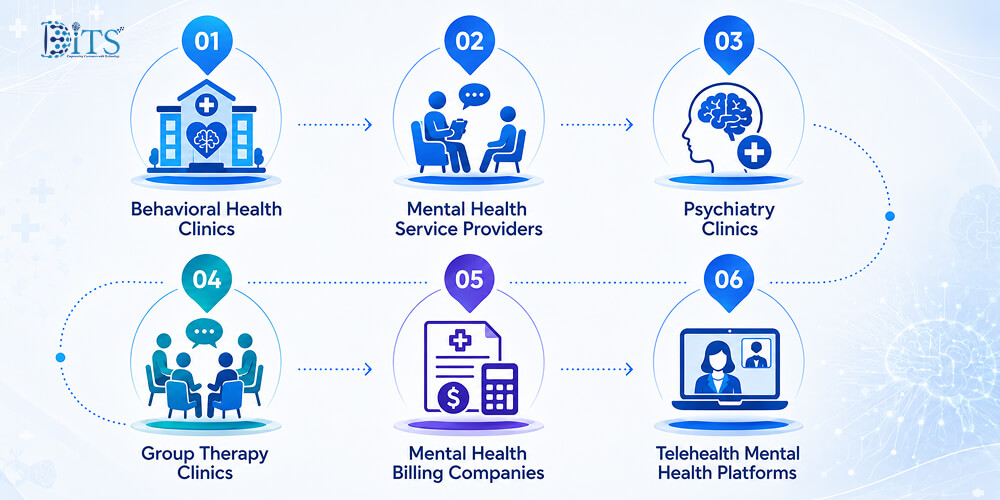
Mental health medical billing software can benefit various healthcare organizations that deal with mental health, psychiatry, therapy, and behavioral health billing operations. It becomes highly helpful for organizations dealing with insurance claims, recurring visits, patient payments, provider-based billing, and other considerations.
Behavioral Health Clinics
Behavioral health clinics can benefit from mental health billing software that helps in managing different providers, a large number of claims, billing for patients, payers’ operations, claim denials, and revenue management from one system.
Mental Health Service Providers
Healthcare organizations providing mental health services in the form of therapy, counseling, psychiatry, and telemedicine can benefit from the medical billing software for mental health.
Psychiatry Clinics
The psychiatry clinics can leverage the software to manage billing of their psychiatric evaluations, medication management, follow-up visits, insurance claims, CPT coding, and patient payments.
Group Therapy Clinics
Group therapy clinics, which have more than one therapist and scheduled therapy sessions, can leverage the software to streamline their billing processes, provider-based income, patient balances, and claim submission.
Mental Health Billing Companies
Third-party billing companies can use the software for managing billing, payments, denials, and reporting for various mental health practitioners or their clients’ practices.
Telehealth Mental Health Platforms
Such platforms support virtual therapy billing, telepsychiatry billing, payments, eligibility, and remote care billing processes.
Planning A Custom Mental Health Billing Platform?
Build scalable billing software that supports compliance, workflow automation, payer management, and long-term organizational growth.
What is the Role of Mental Health Medical Billing Software for Revenue Cycle Management
The use of mental health medical billing software is essential in facilitating the entire process of the revenue cycle, since it links all aspects of billing right from the first encounter of a patient until he or she makes payments.
With the use of this software, healthcare organizations can be in a position to facilitate the management of appointment-related billing information, insurance verification, claims processing, denials management, payments posting, patient billing, and revenue reporting.
Pre-Visit Billing Process
Before the visit, the tool assists in collecting data on the patient, insurance, coverage status, co-payment amount, and other authorization requirements. The eligibility process automates coverage determination to prevent claim-related problems.
Claim Submission Process
After the service is delivered, the tool facilitates verifying CPT codes, preparing claims, performing documentation checks, sending claims to clearinghouses, and monitoring claim status.
Workflow after Claim Submission
Upon claim submission, the software will assist with handling denied claims, posting payments, managing patient account balances, processing invoice payments, and generating revenue reports. Companies will be able to monitor collections, aged claims, delayed payments, and provider-wise revenue.
Read more: Revenue Cycle Management in Medical Billing
Must-Have Integrations for Mental Health Billing Software
When mental health billing software is integrated with other systems currently used by the health care organization, its effectiveness is maximized. This is because billing requires the use of patient information, appointment data, insurance information, payments, and reporting.
| Integration | Purpose |
| EHR/EMR Integration | Connects clinical information, codes, provider notes, treatments and documentation with billing process to generate correct claims |
| Practice Management System Integration | Connects appointment schedule, provider schedule, patient file, billing activities and administrative work in one integrated system. |
| Insurance Clearinghouse Integration | Permits claim submissions, claim verification, rejection management, payer interaction, and faster claims processing. |
| Payment Gateway Integration | Permits payment from the patient via the Internet for co-payments, deductibles, outstanding invoices, and balances. |
| Patient Portal Integration | Permits patients to view invoices, balances, payments, receipts and change billing/insurance information. |
| Telehealth Platform Integration | Helps integrating teletherapy sessions, telepsychiatry sessions, with the billing process for remote care billing. |
| Accounting Software Integration | Helps in synchronizing payment, invoicing, refund, and revenue information with finance for less manual processing. |
| Scheduling Systems Integration | Helps in integrating booked appointments with the billing process and also triggers eligibility checking, claim creation, and missed appointments. |
| SMS/Email Notifications Integration | Helps in automating reminders related to payment, invoicing, appointments, claims, and balances. |
| Business Intelligence and Analytics Integration | Helps in analyzing information about collections, denied claims, aged claims, payer performance, provider-wise revenue, etc. |
Key Features of Mental Health Medical Billing Software
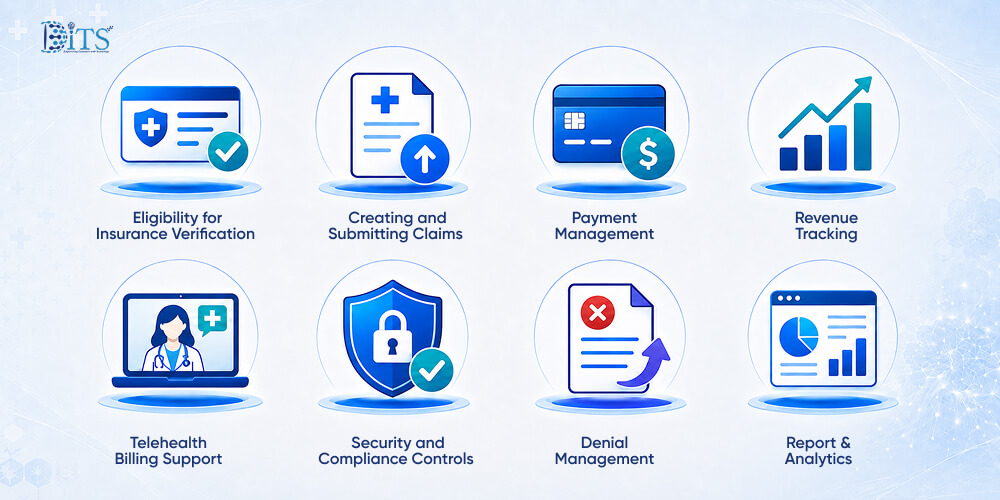
A mental health medical billing software should not only facilitate claim processing but also help in the overall billing process improvement. In addition to making billing more accurate, reducing manual effort, speeding up reimbursement, and increasing visibility into the revenue cycle, there is much more.
Eligibility for Insurance Verification
Helps check the coverage, insurance, copayment information, and any authorization requirements prior to the appointment. It will minimize claims problems, billing shocks, and the need for follow-up afterward.
Creating and Submitting Claims
It is necessary that the system allow for rapid creation, submission, correction, resubmission, and tracking of claims. This way, the billing department can submit more accurate claims without any delays.
Read more: Healthcare claim management software
Payment Management
The application must be able to facilitate invoices, co-payments, deductibles, outstanding balances, online payments, reminders, receipts, and payment history. It simplifies patient billing and increases collections.
Revenue Tracking
Hospitals have to report revenue on a per-therapist basis, per-psychiatrist basis, per-clinic basis, per-department basis, per-service basis, or per-location basis. Per-provider reporting makes it easy for the leadership to see how the providers perform.
Telehealth Billing Support
Allows the organization to manage virtual therapy and remote telepsychiatry, as well as handle payer specific telehealth requirements. This is useful for hospitals that offer online mental health solutions.
Security and Compliance Controls
The system must have HIPAA compliant workflow, role-based access, audit logging, encryption, secure data management, and documentation controls. This will ensure that sensitive patient and billing information is protected.
Denial Management
Enables the organization to monitor denied claims, determine the causes of denials, assign follow-up activities, and resubmit claims faster. This way it minimizes revenue losses and accelerates payment recovery process.
Report and Analytics
Revenue analytics provides insight into collections, claims pending, claims denied, claims aged, payer performance, patient balances, and revenue leakage. This will enable companies to enhance billing performance and cash flow.
Mental Health Billing Software Development: Benefits Every Business Can Avail
To the healthcare businesses, mental health billing software does not serve merely as a process management system. The software plays a significant role in ensuring that businesses generate revenues effectively. It is through automation of the billing processes that businesses will be able to handle their revenue processes with ease.
Timely Payments
By providing businesses with clean claims, automating the verification process and ensuring that claims are submitted on time, the software allows businesses to minimize any delays in payments.
Improved Cash Flow
Better management of claims, denials, patient payments, and outstanding amounts improves the cash flow for companies. It also enables organizations to have better control of their pending payments and revenue leaks.
Reduced Administrative Workload
Through automation, repetitive processes like entering of claims, following up on payments, managing denials, sending out reminders, and creating reports become easier for employees.
More Efficient Billing
Validation, predefined workflow steps, and CPT code support minimize coding errors, omission of necessary information, errors in submission, and posting of payments. This enhances efficiency and minimizes rework.
Better Financial Visibility
Financial managers have visibility into collections, denials, outstanding claims, overdue amounts, provider revenues, and payor performance through dashboards.
Improved Scalability
With increased company size, the software can handle more service providers, patients, claims, medical services, locations, and integration. It helps in scaling the billing operations without increasing any unnecessary manual effort.
Advanced Features for Businesses to Consider
When the mental health business grows, basic billing features will no longer suffice when it comes to handling increasing numbers of claims, payer compliance, payment collection from patients, and report generation. There are certain advanced features that would help make the billing process more efficient, predictive, and ready for business.
Claim Scrubbing Automation
Claim scrubbing is an automatic pre-submission process that helps detect any missing information, coding mistakes, modifier problems, and payer-specific requirements within the claim.
Multi-Location Billing Management
Multi-location billing management is designed to help businesses that have operations in several clinics, departments, or other service locations by integrating claims, payments, and provider earnings into a single billing management system.
Custom Revenue Dashboards
With custom dashboards, leaders will be able to see the information about collections, denied claims, aging claims, provider productivity, payers' trends, and revenue leakage.
AI-Based Denial Prediction
Uses previous claim data to determine possible claim denials. This feature allows billing departments to rectify the problem before submitting a claim and potentially prevent loss of revenue.
Read more: AI in healthcare
Automated Payments Reminders
The process of reminding through automation helps businesses to follow up on copayments, deductibles, outstanding invoices, and amounts due from patients.
Self-Service Billing for Patients
The self-service billing process for patients is one where the patients themselves can view their bills, check their balances, pay the bills, receive receipts, and take care of other billing needs.
How DITS Will Assist You in Developing Your Mental Health Medical Billing Software?
As a reliable healthcare software development company specializes in building custom mental health medical billing software for businesses based on your billing process, vision, and future plans. If you require a standalone billing application or need to integrate your billing software with EHR, EMR, telemedicine, practice management, clearinghouse, patient portal, or payment systems, we can help you make a secure and scalable product.
Our team has assisted entrepreneurs in making custom solutions for the healthcare industry to streamline processes, increase visibility, and provide enhanced digital experiences. We can help you design your billing software idea from scratch until launch and further maintenance.
FAQs
How much does it cost to build mental health medical billing software?
The price varies widely based on specific features, integrations, customization, regulations, user roles, and complexity of the system – mental health medical billing software may cost from $25,000 to $150,000+.
How long does it take to develop mental health billing software?
We can develop a functional prototype in as little as 15 days, while building a fully customized, advanced mental health billing software solution typically takes between 7 and 12+ months, depending on the project's complexity and requirements.
Is behavioral health billing software and mental health billing software the same thing?
They are highly related to each other, yet not always the same. Mental health billing software tends to be focused primarily on therapists, psychiatrists, counselors, and clinics, while behavioral health billing software may include features for addiction treatment, ABA therapy, substance use treatment, etc.
Does mental health billing software support integration with EHR systems?
Yes, the software can be integrated with various healthcare systems, such as EHR, EMR, practice management, insurance clearinghouse, telehealth, patient portal, payment gateway, and accounting systems.

Nidhi Thakur
With more than 19 years of experience - I represent a team of professionals that specializes in the healthcare and business and workflow automation domains. The team consists of experienced full-stack developers supported by senior system analysts who have developed multiple bespoke applications for Healthcare, Business Automation, Retail, IOT, Ed-tech domains for startups and Enterprise Level clients.
Recent Posts

Automated document processing helps reduce cargo insurance claim delays by streamlining document handling, validation, and claims workflows.

Automated document processing helps reduce cargo insurance claim delays by streamlining document handling, validation, and claims workflows.
Discover how chronic care management software uses algorithmic triage to identify patient risk, prioritize care, and improve care team efficiency.