How Automated Medical Claims Processing Helps Reduce Claim Delays and Manual Rework
Table Of Content
Published Date :
11 Aug 2026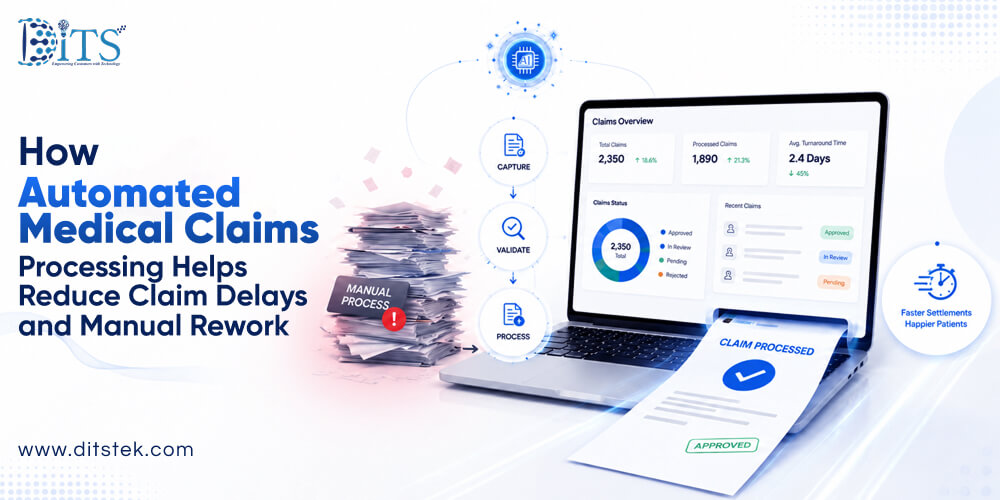
Key Takeaways
- Automated medical claims processing helps insurers and healthcare providers reduce claim delays by automating repetitive checks across intake, eligibility, coding, documentation, authorization, routing, and payment workflows.
- Identifying missing documents, coding inconsistencies, eligibility issues, and authorization gaps earlier helps reduce avoidable denials, resubmissions, and costly manual rework.
- AI strengthens claims automation by predicting claims that need manual review, detecting unusual billing patterns, prioritizing complex cases, and giving claims teams better information for faster decisions.
- Health insurers benefit from faster settlements, lower administrative costs, improved claims productivity, stronger fraud detection, and greater scalability without increasing staff at the same rate as claim volumes.
- Healthcare providers and hospital networks can achieve faster reimbursements, fewer preventable denials, reduced billing workload, improved cash flow, and more efficient communication with payers.
- Successful claims modernization requires connecting existing claims platforms, EHRs, EMRs, clearinghouses, payment systems, and payer applications while aligning automation with measurable business outcomes and operational priorities.
A medical claim can be sent electronically, but it still ends up going through several manual checks before anyone can approve or pay it. If clinical documents are missing, or eligibility doesn’t line up, then a normal claim turns into days of follow up. The result is more admin costs for insurers, slower reimbursements for providers, and a lot more frustration on both sides.
The financial opportunity here is huge. CAQH estimates that the healthcare industry already avoids roughly $222 billion in administrative costs every year thanks to automation, and that another $20 billion could be saved by taking the remaining manual, or partially electronic, transactions and turning them into fully automated workflows.
For business leaders, automated medical claims processing is a practical approach to cut down repetitive work, speed up payment cycles, and scale operations without needing to grow administrative teams at the same pace.
Why Medical Claims Still Get Delayed Despite Digital Systems
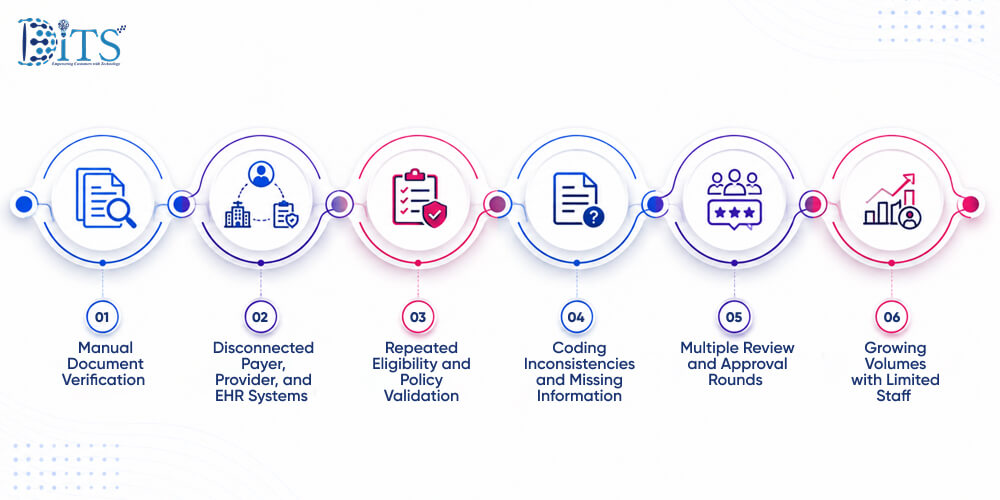
Digital submission has reduced paperwork, but it hasn’t removed the operational gaps behind slow claim decisions.
Manual Document Verification
Teams often review clinical notes, invoices, and supporting records by hand, which slows high-volume workflows.
Disconnected Payer, Provider, and EHR Systems
When systems don’t exchange data properly, staff must search, re-enter, or confirm information across multiple platforms.
Repeated Eligibility and Policy Validation
Coverage, benefits, and authorization rules may be checked more than once when data isn’t available at the right stage.
Coding Inconsistencies and Missing Information
Incorrect codes or incomplete documentation create avoidable queries, corrections, and resubmissions.
Multiple Review and Approval Rounds
Claims move between departments when routing rules are unclear or exceptions aren’t identified early.
Growing Volumes with Limited Staff
Without effective healthcare claims processing automation, workload rises faster than processing capacity, increasing turnaround time, admin costs, and payment delays.
Spending Too Much Time Fixing Claims Manually?
Automate repetitive claims tasks to reduce administrative workload, prevent avoidable errors, and improve processing efficiency across your healthcare operations.
Where Manual Rework is Quietly Increasing Claims Costs
Manual rework does not appear as a single large expense. It builds gradually through small, repeated tasks that consume staff time across billing, claims, compliance, and support.
A rejected claim may require someone to review the coding, contact the provider, correct the record, attach missing documents, and submit it again. One correction may seem manageable. Hundreds of similar cases each week create a serious cost problem.
| Manual Activity | Business Impact |
| Eligibility verification | Slower claim processing |
| Data correction | Higher labour costs |
| Claim resubmission | Delayed revenue and reimbursement |
| Manual approvals | Longer settlement cycles |
| Duplicate data entry | Lower staff productivity |
Repeated payer-provider communication adds another layer of expense. Teams spend hours answering status queries, correcting avoidable errors, and preparing documentation for manual audits.
This is where medical claims automation creates measurable value. By identifying incomplete or inconsistent information earlier, insurers and providers can reduce avoidable rework before it reaches an expensive stage of the process.
What Automated Medical Claims Processing Actually Automates
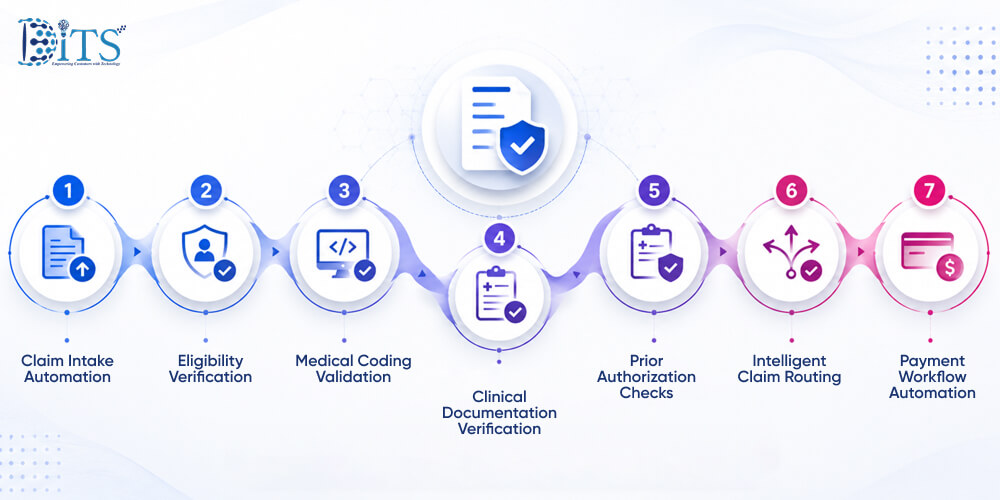
Automation gets the biggest payoff when it spans the whole claim journey, rather than just one lonely task. A good system stitches together intake, validation, routing, review, and payment workflows, so the info keeps flowing forward.
Claim Intake Automation
Claims, plus any supporting documents, can be captured, then classified, and put into the right workflow without people typing everything in manually.
Eligibility Verification
The setup verifies member coverage, policy standing, benefits, and service eligibility before the claim finally lands with an examiner.
Medical Coding Validation
Procedure and diagnosis codes are checked against payer rules, clinical source material, and billing requirements, so inconsistencies show up earlier rather than later.
Clinical Documentation Verification
If reports are missing, treatment notes are nowhere, or authorization records don’t show up, they get flagged before they trigger rejection, or a painful resubmission.
Prior Authorization Checks
The platform confirms whether approval was actually required, and it also compares the submitted authorization with the treatment that was provided.
Intelligent Claim Routing
Most routine claims go through the same predefined routes, but anything complex or high risk gets sent to the right specialist without unnecessary bouncing between departments, or transfer loops.
Payment Workflow Automation
Once a claim is approved it can slide straight into payment scheduling, reconciliation, and status notification routines.
Their implementation of AI in claims processing should not push experienced professionals away from important decisions. It should eliminate the repetitive checks around those choices, so the claims team can concentrate on tasks that really need human judgment.
How AI Helps Reduce Claim Delays Across Claims Lifecycle
AI adds the most value when it helps teams catch problems before a claim ever hits manual review.
For example, a hospital submits a claim that is missing a discharge summary. In a more traditional workflow, the issue might show up days later, during payer review. But an AI enabled system can flag the missing document right at the time of submission, so the provider gets a real chance to correct it before the claim slides into the adjudication queue.
AI can also support faster decisions by:
- Identifying incomplete or inconsistent claim information
- Predicting which claims are likely to require manual review
- Validating policy rules, benefits, and coverage conditions
- Detecting duplicate submissions and unusual billing patterns
- Recommending next steps for claim examiners
- Prioritising complex or high-value cases for specialist review
So, the practical role of AI in healthcare isn't really to make every single claim decision all by itself. It should provide claims teams with better context, cautions, and sharper priorities.
With the right AI consulting services, insurers and providers can figure out where AI reduces turnaround time, and where human judgement must stay front and centre.
Business Benefits of Automated Medical Claim Processing for Health Insurers
For insurers, the value of automation is not just about faster claim decisions, it rewrites how the whole claims operations costs are shaped.
Faster Claim Settlement
When a claim is routine, it can glide through validation and approval workflows quickly. More complex situations then get routed to seasoned reviewers, so you avoid pointless waiting and you also lift member confidence.
Lower Administrative Costs
Automated checks take away a lot of the time spent on data entry, document review, eligibility confirmation, and provider communications. Even “small” time savings turn into something big when you repeat them across thousands of claims every single month.
Higher Claims Productivity
Teams can handle more cases without losing oversight because the everyday tasks are done consistently. Meanwhile the unusual exceptions get the focused attention they need, instead of getting stuck in the general flow. An effective automated claims management system separates low risk claims from the ones with complex billing, missing records, or policy conflicts.
Reduced Fraud Losses Too
AI-supported pattern detection gives insurers the ability to notice duplicate billing, unusual service pairings, and suspicious claim behaviour earlier than before.
Better Compliance and Scalability
With consistent rules, proper audit trails, and structured workflows, regulatory reporting becomes easier, while insurers can handle seasonal spikes, new provider networks, or business growth without turning everything into operational bottlenecks.
The real win is control. Insurers can lower processing costs while also speeding up claims, improving accuracy, and increasing visibility across the whole claims' portfolio, at once.
Business Benefits of Automated Medical Claim Processing for Healthcare Providers and Hospital Networks
For healthcare providers, a delayed claim isn’t just a bureaucratic headache. It hits cash flow, plain and simple. A hospital might finish the treatment today, yet reimbursement can still stall for weeks because of one missing document, a coding mismatch, or even a payer question that really could’ve been handled sooner.
When this kind of thing repeats across hundreds or thousands of claims, that mounting pressure shows up fast and then it just keeps building.
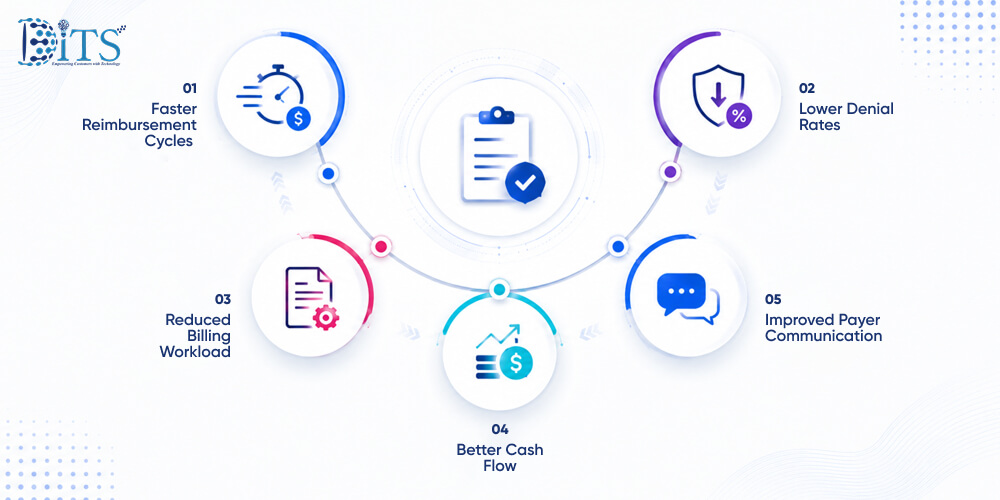
Faster Reimbursement Cycles
Automated checks help billing teams notice problems before anything gets sent. In practice, that usually leads to cleaner claims, less back-and-forth during inquiries, and a tighter timing gap between care delivery and payment arriving.
Lower Denial Rates
Claims tend to pass more smoothly when eligibility, coding, authorization, and documentation are reviewed before the file lands in the payer’s queue. Those pre-screening matters, and it reduces the “wait and see” rhythm.
Reduced Billing Workload
Billing staff spend less time repairing records, following up on claim status updates, or resubmitting corrected information. So, they gain more room to focus on revenue cycle planning, payer coordination, and those unresolved high value cases.
Better Cash Flow
Quicker approvals help revenue feel more predictable. For hospital groups and provider networks, this makes payroll easier, vendor payments smoother, staffing decisions less of a guess, and even opens room for investing in new care programs.
Improved Payer Communication
When providers and insurers work through connected systems, both sides can view claim status, supporting documents, and exception details in a cleaner way. So, you end up with fewer emails, fewer calls, and fewer misunderstandings.
Ready To Modernize Your Medical Claims Operations?
Connect existing claims platforms, healthcare systems, and intelligent automation to reduce rework without unnecessarily replacing your current technology infrastructure.
How DITS Helps Organizations Modernize Medical Claims Processing
Most insurers and healthcare providers already use claims platforms, billing tools, EHRs, and clearinghouse connections, but honestly these things often just sit in their own little worlds. That’s where the trouble shows up, delays, duplicate work, and poor visibility, all because the systems don’t really talk enough.
DITS starts with the business problem first, not with some shiny tech pitch. Through AI consulting services, we look at claim workflows, find automation opportunities, check how ready the data really is, and estimate the possible ROI before we suggest any technology changes.
Then our health insurance software development services kick in, supporting custom claims platforms, adjudication tools, provider portals and member portals. We also build exception dashboards and workflow automation. If there’s a legacy system, we help modernize it too, with cloud migration, API enablement, performance improvements, and phased module replacement.
For connected operations, DITS integrate EHRs, EMRs, clearinghouses, payment gateways, pharmacy systems, and payer apps using HL7 and FHIR standards, so in practice it all lines up.
We also add “intelligent” parts, like AI based claim validation, fraud detection, smart routing, and predictive denial analysis. Rather than replacing every existing system, DITS helps organizations improve what they already have and achieve faster.
Conclusion
Slow claims processing is rarely caused by just one process, it’s usually a mix of disconnected systems, repeated verification steps, missing details, and then workflows that still lean on manual work too much.
So, for insurers, you end up with higher administrative costs, plus those longer settlement periods. For healthcare providers, reimbursements get delayed, billing pressure increases, and cash flow becomes less steady. Automated medical claims processing can help reduce these issues by setting up a more linked, more precise, and more scalable claims environment.
The best outcomes happen when automation is mapped to business priorities first, not treated like another standalone tool that you just plug in. That’s where DITS fits in, with digital transformation services, claims workflow consulting, system integration, legacy modernization, and intelligent automation.
As a strategic technology partner, DITS supports health insurers and provider organizations in reducing rework, improving claim turnaround times, strengthening day to day operational control, and building platforms that can expand as business goals change and regulatory expectations shift. The objective is straightforward: fewer avoidable slowdowns, lower processing costs, and clearer returns from each technology investment.
FAQs
What is automated medical claims processing?
Automated medical claims processing is a system of rules, integrations, and AI that helps validate, route, inspect, and then settle claims with reduced manual work.
How does medical claims automation reduce delays?
Well, it spots missing information, coding errors, eligibility problems and documentation gaps earlier than before. That means fewer unnecessary review loops, plus fewer resubmissions that would have happened anyway.
Can claims automation help reduce denial rates?
Yes, because it can do automated checks to improve accuracy before the claim is even submitted. So preventable denials from incomplete records, odd coding mistakes, or authorization issues are less likely.
How do DITS strategic consulting services support claims modernization?
DITS Strategic Consulting Services support claims modernization by assessing your current claims workflows, identifying high-impact automation opportunities, defining integration strategies, and creating phased modernization roadmaps. This structured approach helps insurers improve efficiency, reduce manual effort, and modernize claims operations with minimal disruption.
Can DITS improve existing claims platforms without replacing them?
Yes. DITS can modernize certain modules, tie together systems that are currently disconnected, add AI capabilities, and improve how the work moves along, while keeping the parts of your existing tech that are already useful.
What systems can be integrated with claims processing software?
Typically claims platforms can be integrated with EHRs and EMRs, clearinghouses, billing tools, payment gateways, pharmacy systems, and payer applications.
How do DITS strategic consulting services for health insurers and healthcare providers improve ROI?
DITS strategic consulting services focus the technology investment on measurable outcomes, for example less rework, quicker settlements, lower administrative expenses, and better staff productivity, so the numbers move in a clearer way over time.

Nidhi Thakur
With more than 19 years of experience - I represent a team of professionals that specializes in the healthcare and business and workflow automation domains. The team consists of experienced full-stack developers supported by senior system analysts who have developed multiple bespoke applications for Healthcare, Business Automation, Retail, IOT, Ed-tech domains for startups and Enterprise Level clients.
Recent Posts
AI triage in healthcare helps prioritize patients, improve access, streamline care decisions, and enhance patient engagement with smarter workflows.

AI-powered dispatch scheduling reduces transportation costs by optimizing routes, vehicle utilization, driver schedules, and delivery operations for greater efficiency.
AI integration connects AI with existing systems and workflows, while AI adoption focuses on using AI effectively to drive measurable business outcomes.