Benefits of AI in Agriculture Sector for Business Growth
Table Of Content
Published Date :
24 Feb 2026
Key Takeaways:
- AI in agriculture enables data-driven farming decisions.
- Artificial intelligence in agriculture reduces input and labor costs.
- AI applications in agriculture improve crop monitoring and yield forecasting.
- Application of AI in agriculture automates irrigation and pest control.
- Benefits of AI in agriculture include higher productivity and efficiency.
- AI integration services ensure scalable and connected agri-tech systems.
Farming businesses today deal with rising input costs, changing weather, labor shortages, and pressure to produce more with less. Owners need better control over crops, resources, and planning without increasing risk. Benefits of AI in agriculture sector for business growth explains how AI in agriculture helps in daily decisions like crop planning, irrigation, pest control, and yield prediction. With artificial intelligence in agriculture, businesses can use data to reduce waste and improve output. Understanding how is AI used in agriculture helps farmers and agribusiness owners apply practical AI applications in agriculture and see real benefits of AI in agriculture for long-term growth.
Quantitative Operational Impact of AI in Agriculture
Firms and independent farmers implementing AI are reporting specific, measurable gains in efficiency and resource management
| Metric | AI-Driven Impact (2026 Median) |
| Crop Yield Increase | 15% – 35% (via precision planting & health monitoring) |
| Water Consumption | 30% – 35% Reduction (via AI-automated smart irrigation) |
| Chemical Input (Pesticides/Fertilizers) | 20% – 25% Reduction (via spot-spraying computer vision) |
| Labor Cost Savings | 20% – 30% (via autonomous tractors and robotic harvesters) |
| Early Disease Detection Accuracy | 95%+ Accuracy (reducing post-harvest losses by 20%) |
North America: Remains the largest market share holder (~36%) due to high-tech infrastructure and massive R&D from players like John Deere.
Asia-Pacific: The fastest-growing region, led by India and China. In India, AI-based monsoon forecasting now reaches 3.88 crore (38.8 million) farmers, with nearly 50% modifying their planting schedules based on AI advisories.
Global Market Valuation: The AI in agriculture market is currently valued at approximately $3.1 billion to $3.9 billion, with a projected CAGR of 22.8% through 2035.
Adoption by Farm Size: Large-Scale Farms: Over 70% of large farms in developed nations have integrated at least one AI system (autonomous machinery or crop monitoring).
How is AI Used in Agriculture Sector
AI supports crop monitoring, irrigation control, pest detection, and yield forecasting. These AI applications in agriculture help agribusinesses reduce cost, improve productivity, and make data-driven decisions for sustainable growth.
Precision Crop Monitoring
AI in agriculture uses satellite imagery, drone data, and computer vision to monitor crop health. Farmers receive alerts on nutrient deficiency, water stress, or disease spread. This application of AI in agriculture reduces field inspection time and prevents large-scale crop loss.
Smart Irrigation & Resource Optimization
AI technology in agriculture connects soil sensors, weather data, and predictive analytics to control irrigation systems automatically. Businesses avoid overwatering and reduce electricity costs. The benefits of AI in agriculture include better water management and improved yield consistency.
Pest & Disease Prediction
Artificial intelligence in agriculture analyzes historical data, humidity levels, and crop patterns to predict pest outbreaks. Early warnings allow targeted spraying instead of full-field treatment. This use of AI in agriculture lowers chemical cost and protects overall crop quality.
Yield Forecasting & Market Planning
AI applications in agriculture process historical yield data, soil performance, and climate trends to forecast production levels. Agribusiness owners can plan storage, logistics, and contracts in advance. Understanding how is AI used in agriculture helps businesses improve revenue predictability and prepare for the future of AI in agriculture.
Read Portfolio: Smart Greenhouse Automation with IoT Precision
Real Time Application of AI in Agriculture 2026
In early 2026, the agricultural sector has moved beyond testing to full-scale adoption. AI is now a critical tool for "climate-proofing" global food supplies, with real-time data showing significant gains in both yield and resource conservation
| AI Application Area | Global Adoption Rate (2026) | Quantitative Business Impact |
| Precision Crop Monitoring | 72% | 15% – 35% average yield increase via satellite/drone health alerts. |
| Smart Irrigation Control | 52% | Up to 35% water savings and 17.5% reduction in energy costs. |
| Pest & Disease Prediction | 69% | 95%+ early detection accuracy; reduces crop losses by up to 40%. |
| Autonomous Field Machinery | 66% | 20% – 30% labor cost savings using driverless tractors and harvesters. |
| Yield & Market Forecasting | 45% | 20% reduction in post-harvest losses through better logistics planning. |
| AI Agri-Finance/Insurance | 58% | 50% faster loan processing via satellite-verified farm data. |
Business Benefits of AI in Agriculture Sector
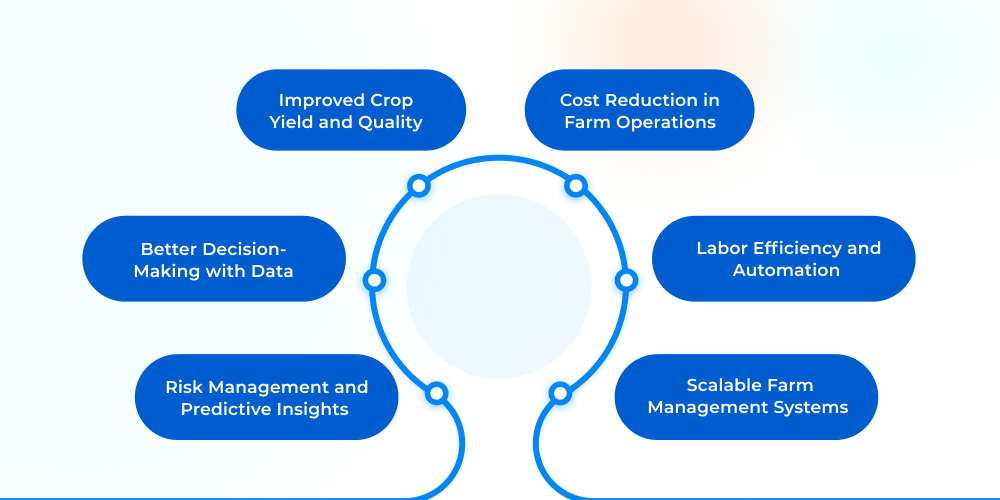
AI-driven systems help agriculture businesses improve yield, control costs, and manage risks with data-based decisions. Integrating AI into operations is a critical step that often requires expert support for scalable and reliable implementation.
Improved Crop Yield and Quality
Farmers use image recognition, soil sensors, and data analytics to monitor crop health in real time. This application of AI in agriculture helps detect issues early and take corrective action, leading to better yield quality and consistent output for market supply.
Cost Reduction in Farm Operations
AI systems optimize the use of water, fertilizers, and pesticides based on field data and weather inputs. This use of AI in agriculture reduces unnecessary spending and improves input efficiency, helping businesses maintain margins even when operational costs increase.
Better Decision-Making with Data
AI models process historical yield data, weather patterns, and soil conditions to guide planting and harvesting decisions. Understanding how is AI used in agriculture helps business owners move from guesswork to structured planning with measurable outcomes.
Labor Efficiency and Automation
Automation through smart machinery, drones, and monitoring systems reduces dependency on manual labor. This is one of the major benefits of AI in agriculture, especially for large farms facing labor shortages and increasing wage costs.
Risk Management and Predictive Insights
AI-driven forecasting systems help predict weather risks, pest attacks, and crop diseases in advance. This supports the future of AI in agriculture by helping businesses prepare early and reduce losses through proactive planning and timely interventions.
Scalable Farm Management Systems
Centralized platforms integrate crop data, financial tracking, equipment usage, and supply chain operations. Since integrating AI in agriculture is a complex task, businesses often require an experienced AI development company to build, integrate, and scale these systems effectively.
Read Portfolio: Smart Farm Monitoring System with AI Air Quality
Future of AI in Agriculture 2026-2029
AI-driven systems will transform farming with automation, predictive insights, and better resource planning. Businesses adopting these solutions can improve yield, reduce costs, and build scalable operations aligned with the future of AI in agriculture.
Autonomous Farming Operations
Modern farms are moving toward self-operating tractors, harvesters, and drones powered by sensors, GPS mapping, and edge computing. This use of AI in agriculture reduces labor dependency, improves field coverage, and ensures consistent operations across large-scale agricultural businesses.
Hyper-Precision Farming
With sensor fusion, satellite imaging, and geospatial analytics, farmers can apply water, fertilizers, and pesticides only where needed. Artificial intelligence in agriculture helps reduce input waste while improving crop quality, making daily farm decisions more accurate and cost-effective.
Climate-Adaptive Farming Models
Predictive models analyze weather patterns, soil conditions, and historical crop cycles to guide planting decisions. Businesses can prepare for uncertain conditions and reduce risk. This is a strong application of AI in agriculture software that supports long-term sustainability and stable production.
Also Read: How AI Applications in Agriculture Improve Crop Yield
AI-Powered Supply Chain Optimization
Farms are now connecting with logistics software and storage systems using demand forecasting and route optimization tools. AI technology in agriculture helps reduce spoilage, improve delivery timelines, and align supply with real-time demand across different markets.
Real-Time Market Intelligence
Advanced analytics track commodity prices, regional demand, and buyer behavior. This helps business owners decide when to sell and at what price. AI applications in agriculture improve revenue planning and reduce dependency on traditional selling methods.
Integrated Farm Management Platforms
Centralized dashboards combine crop monitoring, financial tracking, equipment data, and workforce management. This approach strengthens AI in agriculture adoption and supports businesses through reliable AI integration services, helping them scale efficiently while improving control and decision-making across farm operations.
How is to Integrate AI in Agriculture Business
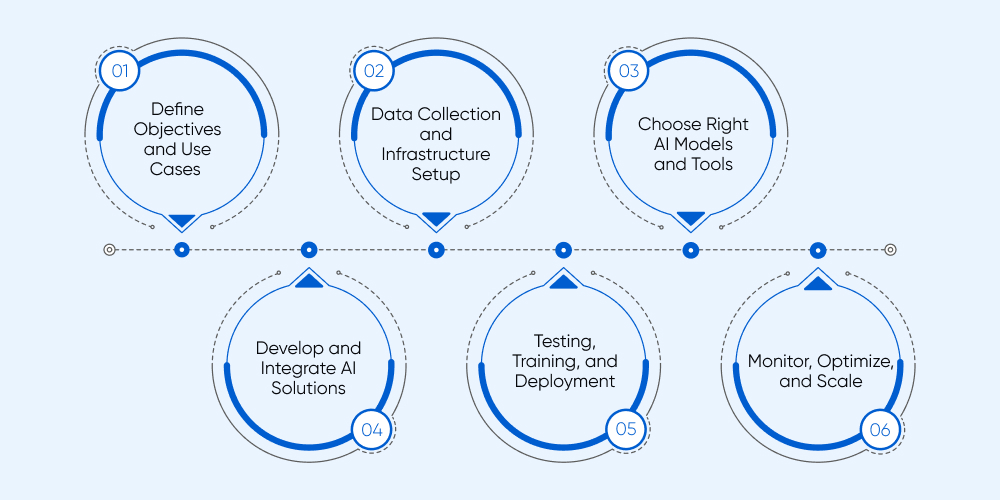
Integrating AI in agriculture business is a complex process that requires technical planning, system integration, and domain expertise. Partnering with an experienced AI software development company helps ensure reliable implementation, faster deployment, and long-term scalability.
Define Objectives and Use Cases
Start by identifying clear goals such as yield improvement, cost reduction, or supply chain efficiency. Map real farm problems like water usage or pest control. Understanding how is AI used in agriculture at a practical level helps businesses select the right direction before investing.
Data Collection and Infrastructure Setup
AI systems depend on quality data from sensors, drones, satellite imagery, and farm records. Businesses must build a centralized data pipeline using cloud infrastructure and IoT integration. This step ensures accurate application of AI in agriculture and avoids poor model performance later.
Choose Right AI Models and Tools
Select machine learning models, computer vision systems, or predictive analytics based on the use case. Whether it is crop monitoring or demand forecasting, expert AI software development service providers ensure the solution aligns with operational needs and delivers measurable outcomes.
Develop and Integrate AI Solutions
Custom AI agent development and system integration connect AI tools with existing farm management software, ERP, and supply chain systems. This step is critical, as integrating AI in agriculture business operations requires technical expertise to ensure smooth workflows and minimal disruption.
Testing, Training, and Deployment
Before full rollout, test models with real farm data and validate accuracy. Train staff to use dashboards, alerts, and automated systems. This ensures the use of AI in agriculture is practical and teams can rely on outputs for daily decision-making.
Monitor, Optimize, and Scale
After deployment, continuously monitor performance using KPIs like yield increase, cost savings, and resource efficiency. Improve models with new data and scale across locations. This ongoing process supports the future of AI in agriculture and keeps systems aligned with business growth.
Also Read: Use Cases of IoT in Agriculture Sector
AI in Agriculture – Quick Business Assessment
Cost of Implementing AI in Agriculture
Starting at a base investment of $25,000, Ditstek Innovations (DITS) provides a structured entry into "Smart Farming" through a focused Discovery and Foundation phase. This initial outlay covers the critical engineering required to unify fragmented field data, from soil sensors and weather APIs to satellite feeds, into a secure, AI-ready data lake.
| Tier | AI Application Type | Core Deliverables | Starting Cost (Est.) |
| Foundation | AI Discovery & Data | ROI modeling, ETL pipelines, and data lake setup. | $25,000 |
| Growth | Smart Monitoring | Drone-based health alerts and NLP crop doctors. | $45,000 |
| Enterprise | Full Farm Autonomy | Autonomous machinery and predictive yield models. | $120,000+ |
| Custom | Precision R&D | Custom LLM orchestration and Computer Vision. | $60,000+ |
Choose DITS for Implementing AI in Agriculture
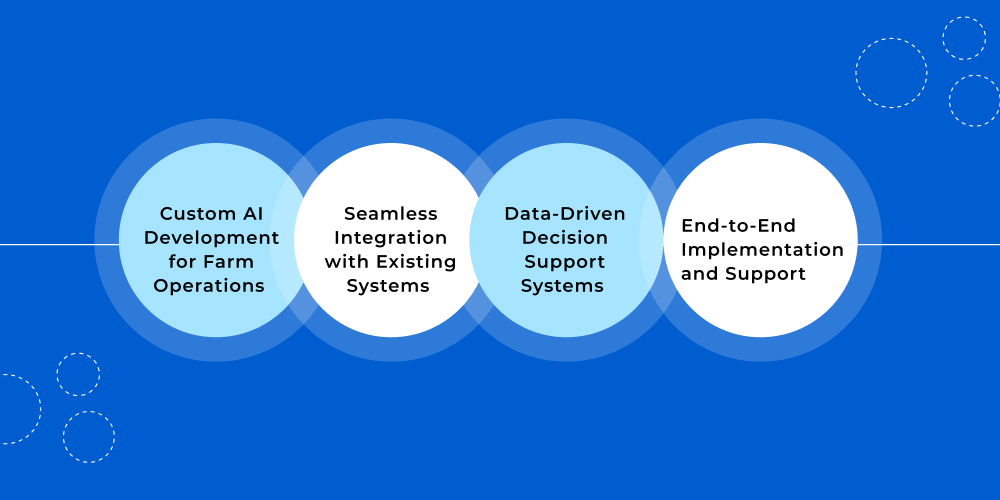
DITS helps agriculture businesses design, develop, and integrate AI-driven systems tailored to real operations. With strong technical expertise, businesses can implement scalable solutions aligned with the future of AI in agriculture.
Custom AI Development for Farm Operations
DITS builds tailored systems using computer vision, IoT integration, and predictive analytics. This supports the application of AI in agriculture for crop monitoring, irrigation control, and yield forecasting based on real farm conditions.
Seamless Integration with Existing Systems
Agriculture businesses often run multiple tools for operations. DITS ensures smooth API integration with ERP, sensors, and farm management systems, making the use of AI in agriculture practical without disrupting current workflows.
Data-Driven Decision Support Systems
DITS develops AI models using historical data, weather APIs, and geospatial analytics. This helps businesses understand how is AI used in agriculture for planning, reducing risks, and improving operational decisions.
End-to-End Implementation and Support
Integrating AI in agriculture is a critical task that requires expert guidance. DITS provides complete support from strategy to deployment, helping businesses realize the benefits of AI in agriculture with scalable and secure solutions.
Start Building Your AI-Driven Agriculture Business Today!
Turn your farm operations into a data-driven system with the right AI strategy and implementation. Work with experts to design, integrate, and scale solutions that improve yield, reduce cost, and support long-term growth./p>
FAQs – AI in Agriculture
1. What is AI in agriculture and how does it work?
AI in agriculture uses data from sensors, weather reports, and farm systems to support decision-making. Artificial intelligence in agriculture processes this data using machine learning models to improve crop monitoring, irrigation, and overall farm operations.
2. What are the main AI applications in agriculture for businesses?
AI applications in agriculture include crop health monitoring, predictive yield analysis, smart irrigation systems, pest detection, and supply chain optimization. These applications help businesses manage resources better and improve operational efficiency across farming activities.
3. What are the key benefits of AI in agriculture?
The benefits of AI in agriculture include higher crop yield, reduced input costs, better risk management, and improved planning. Businesses can make faster and more accurate decisions using data instead of relying on manual observation and guesswork.
4. How is the application of AI in agriculture improving daily operations?
The application of AI in agriculture helps automate repetitive tasks like monitoring fields, analyzing soil data, and managing irrigation schedules. This reduces manual effort and allows business owners to focus on scaling and improving productivity.
5. How can Ditstek Innovations help implement AI in agriculture?
Ditstek Innovations provides custom AI in agriculture solutions tailored to your business needs. From planning to deployment, we help integrate artificial intelligence in agriculture systems that improve efficiency, reduce costs, and deliver measurable results.
6. Why should businesses choose DITS for AI applications in agriculture?
DITS specializes in building scalable AI applications in agriculture with strong technical integration and business alignment. We focus on delivering real benefits of AI in agriculture by creating solutions that match your operations, data, and long-term goals.

Dinesh Thakur
21+ years of IT software development experience in different domains like Business Automation, Healthcare, Retail, Workflow automation, Transportation and logistics, Compliance, Risk Mitigation, POS, etc. Hands-on experience in dealing with overseas clients and providing them with an apt solution to their business needs.
Recent Posts
Explore how intelligent document processing for insurance helps businesses automate document workflows, reduce processing costs, improve accuracy, and strengthen operational efficiency across insurance functions.
Discover how automated medical claims processing reduces delays, manual rework, claim denials, and administrative costs while improving reimbursement speed and operational efficiency.

Learn how to build medical billing software with essential features, integrations, security, and development costs.