Top Agentic AI in Healthcare Use Cases
Table Of Content
Published Date :
07 Jan 2026
Healthcare systems worldwide are under growing pressure from clinician shortages, rising operational costs, and exploding volumes of patient data. This is where agentic AI in healthcare is rapidly shifting from innovation to necessity. According to industry studies, clinicians spend nearly 30–40% of their time on administrative tasks, while healthcare data doubles every 18–24 months, making manual decision-making unsustainable.
Agentic AI use cases in healthcare go beyond automation by enabling autonomous, context-aware decision support across clinical, operational, and financial workflows. From proactive patient monitoring to intelligent care coordination and revenue cycle optimization, an AI agent in healthcare helps organizations act faster, reduce risk, and scale without adding workforce burden. For healthcare leaders, delaying adoption now means falling behind in efficiency, outcomes, and competitive readiness.
Key Takeaways:
- Agentic AI in healthcare enables autonomous, real-time decision-making across clinical and operational workflows.
- AI agents reduce clinician burnout by automating administrative tasks and improving operational efficiency.
- Top agentic AI use cases include remote patient monitoring, triage, clinical support, and revenue cycle optimization.
- Implementing agentic AI ensures faster, evidence-based decisions while maintaining regulatory compliance and traceability.
- Multi-agent ecosystems and AI-IoT convergence are shaping the future of autonomous, proactive healthcare delivery.
- Partnering with an experienced AI agent software development company accelerates secure, scalable, and ROI-driven adoption.
Key Market Trends & Insights of Agentic AI in Healthcare
- Market valuation: for 2025 is $0.80–$0.90 billion, marking shift to autonomous agentic systems.
- Market Growth: The Agentic AI in healthcare market is projected to reach $38.4 Billion by 2035, growing at a staggering CAGR of 45.6%.
- Burnout Crisis: 87% of healthcare workers report working late hours on administrative tasks; AI agents can reclaim up to 2.1 hours per day for clinicians.
- Economic Impact: Better AI triage and navigation could free up 29 million appointments annually, yielding productivity gains of over $400 million.
- Adaptation: 85% of healthcare organizations have adopted or exploring agentic AI by early 2025.
What Is Agentic AI in Healthcare?
Agentic AI in healthcare refers to intelligent systems designed to act autonomously, make context-aware decisions, and pursue defined goals across clinical and operational workflows.
Unlike predictive AI, which only forecasts outcomes, or rule-based automation that follows static logic, an AI agent in healthcare can observe data, reason in real time, and take coordinated actions without constant human input.
What makes it critical for healthcare businesses today:
- Autonomy: Agents independently manage tasks like triage prioritization or claims validation.
- Decision-making: They adapt to changing patient data, regulations, and capacity constraints.
- Goal orientation: Each agent aligns actions with outcomes such as cost reduction, care quality, or compliance.
- Multi-agent collaboration: Specialized agents work together across departments and systems.
As care delivery grows more complex, agentic AI offers healthcare organizations a faster, scalable way to reduce inefficiencies, control rising costs, and stay competitive in an increasingly AI-driven ecosystem.
Explore Our AI & Software Solutions Portfolio
Discover how Ditstek Innovations transforms ideas into scalable, intelligent products across industries. Browse our portfolio to see real-world implementations of AI agents, custom software, and digital innovations that drive measurable business impact.
Top Agentic AI Use Cases in Healthcare

Agentic AI is rapidly shifting from experimentation to execution across healthcare. As operational costs rise, clinician shortages deepen, and patient expectations increase, agentic AI in healthcare enables organizations to move from reactive systems to autonomous, outcome-driven intelligence. Partnering with a trusted AI software development company helps healthcare businesses implement these AI agents efficiently. These use cases highlight how AI agents improve care quality, optimize operations, and scale efficiently, making early adoption a competitive necessity rather than an option.
1. Autonomous Clinical Decision Support Agents
These agents continuously analyze real-time patient data from EHRs, labs, imaging, and vitals to support clinicians with evidence-based recommendations. Unlike static decision tools, an AI agent in healthcare adapts to patient context, reducing diagnostic delays while improving clinical confidence and consistency.
2. AI Agents for Patient Triage and Care Coordination
Agentic systems assess patient risk, symptoms, and history to autonomously prioritize care and route patients across departments or providers. Among the most impactful agentic AI use cases in healthcare, this reduces wait times, prevents care gaps, and improves resource utilization across hospitals and networks.
3. Agentic AI for Remote Patient Monitoring
Artificial Intelligence agent software continuously track vitals, wearables, and home devices, triggering alerts and interventions without manual oversight. As one of the fastest-growing agentic AI applications in healthcare, it enables scalable chronic care management while reducing readmissions and post-discharge risks.
4. Intelligent Administrative & Revenue Cycle Agents
Autonomous agents manage billing, coding, claims validation, and payer follow-ups in real time. By detecting compliance risks and revenue leakage early, healthcare businesses can significantly reduce administrative overhead and accelerate reimbursements, critical for financial sustainability at scale.
5. AI Agents for Personalized Treatment & Care Pathways
Agentic systems dynamically adjust treatment plans based on patient response and population-level insights. This supports precision care at scale, helping providers balance personalization with efficiency while improving outcomes, patient satisfaction, and long-term engagement.
6. Agentic AI for Hospital Operations & Capacity Management
These agents autonomously optimize bed allocation, staffing, equipment usage, and scheduling based on real-time demand. For organizations implementing agentic AI in healthcare, this translates into reduced bottlenecks, higher throughput, and measurable cost optimization across facilities.
7. AI Agents for Medical Research & Drug Discovery
Multi-agent systems analyze literature, match patients to trials, and generate research hypotheses autonomously. By accelerating discovery cycles and lowering R&D costs, this use case enables healthcare enterprises and life sciences firms to innovate faster in an increasingly competitive market.
Worth Reading Blog: How To Create An AI Agent From Scratch
Why Healthcare Organizations Are Adopting Agentic AI
Healthcare systems are under unprecedented pressure to deliver better outcomes with fewer resources. From workforce constraints to compliance demands, traditional automation is no longer sufficient. Agentic AI in healthcare introduces autonomous, goal-driven intelligence that helps organizations operate proactively, scale efficiently, and make faster, traceable decisions. For healthcare leaders, partnering with an experienced AI Agent development company is increasingly critical to deploy secure, compliant, and scalable agent-driven solutions that deliver measurable business value.
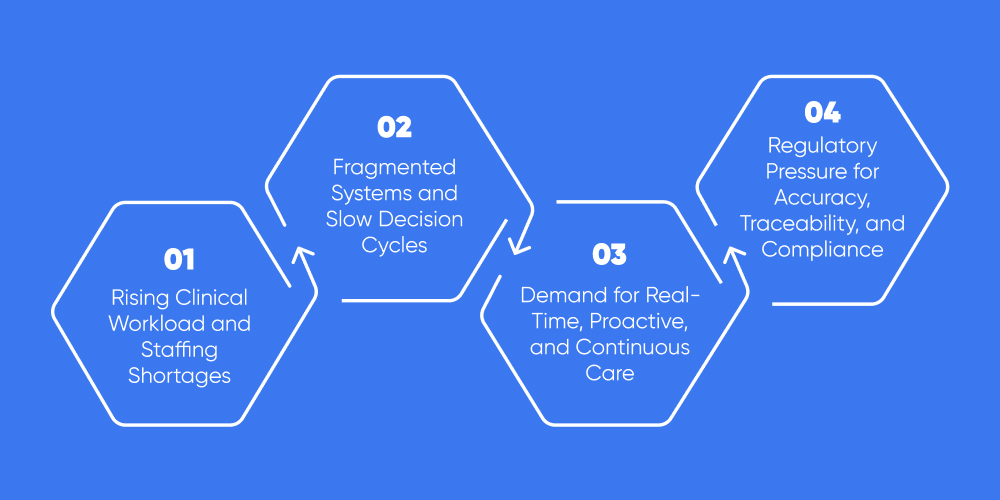
Rising Clinical Workload and Staffing Shortages
Growing patient volumes and clinician burnout are straining healthcare delivery. An AI agent in healthcare autonomously supports clinical and operational tasks, reducing manual burden on staff. This enables care teams to focus on high-value decision-making while maintaining quality and continuity of care at scale.
Fragmented Systems and Slow Decision Cycles
Disparate EHRs, diagnostic tools, and operational systems create delays and inefficiencies. Among the most practical agentic AI use cases in healthcare, intelligent agents unify data, analyze context in real time, and act across systems—shortening decision cycles and improving operational responsiveness.
Demand for Real-Time, Proactive, and Continuous Care
Modern care models require continuous monitoring and early intervention rather than reactive treatment. Agentic AI applications in healthcare enable autonomous monitoring, alerts, and follow-ups, helping organizations deliver proactive care while reducing readmissions and long-term treatment costs.
Regulatory Pressure for Accuracy, Traceability, and Compliance
Healthcare regulations demand transparent, auditable, and error-free processes. When implementing agentic AI in healthcare, organizations gain intelligent agents that log decisions, enforce compliance rules, and detect anomalies early—minimizing regulatory risk while maintaining operational efficiency.
Key Challenges & Solution of Implementing Agentic AI in Healthcare
As healthcare organizations accelerate digital transformation, implementing agentic AI in healthcare introduces both strategic opportunities and operational challenges. While AI agents enables autonomous decision-making, continuous care, and scalable intelligence, successful adoption requires a structured approach to governance, integration, and trust. For healthcare leaders, addressing these challenges early is essential to unlock high-impact agentic AI use cases in healthcare without increasing regulatory or operational risk. When designed correctly, an AI agent operates as a controlled, auditable, and compliant system that augments human expertise rather than replacing it, delivering measurable clinical and business outcomes in an increasingly competitive healthcare landscape.
| Challenge Area | Business Risk | Agentic AI Solution |
| Data Privacy, Security, & Compliance (HIPAA, HL7, FHIR) | Regulatory violations, heavy fines, and patient data breaches. | Secure architectures with end-to-end encrypted data pipelines, role-based access controls, and interoperability built on modern standards. |
| Model Governance & Accountability | Lack of trust in autonomous decisions and potential clinical bias. | Transparent audit trails with built-in decision logs, explainable AI (XAI) models, and mandatory "human-in-the-loop" approval gates. |
| Legacy System Integration | High technical debt, prohibitive integration costs, and workflow disruption. | Modular API-first applications that act as an intelligent layer over existing EHRs and middleware, preventing the need for "rip-and-replace." |
| Human Oversight & Trust Management | Cultural resistance from clinicians and fear of job displacement. | Configurable autonomy levels that allow staff to set the "bounds" of agent behavior, supported by continuous performance monitoring. |
Business Benefits of AI Agents for Healthcare Organizations

AI agents are moving beyond experimentation to become core operational assets for modern healthcare organizations. By embedding decision-making intelligence across clinical, administrative, and operational workflows, an AI agent in healthcare helps leaders reduce risk, improve outcomes, and scale efficiently. Below are the key business benefits driving rapid adoption.
Reduced Clinician Burnout and Operational Load
Agentic systems automate documentation, triage, scheduling, and follow-ups, significantly reducing manual workload for clinicians and staff. By offloading repetitive and data-heavy tasks, agentic AI in healthcare allows care teams to focus on patient interaction, improving morale, retention, and clinical productivity.
Faster Decision-Making with Traceable Reasoning
AI agents analyze real-time data from EHRs, diagnostics, and operational systems to support faster, evidence-based decisions. Unlike black-box models, agent-based systems provide traceable reasoning, helping organizations meet regulatory requirements while accelerating clinical and operational response times.
Scalable Care Delivery Without Proportional Staffing Growth
With intelligent workflow automation services and continuous monitoring, healthcare providers expand services and patient volumes without increasing headcount at the same rate. Agentic AI use cases in healthcare enable scalable care models, supporting chronic care, remote monitoring, and multi-site operations efficiently.
Measurable ROI Through Efficiency, Accuracy, and Retention
AI agents reduce errors, prevent revenue leakage, and optimize resource utilization across departments. The combined impact of operational efficiency, improved patient outcomes, and higher staff retention delivers clear, measurable ROI, making agent-driven transformation a strategic priority for healthcare organizations.
Explore How We Transformed Businesses With AI
Discover real-world impact and innovation with our AI solutions. Check out our detailed AI case studies to see how Ditstek Innovations drives efficiency, scalability, and measurable results across industries.
Future of Agentic AI in Healthcare
Agentic AI is rapidly evolving from isolated implementations into a connected intelligence layer that will redefine how healthcare organizations operate. As adoption accelerates, agentic AI in healthcare will shift from task automation to autonomous, outcome-driven systems that continuously learn, collaborate, and optimize care delivery at scale.
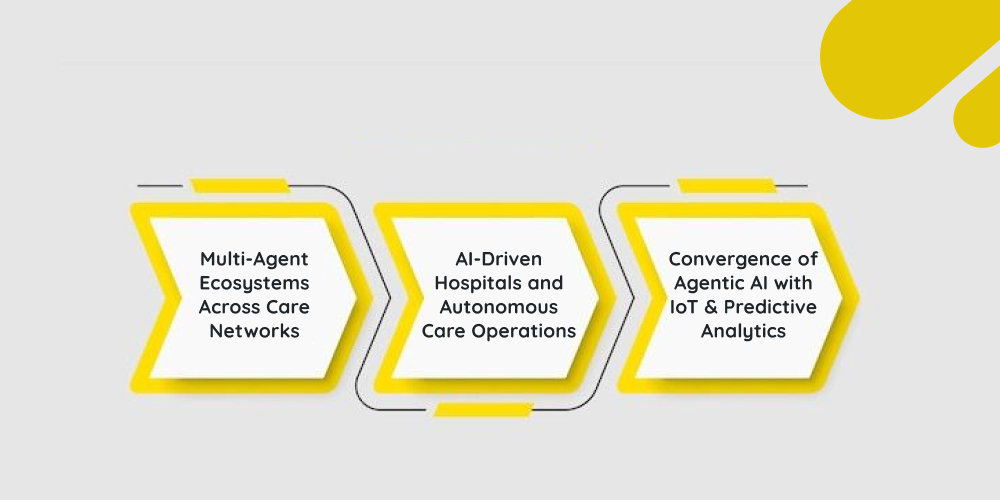
Multi-Agent Ecosystems Across Care Networks
Healthcare is moving toward coordinated ecosystems where multiple AI agents collaborate across hospitals, labs, insurers, and home-care environments. These multi-agent systems enable seamless data exchange, proactive care coordination, and real-time decision alignment across the entire care continuum.
AI-Driven Hospitals and Autonomous Care Operations
Future hospitals will rely on agentic systems to autonomously manage staffing, bed capacity, diagnostics workflows, and patient flow. By embedding agentic AI applications in healthcare into core operations, organizations can achieve higher throughput, lower costs, and consistent care quality.
Convergence of Agentic AI with IoT & Predictive Analytics
The integration of agentic AI with IoT in healthcare devices and predictive analytics will unlock continuous, real-time healthcare intelligence. AI agents will interpret streaming data from wearables and medical devices, anticipate risks, and trigger timely interventions, enabling truly proactive and personalized care models.
Why Choose an AI Agent Development Partner for Healthcare
Selecting the right partner is critical for successfully implementing agentic AI in healthcare. Expert AI development teams provide domain-specific knowledge, technical proficiency, and scalable solutions that ensure AI agents deliver measurable business and clinical outcomes.
Domain Expertise in Workflows and Regulations
A specialized AI partner understands hospital operations, regulatory compliance (HIPAA, HL7, FHIR), and clinical workflows. This ensures implementing agentic AI in healthcare is safe, compliant, and effectively aligned with real-world patient care requirements.
Custom Agent Architecture
Healthcare organizations benefit from tailored AI agent designs optimized for specific tasks like triage, remote monitoring, and personalized treatment planning. Custom architecture ensures maximum efficiency, reliability, and relevance across agentic AI use cases in healthcare.
Interoperable AI Systems
An AI agent development partner delivers secure systems that integrate with existing EHRs, IoT devices, and third-party platforms. Ensuring privacy, traceability, and interoperability minimizes risk while maximizing the value of ai agent in healthcare deployments.
Long-Term Scalability and Lifecycle Support
AI agents require continuous updates, learning, and system optimization. Partners provide ongoing support, lifecycle management, and scalability planning, helping healthcare organizations maintain high performance and ROI as agentic AI applications in healthcare evolve.
Conclusion: Is Healthcare Organization Ready for Agentic AI?
Adopting agentic AI in healthcare can revolutionize operations, enhance patient outcomes, and reduce inefficiencies, but readiness is key. Healthcare organizations experiencing clinician burnout, high patient volumes, fragmented workflows, or slow decision-making should consider early adoption to gain a competitive edge. Starting with high-impact use cases such as autonomous triage, remote patient monitoring, or revenue cycle automation allows rapid ROI while minimizing disruption. Partnering with an experienced IT consulting company, defining integration plans, ensuring regulatory compliance, and scaling AI agents iteratively enables continuous optimization, long-term efficiency, improved patient satisfaction, and sustainable growth across the healthcare ecosystem.
FAQs
1. What is agentic AI in healthcare and how does it work?
Agentic AI in healthcare refers to autonomous AI systems capable of analyzing patient data, making context-aware decisions, and supporting clinical workflows, improving accuracy, efficiency, and patient outcomes across hospitals and clinics.
2. What are the top agentic AI use cases in healthcare today?
Key agentic AI use cases in healthcare include clinical decision support, remote patient monitoring, AI-driven triage, revenue cycle automation, personalized treatment pathways, and hospital operations optimization.
3. How can an AI agent in healthcare enhance patient care?
An AI agent in healthcare can continuously monitor patient vitals, predict risks, automate routine tasks, and provide evidence-based recommendations, helping clinicians make faster, informed decisions and reduce operational bottlenecks.
4. What are the best agentic AI applications in healthcare for hospitals?
Agentic AI applications in healthcare include autonomous care coordination, intelligent administrative assistants, personalized treatment planning, predictive capacity management, and drug discovery support, all designed to streamline hospital operations and improve patient outcomes.
5. How do I start implementing agentic AI in healthcare?
Implementing agentic AI in healthcare begins with assessing workflows, identifying high-impact use cases, partnering with an AI agent software development company, integrating AI systems with EHRs, and ensuring regulatory compliance.
6. Why should healthcare organizations adopt agentic AI in 2026?
Healthcare organizations should adopt agentic AI in 2026 to manage rising clinical workloads, improve real-time decision-making, optimize resources, and scale care delivery, staying ahead in a competitive and patient-centric healthcare environment.
7. Why choose DITS as AI agent development company for healthcare?
DITS is a leading AI agent software development company with expertise in agentic AI in healthcare. We deliver scalable, secure, and compliant AI agent solutions that accelerate clinical decision-making, streamline operations, and enhance patient outcomes globally.
8. How can DITS help implement agentic AI in healthcare for my organization?
DITS provides end-to-end AI agent development services, from workflow assessment and high-impact use case identification to deployment and continuous optimization. Partnering with us ensures fast, reliable, and future-ready implementation of agentic AI applications in healthcare.
9. How can US healthcare providers benefit from DITS AI agent solutions?
For USA-based healthcare organizations, DITS delivers agentic AI in healthcare aligned with HIPAA compliance, optimizing clinical workflows, automating patient monitoring, and reducing operational costs while enhancing care quality and regulatory adherence.

Nidhi Thakur
With more than 19 years of experience - I represent a team of professionals that specializes in the healthcare and business and workflow automation domains. The team consists of experienced full-stack developers supported by senior system analysts who have developed multiple bespoke applications for Healthcare, Business Automation, Retail, IOT, Ed-tech domains for startups and Enterprise Level clients.
Recent Posts
Explore how intelligent document processing for insurance helps businesses automate document workflows, reduce processing costs, improve accuracy, and strengthen operational efficiency across insurance functions.
Discover how automated medical claims processing reduces delays, manual rework, claim denials, and administrative costs while improving reimbursement speed and operational efficiency.
Learn how to build medical billing software with essential features, integrations, security, and development costs.