25+ years of IT software development experience in different domains like Business Automation, Healthcare, Retail, Workflow automation, Transportation and logistics, Compliance, Risk Mitigation, POS, etc. Hands-on experience in dealing with overseas clients and providing them with an apt solution to their business needs.
Real estate businesses are dealing with rising marketing costs, slower sales cycles, pricing pressure, and higher client expectations. Owners and brokers want better forecasting, faster deal closure, and stronger lead management without increasing overhead. That is where top 9 benefits of integrating AI in real estate for future becomes an important business discussion. Today, AI in real estate industry operations helps companies manage listings, qualify buyers, predict pricing trends, and automate follow-ups.
From AI in commercial real estate analytics to conversational AI in real estate websites, smart systems support daily business decisions. Understanding how to use AI in real estate is no longer optional. The benefits of AI in real estate include better cash flow planning, improved marketing ROI, stronger pipeline visibility, and scalable growth. Businesses investing in AI applications in real estate and AI in real estate development are building structured, data-driven companies prepared for long-term competition.
Key Takeaways
AI improves property valuation accuracy and speeds up deal closures significantly.
Intelligent automation reduces operational costs and streamlines daily real estate workflows.
Predictive analytics enhances pricing, rental yield, and portfolio risk management.
Conversational AI boosts tenant engagement, lead conversion, and client satisfaction.
Data-driven AI systems support smarter decisions in real estate development projects.
Scalable AI software solutions benefit startups, mid-sized firms, and large enterprises alike.
The State of AI in Real Estate (2026)
In 2026, the real estate industry has reached a "tipping point" where AI is no longer a luxury but a core operational requirement. For your blog, these statistics highlight the massive scale of adoption and the tangible ROI firms are seeing.
1. Market Growth and Adoption
Global Market Value: The AI in real estate market has surged to approximately $404.9 billion in 2026, on its way to exceeding $1.3 trillion by 2030.
Adoption Rate: Over 70% of real estate companies are now actively using AI in their workflows—a massive jump from just 35% in 2021.
The "Pilot" Phase: A staggering 90% of commercial real estate (CRE) firms are currently piloting at least five different AI use cases simultaneously.
Budget Priority: Roughly 87% of investors report that their technology budgets increased specifically to accommodate AI integration this year.
2. Efficiency and ROI Benchmarks
Data shows that AI isn't just a shiny tool; it’s a cost-cutter and revenue-driver:
Operational Savings: Firms leveraging AI automation are seeing a 30% to 45% reduction in operational and administrative costs.
Lead Engagement: Platforms using AI-driven personalized recommendations report 35% to 50% higher engagement than traditional listings.
Lead Conversion: AI-powered chatbots and virtual assistants have increased lead capture rates by 40% and cut response times in half.
Pricing Accuracy: Predictive analytics models have improved property pricing accuracy by up to 25%, significantly reducing the "days on market" for listings.
3. Impact on Human Productivity
Task Automation: AI is now capable of automating 37% of all tasks in the real estate sector, particularly in management, sales, and maintenance.
Agent Efficiency: Real estate agents using generative AI for content (listings, emails, social media) report a 7.3% increase in individual productivity.
Reduced Physical Viewings: High-fidelity AI virtual tours have cut the need for in-person property visits by 60%, saving time for both buyers and brokers.
4. Regional Leaders (Market Share)
Region
Market Share (Approx.)
Key Driver
North America
38-41%
Mature tech ecosystem & high labor costs
Europe
~25%
ESG compliance & green building AI
Asia-Pacific
~20%
Fastest growing (Smart City initiatives)
Top 9 Benefits of Integrating AI in Real Estate
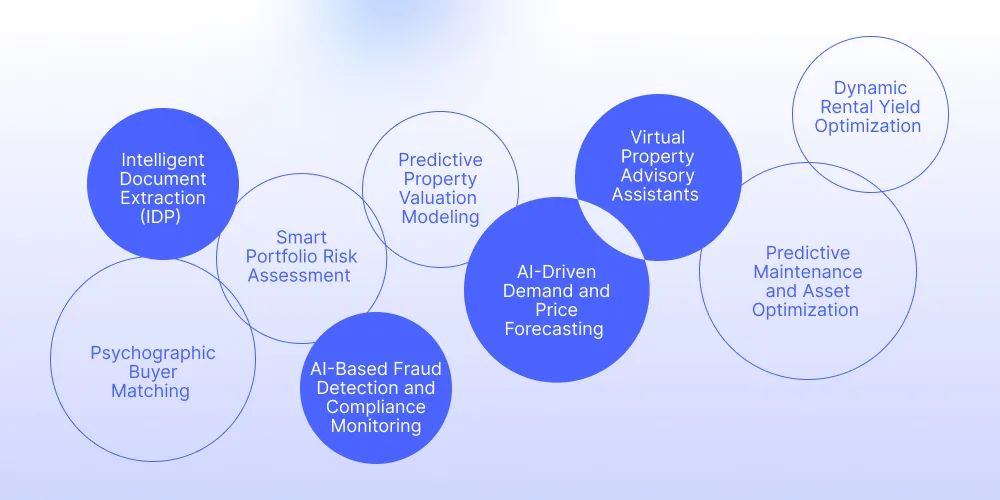
AI-driven systems help real estate businesses improve pricing accuracy, reduce legal risk, automate documents, predict demand, and optimize rental returns. These practical AI applications in real estate support measurable growth, stronger margins, and better decision-making.
Intelligent Document Extraction (IDP)
Real estate firms process leases, title reports, loan documents, inspection records, and compliance forms daily. Intelligent Document Processing uses OCR, NLP, and structured data mapping to extract key clauses automatically. In AI in real estate industry operations, this reduces manual review time, improves accuracy, and accelerates deal closure.
Psychographic Buyer Matching
Beyond demographics, AI analyzes browsing behavior, search filters, transaction history, and engagement patterns to match buyers with suitable properties. This AI in real estate approach increases qualified showings and reduces marketing waste. Businesses clearly see the benefits of AI in real estate through higher conversion rates.
Smart Portfolio Risk Assessment
Investment groups and property managers use predictive risk scoring models to evaluate tenant default probability, market volatility, and asset exposure. In AI in commercial real estate, machine learning models process historical occupancy data and macroeconomic indicators, helping executives rebalance portfolios before financial stress appears.
AI-Based Fraud Detection and Compliance Monitoring
Real estate transactions involve identity verification, financial checks, and regulatory compliance. AI systems apply anomaly detection, KYC validation, and transaction monitoring to flag suspicious patterns. This practical AI in real estate development protects firms from financial loss and strengthens audit readiness.
Predictive Property Valuation Modeling
Valuation models use regression algorithms, comparable sales analysis, neighborhood trends, and property features to estimate market value in real time. Businesses implementing AI in real estate gain faster pricing decisions. This directly supports how to use AI in real estate for smarter acquisitions and listings.
AI-Driven Demand and Price Forecasting
Developers and brokers rely on forecasting engines that analyze historical transactions, seasonal demand, interest rates, and migration patterns. In AI in real estate industry planning, these models guide launch timing and pricing strategy. Leaders reduce guesswork and align inventory with projected market demand.
Virtual Property Advisory Assistants
Conversational AI in real estate supports buyers and tenants with instant answers, property comparisons, EMI calculations, and scheduling. Integrated with CRM systems, these assistants qualify leads automatically. Companies using AI applications in real estate improve response time and capture more serious inquiries.
Predictive Maintenance and Asset Optimization
Property managers use IoT software, maintenance logs, and usage analytics to predict equipment failure in HVAC, elevators, and utilities. In AI in commercial real estate, predictive maintenance reduces downtime and emergency repair costs, protecting tenant satisfaction and long-term asset value.
Dynamic Rental Yield Optimization
AI models analyze occupancy rates, competitor pricing, neighborhood demand, and seasonal trends to adjust rental rates dynamically. Businesses practicing AI in real estate development increase yield without losing occupancy. This is one of the strongest measurable benefits of AI in real estate revenue management.
Challenges Real Estate Face Integrating AI in Real Estate
Real estate software adopting AI often face system limitations, cost pressure, compliance concerns, and operational resistance. Understanding these barriers helps leaders plan structured implementation strategies and secure measurable benefits of AI in real estate.
Challenge
Impact on Business
Strategic Solution
Data Fragmentation
Inaccurate predictive models due to "dirty" or siloed legacy data.
Adopt API-first architecture and centralized Data Lakes to clean and sync information.
Technical Debt
High upfront costs for infrastructure and cloud migration.
Use Phased Deployment; start with modular AI tools that offer immediate ROI (like lead scoring).
"Black Box" Risks
Lack of transparency in AI-driven valuations, leading to trust gaps.
Implement Explainable AI (XAI) frameworks with audit trails and human-in-the-loop validation.
Data Sovereignty
Risks of exposing sensitive financial/tenant records to public models.
Deploy Private/Sovereign AI clusters with end-to-end encryption and role-based access.
Algorithmic Bias
Regulatory exposure from biased screening or mortgage algorithms.
Conduct Fairness Audits and regular bias testing to ensure Fair Housing compliance.
Human-Touch Paradox
Over-automation weakening client trust and personal relationships.
Design a Hybrid Engagement Model where AI handles data, and agents handle negotiation.
1. Data Fragmentation & Siloed Legacy Systems
Many firms store data across CRM platforms, property management software, spreadsheets, and accounting tools. When implementing AI in real estate industry systems, disconnected databases limit predictive accuracy. For example, pricing models fail if sales history and rental data are not synchronized across locations and business units.
Solution:
Adopt API-driven architecture, centralized data lakes, and structured ETL pipelines. Clean and normalize historical data before deploying AI applications in real estate to ensure reliable model performance.
2. High Upfront Capital & Technical Debt
Startups and mid-sized brokerages hesitate due to integration cost, infrastructure upgrades, and outdated systems. In AI in commercial real estate, replacing on-premise systems with scalable cloud environments can appear expensive. Poor planning increases long-term maintenance costs and slows ROI realization.
Solution:
Implement phased deployment with modular AI components. Start with revenue-impact areas such as pricing or lead qualification to demonstrate early benefits of AI in real estate and justify expansion.
3. “Black Box” & Accuracy Risk
Decision-makers worry about relying on algorithms without transparency. If predictive valuation models produce inaccurate estimates, it impacts acquisition strategy and investor trust. Businesses adopting AI in real estate need explainable outputs, especially for financial forecasting and credit risk screening.
Solution:
Use explainable AI frameworks with audit trails, model interpretability dashboards, and human-in-the-loop validation. This improves confidence in how to use AI in real estate responsibly.
4. Privacy, Security & Sovereign AI
Real estate firms manage sensitive financial records, tenant data, and identity documentation. Deploying conversational AI in real estate without strong encryption or compliance controls can expose companies to legal and financial penalties.
Solution:
Adopt role-based access control, end-to-end encryption, and region-specific data hosting. Conduct regular penetration testing and compliance audits before scaling AI in real estate development systems.
5. Algorithmic Bias & Fair Housing Compliance
AI-driven tenant screening or buyer scoring systems may unintentionally reflect biased historical data. In AI in real estate industry operations, this creates regulatory exposure and reputational risk under fair housing standards.
Solution:
Conduct bias testing, fairness audits, and model retraining with diverse datasets. Establish compliance oversight committees to monitor AI applications in real estate decision systems.
6. Human Touch Paradox
Real estate is relationship-driven. Over-automation through AI in real estate can reduce personalized interaction. For example, automated responses without agent follow-up may weaken client trust during negotiations or property tours.
Solution:
Design hybrid engagement models where conversational AI in real estate qualifies leads while agents handle negotiations and closing discussions, preserving relationship value.
Cost to Integrate AI in Real Estate
Tier
AI Solution Type
Key Features
Estimated Cost (Starting)
Foundation
AI Entry & Automation
Rule-based chatbots, basic lead capture, automated email follow-ups, and CRM data cleaning.
$25,000 – $50,000
Professional
Intelligent Real Estate App
AI-driven property recommendations, NLP-powered conversational bots, and automated tenant screening.
$60,000 – $120,000
Enterprise
Advanced Predictive Systems
Predictive property valuation models, 4D Digital Twins, computer vision for appraisal, and market forecasting.
$150,000 – $250,000+
Customized
Modular AI Agents
Task-specific AI agents for legal document review, scheduling, and autonomous lead nurturing.
$30,000+ per module
Factors Influencing AI Integration Budget
Data Readiness: Costs vary depending on whether Ditstek needs to build a "Data Lake" to clean fragmented legacy data or if they are integrating with an existing clean API.
Complexity of Models: Standard Generative AI (GPT-4 based) integrations are generally more cost-effective than building custom-trained Computer Vision models for property scanning.
Engagement Model: Ditstek offers flexible models, including Fixed Price for specific projects or Dedicated Teams ($22–$27/hr for AI Engineers) for long-term AI optimization.
Why Choose DITS for Integrating AI in Real Estate
Ditstek Innovations provides end-to-end AI integration services and digital transformation services for real estate businesses. From predictive analytics to automated workflows, our AI software development ensures measurable business growth, operational efficiency, and smarter decision-making across all property operations.
1. End-to-End AI Integration Services
DITS delivers complete AI integration services for real estate businesses, connecting CRM, property management, accounting, and tenant portals. This ensures seamless data flow and operational automation, allowing business owners to visualize real-time property performance and make faster decisions with confidence.
2. Tailored AI Software Development
Our team builds custom AI software development solutions to match each real estate business model. Whether it’s predictive valuation, tenant matching, or dynamic pricing, DITS designs systems that integrate into existing workflows and deliver measurable benefits across daily operations.
3. Digital Transformation Services for Real Estate
DITS helps businesses modernize legacy systems, centralize data, and implement AI-driven dashboards. These digital transformation services improve transparency, reduce manual tasks, and provide real-time insights, enabling executives to plan property portfolios with accuracy and speed.
4. Scalable Solutions for All Business Sizes
From startups to large-scale property developers, DITS creates scalable AI solutions for enterprises that grow with the business. Real estate companies can deploy AI for lead management, predictive maintenance, and rental optimization without disrupting ongoing operations, maximizing ROI and efficiency.
Facing Challenges Integrating AI in Real Estate?
If system complexity, data silos, or compliance concerns are slowing progress, Ditstek Innovations designs secure, scalable AI architectures tailored to real estate businesses.
If system complexity, data silos, or compliance concerns are slowing progress, Ditstek Innovations designs secure, scalable AI architectures tailored to real estate businesses.
Dinesh Thakur
25+ years of IT software development experience in different domains like Business Automation, Healthcare, Retail, Workflow automation, Transportation and logistics, Compliance, Risk Mitigation, POS, etc. Hands-on experience in dealing with overseas clients and providing them with an apt solution to their business needs.