25+ years of IT software development experience in different domains like Business Automation, Healthcare, Retail, Workflow automation, Transportation and logistics, Compliance, Risk Mitigation, POS, etc. Hands-on experience in dealing with overseas clients and providing them with an apt solution to their business needs.
Modern businesses across every industry are rapidly shifting toward intelligent automation, and AI agents are emerging as the next major driver of digital efficiency. From traditional chatbots and basic workflow automation systems, the market has moved to AI agents.
These systems can understand intent, reason, take action, learn continuously, and operate autonomously across multiple business functions. For leaders focused on productivity, operational cost control, and competitive speed, AI agents are no longer optional; they are becoming mission-critical to scale without manpower bottlenecks.
Companies choose AI Agent development for:
Intelligent task execution without human intervention
Faster decision-making based on contextual and historical data
Major reductions in operational and workforce costs
End-to-end automation across departments like HR, finance, support, sales, logistics, and IT
For enterprises, SMEs, and startups alike, AI agents represent a practical path to staying agile, profitable, and future-ready, and Ditstek Innovations is at the forefront of enabling that transformation.
What Is an AI Agent?
An AI agent is an intelligent software entity designed to understand tasks, analyze context, make decisions, and take action without constant human involvement. Not chatbots that only respond to predefined queries or automation scripts that follow rigid workflows, AI agents combine memory, reasoning, and self-learning to handle complex business operations end to end.
They come in multiple forms, including:
Task-automation agents for repetitive, rule-based work
Reasoning agents capable of problem-solving and recommendations
Multimodal agents that interpret text, voice, images, and documents
Autonomous decision agents that plan, execute, and optimize actions independently
AI agents fit at the core of digital transformation, empowering software to automate support in HR, finance, operations, logistics & transportation, and IT without scaling headcount.
When Do Businesses Actually Need an AI Agent?
Companies usually reach a point where growth is restricted not by opportunity but by bandwidth. When teams are overwhelmed, processes become slow, and manual operations drag down customer experience, an AI agent becomes a strategic necessity rather than a “nice to have.” The decision typically becomes clear when technology must scale faster than hiring.
Typical business triggers include:
Rising workload without proportional team expansion
High cost of manual support or repetitive back-office processes
Delayed decisions due to scattered or underutilized data
Customer expectations for 24/7 responsiveness and personalization
Why Traditional Solutions Fall Short:
Solution Type
Strength
Limitation
Chatbots
Predefined Q&A
Cannot execute tasks
Traditional software
Process digitization
No reasoning or self-learning
AI Agents
Autonomous learning + action
Ideal for end-to-end automation
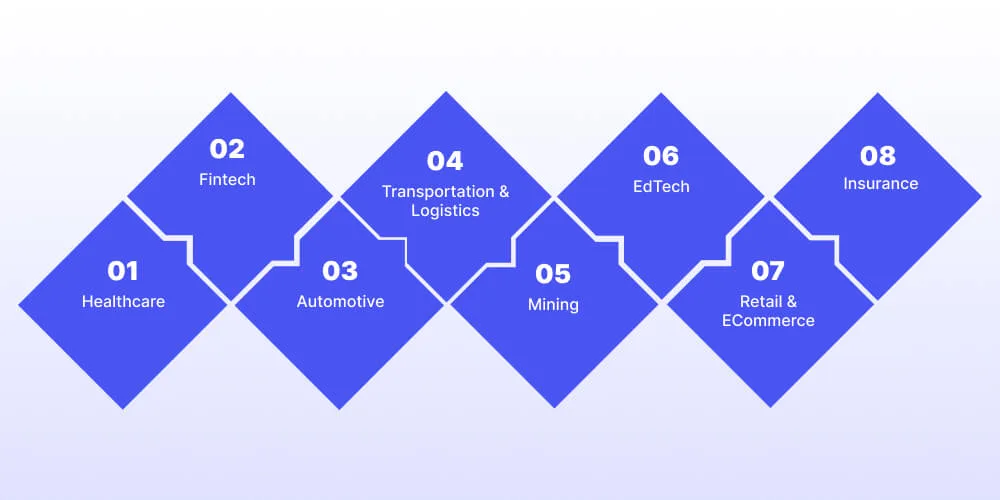
AI Agent development is rapidly becoming a competitive accelerator, empowering industries to operate with unmatched speed, precision, and cost efficiency. From real-time decision automation to round-the-clock process execution, AI agents are reshaping how modern enterprises scale. Sectors leading this transformation include healthcare, finance, insurance, logistics, mining, manufacturing, retail, HR, IT support, SaaS, and automotive, where high-volume operations and data-driven decisions are mission-critical.
By replacing repetitive manual tasks with intelligent, autonomous workflows, AI agents help with faster service delivery, improved accuracy, and dramatically reduced operational overhead, enabling businesses to grow without expanding headcount.
How To Build an AI Agent From Scratch
When executed with a consulting-led approach, it removes repetitive workloads, helps with faster decision-making, and delivers measurable ROI without increasing workforce dependency. Ditstek Innovations covers every phase of this lifecycle, ensuring AI agents deliver reliable business outcomes, operational scalability, and future-proof digital efficiency.
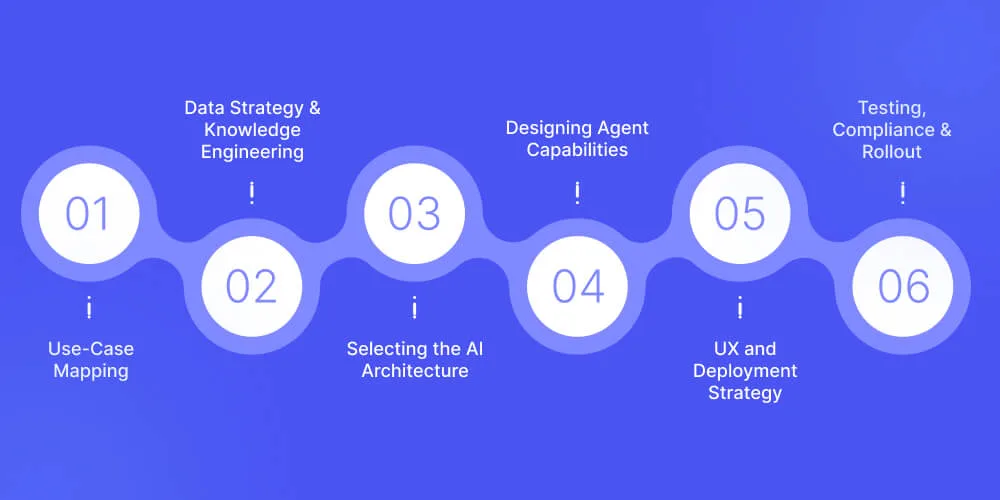
Use-Case Mapping
It helps to identify where automation delivers the highest ROI. Workflows, pain points, and user behaviors are analyzed, and KPIs like cost savings and turnaround time improvements are defined. The output is a prioritized use-case roadmap and success framework that keeps development aligned with measurable business impact.
Data Strategy & Knowledge Engineering
All structured and unstructured data sources are evaluated for quality, security, and compliance. Information is converted into machine-usable formats through indexing, embeddings, and vector databases. A strong data strategy ensures fast, accurate query responses and enables safe access controls for private and regulated information.
Selecting the AI Architecture
The right model stack is chosen based on budget, hosting needs, and performance requirements, whether GPT, Claude, Gemini, LLaMA, or private LLMs. Teams decide between a single or multi-agent system and define autonomy levels. This ensures scalability, predictable cost, and a governance model aligned with business risk.
Designing Agent Capabilities
Memory, reasoning, and tool-calling capabilities are configured so the agent can perform tasks, not just generate responses. Integrations with CRMs, ERPs, EMRs, SaaS tools, and APIs enable real execution. Feedback loops allow continuous improvement and conversion of manual workflows into consistent, machine-driven operations.
UX and Deployment Strategy
The deployment phase determines how the AI agent meets users: dashboards, Slack, Teams, CRM plugins, or portals. Clear onboarding, permissions, and transparency build trust and increase adoption. With feedback built into the interface, the agent launches in a business environment where usability and governance are already established.
Testing, Compliance & Rollout
The system is validated for accuracy, security, and regulatory fit. Stress testing and hallucination control ensure safe behavior under real-world load. Deployment follows a staged model, pilot, optimize, scale, supported by continuous monitoring. This guarantees a reliable, resilient AI agent ready for enterprise-grade operations.
AI agent development costs rise with capability and automation scope, from $25K–$55K for task-focused agents to $60K–$150K for multi-department automation, and $200K+ for enterprise-wide autonomous systems, delivering exponential ROI and reducing workforce dependency.
Full automation across departments; 24/7 task execution
Reduced hiring requirements + improved compliance
Enterprise Multi-Agent System
$200K+
Autonomous operations across business units
Competitive advantage + strategic scalability
The higher the complexity and automation scope, the greater the economic advantage. Investments multiply efficiency while substantially reducing overhead costs and dependency on workforce scaling.
How Long Does It Take to Build AI Agent from Scratch?
Building an AI agent from scratch typically takes 8–16 weeks, depending on complexity, data readiness, integrations, and security requirements. The timeline covers use-case mapping, data engineering, model selection, capability design, deployment, and compliance testing. With the right AI development partner, businesses accelerate automation, reduce manual effort, and start seeing measurable ROI quickly, without disrupting daily operations.
Industries Using AI Agents( Use Cases & Benefits)
AI agents are transforming how modern industries operate by eliminating repetitive manual work, enabling real-time decisions, and driving autonomous business processes. Below is how leading sectors are leveraging AI agents for efficiency, cost savings, and better customer experiences.
AI agents assist clinicians and healthcare staff with appointment automation, medical record retrieval, claims documentation, and patient query resolution. Faster administrative cycle, reduced burnout, improved care coordination, and higher patient satisfaction, without increasing operational load.
Automakers and dealerships use AI agents for supply chain coordination, predictive maintenance alerts, customer service, and smart vehicle diagnostics. Reduced downtime, optimized production, higher sales conversions, and intelligent after-sales support.
Insurance companies integrate AI agents for claims triage, underwriting document review, fraud analysis, and customer assistance. Faster claim settlements, improved compliance, reduced risk, and higher policyholder satisfaction.
Real Life Risks & Challenges of Building AI Agent
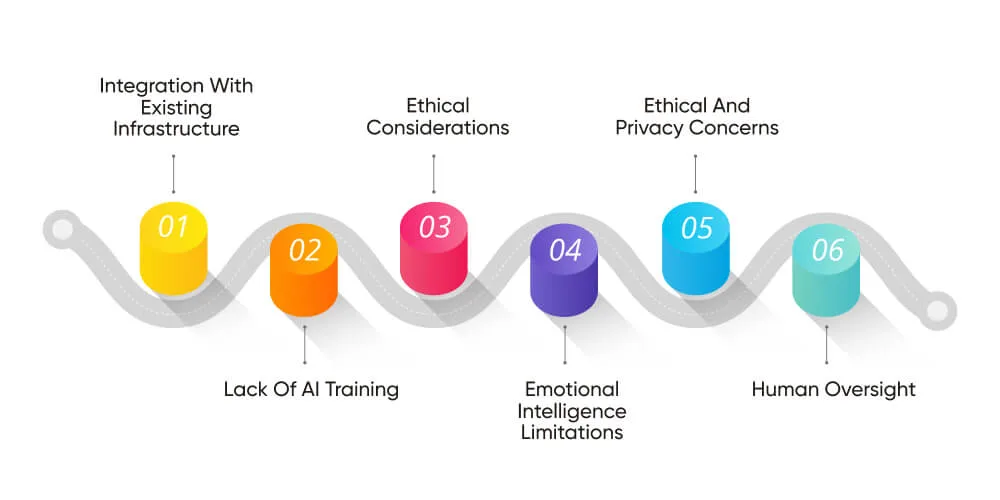
Building AI agent comes with strategic, technical, and ethical complexities. From infrastructure integration to human oversight and regulatory compliance, organizations must deploy strong governance and risk mitigation frameworks to ensure reliability, scalability, and safe automation.
1. Integration with Existing Infrastructure
AI agents can fail to operate efficiently when ERP, CRM, EMR, SaaS platforms, and legacy systems aren’t compatible. Use standardized APIs, middleware, and secure system orchestration to ensure smooth cross-platform automation.
2. Lack of AI Training
Employees often underutilize AI agents due to limited understanding of capabilities, workflows, and prompts. Invest in structured training, prompt engineering workshops, and adoption playbooks for frictionless onboarding.
3. Ethical Considerations
Without defined usage boundaries, AI outputs may lead to discrimination, bias, or unintended influence on business decisions. Implement responsible AI policies, model transparency, and fairness audits to ensure ethical outcomes.
4. Emotional Intelligence Limitations
AI agents struggle to interpret human emotions in customer-facing communication, potentially harming user experience and retention. Integrate sentiment analysis, tone-adjustment models, and human escalation workflows to preserve empathy.
5. Ethical and Privacy Concerns
AI handling confidential user data without guardrails risks data leaks, regulatory penalties, and reputational loss. Enforce encryption, anonymization, consent-driven access, and compliance adherence such as GDPR, HIPAA, and SOC2.
6. Human Oversight
Fully autonomous AI systems without supervision may make critical decisions beyond business tolerance levels. Define human-in-the-loop governance for approvals, risk scoring, and monitored autonomy to maintain control and trust.
Tackle Challenges With Experts: Build Smarter, Safer AI Agents Today!
DITS is the perfect AI agent development partner to overcome technical, ethical, and operational challenges, ensuring secure, scalable, high-ROI automation tailored to your business.
Tracking the right KPIs ensures that AI agents are delivering measurable business value, not just technical output. Organizations should evaluate performance across efficiency, financial impact, and workforce enablement to validate ROI and scale responsibly.
User adoption rate — Measures how consistently employees or customers rely on the agent. High adoption shows trust, usability, and reduced friction in daily workflows.
Accuracy & task completion score — Evaluates the correctness and reliability of decisions, responses, and automated actions across operational processes.
Time/cost reduction — Tracks hours saved, FTE reduction, and cost impact compared to manual execution, showcasing direct efficiency gains.
Employee productivity improvements — Assesses how AI agents free teams from repetitive tasks to focus on high-value strategic work.
Revenue or retention impact — Measures conversion improvements, upsell/cross-sell enablement, support SLA improvement, and reduces customer churn.
Future of AI Agents What Businesses Must Prepare For
AI agents are not just a digital trend; they are shaping the future of automated, intelligent enterprises. Businesses that invest early will outperform competitors through speed, precision, and workforce scalability.
Multi-agent Collaboration
Instead of a single AI agent, multiple specialized agents will work together across operations, finance, HR, sales, logistics, and IT for faster autonomous execution.
AI-first Automated Enterprises
Organizations will shift from “AI assisting teams” to “teams supervising AI,” driving cost-efficient growth without linear workforce expansion.
Workforce Augmentation
AI will empower teams rather than replace them, eliminating repetitive tasks while improving job satisfaction, speed, and decision quality.
Why DITS Should Be AI Agent Development Partner
Building an AI agent is not just a development exercise; it requires deep expertise in LLM engineering, workflow automation, enterprise integrations, security, and responsible AI governance. This is where Ditstek Innovations (DITS) stands out as a strategic partner rather than just a company.
DITS brings end-to-end AI agent development capabilities, from use-case discovery, MVP development, and data engineering to architecture design, deployment, and continuous optimization. Hire dedicated software development company for AI/ML engineers, data scientists, DevOps experts, and compliance specialists to deliver Agentic AI.
What makes DITS the right partner:
Proven expertise in enterprise automation, LLM fine-tuning, multi-agent systems, advanced reasoning, and tool-calling.
Strong focus on security, compliance (SOC2, GDPR, HIPAA), and responsible AI practices.
Deep integration capabilities across CRM, ERP, EMR, SaaS platforms, internal APIs, legacy applications, and IoT ecosystems.
Experience building AI agents that support finance, healthcare, insurance, manufacturing, logistics, SaaS, retail, HR, and automotive.
Transparent pricing, predictable delivery timelines, and tangible ROI tracking after deployment.
DITS doesn’t build experimental AI; we build production-ready AI agents that scale business operations without scaling headcount. Whether you need a workflow execution agent, a reasoning agent, a customer-facing service agent, or a multi-agent enterprise system, we ensure reliability, security, and business value from day one.
Curious How AI Agents Scale Your Operations?
Discover practical use cases, cost structures, and automation opportunities tailored to your business ecosystem and growth priorities.
An AI agent is an autonomous system capable of reasoning, decision-making, and executing tasks across business workflows. Unlike simple chatbots, AI agents perform multi-step operations, integrate with CRMs, ERPs, SaaS platforms, and can operate with minimal human supervision.
Dinesh Thakur
25+ years of IT software development experience in different domains like Business Automation, Healthcare, Retail, Workflow automation, Transportation and logistics, Compliance, Risk Mitigation, POS, etc. Hands-on experience in dealing with overseas clients and providing them with an apt solution to their business needs.