Hospital Queue Management System With EHR Integration
Table Of Content
Published Date :
11 Jul 2026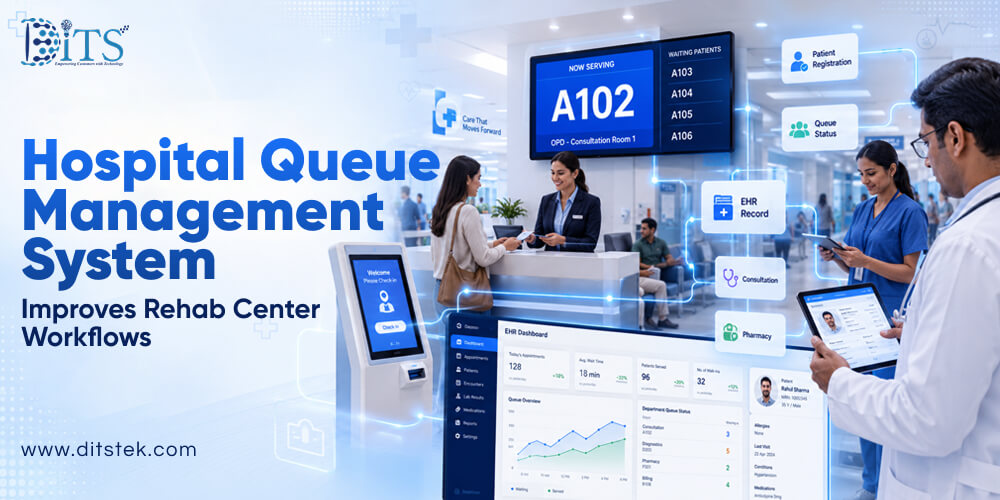
Key Takeaways
- Queue management system in hospital environments are no longer just a symbolic solution. It has an important role in the process of optimization of patient flows, staff productivity, doctor utilization, patient satisfaction, and overall hospital performance.
- Traditional queues in hospital environments cause delays due to manual token operations, disconnected appointment systems, repetitive data entry, and busy front-desk teams.
- EHR integrated queue management system in hospital offers benefits like smooth patient check-ins, appointments, visit history, prescriptions, lab orders, and follow-up information to queue dynamics.
- Real-time monitoring of hospital queues benefits both patients and healthcare teams. While patients receive updates about their situation, hospital teams can monitor queues, control overcrowding, deal with delays, and coordinate departments.
- Prime features of queue management system include digital check-in for patients, token management, integration with EHR/EMR systems, multidepartment queuing process, patient notifications, staff dashboard, analysis, and reporting.
- Before embarking on patient queue management software, hospitals should consider their workflow complexity, compatibility with EHR system, departmental queuing rules, protection of patient information, and ability to accommodate increasing patient traffic.
Queuing has now become much more than just a nuisance for patients. It has a huge impact on staff productivity, doctors' working time, patients' satisfaction with the services provided, as well as hospitals' revenue and overall efficiency. This is why queue management systems in hospitals are essential for ensuring better management of hospital processes and functions.
Currently, many hospitals use token systems, disconnected appointment calendars, and EHR systems. However, if the hospital's queue system is integrated with EHR technology, all hospital operations related to patient records and appointment scheduling can run smoothly through careful management of all hospital facilities involved in patient management.
Market Stats Related to Hospital Queue Management System with EHR
- The hospital EHR market size is projected to reach $26.1B in 2033, from $18.4B in 2026 along with a CAGR growth of 4.51% (2025 to 2033)
- The queue management system market size is estimated to be around USD 77.13 billion by 2031 with a CAGR growth of 12.05%
- The largest market share is held by North America followed by Europe and Asia Pacific.
Looking at these massive numbers, the need for patient queue management software with EHR holds strong ground. If you’re looking to invest in this opportunity and need a reliable partner, Ditstek is here to help.
The Real Problem: Why Traditional Hospital Queues Slow Down Operations
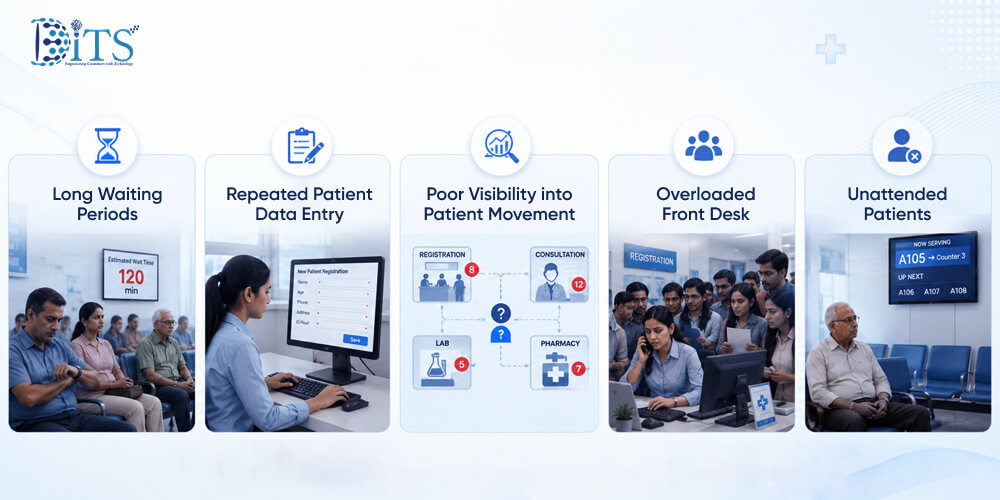
Traditionally, hospital queues are seen as an administrative problem, but they are more likely a reflection of operational gaps that require fixing. Since patient flow relies on manual tokens, siloed systems, and department-based coordination, minor lags can impact the whole patient's journey. Patients end up waiting longer, employees are kept busy by repetitive information updates, and administrators have difficulty understanding where the real problem lies.
Let's have a look at the actual pain points as under;
Long Waiting Periods
When a patient has to wait in long lines to register, wait outside the pharmacy or testing laboratories, or even for follow-ups, it is frustrating. This will cause more problems, delay vital treatment and also cause more stress for the patient and his/her family.
Repeated Patient Data Entry
Without an electronic health record system in place, there are many instances in which front desk and departmental staff must validate or enter patient information multiple times. This can lead to errors and duplicate entries.
Poor Visibility into Patient Movement
There is no visibility in the patient's current location, which department is struggling with too many patients, and which doctor is facing problems in his patient queue.
Overloaded Front Desk
Too much time is spent on answering patient queries, managing cues, checking doctors' availability, and interacting with others. This has a negative impact on productivity and diverts focus towards more productive activities.
Unattended Patients
Patients miss their appointments because of long waiting periods, which leads to delays in diagnostics, pharmacy dropouts, and incomplete bills. Patient satisfaction, service completion, and hospital revenue flow are drastically affected.
Struggling With Long Patient Waiting Times Today?
Improve hospital flow, reduce front-desk pressure, and give patients clearer updates through an integrated queue management system.
How Queue Management Systems Becomes More Effective with EHR
A hospital queue management system with EHR integration not only manages patient check-in, token distribution, appointments, and departmental queues but also integrates these activities with patients' electronic health records. It assists hospitals in monitoring patients' movements in real time and provides access to visit history, prescriptions, lab orders, and follow-ups from the patient’s EHR.
Quick Patient Identification
- Patient identification based on EHR data
- No need for manual searches and re-entry
- Quickens registration process
- Prevents delay during early stage of care
Smart Appointment and Visit Management
- Manages appointments, walk-ins, and follow-ups
- Updates cancellations and reschedules
- Coordinates queues according to doctor's availability
- Optimizes consultation process
Clinical Readiness
- Shows who is waiting and why
- Provides doctors with patient context quickly
- Facilitates better prepared consultations
- Saves clinical time
Efficient Handovers Within Departments
- Integrates OPD, lab, radiology, billing, and pharmacy departments
- Minimizes human effort
- Communicates necessary patient information during visits
- Facilitates patient flow
Administrative Error Reduction
- Eliminates duplicates
- Prevents wrong patient information
- Prevents missed updates
- Enhances data accuracy
Improving Patient Flow and Operational Efficiency with EHR-Integrated Queue Management
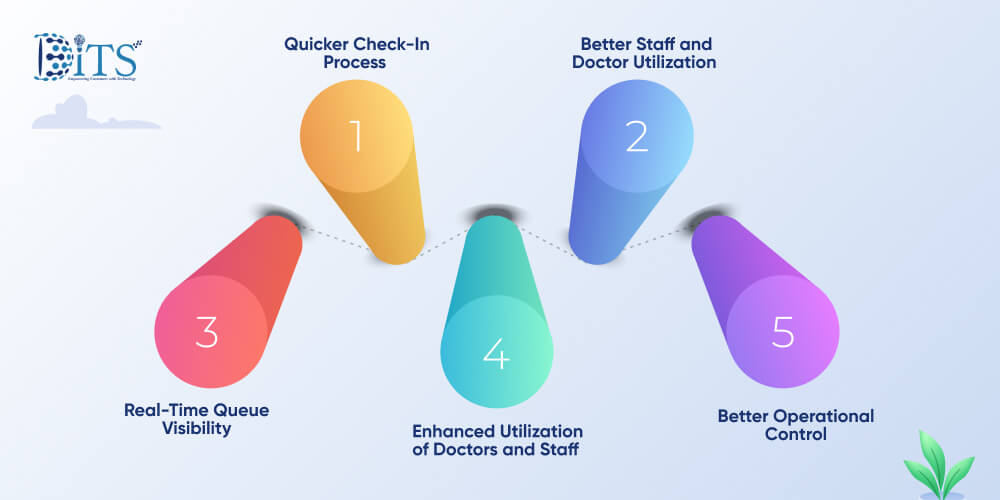
An electronic health record-linked hospital queue management solution associates patient progress to hospital procedures. It provides ease of patient movement throughout the process from registration to consultation, diagnosis, payment, dispensing medication, and subsequent appointments while enabling hospitals to minimize manual interventions, utilize resources more prudently, and boost efficacy.
Quicker Check-In Process
Patients can register at kiosks, through QR codes, mobile applications or through web or face-to-face systems. Owing to EHR integration, the patient information is available automatically, resulting in less time taken for registration and a lighter burden for hospital staff.
Better Staff and Doctor Utilization
The system can provide directions to patients seeking their doctor, laboratory, X-ray unit, billing office, or pharmacy, depending on the type of appointment, the urgency of the case, and the care being provided. This will result in better patient movement and reduced confusion across the hospital's departments as they continue to carry out their responsibilities.
Real-Time Queue Visibility
Patients get real-time information about queue movement through screens, SMS messages, mobile applications or the like. Simultaneously, the hospital staff will monitor the queue status and reduce congestion, repeated messages, and delays.
Enhanced Utilization of Doctors and Staff
The application of automation is beneficial, as it reduces the need for labor-intensive token invoicing and interdepartmental coordination regarding patient statuses. This makes it easier for doctors to analyze the reasons for patients’ wait times and process them more quickly.
Better Operational Control
The integration of live dashboards gives administrators a clear view of waiting times and patient numbers in the hospital. This also enables them to identify areas that hinder operations and quickly transfer staff to use them more effectively.
Key Features to Consider When Choosing EHR-Integrated Patient Queue Management System
Businesses looking for an adequate queue management system in hospitals should keep more than just a token generation in mind. The solution should generally facilitate the check-in process, coincide with EHR/EMR systems, manage queues within the departments, and deliver real-time information about patient movement.
Digital Patient Check-In
- The system includes registration for both scheduled and walk-in patients.
- The check-in approach involves front-desk registration, use of QR codes, mobile applications, and kiosks.
- Reduces registration delays and front-desk workload
Smart Token Management
- Tokens are provided based on the physician’s availability and the department's situation.
- The system determines the order of patients by considering criteria such as urgency, the number of elderly patients, etc.
- Helps maintain a more organized patient flow
EHR/EMR Integration
- Queue management is linked to patients’ visit records.
- Appt details, clinical data, and lab orders related to the visit are synchronized.
- Reduces duplicate data entry and improves coordination
Multi-Department Queue Management
- The system can deal with queue management within OPD, diagnostic, pharmacy, medical billing, and insurance departments simultaneously.
- Queue management allows patients to move quickly through different departments.
Patient Notifications
- Provides notifications for appointment reminders, token status, delays, and consultation calls.
- Allows using SMS, emails, WhatsApp, or other applications.
- Minimizes overcrowding and repeated patient queries.
Staff and Admin Dashboards
- Displays active queues, wait times, patient load, and department performance.
- Enables staff to manage patient flow more efficiently.
- Gives administrators greater control over bottlenecks.
Analytics and Reporting
- Measures average wait time, peak hours, number of no-shows, and incidence of patient drop-offs.
- Helps monitor staff workload and service delays.
- Assists in planning, resource allocation, and operational decisions.
What Hospitals Need to Consider Before Implementing a Queue Management System
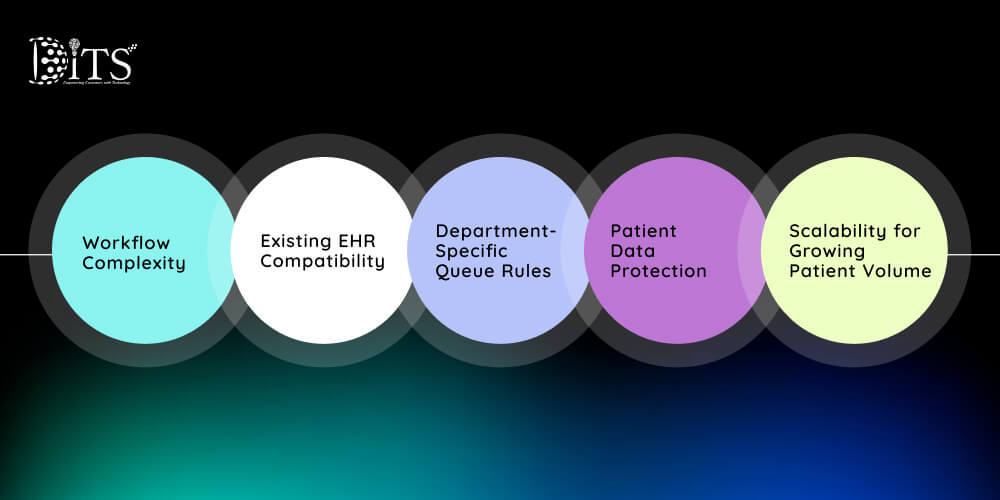
Hospitals need to take a broad view while installing a queue management system, focusing on integrating the method into their existing systems rather than just token allocation. For queue management system in hospital, go through the following considerations discussed as under;
Workflow Complexity
Hospitals need to analyze how ease of movement is achieved across the registration, consultation, diagnosis, billing, medication, and follow-up stages. This will be very effective in identifying delays, imperfections, and departments that lack adequate visibility into the queue.
Existing EHR Compatibility
Hospitals also need to ensure that the current EHR system can use APIs, HL7, FHIR, or other methods for the secure exchange of data with this new technology.
Department-Specific Queue Rules
The organization faces a challenge in which each department demands different queue rules. It is particularly important for cases such as emergency visits, visits by senior patients, follow-ups, walk-ins, and cases that depend on the point of priority based on a doctor’s recommendations.
Patient Data Protection
It is vital to implement a system that does not leave sensitive patient data exposed, and that is used only by people with specific rights to prevent leaks or software malfunctions.
Scalability for Growing Patient Volume
A queue management system must be scalable to handle increases in visitor flow. It helps reduce patient overcrowding and eliminate repeated questions.
Why Custom Development Works Better for Complex Hospital Workflows
The ready made software solutions may be sufficient for implementing token generation in simpler cases, but in reality, patient workflow in hospitals is much more complex. Patients can go from registration to OPD, diagnostics, billing, pharmacy, the insurance desk, and then on to follow-up, with each department having its own procedures and needs.
Custom software development allows hospitals to create a queue management system tailored to their actual workflow. It is further integrated with EHR, scheduling systems, laboratory software, pharmacy systems, billing systems, and administration dashboards. Priority rules for emergencies, older people, walk-ins, follow-up appointments, and department-specific flows can also be set.
Hospitals that work with a large number of patients and have several departments or locations should opt for custom development.
Need Custom Software For Complex Hospital Workflows?
Build a scalable queue management platform tailored to your departments, EHR environment, patient priorities, and operational requirements.
How Ditstek Can Assist in Creating a Hospital Queue Management System with EHR Integration?
As a healthcare software development company, Ditstek assists businesses in creating custom queue management systems that streamline patient flows, optimize waiting times, and improve operational processes. Our specialists can develop solutions that incorporate features such as digital check-in, an intelligent token system, EHR/EMR integration, multi-department routing, patient notifications, a dashboard, and analytics.
If you wish to create a queue management system for hospital or integrate EHR systems into the current operation process, Ditstek will assist you in designing and developing relevant software.
FAQs
In what ways will a queue management system in hospital improve patient flow?
A patient queue management system will improve patient flow through automated check-in and adding tokens, routing patients to the appropriate departments while sending real-time queue updates to the hospital.
Why should there be an EHR integration in the queue management systems in hospitals?
Integration of queue management systems with EHRs will link queue activities to patient history information, including records, appointments, visits, and clinical information.
What should be included in an EHR integrated patient queue management system?
The system should include digital check-in, intelligent token management, EHR/EMR integration, multi-departmental queue management, appointment synchronization, notifications for patients, a dashboard for staff, analysis, and role-based access security.
How much will it cost to develop a hospital queue management system with EHR integration?
The development cost for a hospital queue management system is $25,000- $150,000+ with EHR integration, depending on how complex patient flows and workflows are, the number of departments, which EHR or EMR integration features are required, security requirements, and reporting needs.
Is an EHR-compatible queue management solution worth it?
Yes, particularly for hospitals with high patient volumes, multiple departments, or disjointed processes. The benefits include reducing wait times, increasing healthcare professionals' efficiency, ensuring efficient use of doctors, and gaining greater visibility into patient flow and process bottlenecks.

Nidhi Thakur
With more than 19 years of experience - I represent a team of professionals that specializes in the healthcare and business and workflow automation domains. The team consists of experienced full-stack developers supported by senior system analysts who have developed multiple bespoke applications for Healthcare, Business Automation, Retail, IOT, Ed-tech domains for startups and Enterprise Level clients.
Recent Posts
Explore how intelligent document processing for insurance helps businesses automate document workflows, reduce processing costs, improve accuracy, and strengthen operational efficiency across insurance functions.
Discover how automated medical claims processing reduces delays, manual rework, claim denials, and administrative costs while improving reimbursement speed and operational efficiency.
Learn how to build medical billing software with essential features, integrations, security, and development costs.