Benefits of Using AI in Education
Table Of Content
Published Date :
21 May 2026
Educational institutions from schools to universities and edtech organizations are experiencing that generative artificial intelligence has evolved to help them achieve better educational results while controlling their operational expenses and workload issues.
AI-powered systems enable educational institutions to deliver personalized learning experiences which include real-time assessment, task automation and student identification systems which enable educators to assist students in need of assistance.
Educational institutions and organizations are adopting AI in education at a very fast pace. According to research, the global AI in education market that was valued at $7.05 billion in 2025 is expected to reach $136.79 billion by 2035.that was valued at $7.05 billion in 2025 is expected to reach $136.79 billion by 2035.
This massive projected value explains why education businesses that move quickly to adopt and build custom GenAI solutions are gaining a significant competitive advantage.
In this guide, we explore the most impactful benefits of AI in education and provide practical insights on how education organizations can strategically build and deploy their own generative AI solutions tailored specifically for schools and learning environments.
What Is Generative AI In Education?
Generative AI helps schools create smarter and more adaptive learning experiences. AI-powered software can create content while providing answers and customizing educational materials and handling routine academic duties throughout the day.
Today, examples of AI in education include AI tutor for students, automated grading systems, smart quiz generators, and personalized learning assistants. Schools are implementing AI tools to assist teachers with their administrative duties while enhancing their teaching effectiveness.
AI technology helps educators by saving them time and delivering support for making better decisions. The demand for AI-powered educational software has led many institutions to work with an education software development company to create scalable AI learning platforms.
Why Educational Organizations Need AI-Powered Learning Solutions
Educational Organizations are facing double challenges because they must meet increased demands while dealing with resource shortages. Teachers handle larger student groups because students want individualized help while administrators want to raise student achievement at lower expenses.
The existing systems have reached their operational limits because traditional methods can no longer meet current requirements. Educational institutions use artificial intelligence to automate their standard operations which enables them to monitor student progress with greater speed while providing customized learning experiences.
Today, schools which implement artificial intelligence technologies can detect academic difficulties in students two weeks before their actual identification while decreasing grading duration by almost 40 percent and increasing student participation through personalized learning systems. The results show a transformation. The process occurs with silent power, yet it achieves major results.
Educational institutions need software which can accommodate rising student numbers while enabling remote education and providing immediate educational information. Most organizations choose to fund educational technology development projects which create adaptive educational environments instead of developing fixed educational software solutions.
Key Benefits of AI In Education
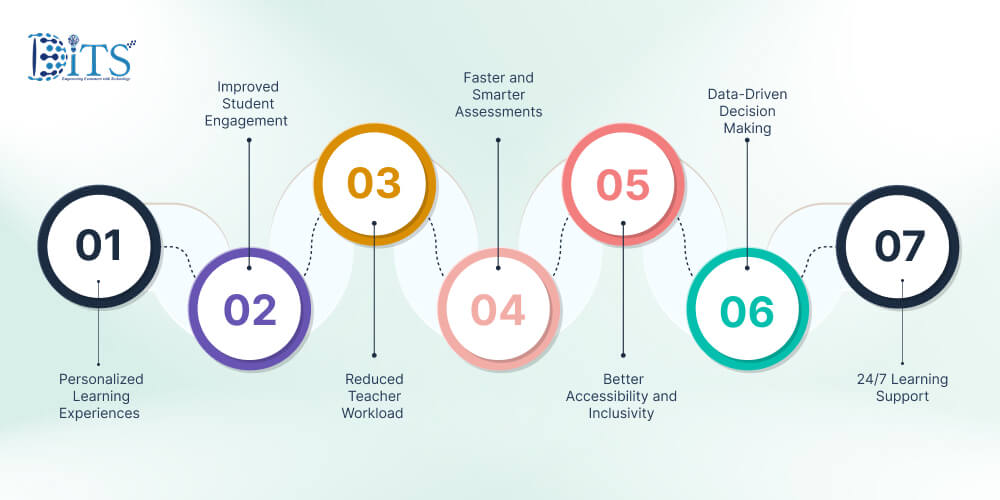
No business adopts a technology without analysing its benefits and education sector is no exception. So, let us explore the key benefits of adopting AI in education with a business perspective.
Personalized Learning Experiences
The main benefit of AI technology in educational settings delivers personalized learning experiences for students. AI system uses student performance data to create customized lesson plans which match each student's learning style and academic strengths.
Schools experience a major long-term effect from this development. The study demonstrated that student engagement increases while retention rates rise and academic performance remains stable across various student groups.
Improved Student Engagement
Student attention problems have reached their most difficult point in modern times. Digital educational systems experience decreased student participation because of their combination of unchanging teaching practices and their use of identical instructional methods.
AI-powered learning platforms solve part of that problem by making lessons more interactive and responsive. Students remain engaged throughout their educational journey because of intelligent feedback systems, virtual learning assistants and adaptive quizzes.
Schools that use AI-driven engagement tools have documented substantial increases in their course completion rates throughout an entire academic year. Students who show even slight improvements in their engagement will experience bigger academic progress in future.
Reduced Teacher Workload
Teachers spend a surprising amount of time on repetitive administrative work instead of actual teaching. Grading assignments and preparing quizzes and tracking attendance and managing reports can easily consume several hours every week.
AI helps automate many of these tasks. Assessment results now receive immediate evaluation while lesson planning requires less time to complete, and student assessment reports have become simpler to handle.
That doesn’t replace educators. It gives them breathing room. Most teachers require that space more than they need one more software dashboard.
Faster and Smarter Assessments
Assessment practice through traditional methods takes considerable time because it depends on student performance during actual testing periods. The process of detecting performance problems takes too long.
AI systems deliver immediate academic performance information which enables schools to discover learning deficiencies at an earlier stage. Students can correct their errors through automated feedback systems which provide instant results instead of making them wait multiple days for assessment results.
This is one of the less discussed but very practical benefits of AI in education. Students experience higher learning progress when educators provide them with quick academic results because their self-assurance rises.
Better Accessibility and Inclusivity
Modern classrooms consist of students who have various learning requirements and different language preferences and special accessibility requirements. AI technology allows educational institutions to build inclusive learning spaces because it requires no additional systems to accommodate different student groups.
Educational institutions use speech-to-text technology together with language translation tools and customized learning resources to create a learning environment that benefits all students. Students who formerly struggled to participate now show better engagement because their learning obstacles have been removed.
Data-Driven Decision Making
Schools generate vast amounts of academic data, yet most of it remains unutilized. AI helps institutions transform their data into operational insights.
Administrators use the system to track attendance patterns while they detect academic performance trends, and they estimate future academic risks before they develop into major issues. The system enables leadership teams to execute their decision-making process for curriculum development, staff recruitment and student assistance programs.
24/7 Learning Support
Students continue their learning process during the time after school ends. Students present their questions at nighttime and during their exam preparation and while they work on their assignments.
AI-powered tutors and virtual assistants provide students with academic assistance throughout the day which enables them to access study materials and explanations whenever they want. This type of availability enhances learning consistency for students who use remote and hybrid education systems.
The need for continuous learning assistance has become a vital competitive asset for educational institutions that want to test artificial intelligence solutions for their enterprise-level educational systems.
Use Cases of AI in Schools
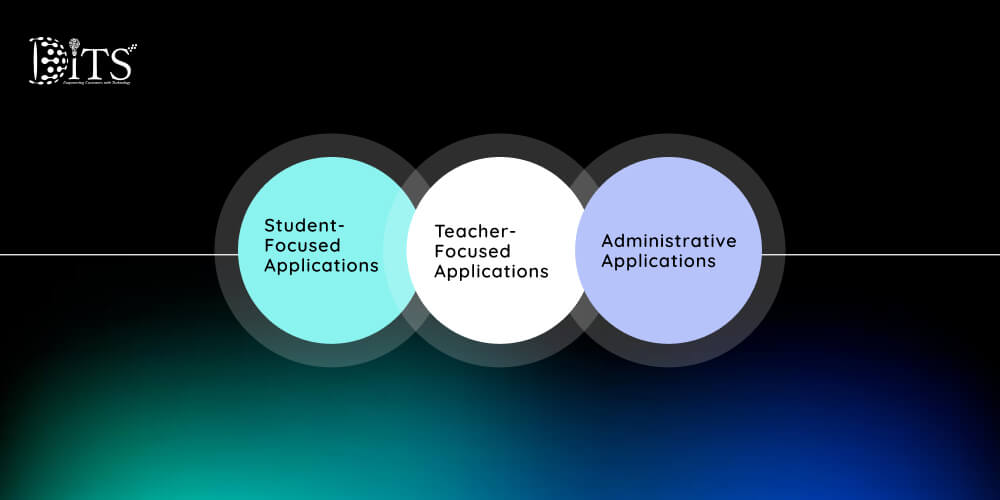
Student-Focused Applications
Students today expect faster support and more flexible learning experiences. AI is helping schools meet those expectations without increasing pressure on academic staff.
Common student-focused applications include:
- Personalized tutoring based on learning pace
- AI study companions for homework support
- Intelligent exam preparation systems
- Real-time doubt resolution through virtual assistants
- Learning recommendations based on performance history
A good example is language learning platforms that adjust lesson difficulty automatically after analyzing quiz scores and participation behavior.
Teacher-Focused Applications
Teachers are using AI to reduce repetitive work and improve classroom efficiency. Instead of spending evenings preparing worksheets or grading assessments, educators can focus more on student interaction and academic planning.
Popular AI tools for teachers include:
- Automated grading systems
- AI-generated quizzes and lesson plans
- Classroom performance analytics
- Attendance and assignment tracking
- Smart content creation tools
Many institutions implementing AI in the classroom report improved teacher productivity within the first few months of adoption.
Administrative Applications
School operations involve far more than academics. Admissions, communication management, scheduling, and performance reporting consume substantial administrative time.
AI helps streamline these processes through:
| Administrative Area | AI-Powered Application |
| Enrolment Management | Automated application screening |
| Student Analytics | Performance tracking and forecasting |
| Communication | AI chatbots for parent and student queries |
| Scheduling | Intelligent timetable management |
| Reporting | Automated academic and operational reports |
As schools scale digitally, demand for reliable AI software development services is also increasing. Institutions now want connected systems capable of supporting academic, operational, and administrative functions from a single platform.
Future of AI In Education
The upcoming development of educational AI systems will create intelligent learning ecosystems that schools will implement instead of using automated learning systems. Schools are implementing systems which will automatically adjust to student behavior and academic results and their current levels of participation throughout the school day.
The existing virtual classrooms which use artificial intelligence enable remote students to learn through interactive learning methods that provide immediate assessment results and self-paced support and tailored educational materials. The next few years will see hyper-personalized learning environments become standard educational tools instead of exclusive advanced features.
Predictive education systems represent a major transformation in the educational field. Schools will increasingly use AI to identify learning risks early, forecast student outcomes, and improve retention strategies before academic issues escalate.
The process still includes educators who will participate in it, which makes this detail fascinating. The future will bring increased teamwork between people as it develops. AI handles repetitive and data-heavy tasks, while teachers focus on mentoring, critical thinking, and student development.
The discussion about AI adoption now reaches a new stage for institutions which have established their long-term digital transformation paths. The primary obstacle requires educational organizations to construct systems which can adapt to their evolving needs.
Why Partner with DITS for AI Based Education Software
Building AI-powered education platforms is not only about adding automation features. Schools need systems that are secure, scalable, easy to manage, and capable of adapting to changing academic requirements over time. That’s where implementation experience becomes critical.
At DITS, we build AI-powered education platforms designed around real operational challenges faced by schools, training institutes, and educational organizations. Our team integrates AI into software architecture from the beginning, allowing institutions to improve learning delivery, automate workflows, and manage academic operations more efficiently.
Our expertise includes:
- Custom AI-powered learning platforms
- Student performance analytics systems
- Smart assessment and grading solutions
- AI-driven administrative automation
- Personalized learning applications
- Scalable edtech platform development
We also use AI internally for software development, quality assurance, code optimization, and customization processes. This helps us deliver faster, maintain higher code quality, and build more reliable education systems for clients.
For institutions looking to upgrade their legacy modernization systems into their digital infrastructure, partnering with an experienced team often reduces implementation risks significantly. Because in education, poorly integrated technology doesn’t just slow operations. It affects learning outcomes too.
Conclusion
AI technology is transforming educational institutions through its impact on teaching methods, operational activities and student support services. The practical benefit of personalized learning, automated assessment, and intelligent administrative systems have reached a point where educational institutions must acknowledge their existence.
The shift gained importance through its capacity to establish more effective learning environments which operate without burdening teachers and academic staff with extra duties. AI implementation at schools has shown positive effects on student participation and operational efficiency and academic results.
The educational system needs adaptable data-driven systems which can update their capabilities according to new requirements. Educational institutions will achieve substantial competitive benefits through their initial investment in advanced intelligent learning systems.
The best time to assess contemporary learning environment solutions exists when your organization intends to develop scalable AI educational software for its educational programs.
FAQs
How is AI used in education today?
Schools and educational institutions use AI for personalized learning, automated grading, student performance tracking, virtual tutoring, attendance management, and academic analytics. Many institutions are also using AI to improve operational efficiency and reduce administrative workload.
What are common examples of AI in education?
Some common examples of ai in education include AI tutor for students, adaptive learning platforms, automated assessments, intelligent content generators, virtual classroom assistants, and predictive student analytics systems. These tools help schools deliver more personalized and efficient learning experiences.
Can AI replace teachers in classrooms?
No, AI is designed to support educators rather than replace them. AI handles repetitive and time-consuming tasks like grading, reporting, and content generation, allowing teachers to focus more on student interaction, mentoring, and classroom engagement.
What are benefits of using AI software in schools?
The major benefits include personalized learning, faster assessments, improved student engagement, reduced teacher workload, better accessibility, and data-driven academic decision-making. Schools also gain operational efficiency through automated administrative processes.
Why should schools choose DITS for AI software for education development services?
DITS builds scalable and intelligent AI software for education designed around real academic and operational challenges. Our team develops custom AI-powered learning platforms, smart assessment systems, and student analytics solutions while integrating AI into software development, testing, and quality assurance processes for better long-term performance.
Does DITS provide customized AI software for education platforms?
Yes, DITS offers customized AI software for education development services based on institutional requirements, learning models, and operational goals. We develop AI-enabled education platforms that support personalized learning, automation, academic analytics, and scalable digital learning environments.

Dinesh Thakur
21+ years of IT software development experience in different domains like Business Automation, Healthcare, Retail, Workflow automation, Transportation and logistics, Compliance, Risk Mitigation, POS, etc. Hands-on experience in dealing with overseas clients and providing them with an apt solution to their business needs.
Recent Posts
Explore how intelligent document processing for insurance helps businesses automate document workflows, reduce processing costs, improve accuracy, and strengthen operational efficiency across insurance functions.
Discover how automated medical claims processing reduces delays, manual rework, claim denials, and administrative costs while improving reimbursement speed and operational efficiency.
Learn how to build medical billing software with essential features, integrations, security, and development costs.