Guide to Migrating Data from Legacy Systems for Startups
Table Of Content
Published Date :
05 Feb 2026
Many tech startups move fast in the early days, choosing tools and databases that solve immediate problems rather than long-term issues. It works in the present but may not be suitable in the future. As teams grow, products mature, and customer expectations rise, those early systems start to push back. Even simple changes that took a few days earlier now require weeks of work.
This is where migrating data from legacy systems for startups becomes essential. Founders and technology leaders often realize the issue only after missed deadlines, unreliable insights, or questions from investors.
Data migration, when done right, removes friction from growth. It creates room to scale, experiment, and integrate modern platforms without fear. Ignore it too long, and the cost shows up quietly in lost momentum and poor decisions, especially when legacy constraints start blocking software development initiatives tied to new products or markets.
Why Startups Struggle with Legacy Data
Most startups do not set out to build long-term technical debt. It creeps in quietly through early decisions made under pressure. A quick database choice to meet a launch deadline. A temporary workaround that becomes permanent. Six months later, the system still runs but struggles to perform.
Over time, data spreads across tools that do not talk to each other. Formats change. Documentation disappears as early engineers move on. These issues rarely surface during day-to-day operations, but show up during audits, product expansions, or investor due diligence.
The real damage is subtle but serious. Teams stop trusting reports. Analytics lose credibility. Compliance becomes harder to prove. At that point, fixing the data feels harder than building new features or scaling application development efforts that depend on clean, reliable data foundations. That is why startups need to migrate data from legacy systems to new, updated systems.
Ready to Remove Legacy Data Bottlenecks?
Talk to our experts about migrating your data safely, efficiently, and without disrupting growth. Build a clean foundation that supports faster development, better decisions, and scalable systems.
When Should Startups Migrate Data from Legacy Systems?
Timing is crucial for legacy data migration in startups. Move too early, and it feels like overengineering. Wait too long, and the cost quietly multiplies. In practice, the right moment often arrives sooner than expected.
Early warning signs are usually operational, not technical. Release cycles slow down because integrations continue to fail, and reports from different systems don’t match. Customer-facing teams start compensating manually, which works until it doesn’t. These signals suggest the underlying data structure is no longer supporting growth or modern MVP development cycles.
There is also a business angle that founders sometimes overlook. Fundraising discussions involve deep technology reviews, and investors notice fragile systems quickly. Balancing migration with limited budgets is difficult but delaying it often proves more expensive than acting with a clear, phased plan.
Benefits of Migrating Data from Legacy Systems for Startups
When startups address legacy data at the right time, the impact shows up in daily execution and long-term planning, often faster than expected.
Teams experience immediate gains once data starts flowing across systems. Product decisions become reliable, and leadership gets numbers they can trust. On top of that, engineering teams regain time lost earlier to resolving avoidable issues instead of focusing on high-impact application development.
Key benefits typically include:
- Faster product development cycles, as teams no longer work around fragile data pipelines
- More accurate reporting and near real-time insights that support confident decision-making
- Easier integration with modern tools, platforms, and customer-facing applications
- Lower operational risk and reduced long-term maintenance costs as complexity drops
These improvements compound over time. What starts as a technical cleanup often becomes a competitive advantage that supports scale, partnerships, and enterprise readiness.
Modernize Your Data Without Slowing Down
Discover how a phased, secure legacy data migration can unlock reliable insights, smoother integrations, and long-term scalability for your startup.
Types of Data Migration Approaches for Startups
Choosing the right migration approach is less about trends and more about context. What works for a funded scale-up may be excessive for an early-stage product team. Startups that get this decision right avoid rework later and keep operations steady during transition.
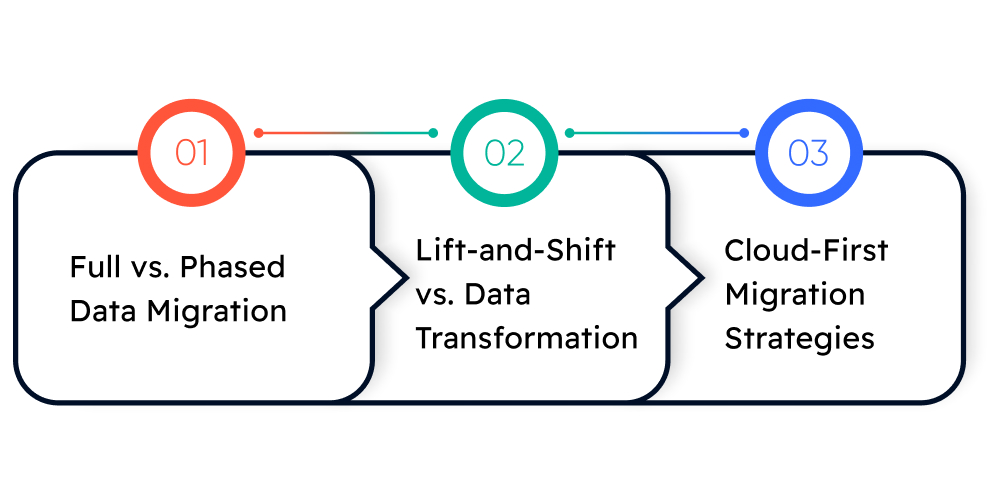
Full vs. Phased Data Migration
A full migration moves all data in one planned window. This suits startups with simpler systems and clear cut timelines. Phased migration spreads the effort over stages, shifting high-impact data first. It reduces risk and keeps critical operations running, which is often a safer choice for growing teams building data-heavy MVP development pipelines.
Lift-and-Shift vs. Data Transformation
Lift-and-shift transfers data with minimal changes. It is faster but often carries legacy issues forward. Data transformation takes more effort, yet cleans inconsistencies, aligns formats, and improves usability. Startups aiming for long-term analytics, automation, or AI agent development typically benefit more from data transformation.
Cloud-First Migration Strategies
Cloud-first approaches support scalability and faster integrations. They also align well with data migration from legacy systems to modern database setups that demand flexibility and performance. For tech startups, this often becomes the foundation for future growth.
Step-by-Step Process of Migrating Data from Legacy Systems for Startups
A structured approach is what separates a controlled migration from a costly disruption. For startups, this process needs to be disciplined. Each step should tie back to a clear business outcome, not just technical completion.
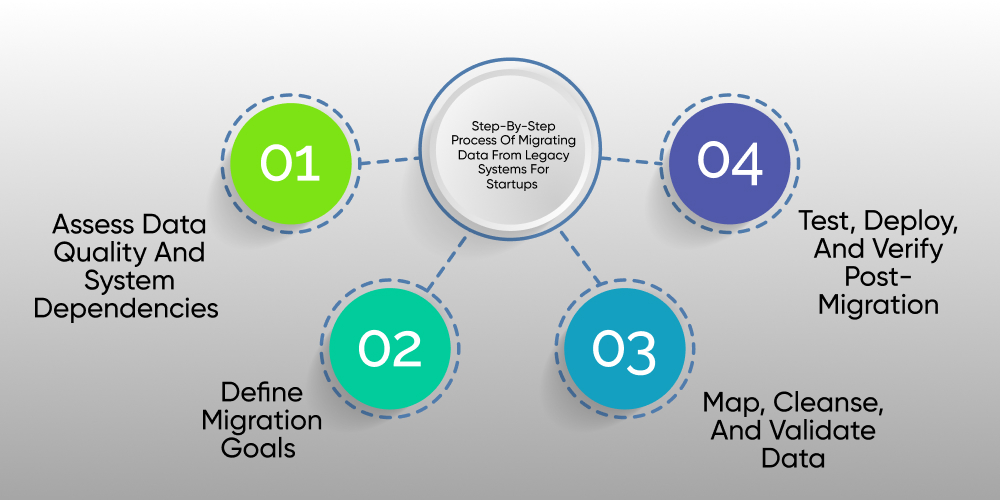
Assess Data Quality and System Dependencies
The process starts with understanding what exists today. Teams review data sources, dependencies, and usage patterns across products and internal tools. This is where hidden issues surface, such as duplicate records or undocumented workflows tied to data migration for legacy systems that later block the momentum of software development.
Define Migration Goals
Clear goals keep the effort focused. Some startups prioritize speed, others accuracy or scalability. Defining outcomes early prevents scope creep and aligns stakeholders around what success looks like.
Map, Cleanse, and Validate Data
Data mapping aligns legacy fields with new structures, while cleansing removes outdated or inconsistent entries. Validation ensures accuracy before anything goes live. This step is critical in migrating data from legacy systems for startups, especially when future analytics, automation, or custom software development initiatives depend on clean inputs.
Test, Deploy, and Verify Post-Migration
Testing reduces surprises. Controlled deployment limits risk. Post-migration verification confirms systems behave as expected. When done right, teams move forward with confidence rather than caution.
It is crucial to get the data migration done by a team with hands-on experience in legacy modernization services; one that understands how migration impacts application development, analytics, and long-term scalability.
Turn Legacy Data into a Growth Advantage!
Prepare your systems for scale, investor reviews, and modern applications with a structured data migration approach built for startups.
Why Choose DITS for Legacy Data Migration
Legacy data migration is rarely just about moving records from one system to another. It is about protecting business continuity while preparing the foundation for what comes next.
At DITS, legacy data migration is approached as a business transformation exercise, not a standalone technical task. Teams begin by understanding how data supports products, customers, and internal workflows, then design migration paths that reduce risk and avoid operational disruption. This approach supports future MVP development, system scalability, and faster innovation cycles.
DITS also integrates AI into software development, quality assurance, code quality management, and customization. This AI-driven execution strengthens custom application development, improves accuracy, identifies inconsistencies early, and shortens delivery cycles, resulting in cleaner data and more resilient platforms.
DITS also integrates AI into software development, quality assurance, code quality management, and customization. This AI-driven approach improves accuracy, identifies inconsistencies early, and shortens delivery cycles. Combined with expertise in AI software development and business workflow automation, this results in cleaner data, more resilient systems, and platforms that scale with confidence.
Conclusion
Legacy data is often treated as a burden, something to tolerate until it becomes impossible to ignore. In reality, it is one of the most underused levers for sustainable growth. When handled strategically, migration unlocks speed, clarity, and confidence across the business.
Startups that approach this work early gain more than technical stability. They make better decisions, move faster with fewer surprises, and build credibility with investors and enterprise customers. The transition requires planning and discipline, but the alternative is far more expensive in the long run.
The real shift happens when leadership stops seeing migration as cleanup work and starts viewing it as a growth investment. That mindset changes outcomes. And it keeps the business ready for what comes next, instead of reacting to what breaks.
FAQs: Migrating Data from Legacy Systems for Startups
How long does legacy data migration typically take for startups?
Timelines depend on data volume, system complexity, and migration approach. For early to mid-stage startups, projects often run between six and twelve weeks. Phased migrations may extend longer, but they reduce risk and keep operations stable. The key factor is preparation. Clean data and clear goals shorten timelines significantly.
How much does it cost to migrate data from legacy systems?
Costs vary based on scope, transformation needs, and risk controls. Smaller migrations may stay within five figures, while complex environments can move higher. What often surprises founders is this. Poor planning costs more than the migration itself. Structured data migration for legacy systems reduces rework and unexpected expenses.
Can startups migrate data without disrupting operations?
Yes, if the migration is planned correctly. Phased rollouts, parallel systems, and validation checkpoints help avoid downtime. Many startups also use migration windows outside peak usage. This approach is especially effective in migrating data from legacy systems for startups that cannot afford service interruptions.
Should early-stage startups invest in migration now or wait?
Waiting feels safer, but it often increases long-term cost and risk. If reporting is unreliable or integrations are slowing teams down, delaying migration compounds the problem. Early action creates flexibility and supports future tools, including customer-facing platforms and AI chatbot development initiatives.
How does DITS ensure data security and compliance during legacy data migration?
DITS follows a security-first approach throughout the migration lifecycle. Data is protected using access controls, encryption standards, and strict role-based permissions during transfer and validation. Compliance requirements are maintained at every stage, ensuring audit readiness and data integrity even while systems are in transition. This disciplined approach reduces regulatory risk and protects sensitive business and customer information.
What makes DITS different from other legacy data migration service providers?
DITS combines deep legacy system expertise with AI-driven execution. By integrating AI into software development, quality assurance, code quality maintenance, and customization, DITS improves accuracy, detects inconsistencies early, and shortens migration timelines. This blend of technical rigor and business-focused delivery allows startups and growing enterprises to modernize their data with confidence, clarity, and measurable outcomes.

Dinesh Thakur
21+ years of IT software development experience in different domains like Business Automation, Healthcare, Retail, Workflow automation, Transportation and logistics, Compliance, Risk Mitigation, POS, etc. Hands-on experience in dealing with overseas clients and providing them with an apt solution to their business needs.
Recent Posts
Automated document processing helps reduce cargo insurance claim delays by streamlining document handling, validation, and claims workflows.
Automated document processing helps reduce cargo insurance claim delays by streamlining document handling, validation, and claims workflows.
Discover how chronic care management software uses algorithmic triage to identify patient risk, prioritize care, and improve care team efficiency.