How to Train an AI Agent
Table Of Content
Published Date :
16 Feb 2026
Key Takeaways
- Training an AI agent is not about feeding random PDFs. It’s about making the agent understand how the business works.
- Most AI agents fail after launch because they perform well in testing but break when real users ask real questions.
- The quality of training data matters more than quantity. Support tickets, SOPs, emails, and real conversations train better than general documents.
- Tone and response rules are important, because even one wrong or robotic reply can reduce customer trust quickly.
- The real value comes when the agent relates to APIs and business tools like CRM, order systems, and internal dashboards.
- Working with a software development company makes the process smoother because integrations, security, testing, and scalability are handled properly.
Many businesses are trying AI agents right now, hoping they will instantly reduce workload and improve efficiency. But in most cases, the results don’t last beyond the first few days. The agent performs well during initial testing, yet starts struggling the moment real business queries, real customer conversations, and real operational workflows come in.
Many businesses start with excitement. They install a chatbot, connect it to a few documents, and expect it to work like a smart digital employee. The agent gives half-correct answers, misses context, fails to understand user intent, and sometimes responds in a way that damages trust.
That is why training an AI agent is not just about “feeding it data.” It is about designing a system that understands the business, communicates clearly, integrates with tools, and delivers reliable results.
This blog explains how to train an AI agent in a practical way, based on real business needs, not theoretical ideas. An AI agent that lacks proper training cannot understand business context, handle specific workflows, or support decision-making. It becomes another tool that looks promising but delivers limited value.
What Does “Training an AI Agent” Actually Mean?
Many people assume training means teaching an AI model from scratch like ChatGPT. That is not what most businesses need.
Training an AI agent usually means:
- Teaching it the brand’s processes and workflows
- Giving it the right knowledge base
- Setting boundaries for how it should respond
- Connecting it with APIs and tools so it can perform tasks
- Testing it repeatedly until responses become consistent
A trained agent is not just answering questions. A trained agent is behaving like a helpful team member who understands the system.
Looking to Automate with AI Agents?
Design intelligent agents that connect with CRM, ERP, and internal tools while maintaining accuracy and brand tone.
Why Most AI Agents Fail After Launch
A lot of AI agents fail for one simple reason: they are trained like a demo, not like a real product.
Businesses often upload a few PDFs, connect them to a chatbot, and launch it immediately. That approach works only for basic FAQ bots. But if the goal is automation, support handling, internal operations, or lead generation, the agent needs deeper training, hiring an AI software development company can resolve this issue of developing, training and deploying the AI agent with perfection. Some common problems seen in poorly trained agents include:
- Giving answers that sound confident but are incorrect
- Not understanding business-specific terms
- Repeating generic responses that feel robotic
- Unable to access real-time data (orders, tickets, CRM, inventory)
- Not following brand tone and customer support etiquette
This is where the training process becomes important.
Step-by-Step Process to Train an AI Agent
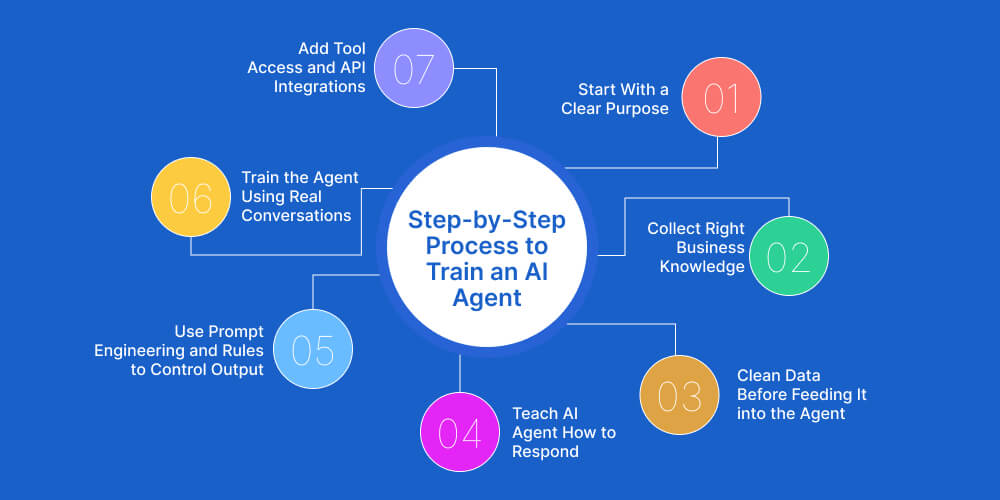
Training an AI agent requires defined goals, curated data, response governance, rigorous testing, and system integrations. When executed correctly, it evolves from chatbot functionality into dependable business automation.
1. Start With a Clear Purpose
Before training begins, it is important to define what the agent is expected to do.
For example:
- Handle customer support queries
- Assist HR team with internal questions
- Help sales teams qualify leads
- Automate appointment booking
- Track order status and respond automatically
- Summarize internal reports
Without a clear use case, training becomes random and results become unreliable.
A good AI agent is built around a goal, not around a dataset.
2. Collect Right Business Knowledge
Most people upload documents and assume the AI will understand everything. But not every file is useful. The best training data comes from:
- Customer support tickets
- Email conversations
- Internal SOPs and workflow documents
- Product manuals and service descriptions
- Pricing sheets and policy documents
- Real customer queries from WhatsApp, live chat, and calls
This is the type of content that reflects actual business problems and real communication patterns.
3. Clean Data Before Feeding It into the Agent
A common mistake is uploading messy content. If the data has outdated pricing, conflicting information, or poorly written notes, the AI agent will produce confused answers. Training data should be:
- Updated
- Structured
- Free from duplicated information
- Clear in language
- Aligned with the company’s current offerings
A well-trained agent is only as good as the content it learns from.
4. Teach AI Agent How to Respond
Businesses often ignore tone, but tone is what makes AI responses feel real. For example, a healthcare agent must be polite and cautious. A SaaS agent should be confident and clear. A finance agent should be formal and structured.
The agent should be trained with:
- Sample conversations
- Approved response formats
- Brand language guidelines
- Dos and don’ts for communication
This is where the difference between a robotic bot and a professional AI assistant becomes visible.
5. Use Prompt Engineering and Rules to Control Output
AI agents need instructions. Not just one instruction, but a complete set of rules like:
- What topics to answer confidently
- What topics to avoid
- When to escalate to a human
- How to handle complaints
- How to respond if data is missing
- How to format the answer (bullets, steps, short reply, etc.)
These rules keep the AI agent consistent. Without this, the agent may give random answers depending on how the user asks the question.
6. Train the Agent Using Real Conversations
A real training process involves real-world testing. This means:
- Testing the agent with customer-like questions
- Creating edge-case scenarios
- Checking how it responds when the question is unclear
- Testing if it follows company policy properly
This phase is extremely important because most issues are discovered only after testing.
AI agents don’t fail because the technology is bad. They fail because the testing is incomplete.
7. Add Tool Access and API Integrations
Here is the point most businesses miss. A chatbot without integrations is just a talking tool.
A trained AI agent with API access becomes an automation system. For sales team, integrating Salesforce AI sales agent can streamline lead tracking, update crm records automatically, and improve overall sales performance.
When API integration is added, the agent can:
- Pull order details from a database
- Check live delivery status
- Create a support ticket automatically
- Update CRM records
- Schedule appointments
- Fetch inventory status
- Trigger internal workflows
This is the stage where AI becomes useful for operations, not just conversations.
But API integration is not a DIY task for most businesses. It requires development experience, backend understanding, security planning, and testing.
Need a Scalable AI Agent Strategy?
Build AI agents that support operations, reduce manual effort, and evolve with your business growth.
How DITS Helps to Build & Train AI Agents
AI agent development services & training the AI agent properly requires more than access to AI tools. It requires experience in software architecture, data pipelines, AI integrations, and security building services. Partnering with AI agent development company is more effective because the company can handle everything end-to-end, including:
- Custom agent design based on business workflow
- Data structuring and knowledge base setup
- API integration with CRM, ERP, and internal tools
- Backend development for automation tasks
- Security, permissions, and access controls
- Scalable deployment (cloud, servers, dashboards)
- Continuous testing and optimization
At Ditstek Innovations, we approach AI agent development as part of a larger system. We focus on how the agent fits into operations, how it scales with growth, and how it stays maintainable over time. We don’t just train an AI agent to talk; we train it to work.
We do not aim to build impressive demos; we build AI agents that teams use. Our training approach ensures that AI agents understand business context, work within existing systems, and deliver consistent value instead of creating additional complexity.
What AI Agent Means for Business Owners
For most founders, the excitement around AI starts with possibilities. Faster workflows. Lower costs. Smarter systems. But what determines success is not the tool it’s the groundwork.
If training is rushed, the AI agent may technically function, but teams won’t rely on it. It gives inconsistent answers. It struggles with real scenarios. Over time, people stop using it. That usually has nothing to do with the AI model itself. It’s about how it was prepared.
Early decisions matter. What data was used? Was it cleaned? Was the agent connected to live systems? Were real business cases tested? These details quietly decide whether the agent becomes helpful or frustrating. AI agents are not plug-and-play products. They behave more like internal systems. They need context. They need structure. They need to fit into existing workflows instead of forcing new ones.
When training is handled properly with the right data, proper API integrations, and ongoing refinement the shift is noticeable. The agent stops feeling experimental. It becomes part of how work gets done and that’s when real return on investment starts to show.
Want an AI Agent That Actually Works?
Move beyond demos and create an AI agent designed for real workflows, real data, and real operational impact.
Final Perspective
Training an AI agent is less about intelligence and more about usefulness. An agent can sound impressive in a demo. That doesn’t mean it will survive real usage.
Performance shows up in small things:
- Accurate responses under pressure
- Smooth integration with existing systems
- Fewer manual steps for teams
- Consistent outputs over time
People that invest in proper development and integration avoid the cycle of rebuilding and patching later.
At Ditstek Innovations, AI agent development is approached with this long-term mindset. The focus remains on building systems that integrate cleanly, scale confidently, and continue delivering value well beyond deployment. In the end, successful AI agents are not the loudest ones. They’re the ones that quietly work and keep working.
FAQs
Why do many AI agents fail after launch?
Most AI agents fail because they’re prepared like demos. A few documents are uploaded, basic testing is done, and the system goes live too quickly. Once real users start interacting with it, gaps appear missing context, wrong answers, no access to live data. The issue is rarely the AI model itself. It’s the training and integration that were incomplete.
Why do businesses work with software development companies for AI agent training?
Training an AI agent properly involves more than prompts. It includes API integration, backend setup, security planning, database connections, and continuous testing. Software development companies handle these technical layers and ensure the agent works smoothly inside existing systems. That’s often the difference between a chatbot that talks and an AI agent that supports operations.
What makes an AI agent different from a basic chatbot?
A basic chatbot follows scripts. An AI agent is trained to understand context and, in many cases, act. The difference becomes obvious when integrations are added. A chatbot might answer a question about an order. An AI agent can check the order status in the system and respond with real-time information.
Why do some AI agents give confident but wrong answers?
This usually happens when the training data is incomplete or messy. If the agent learns from outdated files or unclear documentation, it tries to “fill the gaps.” The response may sound polished, but the information can be off. That’s why structured data and proper testing matter more than just volume.

Dinesh Thakur
21+ years of IT software development experience in different domains like Business Automation, Healthcare, Retail, Workflow automation, Transportation and logistics, Compliance, Risk Mitigation, POS, etc. Hands-on experience in dealing with overseas clients and providing them with an apt solution to their business needs.
Recent Posts
Explore behavioral health workflow automation to identify where to automate, integrate, or modernize processes for more efficient care delivery.
AI triage in healthcare helps prioritize patients, improve access, streamline care decisions, and enhance patient engagement with smarter workflows.
AI-powered dispatch scheduling reduces transportation costs by optimizing routes, vehicle utilization, driver schedules, and delivery operations for greater efficiency.