How Can AI be Used in Healthcare
Table Of Content
Published Date :
12 Feb 2026
Healthcare organizations manage rising costs, workforce shortages, regulatory pressure, and growing patient expectations. Decision makers are searching for reliable ways to improve performance without adding complexity. How can AI be used in healthcare is no longer a futuristic idea; it is a boardroom priority tied to efficiency and measurable outcomes. As Satya Nadella said, “AI is perhaps the most transformational technology of our time, and healthcare is perhaps AI's most pressing application.” Leaders are adopting AI for healthcare business to optimize operations, and practical AI solutions in healthcare to control risk, improve service delivery, and support sustainable growth.
Key Takeaways
- AI helps healthcare organizations cut waste, control cost, and run operations with better visibility.
- Faster billing, fewer denials, and smarter forecasting directly improve revenue performance.
- Automation reduces staff burden so teams can handle more patients without increasing headcount.
- Starting small with the right use case lowers risk and proves value quickly.
- Strong integration with existing systems determines whether AI delivers real results.
- Choosing an experienced technology partner improves speed, adoption, and long-term returns.
Stats on AI Use in Healthcare
- By late 2025, 22% of healthcare organizations had implemented domain-specific AI tools, representing a sevenfold increase compared to 2024 and ten times growth since 2023. Large health systems led adoption at 27%.
- In the U.S., 71% of non-federal acute-care hospitals were already using predictive AI within EHR systems in 2024, with adoption continuing to rise through 2025. Physician-level AI usage reached 66% by early 2025, reflecting a 78% increase over 2023 levels.
- The global AI in healthcare market reached $21.66 billion in 2025 and is expanding rapidly at a 38.6% compound annual growth rate, with projections estimating the market to grow to $110.61 billion by 2030, driven by operational automation and clinical decision support demand.
- Surveys in 2025 show that 86% of healthcare organizations reported widespread use of AI across their operations. Among AI adopters, billing and revenue cycle automation increased to nearly 80%, up by 25 percentage points since 2023. Multi-hospital systems demonstrated significantly higher predictive AI adoption rates, ranging from 81–86%, compared to 31–37% among independent hospitals, highlighting scale-driven advantages.
| Metric | 2025 Stat | Growth Note |
| Org Adoption | 22% domain AI | 7x YoY increase |
| Hospital Predictive AI | 71% U.S. | Up from 66% in 2023 |
| Physician Use | 66% | 78% from prior year |
| Market Value | $21.66B | 38.6% CAGR |
How Can AI be Used in Healthcare Operations
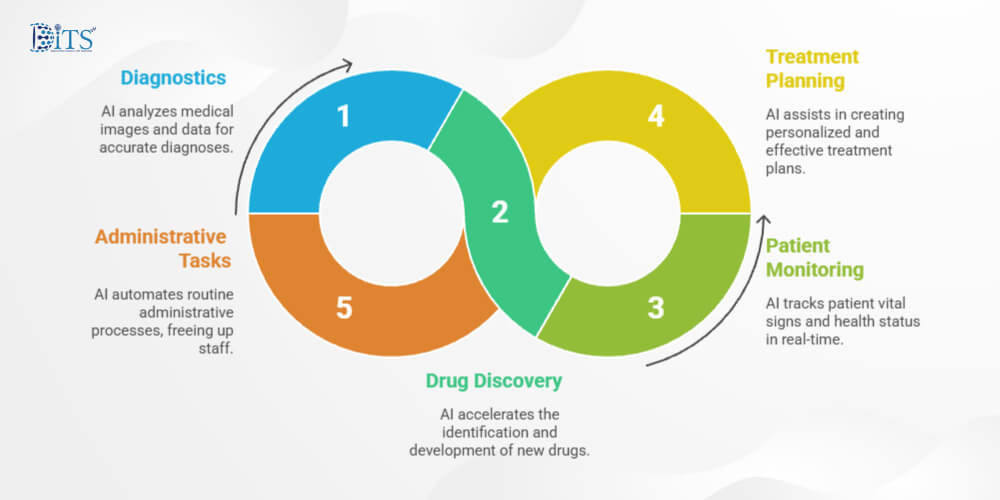
Healthcare businesses use intelligent systems to improve speed, accuracy, and cost control. Read how AI can be used in healthcare operations to support diagnostics, research, monitoring, planning, and daily administration.
Diagnostics
AI for healthcare helps doctors review scans, lab reports, and patient histories faster. It highlights risk areas so teams can act early, reduce repeat tests, and improve outcomes. This practical AI use in healthcare supports consistent quality across facilities.
Drug Discovery
In the AI in healthcare industry, research teams use intelligent models to study large data sets and predict which compounds may work. This shortens development cycles, lowers investment risk, and improves the benefits of AI in healthcare innovation.
Patient Monitoring
Remote patient monitoring software with AI in healthcare allows continuous tracking of vital signs, recovery patterns, and alerts. Providers respond quickly to changes, avoid complications, and reduce readmissions. This is a strong example of how AI can be used in healthcare to maintain care beyond hospitals.
Treatment Planning
AI in healthcare industry systems compares patient data with thousands of similar cases. Doctors receive guidance on possible therapies, expected responses, and cost implications. The use of AI in healthcare improves decision support while keeping clinicians in control.
Administrative Tasks
Hospitals implement AI in healthcare for scheduling, billing checks, document handling, and insurance business workflows. Automation cuts manual effort, improves accuracy, and saves staff time. Among the benefits of AI in healthcare, operational efficiency delivers immediate financial value.
| AI Application | Key Business Impact | Expected ROI Example |
| Triage & Scheduling | Reduced no-shows, optimized slots | 15-20% efficiency gain |
| Predictive Analytics | Lower readmissions, better forecasting | $300B denial savings potential |
| RCM Automation | Fewer denials, faster payments | 30% collection boost |
| Resource Planning | Optimized staffing & beds | 5-10% throughput improvement |
Also Read: Generative AI Use Cases of Healthcare
Top 6 Benefits of AI in Healthcare Business
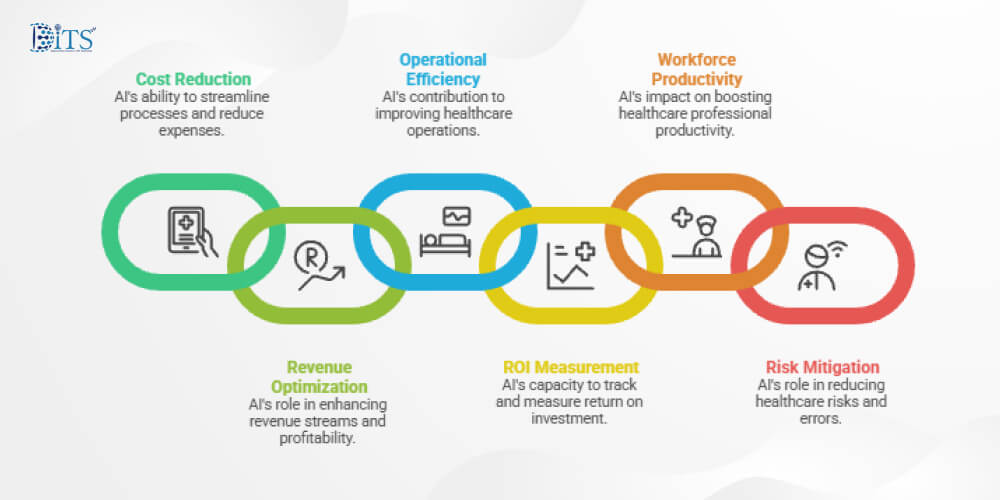
AI-driven systems help healthcare enterprises control cost, improve revenue, streamline operations, measure returns, empower staff, and reduce risk. DITS will help you to understand what are the benefits of using AI in healthcare with clarity. AI for healthcare delivers practical, real-world value across daily business functions.
Cost Reduction
Hospitals and clinics face rising labor, supply, and compliance expenses. AI for healthcare reduces waste through demand forecasting, inventory analytics, automated coding, and fraud detection. One of the measurable benefits of AI in healthcare is fewer denials, optimized procurement, and lower administrative overhead across the AI in healthcare industry.
Revenue Optimization
Missed charges, under-coding, and delayed reimbursements directly affect margins. Intelligent eligibility verification, clinical documentation improvement, and predictive billing models strengthen cash flow. With structured AI use in healthcare, finance teams capture accurate claims, shorten revenue cycles, and increase collections without expanding staff.
Operational Efficiency
Emergency departments, labs, and surgical units generate massive workflow complexity. AI in healthcare industry platforms coordinate scheduling, bed allocation, asset management, and patient routing. These AI for healthcare capabilities reduce wait times, prevent bottlenecks, and create smoother throughput that leaders can monitor in real time.
ROI Measurement
Executives require visibility before scaling technology investments. AI for healthcare supports KPI dashboards, utilization metrics, cohort analytics, and cost-per-case benchmarking. Among the benefits of AI in healthcare, data transparency allows leadership to validate performance, justify expansion, and align digital programs with financial goals.
Workforce Productivity
Clinical and non-clinical teams spend hours on repetitive documentation and coordination. AI in healthcare industry solutions use voice capture, intelligent triage, and automated task assignment. This AI se in healthcare lets professionals focus on patient engagement while organizations manage higher volumes with the same workforce.
Risk Mitigation
Regulatory exposure, patient safety events, and cybersecurity threats demand constant monitoring. AI for healthcare applies anomaly detection, compliance validation, and predictive risk scoring. Strong governance frameworks show how AI can be used in healthcare to prevent errors, strengthen audit readiness, and protect reputation.
Find Your AI Starting Point in Healthcare
Top 7 AI Solutions in Healthcare Can Be Implemented
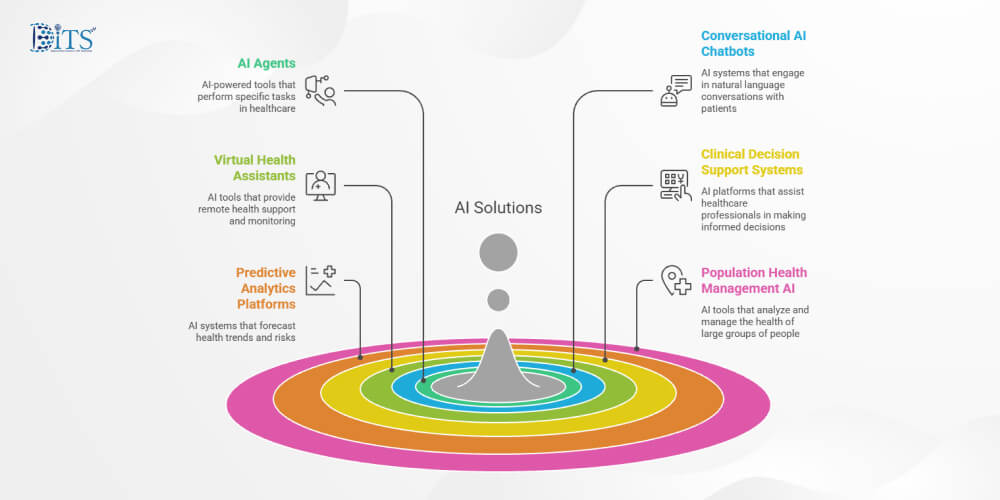
Healthcare software development company help enterprises adopt intelligent platforms to automate coordination, improve decisions, and control financial risk. These widely implemented AI for healthcare solutions help startups, growing providers, and large organizations modernize infrastructure while delivering measurable benefits of AI in healthcare operations.
AI Agents in Healthcare
AI agent development helps to manage multi-step workflows such as referral intake, eligibility validation, discharge planning, and prior authorization tracking. They connect EHR, billing, and CRM systems while escalating exceptions to staff. This AI use in healthcare reduces manual follow-ups and improves service consistency across the AI in healthcare industry.
Also Read: EHR Implementation Cost Breakdown
Conversational AI Chatbots
Custom AI chatbot development helps to handle appointment booking, pre-visit questionnaires, insurance queries, and medication reminders for healthcare businesses. Integrated with hospital information systems, these AI for healthcare tools reduce call volume and improve response time. The benefits of AI in healthcare become visible through higher patient satisfaction and lower support costs.
Also Read: How To Build a Conversational AI
Virtual Health Assistants
Virtual assistants support patients after discharge with personalized care plans, symptom tracking, and adherence nudges. Businesses visualize fewer readmissions and stronger engagement metrics. Within the AI in healthcare industry, this AI use in healthcare extends care continuity without increasing clinician workload.
Clinical Decision Support Systems
Clinical platforms process imaging, lab values, comorbidities, and treatment protocols to generate risk stratification and therapy guidance. Physicians validate recommendations while maintaining authority. AI for healthcare in this form improves diagnostic confidence and demonstrates measurable benefits of AI in healthcare quality programs.
Predictive Analytics Platforms
Executives rely on forecasting engines to anticipate admissions, length of stay, staffing needs, and equipment demand. Operations teams act before congestion occurs. This AI use in healthcare transforms raw data into planning intelligence that strengthens margins across the AI in healthcare industry.
Population Health Management AI
Organizations managing value-based contracts use AI for healthcare to segment populations, identify high-risk cohorts, and prioritize interventions. Care managers visualize outreach lists and prevention pathways. The benefits of AI in healthcare include better outcomes, improved reimbursement models, and reduced long-term costs.
Read Our Portfolio: SaaS RPM & IoT Platform for Population-Health Programs
Fraud Detection AI
Payment systems apply anomaly detection, behavioral analytics, and rule engines to flag suspicious claims before submission. Compliance teams gain early visibility into exposure. AI for healthcare protects claim processing, financial stability and reinforces trust, a critical part of the benefits of AI in healthcare governance.
Cost of Implementing AI in Healthcare
Healthcare businesses rarely benefit from off-the-shelf models. Custom AI software development services include algorithm selection, data training, validation, and optimization for workflows such as diagnostics or revenue analytics. The cost of implementing AI in healthcare typically starts around $30,000 and rises with model complexity, accuracy expectations, integration depth, and formal clinical validation requirements.
Data Assessment & Preparation
This stage includes extracting information from EHR and ERP systems, cleansing records, labeling datasets, and building interoperability mappings. Strong preparation determines model accuracy, regulatory readiness, and long-term scalability. Typical investment ranges between $10,000 and $60,000.
AI Model Engineering
Teams design algorithms, train models, run validations, tune performance, and evaluate bias. The sophistication of clinical or operational outcomes directly affects this budget. Organizations generally spend $25,000 to $120,000 depending on complexity and precision requirements.
Integration & APIs
AI must communicate with platforms such as EHR, PACS, billing engines, CRM, and identity management. Work includes interface development, secure data exchange, and workflow triggers. Integration often shapes usability and typically costs $15,000 to $100,000.
Cloud & Infrastructure Setup
This covers compute provisioning, storage architecture, networking, disaster recovery, and DevOps pipelines. Infrastructure decisions influence performance, uptime, and future expansion. Businesses usually allocate $10,000 to $80,000 for this layer.
Security & Compliance Framework
Healthcare environments require encryption, role-based access, audit trails, and adherence to HIPAA or GDPR. Governance design is essential for approvals and insurance alignment. The common range falls between $15,000 and $90,000.
UI/UX & Application Layer
Dashboards, clinician views, and administrative panels translate AI outputs into action. Adoption depends heavily on usability and workflow fit. Investment here typically runs $10,000 to $70,000.
Testing & Clinical Validation
Before production use, organizations perform accuracy benchmarking, user acceptance cycles, and workflow simulations. This confirms reliability and reduces operational risk. Budgets often range from $10,000 to $75,000.
Deployment & Training
Go-live planning, documentation, configuration, and workforce onboarding occur at this step. Proper training improves utilization and ROI realization. Most projects spend $5,000 to $40,000.
Ongoing Support & Model Maintenance (Annual)
After launch, AI systems require monitoring, retraining, upgrades, and SLA governance. Continuous optimization preserves performance as data changes. Annual commitments usually range from $15,000 to $120,000.
Looking to Reduce Costs with AI?
Identify high-impact automation opportunities across billing, diagnostics, and operations that deliver fast, measurable returns.
Cost of AI in Healthcare Based on Complexity
AI investment varies according to functional depth, integration surface, regulatory burden, and scalability expectations. The ranges below help healthcare leaders compare solution sophistication with budget requirements, from basic automation to enterprise-grade, compliance-driven intelligent ecosystems.
| AI Solution Scope | Business Use Case Example | Estimated Development Cost |
| Basic AI Automation | Scheduling, chatbot, rule-based workflows | $30,000 – $50,000 |
| Mid-Level AI System | Predictive analytics, revenue intelligence | $50,000 – $90,000 |
| Advanced AI Platform | Clinical decision support, imaging AI | $90,000 – $120,000 |
| Enterprise AI Ecosystem | Multi-module AI with EHR integration | $120,000 – $200,000+ |
| AI Agents & Automation | End-to-end task orchestration | $30,000 – $80,000 |
| Compliance-Heavy AI | Regulated clinical AI deployments | $120,000 – $250,000 |
Cost of AI Implementation in Healthcare: MVP vs. Enterprise Scale
| Feature / Phase | Minimum Viable Product (MVP) Development | Full-Scale Enterprise Solution |
| Primary Goal | Concept validation & rapid feedback | Workflow automation & business transformation |
| Typical Timeline | 3 – 5 months | 12 – 18+ months (ongoing) |
| Model Strategy | Pre-trained models or Wrapper APIs | Custom-trained models or Fine-tuned LLMs |
| Data Scope | Single source (e.g., CSV or one silo) | Multi-modal (EHR, PACS, ERP, IoT devices) |
| Integration | Standalone or minimal "Read-only" | Deep "Write-back" integration (e.g., EPIC/Cerner) |
| Compliance | Basic HIPAA/GDPR architecture | Full clinical validation & FDA/MDR certification |
| Total Build Cost | $25,000 – $150,000 | $500,000 – $2,000,000+ |
Why Choose DITS for Implementing AI in Healthcare Industry
Healthcare AI demands more than model development. It requires deep workflow understanding, regulatory discipline, and the ability to integrate with complex clinical and financial ecosystems. DITS provides AI integration services & solutions that operate reliably in real environments where uptime, accuracy, and adoption define success.
With experience across 60+ healthcare projects built from the ground up, our teams understand how to translate operational pain points into scalable digital systems. From patient access and diagnostics to revenue intelligence and interoperability, we engineer platforms that align technology investment with measurable performance outcomes.
We work closely with leadership, clinicians, and IT departments to define architecture, data strategy, and governance from day one. This reduces rework, accelerates approvals, and ensures the AI solution fits existing processes rather than disrupting them.
Our approach combines custom model engineering, secure cloud infrastructure, integration with EHR and enterprise applications, and continuous optimization after deployment. Clients gain a long-term technology partner capable of supporting growth, compliance evolution, and multi-location expansion.
Planning Enterprise-Grade AI Implementation?
Align technology, compliance, and integration strategy with scalable solutions built for complex healthcare ecosystems.
FAQs
1. How long does it take to implement AI in a healthcare organization?
Timelines depend on scope, integrations, and compliance requirements. Pilot systems may take a few months, while enterprise programs with EHR connectivity and validation can extend beyond a year.
2. Do we need clean and structured data before starting?
Not necessarily, but data readiness affects speed and cost. Most providers begin with assessment, normalization, and interoperability planning before model deployment.
3. Will AI replace doctors or staff?
AI supports professionals by automating repetitive work, improving visibility, and providing decision assistance. Clinical authority remains with healthcare experts.
4. Can AI integrate with our existing hospital systems?
Modern solutions connect through APIs with EHR, PACS, billing, CRM, and other enterprise platforms while maintaining security and auditability.
5. Why should we partner with DITS for healthcare AI implementation?
DITS combines domain knowledge, engineering depth, and experience from 60+ healthcare builds. Organizations receive secure, scalable, and integration-ready systems designed to deliver measurable operational and financial impact.
6. Can DITS build a solution tailored to our specific workflows?
DITS designs AI platforms around your clinical, administrative, and financial processes. Every deployment aligns with your infrastructure, compliance environment, and long-term growth strategy.

Nidhi Thakur
With more than 19 years of experience - I represent a team of professionals that specializes in the healthcare and business and workflow automation domains. The team consists of experienced full-stack developers supported by senior system analysts who have developed multiple bespoke applications for Healthcare, Business Automation, Retail, IOT, Ed-tech domains for startups and Enterprise Level clients.
Recent Posts
AI triage in healthcare helps prioritize patients, improve access, streamline care decisions, and enhance patient engagement with smarter workflows.
AI-powered dispatch scheduling reduces transportation costs by optimizing routes, vehicle utilization, driver schedules, and delivery operations for greater efficiency.
AI integration connects AI with existing systems and workflows, while AI adoption focuses on using AI effectively to drive measurable business outcomes.