How do I Implement Responsible AI in my Business: Guide
Table Of Content
Published Date :
13 Feb 2026
Businesses want growth from technology, but they also need trust, safety, and accountability. Customers, regulators, and partners expect systems that make fair decisions and protect data. How do I Implement Responsible AI in my Business: Guide becomes essential when leaders plan AI in business initiatives. Responsible adoption ensures the use of AI in business improves outcomes without creating hidden risks. When governance is clear, teams gain the real benefits of AI in business such as efficiency, faster service, and better insights. With structured AI integration in business, organizations prepare for the future of AI in business while staying reliable and compliant.
How Many Businesses Adopted AI from 2021-2026
AI adoption is accelerating worldwide, with most organizations deploying it across multiple functions. Enterprises lead investment, generative AI is expanding fast, and competitive pressure continues to push broader implementation.
AI Adoption Snapshot
By the end of 2024 and moving into 2026, about 78% of organizations globally are using AI in at least one function. Among larger enterprises, several studies suggest the figure may be closer to 88%, showing rapid mainstream acceptance.
Adoption Trends
Usage has climbed sharply from nearly 55% the previous year. Companies now apply AI across IT, marketing, sales, and customer service. Generative AI shows especially strong growth, reaching 71% implementation in at least one area, compared with 33% in 2023.
By Company Size
Bigger organizations continue to move faster. Firms with more than 250 employees report higher adoption and expect continued expansion. Smaller companies are also increasing investment. Nearly all Fortune 500 businesses apply AI, often in hiring, workforce management, and planning.
Global Scale
With hundreds of millions of businesses operating worldwide, AI penetration represents a vast and growing footprint. Exact numbers differ by methodology, but North America currently leads, with adoption rates reported above 80%.
| Year | Adoption Rate (%) | Year-over-Year Increase (pp) | |
| 2021 | 25 | - | Estimated from trends (pre-2023 baseline ~20-25%) |
| 2022 | 35 | +10 | Interpolated growth trajectory |
| 2023 | 33-55 | -2 to +20 | GenAI 33%; overall ~55% by end |
| 2024 | 71-78 | +16 to +23 | GenAI 71%; overall 78% |
| 2025 | 78 | 0 to +7 | Mainstream adoption |
| 2026 | 80-88 | +2 to +10 | Enterprise projections up to 88% |
How Can I use AI in my Business: Step by Step Guide
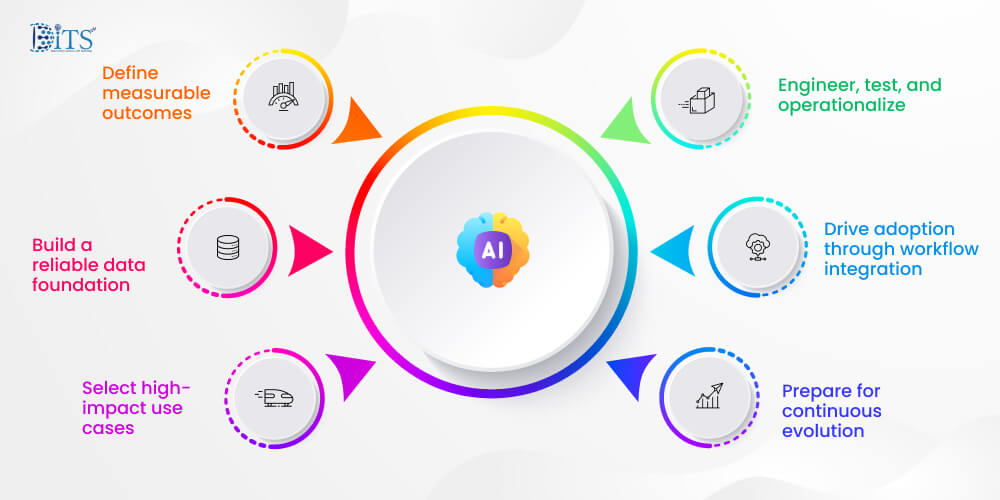
Integrating AI in business demands structured planning, cross-functional alignment, and production-grade engineering. This guide walks decision makers through practical stages, real operational scenarios, and governance considerations while emphasizing why partnering with an experienced AI integration service provider reduces risk and accelerates measurable outcomes.
1. Define measurable outcomes
Successful AI in business begins with clarity on revenue, cost, risk, or experience metrics. Map operational bottlenecks such as manual underwriting, delayed ticket routing, or demand volatility. Translate them into KPIs, data requirements, latency thresholds, and ROI horizons. Because AI integration into business is a complex and crucial procedure, leadership teams often benefit from structured guidance from an AI integration service provider to avoid misaligned investments.
2. Build a reliable data foundation
AI applications in business depend on clean, governed, interoperable data pipelines. Consolidate ERP, CRM, IoT, and third-party feeds into validated schemas. Implement lineage, access controls, anonymization, and real-time ingestion where decisions require low latency. Since AI integration into business is a complex and crucial procedure, collaboration with an AI integration service provider ensures architecture readiness, regulatory compliance, and scalability from pilot to enterprise deployment.
3. Select high-impact use cases
Prioritize scenarios where automation or augmentation changes day-to-day work. Think predictive maintenance reducing downtime, intelligent document processing accelerating claims, or recommendation engines improving conversion rates. Quantify baseline performance and target deltas. This structured approach demonstrates the benefits of AI in business while creating internal confidence for broader adoption across departments and geographies.
4. Engineer, test, and operationalize
Move beyond prototypes into hardened environments with CI/CD, model monitoring, bias evaluation, rollback strategies, and human-in-the-loop validation. For example, a service desk copilot must integrate with identity systems, ticket taxonomies, and audit logs. Mature AI software development company practices to transform isolated models into dependable digital capabilities aligned with enterprise risk frameworks.
5. Drive adoption through workflow integration
Value materializes when teams actually use the system. Embed intelligence into familiar interfaces such as sales dashboards, mobile workforce apps, or procurement portals. Provide explainability outputs and feedback loops so employees can refine results. Real change management converts experimental use of AI in business into standardized operating procedure across functions.
6. Prepare for continuous evolution
The future of AI in business will include adaptive models, multimodal interfaces, and autonomous orchestration across supply chains and customer journeys. Establish governance boards, retraining cadences, cost controls, and vendor strategies. Organizations investing early in GenAI software development position themselves to extend capabilities rapidly as technologies mature and competitive expectations rise.
AI Use Cases in Business: Industry Wise
Businesses across industries are applying AI to reduce costs, improve decision-making, and scale operations. This section explains practical, real-world AI applications in business, showing how startups, mid-sized firms, and enterprises use AI to solve industry-specific challenges and prepare for long-term growth.
Healthcare
Organizations apply AI in healthcare business operations for diagnostics support, patient scheduling, revenue cycle automation, and population health analytics. Hospitals visualize reduced readmissions, faster billing cycles, and better care coordination. These use cases of AI in business improve operational stability while meeting regulatory and clinical performance expectations.
Finance
Banks and financial firms use AI applications in business for fraud detection, credit scoring, risk modeling, and customer support automation. Real-time transaction monitoring reduces losses, while predictive analytics improve loan decisions. The use of AI in business strengthens compliance, speeds processing, and protects margins.
Automotive
Automotive companies deploy AI use cases in business for demand forecasting, predictive maintenance, quality inspection, and supply chain optimization. Manufacturers identify defects early, dealers forecast inventory accurately, and service teams reduce downtime. These AI-driven workflows directly impact cost control and production efficiency.
Real Estate
Real estate firms use AI in business to analyze property prices, predict demand, automate lease management, and personalize buyer experiences. Brokers visualize faster deal closures and improved valuation accuracy. These use cases for AI in business help firms operate efficiently in competitive and location-driven markets.
Oil & Gas
Energy enterprises rely on AI applications in business for seismic data analysis, asset monitoring, production forecasting, and safety compliance. Operations teams detect equipment failures early and optimize drilling decisions. The benefits of AI in business here include reduced downtime, safer operations, and improved capital utilization.
Mining
Mining companies apply AI use cases in business for ore grade prediction, equipment health monitoring, and logistics optimization. Site managers visualize improved yield and fewer operational disruptions. The use of AI in business enables better resource planning while maintaining safety and environmental standards.
Also Read: AI and IoT Integration in Mining Automation Systems
EdTech
Education technology companies integrate AI in business platforms for personalized learning paths, student engagement analysis, and automated assessments. Providers see higher retention and improved learning outcomes. These AI applications in business support scalable education delivery without increasing administrative overhead.
Retail
Retailers implement AI use cases in business for demand forecasting, dynamic pricing, recommendation engines, and inventory management. Store managers visualize fewer stockouts and better customer targeting. The use of AI in business directly improves sales performance and supply chain efficiency.
Transportation
Logistics and transportation companies use AI in business to optimize routes, predict delays, manage fleets, and control fuel consumption. Operations teams reduce delivery times and operating costs. These use cases of AI in business improve reliability across regional and global networks.
Agriculture
Agribusinesses apply AI applications in business for crop yield prediction, soil analysis, weather forecasting, and automated irrigation. Farmers visualize higher output with controlled input costs. The benefits of AI in business support sustainable production and better planning across seasons.
Also Read: How AI Applications in Agriculture
Manufacturing
Manufacturers use AI in business operations for predictive maintenance, quality inspection, production scheduling, and demand forecasting. Plant managers identify bottlenecks before they impact output. These use cases for AI in business improve throughput and reduce unplanned downtime.
Insurance
Insurance companies rely on AI use cases in business for risk assessment, claims automation, fraud detection, and customer service optimization. Insurers visualize faster claim settlements and improved underwriting accuracy. The use of AI in business strengthens profitability and customer trust.
Planning to Integrate AI in Your Business Operation?
Get in touch with DITS AI development & integration experts to discuss and integrate artificial intelligence into the business.
Cost to Integrate AI in Business in Detail
Understanding the cost to adopt AI in business requires clarity on infrastructure, data readiness, model engineering, compliance, and long-term operations. This section explains where budgets go, how pricing scales from pilot to enterprise rollout, and what leaders should plan before starting.
| Phase | Component | Key Deliverables | Starting Cost |
| I. Discovery | Strategy & Feasibility | ROI modeling, tech stack selection, roadmap | $25,000 |
| II. Foundation | Data Engineering | Scalable ETL pipelines, data lake/warehouse, security | $35,000 |
| III. Build | GenAI Development | LLM orchestration (RAG), prompt engineering, UI/UX | $40,000 |
| IV. Integration | Custom Models & APIs | Fine-tuning, third-party API hooks, validation | $45,000 |
| V. Launch | Deployment & Governance | MLOps, drift monitoring, SOC2/GDPR compliance | $30,000 |
| VI. Adoption | Training & Change Management | User manuals, SOP updates, internal workshops | $15,000 |
| TOTAL | Minimum Baseline Investment | $100,000 |
Key Considerations:
- Recurring Costs: Keep in mind these are "starting" costs for development. You’ll also need to account for token usage fees (OpenAI, Anthropic, etc.) and compute costs (AWS/Azure/GCP) which can range from $500 to $5,000+ per month depending on scale.
- The "Data Debt" Variable: If the client's data is messy or siloed, the Data Engineering phase can easily double in cost.
- Security Guardrails: For enterprise clients, the Governance cost is often higher because they require private VPC deployments rather than simple API calls.
1) Strategy, Discovery, and Architecture Planning
Every successful AI integration in business begins with assessment. Teams map workflows, define KPIs, review data maturity, and design target architecture. Businesses visualize where automation, prediction engines, or GenAI assistants will sit within existing ERP, CRM, or HIS environments. The benefits of AI in business depend heavily on this foundation, because poor planning leads to rework, security gaps, and low adoption across departments.
2) Data Engineering and Infrastructure Setup
Raw information must be aggregated, cleaned, normalized, and secured before any production deployment. This stage includes building data pipelines, ETL processes, warehouse or lake configuration, and access governance. Many AI applications in business fail because datasets are fragmented across legacy systems. Investment here ensures models receive reliable inputs and leadership gains auditability, performance consistency, and measurable ROI.
3) Model Development, Integration, and Testing
This is where AI software development converts business rules into working intelligence. Engineers train or fine-tune algorithms, connect APIs, embed decision logic into operational systems, and run validation cycles. For example, a service desk may see automated ticket routing, or finance may implement anomaly detection. Proper testing protects uptime, accuracy, and regulatory alignment.
4) Deployment, Training, and Continuous Optimization
After launch, organizations maintain performance through monitoring, retraining pipelines, cybersecurity checks, and user onboarding. AI integration Services typically include dashboards, drift detection, and governance workflows. The future of AI in business depends on continuous improvement, not one-time installation. Companies that invest in change management see faster adoption and stronger financial outcomes.
Common Integration Mistakes Businesses Do
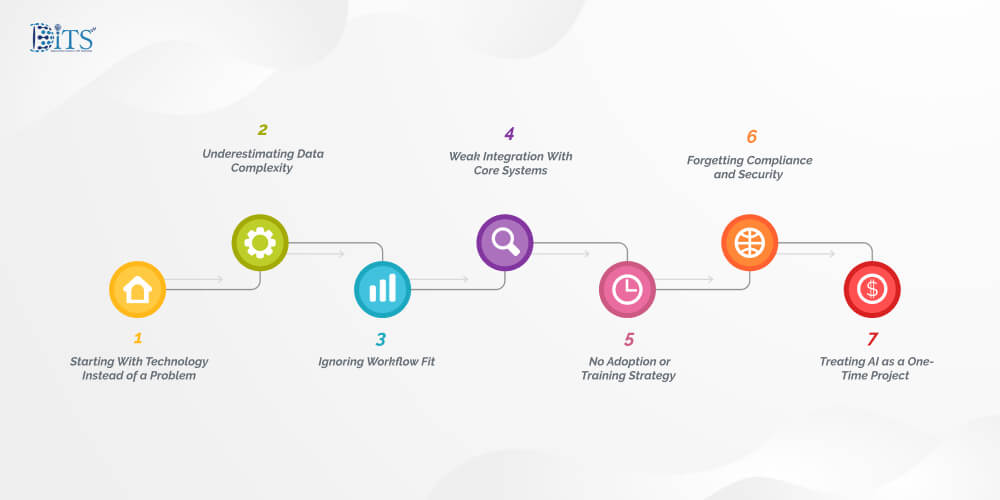
AI initiatives often fail due to poor planning, weak data foundations, and limited adoption strategies. Understanding common pitfalls helps organizations reduce risk, accelerate deployment, and ensure technology investments translate into measurable business performance.
Starting With Technology Instead of a Problem
Many companies purchase tools before defining success metrics. Projects drift, teams lose confidence, and adoption stalls. Experienced partners begin with operational KPIs, map value streams, and align AI in business initiatives with financial outcomes.
Underestimating Data Complexity
Leaders often assume their data is ready for modeling. In reality, silos, missing fields, and inconsistent formats delay progress. Skilled providers conduct audits, design pipelines, and create governance structures that support reliable AI applications in business.
Ignoring Workflow Fit
If AI outputs do not match how employees work, the system becomes unused software. Implementation experts embed intelligence into existing processes, dashboards, and approvals so the use of AI in business becomes natural.
Weak Integration With Core Systems
Standalone pilots rarely scale. Without deep connectivity to ERP, CRM, EHR, or supply platforms, insights cannot trigger action. Mature partners design API frameworks and interoperability layers from the start.
No Adoption or Training Strategy
Even accurate models fail when teams do not trust them. Experienced integrators plan change management, user education, and phased rollouts so stakeholders see the benefits of AI in business early.
Forgetting Compliance and Security
Regulatory gaps can stop deployment instantly. Proven vendors build encryption, access control, monitoring, and audit trails into architecture, protecting the organization while preparing for the future of AI in business.
Treating AI as a One-Time Project
Models degrade as behavior and markets change. Reliable partners establish monitoring, retraining cycles, and performance management so systems keep delivering value year after year.
Want Risk-Free AI Implementation into Your Business?
Build ethical, scalable AI systems that protect data, ensure transparency, and drive sustainable business performance.
Why Choose DITS for AI Applications in Business
Organizations must align technology with revenue goals, operational realities, compliance expectations, and long-term scalability. DITS delivers AI applications in business environments where performance, reliability, and measurable outcomes determine success.
Our teams translate business objectives into production-ready systems. Whether a startup is building digital capability from the ground up or an enterprise is modernizing legacy platforms, we design architectures that integrate with ERP, CRM, data warehouses, and cloud ecosystems.
With experience across industries including healthcare, finance, real estate, manufacturing, energy, and retail, we understand how AI in business must function inside real workflows. We focus on interoperability, data governance, model accuracy, and user adoption so solutions move beyond pilots.
DITS follows an engineering-led approach covering discovery, feasibility analysis, model development, validation, deployment, and continuous improvement. This ensures clients achieve the benefits of AI in business through controlled investment, faster implementation cycles, and predictable ROI.
Businesses working with DITS gain a long-term partner capable of supporting expansion, multi-location operations, evolving regulations, and future AI innovation.
FAQs
1. What does AI in business actually mean?
AI in business refers to using intelligent systems and data-driven models to automate processes, improve decisions, and increase operational efficiency. It can support departments such as sales, service, finance, HR, and supply chain with faster, more accurate outcomes.
2. What are the key benefits of AI in business?
The benefits of AI in business include cost reduction, productivity improvement, faster response times, and better forecasting. Companies also gain stronger visibility into performance metrics, enabling leadership teams to plan growth with confidence.
3. What are common AI applications in business today?
Popular AI applications in business include predictive analytics, customer support automation, fraud monitoring, demand forecasting, document processing, and recommendation systems. These applications help organizations run daily operations with greater speed and consistency.
4. How can companies prepare for the future of AI in business?
The future of AI in business will depend on scalable data strategies, strong governance, and systems that integrate across departments. Businesses that begin building digital foundations now will adapt faster as intelligence becomes central to every workflow.
5. How do I start AI integration in business with DITS?
DITS evaluates your workflows, data readiness, and ROI priorities before recommending the right AI use cases in business. Our teams design, build, and integrate solutions that align with operational goals, ensuring measurable value instead of experimental deployments.
6. Why choose DITS when planning how to implement AI in business?
DITS delivers end-to-end AI integration in business environments, from consulting and architecture to deployment and optimization. We focus on secure, scalable systems that produce real performance gains and long-term competitive advantage.

Dinesh Thakur
21+ years of IT software development experience in different domains like Business Automation, Healthcare, Retail, Workflow automation, Transportation and logistics, Compliance, Risk Mitigation, POS, etc. Hands-on experience in dealing with overseas clients and providing them with an apt solution to their business needs.
Recent Posts
AI triage in healthcare helps prioritize patients, improve access, streamline care decisions, and enhance patient engagement with smarter workflows.
AI-powered dispatch scheduling reduces transportation costs by optimizing routes, vehicle utilization, driver schedules, and delivery operations for greater efficiency.
AI integration connects AI with existing systems and workflows, while AI adoption focuses on using AI effectively to drive measurable business outcomes.