How SaaS MVP Validates Business Idea and Reduce Investment Risk
Table Of Content
Published Date :
06 Aug 2026
Key Takeaways
- Creating a SaaS platform without prior validation is a waste. It can be costly, time-consuming, and bring in features that are not useful to the potential customers.
- MVP development for SaaS reduces investment risk by limiting upfront spending, eliminating unnecessary functionality, and enabling phased funding.
- The actual behavior of users is more important to SaaS validation than the assumptions of the creator, surveys, or statement from the inner circle.
- MVP can help to identify various issues, such as architecture, integration, performance, data, and security concerns, earlier and less expensively.
- Initiating user feedback helps immensely when discussing the prospects of the product with investors and allowing for increasing the credibility of the business.
- Activation, engagement, retention, churn, adoption of the features, workflow completion, conversion, CAC, and MRR are better ways to validate an idea than just registration metrics.
What if you spend months developing your SaaS product, only to find out later that people do not actually require that? Unfortunately, there is a chance of this scenario when companies decide to jump directly to developing their product without prior validation of its viability.
This is where SaaS MVP development becomes useful. It enables testing the product concept with actual consumers, measuring its performance, identifying problems, and gauging consumer willingness to pay. Without any assumptions, companies will be able to base their next investments on solid information.
Why Full-Scale SaaS Development Is Risky Without Validation
Jumping right from an idea to full-scale SaaS development leaves room for unnecessary risks for a business. People might spend months developing things that will never be needed by clients, target the wrong audience, or simply underestimate market demands.
The choice of technology might prove to be quite expensive in this case. An inappropriate stack will leave room for poor integrations, performance issues, security risks, and scalability problems later on.
Building at scale brings the same risks. One might invest in additional cloud computing capacity, expand the development team, and build complex systems before ensuring there is actually steady adoption of the product.
From an investor's perspective, validation is very important. Without proof of demand, securing additional funds is quite hard.
Unsure If Your SaaS Idea Will Succeed?
Validate your product concept with an MVP before making a large investment in full-scale software development and market expansion.
What Is a SaaS MVP, and What Must It Validate?
SaaS MVP refers to a version of a product that is developed by including only those features that address a single primary user problem. An MVP does not aim to create a working project that would only check whether the next stage of product development is worthwhile.
A well-prepared MVP should reveal the significance of the problem, whether customers appreciate the product, and whether they can complete the necessary actions without any problems. It should also determine the market interest and willingness to buy and pay for the service.
The information obtained from potential users enables companies to decide whether to improve their project or completely change their ideas.
Connect with our professionals that will answer all your questions regarding how to create a SaaS MVP at affordable prices.
Market Statistics
The MVP development market size is anticipated to rise to 10 USD Billion by 2035 from 4,710 USD Million in 2025. Moreover, the CAGR will be around 7.8% (2026-2035)
SaaS market size is projected to grow from USD 530.0 billion in 2026 to USD 1,109.2 billion by 2033. Also, the CAGR is expected to be 11.1% from 2026 to 2033.
How SaaS MVP Development Reduces Investment Risk?
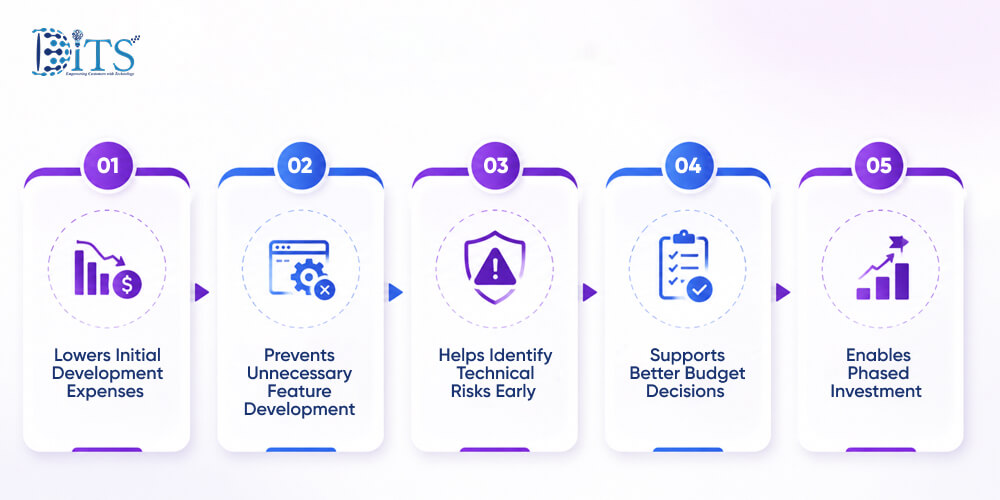
SaaS MVP development entails considerable expenses for designing, developing, integrating, setting up a cloud platform, testing, and maintaining it. An MVP lowers the risk for a business to incur losses through gradual investments in the development process.
Lowers Initial Development Expenses
Through an MVP, a company can minimize the amount of money it needs to spend on creating a full-fledged platform without proving its need for existence. It will be more affordable and safer to start.
- Focuses on critical spending on the customer workflow
- Postpones non-critical functions until proven demand
- Decreases initial designing and engineering efforts
- Restricts initial infrastructure and integration expenses
- Prevents possible losses from underperforming idea
Prevents Unnecessary Feature Development
With less ground work, the product team can emphasize features that seem valuable but don’t drive adoption or revenue at all. With an MVP, businesses can create future capabilities based on proven customer needs.
- Replaces assumptions with product usage data
- Pinpoints the features that customers want
- Prioritizes capabilities related to business success
- Avoids wasting time building useless features
- Makes product roadmap realistic and actionable
Helps Identify Technical Risks Early
It gets harder to address technical risks the more the platform scales. An MVP allows product teams to identify architecture, integration, performance, data, and security risks when the product is still small enough to manage.
- Validates whether the chosen architecture can support the product
- Unearths third-party integration challenges
- Determines the performance and scalability risks
- Determines data quality and migration problems
- Unearths security vulnerabilities
Supports Better Budget Decisions
An MVP SaaS lets companies make investments gradually based on specific criteria. Development can be linked to product performance or to customer response.
- Links investment to the results of development
- Allows checking results before additional investment
- Lets you make changes without losing the entire investment
- Allows controlling development budgets
- Avoids investing in an unproven idea
Enables Phased Investment
It gets harder to address technical risks the more the platform scales. An MVP allows product teams to identify risks in architecture, integration, performance, data, and security when the product is still small enough to manage.
- Validates whether the chosen architecture can support the product
- Unearths third-party integration challenges
- Determines the performance and scalability risks
- Determines data quality and migration problems
- Unearths security vulnerabilities
Want To Reduce Product Development Investment Risk?
Launch a focused MVP to test user demand, collect feedback, and refine your product before investing in advanced features.
How MVP SaaS Strengthens Investor Readiness?
Investors do not just want to be convinced by an interesting idea. An MVP makes it possible for them to have tangible proof that a startup is capable of solving some problem, attracting customers, and creating a sustainable business model.
The following ways a SaaS MVP can help improve investor readiness include:
- A functioning product that proves its basic value proposition works
- Feedback from actual customers that shows their willingness to use the product
- Data on how the product performs in the real world
- Information about how the product performs in different marketing efforts
- Signs of subscription, pilots, or revenue generation
- Proof of customer demand in a certain market segment
- A more realistic roadmap with priorities validated
- More realistic estimates regarding costs, growth, and revenue
Having an MVP does not mean the company will be able to secure investments right away. Nevertheless, it can significantly improve business case and investor conversations.
Which SaaS MVP Metrics Helps Businesses to Make Investments
The success of the SaaS MVP needs to be assessed based on user behavior, revenue metrics, and product effectiveness. All these aspects help determine whether the product starts gaining popularity and should attract any investments.
Key MVP SaaS metrics:
- User activation: Signifies the number of users who completed the onboarding process and reached the product's core value.
- Conversion from trial to paid customer: Tells about the percentage of trial users who became paying customers.
- Feature adoption: Describes the most-used features by product users.
- User engagement: Tells about the regularity of visits and usage.
- Customer retention: Tells whether users use the product constantly.
- Churn rate: Tells about the number of users who stop using and paying for the product.
- Cost per customer acquisition: Calculated as costs spent on acquiring every single customer.
- MRR (Monthly Recurring Revenue): Talks about the consistency of income.
- Customer feedback: Indicates which needs are not met and where improvements are needed.
- Core workflow completion rate: Indicates whether users successfully complete the main activity in the product.
Most relevant metrics vary depending on where the product is, the intended audience, and revenue generation strategy. Though impressive registration numbers may be achieved, they do not guarantee adoption, customer value, or market viability.
When is a SaaS Idea Fit for Full-Scale Development?
A SaaS idea is qualified for full-scale development when the MVP provides consistent evidence of user value, commercial viability, and technical feasibility. The decision to scale should stem from actual proof of product success rather than any preset timings or internal enthusiasm.
The primary signs of readiness are:
- Users accomplish core processes consistently: This signifies that the product provides real value and is easy to use.
- The product addresses a measurable problem: Users can strengthen the link between problem-solving and serious business results.
- Early customers use the product consistently: Continuous usage demonstrates that the product brings value beyond the trial period.
- Users want to pay: Paid pilots, subscriptions, and upgrades prove commercial potential.
- Product evaluations are consistent: Repeating evaluations enable teams to determine the priorities for further improvements.
- The business model is promising: Profitability, client acquisition needs, and retention demonstrate future growth.
- Technical risks have been evaluated: Architecture, safety, integrations, and scalability have been examined.
How to Pick the Right Partner for SaaS MVP Development
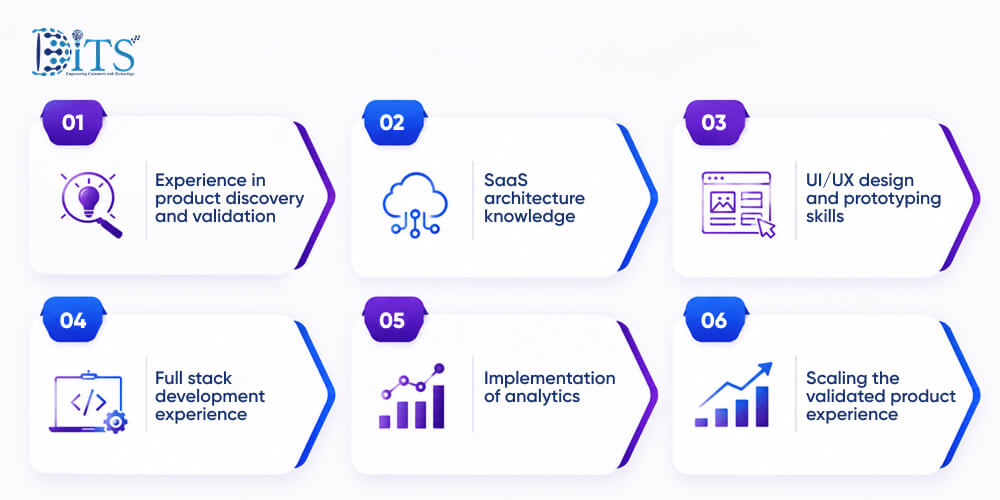
The ideal partner for SaaS MVP development must accomplish more than just transforming a list of features into a software application. They must assist in testing the idea, challenging incorrect conclusions, tracking the project, and creating a solution that provides valuable insights for both the user and the business.
- Experience in product discovery and validation: The partner should contribute to problem formulation, target audience identification, assumptions, and goal definition to validate the product before development.
- SaaS architecture knowledge: The company should take into consideration factors such as security, integration, subscription management, user roles, and so on when building the architecture.
- UI/UX design and prototyping skills: Prototypes should be developed in the early stages of product creation to validate processes and enhance usability.
- Full stack development experience: Everything from front-end and back-end development to API and database development and third-party integrations should be done by your company.
- Implementation of analytics: The software should be monitored, and its performance should be measured in terms of activation, engagement, and conversion.
- Scaling the validated product experience: The partner should know how to shift from MVP validation to a full-fledged SaaS platform.
Ready To Turn Your SaaS Idea Into Reality?
Partner with experienced SaaS developers to build, validate, and scale your MVP while minimizing development risks and costs.
How Ditstek Can Help You Validate Your SaaS Concepts
Ditstek is your consulting and product engineering partner that will help you assess feasibility, define the right MVP scope, and validate your idea before fully developing it.
Here's how we can help:
- SaaS Feasibility Assessment
- SaaS Product Development
- SaaS Architecture Consulting
- Custom MVP Development
- Analytics & Feedback Inclusion
- Third-Party Integrations
- AI SaaS Platform Development
- Cloud, DevOps, Testing & Security
- Scaling and Modernizing Post-Launch
Our experts will enable your business to turn unproven SaaS concepts into valuable MVPs. Schedule a consultation now!
FAQs
1. How does a SaaS MVP validate the idea of the business?
It is possible to try out a fundamental software before investing in its full-scale creation thanks to a SaaS MVP, allowing you to validate demand, usability, interest, and value of your solution.
2. How can an MVP cut down on SaaS development costs?
A minimum viable product includes only key features, which helps save money during the design, testing, and development processes.
3. What functionality is necessary for validating the product using an MVP?
A validation-oriented SaaS MVP must include a core workflow, basic user access rights, a dashboard, analytics, feedback mechanisms, and everything else needed to validate user engagement or interest.
4. How much time does it take to develop a SaaS MVP?
Depending on the number of features, integrations, user roles, security requirements, etc., the MVP development will take from eight to twelve weeks.
5. Will an MVP SaaS solution help attract investments?
Certainly. The MVP allows providing potential investors with demos, feedback from users, engagement metrics, early signs of revenue, etc. Nevertheless, having an MVP does not mean that investments will be attracted.
6. When is a SaaS MVP ready for scaling?
If users consistently complete the core workflow, remain engaged, express willingness to pay, and provide feedback, the SaaS MVP can be scaled.

Dinesh Thakur
21+ years of IT software development experience in different domains like Business Automation, Healthcare, Retail, Workflow automation, Transportation and logistics, Compliance, Risk Mitigation, POS, etc. Hands-on experience in dealing with overseas clients and providing them with an apt solution to their business needs.
Recent Posts
Automated document processing helps reduce cargo insurance claim delays by streamlining document handling, validation, and claims workflows.

Automated document processing helps reduce cargo insurance claim delays by streamlining document handling, validation, and claims workflows.
Discover how chronic care management software uses algorithmic triage to identify patient risk, prioritize care, and improve care team efficiency.