How AI Will Change Software Development & Applications 2026
Table Of Content
Published Date :
08 Jan 2026
Most business leaders have felt it already. Release cycles feel longer than they should. Software costs rise quietly. Teams spend weeks fixing issues that customers never asked for. And the pressure to move faster never really lets up. This is exactly where the conversation around how AI will change software development and applications becomes practical, not theoretical.
AI is no longer sitting on the sidelines as an experimental tool. It is actively reshaping how software is planned, built, tested, and improved after launch. Companies that once relied on rigid development models are now watching competitors ship smarter systems in less time, with fewer errors and better user experiences.
Here’s the real shift. AI is turning software from something static into something responsive. Systems learn from data, adapt to usage patterns, and improve without constant human intervention. For leadership teams, this is not about chasing trends. It is about staying operationally relevant in markets that punish slow execution.
Ready to modernize your software with AI? Let’s design systems that move faster, stay stable, and grow with your business.
Traditional Software Development Vs AI-Driven Development
For years, most software followed a familiar pattern. Business teams defined requirements upfront, developers translated them into fixed logic, and the system behaved exactly as programmed. That approach worked when markets were predictable, and user expectations moved slowly. Today, that certainty is gone.
Traditional development relies heavily on manual decision-making. Every rule is written in advance. Every exception needs human attention. When business conditions change, the software waits. And waiting costs money.
AI-driven development shifts this dynamic. Instead of hard-coding every scenario, systems learn from historical data, user behavior, and operational signals. The result is software that adjusts in real time, not months later during the next release cycle.
Here’s a simple comparison business leaders usually relate to:
| Aspect | Traditional Development | AI-Driven Development |
| Response to Change | Manual updates required | Continuous adaptation |
| Error Detection | Reactive, post-failure | Predictive, early signals |
| Scalability | Linear cost increase | Smarter scaling with data |
| Decision Logic | Fixed rules | Context-aware intelligence |
But there’s a catch. AI does not replace structure. It enhances it. Strong architecture still matters. Clean data still matters. The difference is that AI reduces dependency on constant human correction.
This shift is also what makes AI-assisted software development appealing to leadership teams under pressure. Faster iterations, fewer production surprises, and systems that improve quietly in the background. And guess what? It works when applied with discipline.
How AI is Transforming Software Development Lifecycle
AI is no longer confined to a single phase of development. It now influences the entire lifecycle, from the first planning discussion to long-term system maintenance. This is where AI-assisted software development starts delivering measurable business value, not just technical efficiency.
AI In Requirement Analysis And Planning
Early-stage planning is where many projects quietly fail. Assumptions go unchecked, future scale is underestimated, and edge cases surface too late. AI changes this by analyzing historical project data, user behavior patterns, and operational metrics to flag risks early.
For example, a retail enterprise planning a new internal platform can use AI to predict seasonal load spikes, integration complexity, and even likely feature changes based on past launches. Instead of guessing, teams plan with evidence. That alone can save months.
AI-Assisted Coding And Development
This is where development speed visibly improves. AI tools support developers by suggesting cleaner code structures, identifying redundant logic, and reducing repetitive work. Developers still lead. AI simply removes friction.
Here’s the kicker. Fewer rushed fixes mean stronger foundations. Over time, codebases stay cleaner, easier to scale, and less expensive to maintain. This is one reason agentic ai software development is gaining attention, as systems can independently handle defined development tasks within clear boundaries.
As development maturity increases, many organizations are now experimenting with AI agent development to handle narrowly defined tasks such as code validation, dependency checks, or performance optimization.
These agents operate within clear guardrails, reducing manual oversight while maintaining control. For leadership teams, this means fewer bottlenecks and more predictable delivery timelines without expanding headcount.
AI in Software Testing and Quality Assurance
QA Testing is often where timelines slip. Manual test cases grow outdated fast, and edge cases are easy to miss. AI-driven testing adapts automatically as the application evolves.
At DITS, we use AI not only during development but also across quality assurance, code maintenance, and customization workflows. AI continuously checks code quality, identifies potential failure points, and helps teams act before users are affected. The result is quieter releases and fewer late-night escalations.
AI In Deployment and Maintenance
Once software goes live, the real costs begin. AI-powered monitoring tracks performance, usage anomalies, and infrastructure health in real time. Instead of waiting for complaints, teams receive early signals.
Nobody likes costly surprises, especially when downtime impacts customers and revenue. AI reduces those moments.
Talk to our AI experts and see how intelligent software can reduce delivery risk, lower long-term costs, and scale with your business.
How AI Will Change the Way Applications Are Built
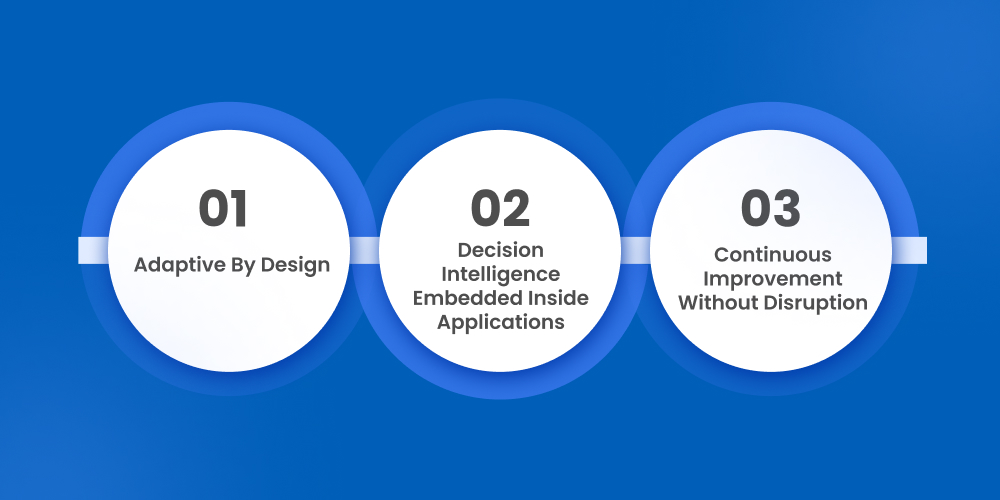
The biggest shift is not how software is coded, but how applications behave once they are live. Businesses are moving away from rigid systems that need constant updates and toward applications that adjust on their own. This is where how ai will change enterprise software development and applications becomes visible to end users, not just IT teams.
Adaptive By Design
Modern applications are no longer built to handle a fixed set of scenarios. They are designed to observe, learn, and adjust. A sales platform can change dashboards based on how teams actually use them. An operations tool can reorganize workflows when bottlenecks appear. These are not future promises. They are happening now.
AI enables applications to respond to real usage patterns instead of assumptions made months earlier during planning. That flexibility reduces rework and protects long-term ROI.
Decision Intelligence Embedded Inside Applications
AI is quietly moving decision logic closer to where work happens. Instead of exporting data to external tools, applications can now surface recommendations directly inside daily workflows.
For example, finance teams see risk signals while reviewing transactions. Operations managers receive early warnings during scheduling. This is a natural extension of AI software development, where intelligence is embedded rather than layered on later.
Continuous Improvement Without Disruption
Here’s the part executives appreciate most. Improvements no longer require full rebuilds. AI allows applications to refine performance incrementally, often without visible downtime. It’s not flashy. It’s effective. And over time, these small improvements compound into significant operational advantages.
Key Application Areas Being Transformed By AI
AI’s impact becomes clearest when you look at where businesses feel the change day to day. These are not experimental use cases. They are operational systems that carry revenue, customer trust, and internal efficiency.
Enterprise Business Applications
Large organizations often struggle with fragmented systems and slow internal processes. AI brings structure without adding complexity. Workflow tools can now prioritize tasks based on urgency and business impact. Reporting systems surface anomalies instead of forcing teams to search for them.
This shift reduces internal friction. Fewer handoffs. Fewer blind spots. And decisions happen closer to real time. For enterprises managing scale, this alone changes how leadership views internal software investments.
Customer-Facing Applications
Customer expectations are unforgiving. Slow interfaces, generic experiences, and delayed responses quietly push users away. AI changes this dynamic by allowing applications to adjust based on individual behavior.
Support platforms enhanced through AI chatbot development handle routine queries instantly while routing complex issues with context already attached. Recommendation engines adapt based on interaction history, not static rules. Customers feel understood, even if they never see the technology behind it.
Industry-Specific Software Solutions
AI is also reshaping industry platforms where precision matters. In logistics, systems forecast delays before they occur. In healthcare operations, healthcare software prioritizes resources based on demand signals. In finance, anomalies are flagged before risk escalates.
Asset-heavy industries benefit as well. With AI asset management, organizations gain clearer visibility into usage patterns, maintenance cycles, and lifecycle costs. Decisions become proactive rather than reactive, and that difference shows up on balance sheets.
And here’s the subtle win. These systems reduce cognitive load on teams. Less firefighting. More planning.
Benefits Of AI-Driven Software Development For Businesses
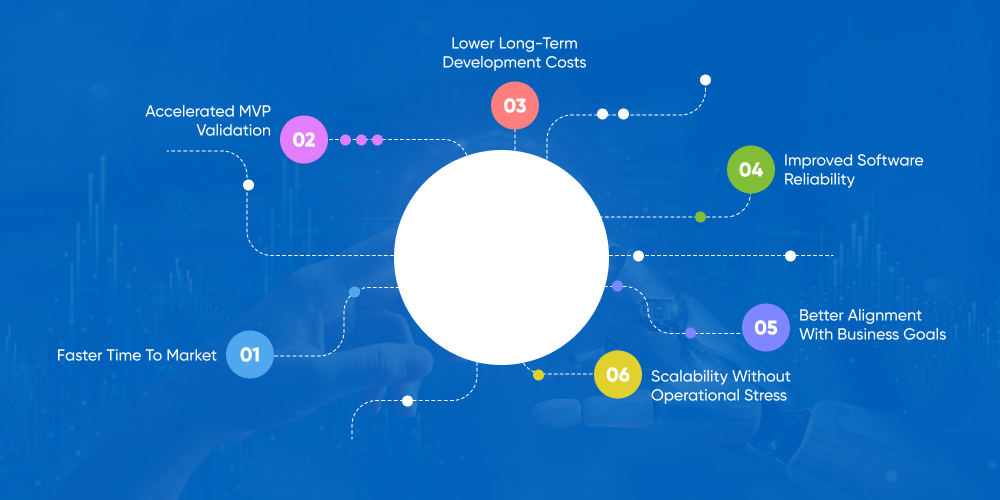
The value of AI becomes clear when you look beyond features and focus on outcomes. Business leaders care about speed, cost control, and reliability. AI directly influences all three when applied with purpose.
Faster Time To Market
AI shortens development cycles by reducing rework and manual effort. Planning becomes sharper, testing adapts automatically, and releases stabilize faster. Teams spend less time correcting and more time delivering what the business actually needs.
Accelerated MVP Validation
AI has also changed how early-stage products are built and tested. With intelligent prototyping, faster iterations, and usage-driven feedback loops, companies can validate ideas without overinvesting upfront. This is where MVP development services supported by AI help leadership teams test assumptions quickly, refine scope, and move forward with confidence before committing to full-scale builds.
Lower Long-Term Development Costs
AI reduces technical debt over time by continuously monitoring code quality and system performance. Fewer emergency fixes mean fewer unplanned expenses. Budgets become predictable, which leadership teams appreciate.
Improved Software Reliability
Predictive monitoring helps identify issues before users are impacted. Downtime drops. Support tickets decline. Customer confidence rises quietly, which is often the most valuable outcome of all.
Better Alignment With Business Goals
AI connects software behavior to real usage patterns. Features that add value are refined. Features that don’t quietly fade. That alignment is why many organizations now evaluate partners based on whether they operate like a best AI software development company, not just a delivery vendor.
Scalability Without Operational Stress
As usage grows, AI helps systems scale intelligently instead of linearly. Infrastructure expands where needed. Performance stays steady. Growth stops feeling risky. These benefits don’t arrive overnight. But once they compound, reverting to older models feels inefficient.
Explore how DITS builds AI-driven software that adapts, improves, and delivers measurable business outcomes from day one.
Why Choose DITS For AI Software And Application Development
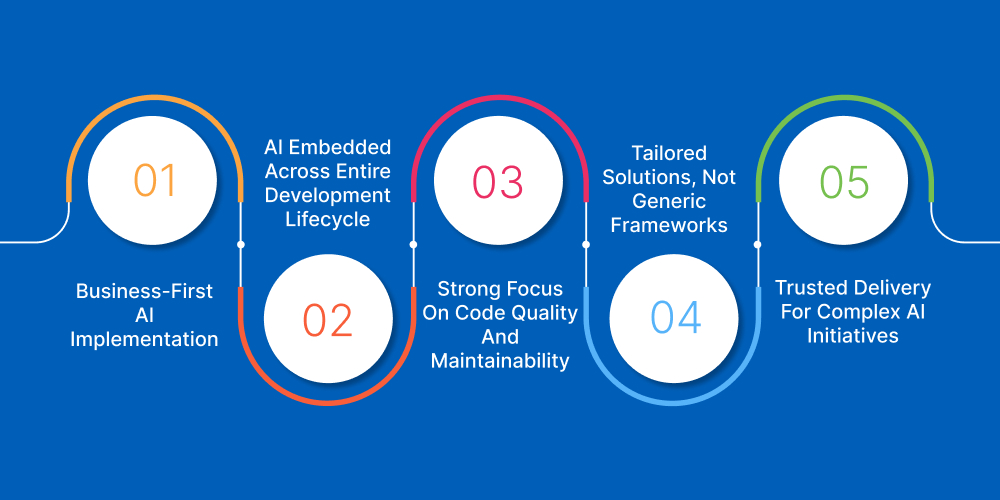
Choosing the right development partner is less about tools and more about execution discipline. AI delivers value only when it is applied with structure, accountability, and a deep understanding of business realities. This is where DITS stands apart.
Business-First AI Implementation
At DITS, AI is not treated as an add-on or experimental layer. Every initiative starts with clear business objectives such as reducing operational friction, improving system reliability, or accelerating time to market. AI decisions are tied directly to measurable outcomes, not vague innovation goals.
AI Embedded Across Entire Development Lifecycle
We use AI consistently across custom software development, quality assurance, code quality monitoring, and ongoing customization. From early planning insights to predictive testing and post-deployment monitoring, AI is integrated into every system we build. This reduces long-term risk and keeps applications stable as they scale.
Strong Focus On Code Quality And Maintainability
Many AI-driven projects fail quietly due to growing technical debt. DITS uses AI to continuously evaluate code health, flag inefficiencies, and maintain clean architectures. Over time, this lowers maintenance costs and prevents performance erosion.
Tailored Solutions, Not Generic Frameworks
Every organization operates differently. Our teams design AI-driven systems that reflect actual workflows, data maturity, and growth plans. Whether modernizing existing platforms or building new applications, customization remains central to our delivery approach.
Trusted Delivery For Complex AI Initiatives
Companies evaluating a long-term partner often look beyond location or branding and focus on execution reliability. DITS delivers with the rigor expected from a best AI software development company, while maintaining flexibility to adapt as business needs evolve.
Conclusion
AI is no longer a future consideration. It is already shaping how modern software is planned, built, tested, and improved over time. The real value does not come from automation alone, but from creating systems that adapt as business conditions change.
What stands out is how clearly how AI will change software development and applications ties back to executive priorities. Faster delivery without sacrificing quality. Fewer operational surprises. Software that aligns with how teams actually work, not how someone assumed they would.
At DITS, we integrate AI across software development, quality assurance, code quality management, and customization. AI is embedded into every solution we build, not added later as an afterthought. This approach allows applications to scale intelligently while staying stable and cost-efficient over time. For organizations evaluating an AI software development company in NYC or global delivery partners, this level of integration is quickly becoming a baseline expectation.
The companies that treat AI as a strategic layer rather than a toolset will move faster, adapt better, and spend less correcting mistakes. And in markets that reward speed and reliability, that difference matters more than ever.
FAQs
What does AI-powered software development actually mean for businesses?
AI-powered development means building software that can learn from data, adapt to usage patterns, and improve performance over time. For businesses, this results in faster releases, fewer system failures, and applications that align more closely with real operational needs rather than static assumptions.
How is AI different from traditional automation in software?
Traditional automation follows fixed rules and breaks when conditions change. AI, on the other hand, recognizes patterns, predicts outcomes, and adjusts behavior without constant human intervention. This makes software more resilient and better suited for dynamic business environments.
Can AI really reduce long-term software maintenance costs?
Yes, when implemented correctly. AI continuously monitors code quality, system performance, and usage trends. This helps detect issues early, reduces emergency fixes, and prevents technical debt from piling up, which significantly lowers long-term maintenance expenses.
Is AI-assisted software development suitable for large enterprises only?
No. While large enterprises benefit from scale, mid-sized and growing businesses often see faster ROI. AI helps smaller teams do more with fewer resources by reducing manual work, improving accuracy, and speeding up decision-making across systems.
How do businesses get started with AI-driven software development?
The first step is identifying clear business problems, not tools. Organizations should assess data readiness, integration needs, and desired outcomes before selecting a development partner. Starting with targeted use cases ensures controlled adoption and measurable impact.
What should companies look for when selecting an AI development partner?
Beyond technical expertise, companies should evaluate the extent to which AI is integrated into the development process. A reliable partner applies AI across planning, development, testing, and maintenance, rather than limiting it to isolated features. Execution consistency matters more than promises.

Dinesh Thakur
21+ years of IT software development experience in different domains like Business Automation, Healthcare, Retail, Workflow automation, Transportation and logistics, Compliance, Risk Mitigation, POS, etc. Hands-on experience in dealing with overseas clients and providing them with an apt solution to their business needs.
Recent Posts
Explore how intelligent document processing for insurance helps businesses automate document workflows, reduce processing costs, improve accuracy, and strengthen operational efficiency across insurance functions.
Discover how automated medical claims processing reduces delays, manual rework, claim denials, and administrative costs while improving reimbursement speed and operational efficiency.
Learn how to build medical billing software with essential features, integrations, security, and development costs.