Benefits of AI in Automotive Industry 2026
Table Of Content
Published Date :
27 Feb 2026
Key Takeaways
- AI in 2026 is a strategic growth lever, not an experimental initiative.
- Production downtime and warranty risks can be reduced significantly with predictive analytics.
- Supply chain visibility improves forecasting accuracy and protects working capital.
- Intelligent pricing and recommendation systems increase dealership conversion rates.
- Connected vehicle data opens recurring revenue opportunities beyond initial sale.
- Faster R&D cycles shorten time to market and strengthen competitive position.
- Structured implementation with clear KPIs determines long-term ROI.
- Automotive businesses that act early build operational resilience and market advantage.
Margins are tighter and supply chains are still unpredictable in automative industry. EV competitors are moving fast and customers expect smarter vehicles every year.
Plants that still rely heavily on manual monitoring are seeing higher downtime. Dealerships without data-driven pricing lose deals to competitors who adjust in real time. Warranty claims quietly eat into profits because early defect signals go unnoticed. Nobody likes those kinds of surprises, especially when they hit quarterly numbers.
The use of AI in automotive industry is helping manufacturers cut production waste, forecast demand with sharper accuracy, and design vehicles faster without compromising safety.
The benefits of AI in automotive industry. Benefits about measurable performance, market share, and staying relevant in a rapidly evolving automotive industry.
AI in Automotive Industry: What It Means for Business Leaders
In 2026, the use of AI in automotive industry is about improving decisions at scale and doing it faster than competitors. It begins with data already sitting inside your systems.
Production logs, sales trends and supplier performance metrics. AI tools analyze these patterns and highlight what managers might miss.
There is also a clear distinction between automation and intelligence. Automation follows predefined rules. Intelligent systems learn from outcomes and improve over time. That shift alone changes how plants operate, how vehicles are tested, and how service models are structured.
Across the U.S., adoption maturity varies. Large OEMs are embedding AI into core systems, while mid-sized manufacturers often start with targeted pilots in quality control or forecasting. Both approaches can work, provided the business case is defined upfront.
Key Benefits of AI in Automotive Industry
Now as we have an idea of the role of AI in the automobile industry, let us now dive into the real benefits it offers for automobile manufacturers as well as dealerships.
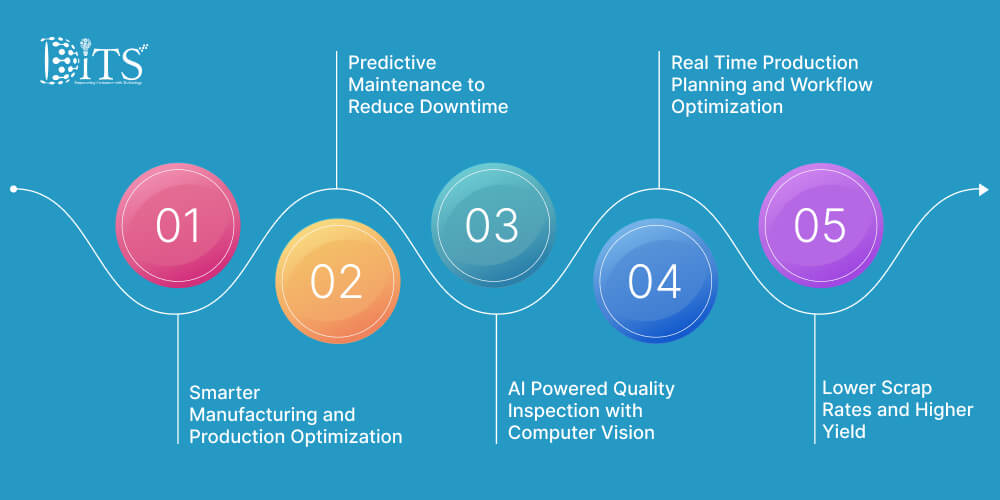
Smarter Manufacturing and Production Optimization
Production efficiency has always defined automotive profitability. A single hour of downtime in a large assembly plant can cost tens of thousands of dollars. AI manages that risk to minimize downtimes.
Predictive Maintenance to Reduce Downtime
Instead of waiting for equipment failure, predictive systems analyze vibration patterns, temperature changes, and machine behavior in real time. One U.S. parts manufacturer reported a 25 percent reduction in unplanned stoppages within nine months of deployment.
The financial impact compounds quickly. Fewer emergency repairs. Lower overtime costs. More stable output.
AI Powered Quality Inspection with Computer Vision
Manual inspection catches many issues, but not all. AI-driven visual systems detect microscopic defects at production speed. Paint inconsistencies. Weld misalignment. Surface cracks invisible to human eyes.
The result is fewer recalls and lower warranty exposure. In high-volume production, even a 1 percent defect reduction can translate into millions saved annually.
Real Time Production Planning and Workflow Optimization
AI models adjust schedules based on material availability, workforce allocation, and order demand. When supply chain disruptions occur, systems recalculate priorities instantly.
That flexibility protects delivery timelines. It also protects customer trust.
Lower Scrap Rates and Higher Yield
Waste reduction directly impacts margins. By analyzing historical production data, AI identifies process variables that cause material loss. Plants become leaner without compromising quality.
And here’s the strategic edge. Efficient production frees capital that can be reinvested into R&D, EV programs, or advanced safety features.
Manufacturing has always been the backbone of automotive success. In 2026, intelligence inside the factory is becoming the differentiator.
Stronger Supply Chain Resilience and Demand Forecasting
If the last few years have taught automotive leaders anything, it is this. Supply chains can break without warning. Semiconductor shortages, port delays, sudden demand spikes. Each disruption carries financial consequences.
AI does not eliminate uncertainty, but it reduces blind spots.
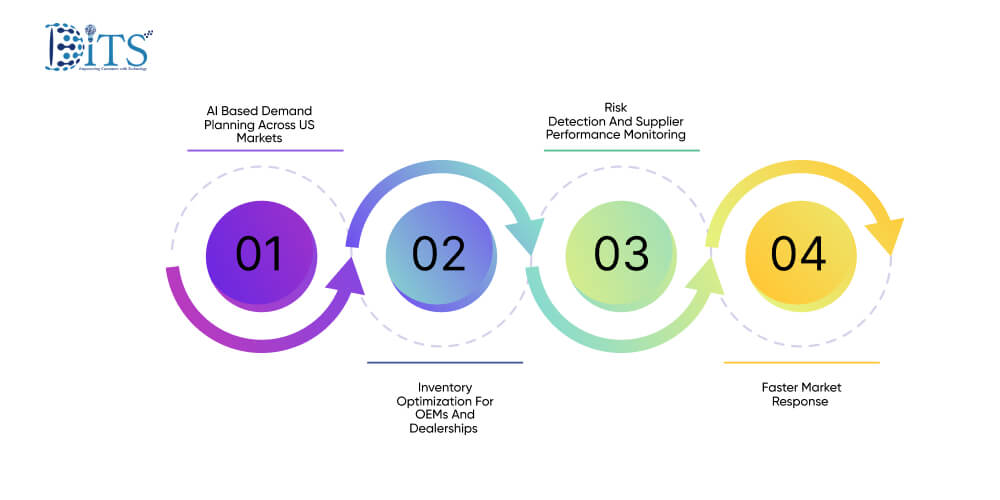
AI Based Demand Planning Across US Markets
Traditional forecasting relies heavily on historical sales. That approach struggles when consumer behavior shifts quickly. AI models incorporate dealership data, regional buying patterns, financing trends, fuel prices, and even seasonal fluctuations.
A regional distributor in Texas reduced excess inventory by 18 percent after implementing AI-driven forecasting across 120 dealerships. Inventory turnover improved within two quarters. Capital was no longer locked in slow-moving models.
Better forecasting improves working capital efficiency. That directly impacts balance sheets.
Inventory Optimization for OEMs And Dealerships
Holding too much inventory increases storage and depreciation costs. Holding too little results in missed sales. AI continuously balances this equation.
Systems analyze real-time sell-through rates and automatically recommend stock reallocation between regions. This minimizes aging inventory and keeps high-demand models available where needed.
The benefit is subtle but powerful. Revenue leakage declines.
Risk Detection and Supplier Performance Monitoring
AI evaluates supplier delivery history, quality metrics, and geopolitical signals. Early warning indicators highlight potential bottlenecks before they escalate.
Procurement teams gain negotiating leverage and contingency planning improves. Instead of reacting to crises, leadership can act early.
Faster Market Response
When EV demand spikes in one region or truck sales dip in another, AI models flag shifts almost immediately. Production schedules adjust accordingly.
In an industry where quarterly performance influences investor confidence, speed matters.
Supply chains will always carry risk. The difference in 2026 lies in visibility and response time.
Next, we move from operational backbone to product intelligence and safety innovation.
Enhanced Vehicle Safety Through ADAS And Autonomous Intelligence
Safety is not only regulatory. It is brand reputation.
Real Time Sensor Data Processing
Modern vehicles generate massive streams of data from cameras, radar, and onboard sensors. AI systems interpret this data in milliseconds, enabling features such as lane assistance and collision avoidance.
Accident prevention is no longer purely mechanical. It is computational.
Improved Driver Assistance Systems
Advanced driver assistance technologies are improving year after year. AI enhances object recognition accuracy and reduces false alerts.
That improves driver trust. And trust influences purchase decisions.
Competitive Differentiation Through Smart Features
Consumers increasingly compare vehicles based on intelligent features rather than horsepower alone. Safety ratings, autonomous capabilities, adaptive cruise control performance. These features impact brand perception.
Here is where long-term value appears. The impact of AI in automotive industry extends beyond cost savings. It shapes customer loyalty and pricing power.
Safer vehicles reduce liability exposure and strengthen brand equity at the same time.
Personalized Customer Experience and Sales Growth
Vehicle buyers today expect relevance. They compare models online, check financing options instantly, and walk into dealerships already informed. Automotive businesses that rely on static pricing or generic offers often lose deals quietly.
AI changes that equation.
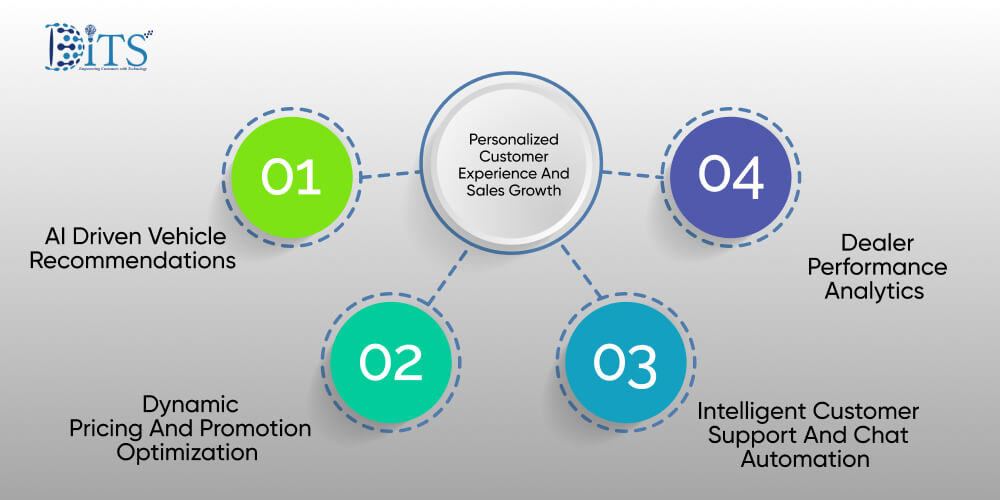
AI Driven Vehicle Recommendations
AI analyzes browsing behavior, trade-in data, credit profiles, and regional preferences to suggest the right vehicle configuration. Instead of overwhelming buyers with options, dealerships can narrow recommendations with precision.
Conversion rates improve because conversations become targeted. A California dealer group reported a 14 percent increase in closing ratios after deploying AI-based recommendation engines across digital platforms.
It feels subtle to the customer. But the impact on revenue is measurable.
Dynamic Pricing and Promotion Optimization
Market demand fluctuates weekly. Incentives that worked last quarter may not move inventory today. AI models evaluate competitor pricing, inventory age, and demand elasticity before recommending price adjustments.
Margins are protected. Discounts become strategic instead of reactive.
Intelligent Customer Support and Chat Automation
Service departments handle thousands of inquiries every month. Appointment scheduling, warranty questions, recall checks. AI-powered chat systems reduce call center load while improving response time.
Customers receive instant answers. Service teams focus on high-value interactions.
Dealer Performance Analytics
AI dashboards highlight underperforming models, sales rep productivity, and regional demand gaps. Leadership teams gain clarity without waiting for monthly reports.
Here’s the broader shift. Sales is no longer intuition driven. It is data informed.
And when customer journeys become smarter, retention improves naturally.
Next, we explore how connected vehicles and predictive service models open new revenue streams.
Connected Vehicles and Predictive Service Models
Modern vehicles continuously generate performance data. Most businesses are only scratching the surface of its potential.
Telematics Data for Performance Insights
Engine performance, battery health, brake wear. AI analyzes this data to identify patterns long before failure occurs.
Manufacturers gain real-world performance intelligence. Product improvements accelerate.
Predictive Maintenance Alerts for Vehicle Owners
Instead of waiting for breakdowns, drivers receive proactive service notifications. This increases dealership service bookings and reduces roadside incidents.
Nobody enjoys unexpected repairs. Early alerts build trust.
Subscription Based Service Revenue Models
AI enables usage-based services such as feature activation, remote diagnostics, or fleet performance analytics. Revenue shifts from one-time sales to recurring streams.
Margins stabilize over time.
Aftermarket Revenue Optimization
AI identifies parts likely to fail within certain mileage ranges and aligns inventory accordingly. Service centers stock what customers will need before they ask.
Here’s the bigger picture. The use of AI in automotive industry is transforming post-sale engagement into long-term value creation.
Next, we turn inward again and examine cost efficiency across operations.
Operational Cost Reduction and Efficiency Gains
Cost control remains central to executive strategy. AI supports this in multiple layers.
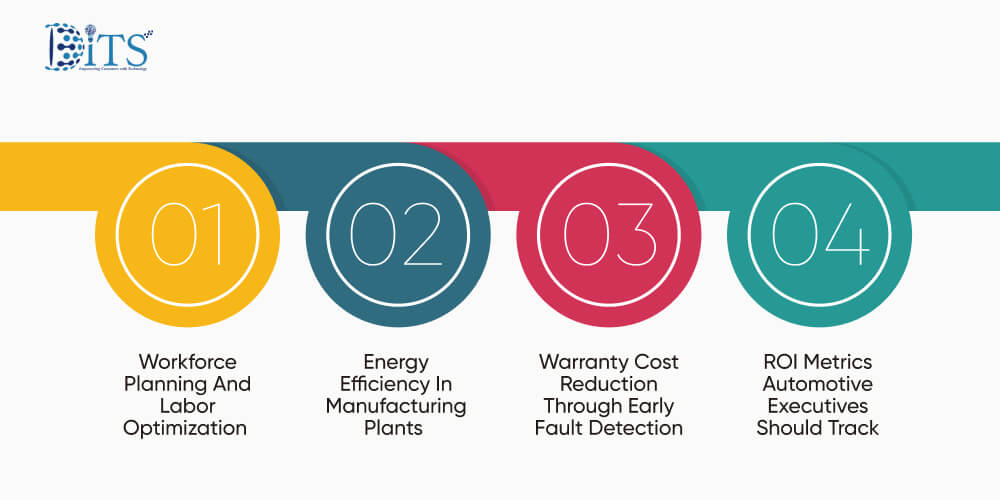
Workforce Planning and Labor Optimization
AI models forecast labor demand based on production schedules and seasonal sales cycles. Overtime costs decline. Staffing gaps reduce.
Balanced teams operate more efficiently.
Energy Efficiency in Manufacturing Plants
Energy consumption is a major expense in automotive manufacturing. AI systems monitor power usage across equipment and recommend adjustments.
A plant in Ohio reported nearly 12 percent reduction in annual energy costs after deploying AI-based monitoring tools.
Savings accumulate quietly but significantly.
Warranty Cost Reduction Through Early Fault Detection
By analyzing early defect signals across thousands of vehicles, AI identifies recurring issues before large-scale recalls occur.
That alone can protect millions in potential liability.
ROI Metrics Automotive Executives Should Track
Below is a snapshot of measurable outcomes commonly reported within 12 to 24 months of structured AI adoption:
| Area of Impact | Average Improvement Range |
| Unplanned Downtime | 20% to 30% Reduction |
| Inventory Holding Costs | 10% to 18% Reduction |
| Warranty Claims | 8% to 15% Reduction |
| Sales Conversion Rates | 10% to 20% Increase |
Numbers vary by organization, but the direction is consistent.
Efficiency is no longer achieved solely through cost cutting. It is achieved through intelligent optimization.
Next, we examine how AI accelerates design and innovation cycles.
Faster Vehicle Design And R&D Innovation
Product cycles are shrinking. What once took five years from concept to launch now needs to happen in three, sometimes less. Speed without precision, however, is expensive. This is where intelligent systems reshape engineering workflows.
AI Assisted Simulation and Virtual Testing
Instead of building multiple physical prototypes, engineering teams now rely on AI-driven simulations to test aerodynamics, crash scenarios, and battery performance digitally. Thousands of variations can be evaluated in weeks.
Development costs decline. Validation timelines compress.
Design Optimization Using Data Models
AI analyzes historical performance data, customer feedback, and environmental factors to suggest design improvements. Engineers are not replaced. They are augmented.
Here is where generative AI in automotive industry is gaining attention. It helps design teams explore alternative component structures that reduce material weight while maintaining strength. Lighter vehicles improve efficiency without compromising safety.
Innovation becomes structured rather than trial and error.
Shortened Prototype Cycles
By predicting failure points early, AI reduces the number of physical iterations required. This accelerates go-to-market strategies and supports faster response to competitive launches.
Reduced Time To Market
In competitive EV and hybrid segments, launching six months earlier can shift market share significantly. AI-supported R&D allows leadership to move confidently without sacrificing compliance.
Speed creates advantage. Smart speed creates profit.
Next, we address an area executives increasingly prioritize: risk and cybersecurity.
Advanced Cybersecurity and Risk Management
Connected vehicles and intelligent manufacturing systems introduce new risk layers. Digital exposure increases. So, must protection.
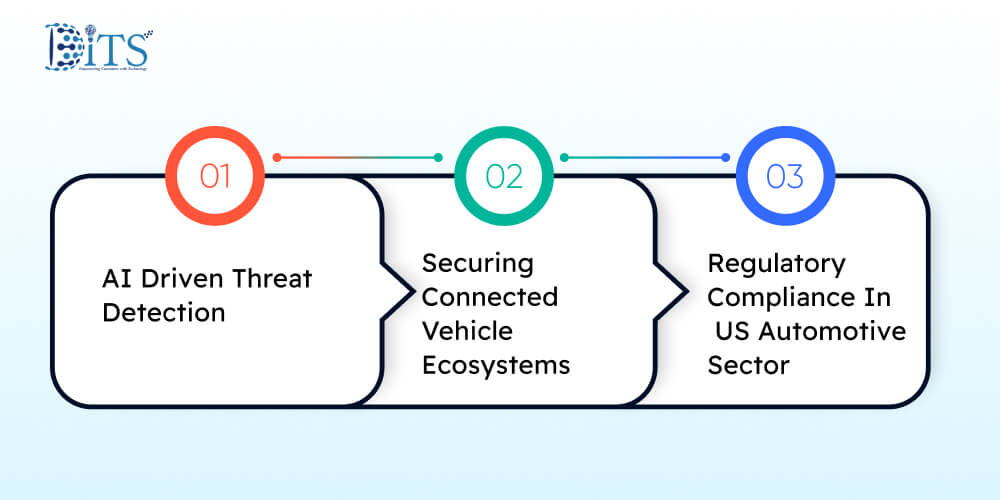
AI Driven Threat Detection
AI continuously monitors network traffic across production systems and connected vehicles. Suspicious patterns are flagged instantly.
This reduces potential downtime from cyber incidents. It also protects brand reputation.
Securing Connected Vehicle Ecosystems
With vehicles communicating through cloud platforms, data protection becomes mission-critical. AI identifies anomalies in telematics data that may signal intrusion attempts.
Proactive monitoring reduces liability exposure.
Regulatory Compliance In US Automotive Sector
Compliance requirements around safety data and cybersecurity are tightening. AI assists in tracking audit trails, system changes, and anomaly reports.
For executives, the benefit is clarity. Risks become visible instead of hidden.
Now, before implementing at scale, automotive businesses must acknowledge real-world challenges.
Key Challenges Automotive Businesses Must Address
AI initiatives fail not because of technology but because of execution gaps.
Data Quality and Governance
Inconsistent or incomplete data weakens outcomes. Structured governance frameworks are essential before scaling initiatives.
Legacy System Integration
Older ERP and production systems may not easily integrate with advanced models. Strategic planning is necessary to avoid fragmented deployments.
This is where AI Integration services play a crucial role, aligning new intelligence layers with existing infrastructure without disrupting operations.
Workforce Skill Gaps
Upskilling engineers and managers ensure adoption translates into measurable value. Technology without training rarely delivers ROI.
Ethical And Regulatory Considerations
As AI influences safety features and automated decisions, transparency becomes critical. Clear accountability frameworks protect both customers and businesses.
Execution discipline determines whether AI becomes a growth engine or an expensive experiment.
Next, we look at how leadership teams can structure a practical roadmap.
Building AI Roadmap For Automotive Growth
Strategic planning begins with prioritization.
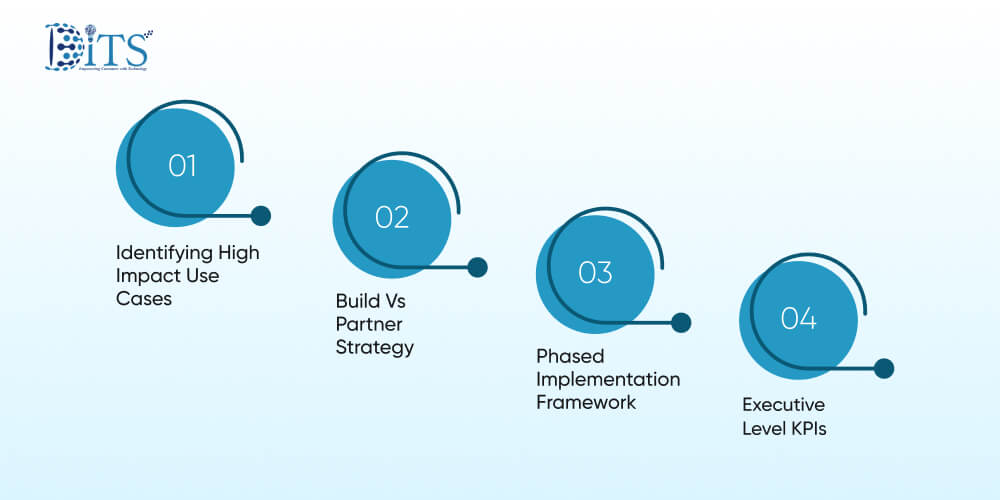
Identifying High Impact Use Cases
Focus on measurable outcomes. Downtime reduction. Inventory optimization. Warranty cost control. Early wins build internal confidence.
Build Vs Partner Strategy
Some organizations choose in-house development. Others collaborate with an AI software development company to accelerate implementation and reduce risk.
The right model depends on internal capabilities and timeline pressures.
Phased Implementation Framework
Start with pilot programs in defined operational units. Measure performance for six to nine months. Scale gradually.
Disciplined rollouts prevent resource strain.
Executive Level KPIs
Track metrics tied to profitability, not just technical performance. ROI, cost reduction, conversion growth, defect rate improvement.
For companies seeking advanced orchestration, agentic AI in automotive industry is emerging as a next phase. These systems autonomously coordinate processes across supply chain, production, and service functions, reducing manual intervention further.
At DITS, AI is embedded into every software initiative we deliver. From development and quality assurance to maintaining code quality and customization, intelligence supports precision at every stage. Our AI agent development capabilities enable scalable automation tailored to automotive workflows. Structured IT consulting services further help organizations align technology investments with long-term strategy.
Why US Automotive Businesses Must Act Now
Market cycles are tightening. EV adoption is accelerating. Consumer expectations are rising.
The impact of AI in automotive industry is no longer incremental. It influences profitability, valuation, and long-term competitiveness. Organizations that delay risk widening performance gaps compared to early adopters.
The opportunity is clear. Implement strategically. Measure rigorously. Scale intelligently.
Conclusion
AI in 2026 is not a side initiative. It is operational infrastructure.
From plant floors to customer service desks, intelligent systems improve visibility, reduce risk, and unlock new revenue models. Automotive leaders who approach AI with discipline and clarity are building more resilient enterprises.
The question is no longer whether AI fits automotive strategy, but how quickly automobile businesses can execute.
Frequently Asked Questions
1. How long does it take to implement AI in automotive operations?
Timelines depend on scope. A focused pilot in predictive maintenance or demand forecasting can take 3 to 6 months. Enterprise-wide transformation across production, supply chain, and dealership systems may take 12 to 24 months. The key is phased execution with measurable milestones rather than large, uncontrolled rollouts.
2. What is typical ROI from AI adoption in automotive business?
Most U.S. automotive companies see financial impact within the first year when projects are aligned with operational metrics. Downtime reduction of 20 percent, inventory cost reduction of 10 to 15 percent, and improved sales conversion rates are common early indicators. ROI improves significantly when AI initiatives are tied directly to profitability and cost control metrics.
3. How can DITS support AI software development for automotive business?
DITS delivers specialized AI software development for automotive business by embedding intelligence into production systems, dealer platforms, predictive maintenance tools, and connected vehicle applications. Our approach combines custom engineering, quality assurance, and scalable architecture to ensure AI solutions integrate seamlessly with existing automotive infrastructure while maintaining performance and compliance standards.
4. Why choose DITS for AI software development for automotive business?
DITS goes beyond surface-level automation. Our AI software development for automotive business focuses on measurable outcomes such as reduced operational risk, improved production efficiency, and enhanced customer engagement. We integrate AI into software design, testing, code quality management, and customization, ensuring long-term scalability rather than one-time deployment.
5. Is AI suitable for mid sized automotive manufacturers or only large OEMs?
AI is not limited to large OEMs with massive R&D budgets. Mid sized manufacturers can begin with focused initiatives such as predictive maintenance, supplier risk analysis, or inventory optimization. When implemented strategically, even a single plant level deployment can generate meaningful cost savings within the first year. The key is selecting high impact use cases and scaling gradually based on measurable business results.

Dinesh Thakur
21+ years of IT software development experience in different domains like Business Automation, Healthcare, Retail, Workflow automation, Transportation and logistics, Compliance, Risk Mitigation, POS, etc. Hands-on experience in dealing with overseas clients and providing them with an apt solution to their business needs.
Recent Posts
Explore how intelligent document processing for insurance helps businesses automate document workflows, reduce processing costs, improve accuracy, and strengthen operational efficiency across insurance functions.
Discover how automated medical claims processing reduces delays, manual rework, claim denials, and administrative costs while improving reimbursement speed and operational efficiency.

Learn how to build medical billing software with essential features, integrations, security, and development costs.