How Custom Billing Software Solves Behavioral Health Billing Gaps
Table Of Content
Published Date :
04 Aug 2026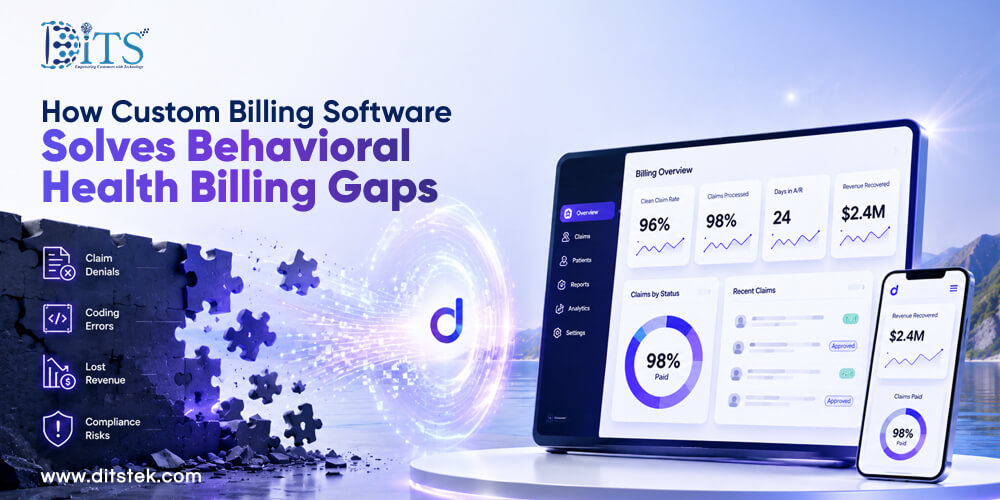
Key Takeaways
- Behavioral health-specific custom billing software facilitates verifying eligibility, payer policies, clinical documentation, and claim information prior to claim submission.
- Automation eliminates revenue loss from missing charges, late submissions, incorrect payment posting, underpayment, and outstanding patient accounts.
- Comprehensive claim management allows better control over denials, follow-ups, appeals, and important claims.
- Custom behavioral health billing software development makes complete sense if standard solutions cannot handle particular workflow, payer demands, integration, or reporting needs.
What is it that makes behavioral health organizations struggle with denials and revenue loss in spite of their billing systems? It turns out to be associated with complicated payer guidelines, repeat treatments, stringent authorization criteria, inadequate documentation, wrong coding, and slow claims processing.
When all of these occur in conjunction with the operation of clinical, billing, and financial systems in isolation, the situation only gets worse. To cater to this, behavioral health billing software comes to the rescue. It integrates documentation, payer guidelines, claims processing, denial management, and payment information all into a single system.
Market Statistics
The behavioral health care software market size is estimated to be around USD 8.6 billion by 2030 with a growth in CAGR of 13.0% (from 2025-2030).
Asia pacific region is anticipated to see a full-fledged growth rate from 2026 to 2031.
Why Revenue Slips Through Behavioral Health Workflows?
It is important to understand that in the case of behavioral health organizations, revenue leakage starts way earlier than the submission of the claim to the payer. A simple mistake in the process of documentation or coding may significantly decrease the likelihood of successful reimbursement.
Main reasons include:
- Lack of complete and timely clinical documentation
- Lack of preauthorization and eligibility check-ups
- Inappropriate procedure and diagnosis codes used
- Delayed claim submission
- Lack of tracking of underpayments and outstanding balances
- Manual transfer of information from one team to another
- Absence of data on denial patterns
- Disconnection of EHR, EMR, and billing software
Failure to address these challenges will result in additional time spent on correcting claims and dealing with denial management. A well-integrated medical billing software for behavioral health assists in detecting the gaps beforehand thereby influencing the cash flow of the organization.
Facing Behavioral Health Billing Delays And Errors?
Automate billing workflows, reduce claim denials, and improve reimbursement accuracy with custom behavioral health billing software.
How Custom Behavioral Health Billing Software Helps Prevent Claim Rejections
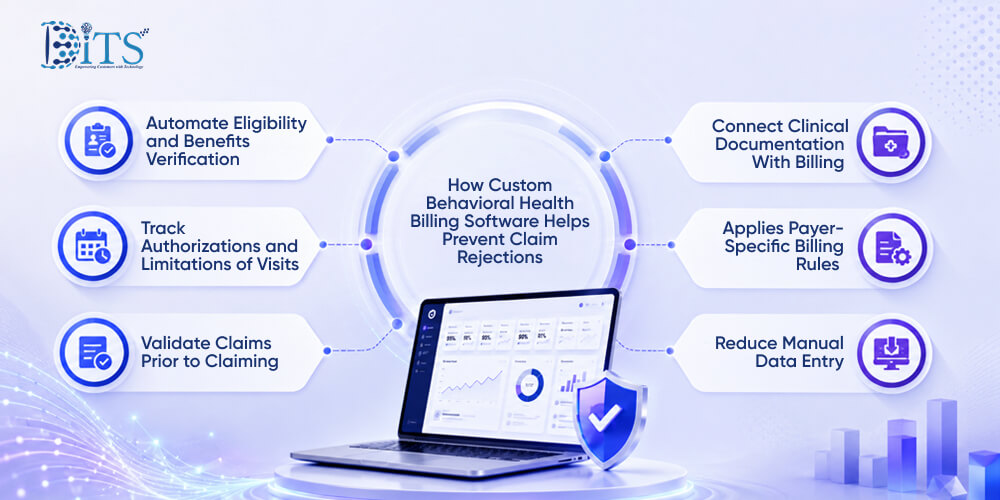
Custom behavioral health billing software helps prevent claim rejections before submitting claims. This makes sure that all aspects including eligibility, authorization, documentation, coding, and payer requirements are considered in a more streamlined process.
The use of rehab billing software can be extended to accommodate for the repeat process, tiers of care, limitation on authorizations, and specialized procedures of substance abuse treatment and rehabilitation centers too.
Custom behavioral health billing software helps:
Automate Eligibility and Benefits Verification
- Determines if coverage is active
- Reviews deductibles, copay, and benefits limit
- Checks if proposed treatments will be covered
- Detects any potential eligibility problems in advance
Track Authorizations and Limitations of Visits
- Monitor the date of authorization start and expiry
- Track visits authorized, utilized, and remaining
- Notify teams regarding re-authorizations needed
- Avoid exceeding the allowed number of visits
- Minimize denial of claims for authorization issues
Validate Claims Prior to Claiming
- Determine missing data related to patient or provider
- Spot coding errors of diagnosis and procedure
- Detect duplicated services or charge codes
- Verify claims in accordance with payer requirements
Connect Clinical Documentation With Billing
- Aligns clinical documentation with billing services
- Links treatment protocols with clinical documentation
- Aligns appointments, documentation, and charges
- Decreases differences in documented care and claims
- Assists in better documentation for payer audits
Applies Payer-Specific Billing Rules
- Customizes rules based on payer’s criteria
- Tracks limits on claim submission and deadlines
- Considers applicable coding and authorization guidelines
- Adapts different types of claims and documentation policies
- Decreases mistakes due to differences in payer policies
Reduce Manual Data Entry
- Imports data from scheduling and billing systems
- Syncs data between EHR/EMR and payment system
- Avoids duplicate input of patient and services details
- Prevents human mistakes in billing processes
- Makes claims processing easier for staff
All these capabilities enable behavioral health organizations to create more accurate claims, prevent unnecessary rejections, and achieve greater consistency in reimbursement.
How Does Billing Automation Mitigate Revenue Leakage?
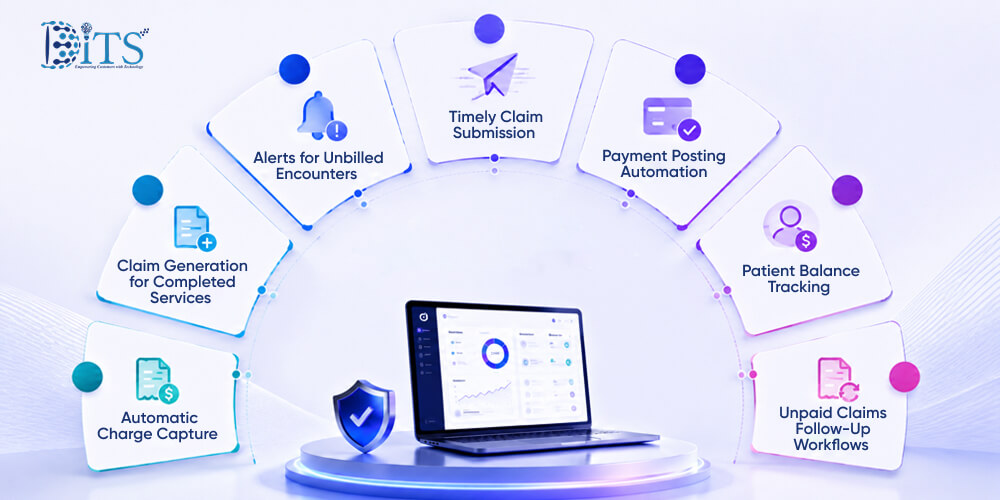
Revenue leakage is not always the result of denial of claims alone. Revenue leakage may also occur through services provided but not billed, payment posting errors, failure to detect underpayments, and delays in collecting outstanding balances. Billing automation plays an important role in mitigating revenue leakage with revenue-related tasks throughout the billing process.
Through automatic capturing of charges, generating claims, posting payments, and collections process, behavioral health billing software ensures that money that is already due to an organization through revenue that is not billed gets accounted for.
Automatic Charge Capture
- Captures completed services as charges
- Prevents missed charges because of manual data entry
- Connects services with billing process
- Ensures accuracy in high volume billing processes
Claim Generation for Completed Services
- Creation of claims only after completion of required services
- Retrieval of information related to patients, providers, and services automatically
- Minimizes time gaps between services and claim generation
- Aids in efficient claim creation
Alerts for Unbilled Encounters
- Completion of visits that have no claims created
- Identification of missing documentation or billing information
- Allows resolving problems before the deadline for filing
- Avoids revenue leakage
Timely Claim Submission
- Faster processing of approved claims into the submission process
- Minimizes the risk of delays resulting from manual processes
- Enables the team to comply with payer filing deadlines
- Contributes to a more predictable reimbursement process
Payment Posting Automation
- Matching of payment details to claims submitted
- Updating of claims' payment status
- Minimizes manual errors during the process
- Facilitates understanding of outstanding balance
Patient Balance Tracking
- Monitors copays, deductibles, and outstanding balances of patients
- Keeps the balances updated after insurance payments
- Enhances statement processing and collection activities
- Increases visibility in patient-side revenue collection
Unpaid Claims Follow-Up Workflows
- Puts emphasis on the oldest or most valuable unpaid claims
- Assigns follow-up tasks to members of the billing team
- Keeps track of pending activities and payer responses
- Prevents the claims from becoming forgotten
Through these automated processes, behavioral healthcare organizations can capture more of their earned revenue without allowing human errors in billing and collections.
How Centralized Claim Tracking Improves Denial Management?
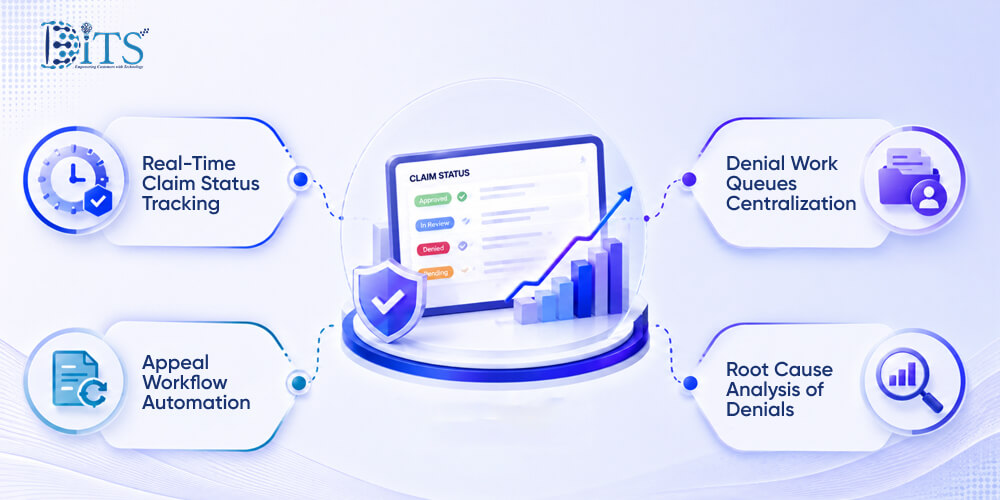
Centralized claim tracking improves billing teams' oversight of each step in the revenue cycle. As opposed to using spreadsheets, emails, and several portals for different payers, the billing software for behavioral health brings all claim statuses, reasons for denial, follow-up procedures, and appeals management into one consistent process.
Real-Time Claim Status Tracking
Billers can trace claims from their creation and submission through acceptance, payment, denial, or appeal. Real-time access to information about claim statuses allows for the recognition of problematic cases before they impact cash flow.
Denial Work Queues Centralization
Denied claims can be sorted by reason for denial, payer, value, resubmission deadlines, and even biller names. It helps to prioritize claims that are valuable or require quick attention.
Appeal Workflow Automation
Workflow automation software monitor deadlines, compile required documentation, allocate assignments, and track appeal status. This can minimize human intervention and facilitate timely filing of appeals against eligible denials.
Root Cause Analysis of Denials
Using in-built reporting, organizations uncover any underlying reasons for frequent denials, which may include authorization issues, wrong codes, lack of clinical notes, etc.
How Does Payment Visibility Help Prevent Revenue Leakage?
Financial decision-makers should have a complete view of the revenue cycle process, not merely the final revenue figure at the end of the month. Customized behavioral health billing software provide the dashboards and reports needed to show where claims, payments, and balances currently stand. This enables one to know whether revenue is going as expected or if there is some delay at a certain level.
The rehab billing software helps team to track submitted claims, pending claims, denied claims, clean claims, collected claims, and days in accounts receivable. They will also be able to analyze whether expected reimbursement matches actual reimbursement to spot partial payments, underpayments, and unpaid claims that need follow-up.
Revenue is broken down by payers, locations, treatment programs, services offered, or even providers. This will enable financial decision-makers to know which revenue cycles are performing and which areas of the billing process may lead to cash flow problems. Patient outstanding balances can be tracked separately to give a better idea of revenue from both the payer and the patient's side.
How EHR and EMR Integration Reduces Billing Errors
Disconnected systems will require clinical and billing teams to repeatedly enter information into different systems. This is likely to increase administrative costs and make it easier for information to be entered incorrectly or become obsolete and inconsistent. Connecting behavioral health medical billing software with EHR and EMR systems will help ensure that documentation, services, and billing information are consistent.
Behavioral health organizations can also use healthcare software development services to connect billing software with their existing clinical, administrative, and financial systems. Such integration helps information move smoothly between different platforms, minimizes repeated manual data entry, and allows teams to access accurate information while processing claims, tracking payments, and resolving billing issues.
Some of the integration options includes:
- EHR integration
- Appointment and scheduling system
- Patient intake portal
- Insurance eligibility system
- Claims clearinghouse
- Payment gateway
- Accounting system
- Reporting and analysis
Connected systems will allow critical billing information to flow across platforms without the need for repetition of manual data entry. Some examples of such information include patient demographics, insurance information, appointment information, authorizations, clinical notes, diagnosis codes, procedure codes, claims status, remittance information, and payment information.
This eliminates duplication of effort, increases claim accuracy, and decreases the time lag between service provision and claims filing. This enables all the clinical, billing, and financial personnel to have better access to information that can help them solve issues quickly.
Why Custom Behavioral Health Billing Software Makes Sense
Developing custom software is beneficial when billing platforms fail to meet an organization's workflow, integration, and reporting needs. Providers of behavioral health services need to manage complex payer guidelines, treatments that have to be performed repeatedly, limits on authorizations, many programs, and specific billing requirements for different locations.
This can also be the case where teams use spreadsheets, perform repetitive tasks, have trouble managing denials, and have poor visibility into payments. Custom behavioral health medical billing software will help organizations meet their operational needs through automation, integration, reporting, and ongoing development.
Ready To Modernize Behavioral Health Billing Operations?
Partner with healthcare software experts to build secure, scalable billing solutions that improve financial performance and operational efficiency.
How Ditstek Facilitates Behavioral Health Billing Software Development
Ditstek is a an established IT consulting and product engineering firm that helps behavioral health providers update their billing processes through customized software solutions and automation.
At DITS, we first identify any existing issues, including revenue leakage, denial trends, payer policies, and technical challenges, before creating a realistic roadmap for moving forward. Our substance abuse software solutions range from custom billing software to analytics and legacy migration.
Want to get ahead of your competitors, get in touch with our professionals now!
FAQs
How does behavioral health billing software minimize claim denials?
Behavioral health billing software performs a pre-submission analysis of eligibility, authorizations, clinical documentation, coding, and payer rules. Such functionality assists billing teams in avoiding submission of inaccurate claims, which may lead to denials.
How does medical billing software for behavioral health eliminate revenue leakage?
Medical billing software for behavioral health detects unbilled services, late claims, underpayments, and outstanding balances. In addition, automation of follow-up, charge capture, and payment posting helps avoid revenue leakage.
Does behavioral health medical billing software integrate with EHR and EMR systems?
Yes. Behavioral health medical billing software allows for integration with EHR and EMR systems to facilitate the exchange of patient data, clinical documentation, authorizations, service codes, claim statuses, and payments while minimizing the need for duplicating information.
Which features should behavioral health medical billing software have?
The top features of behavioral health medical billing software include eligibility checking, authorization tracking, claim validation, payer rule configurations, denials management, payment posting, patient balance tracking, dashboards, and integration with EHR/EMR.

Nidhi Thakur
With more than 19 years of experience - I represent a team of professionals that specializes in the healthcare and business and workflow automation domains. The team consists of experienced full-stack developers supported by senior system analysts who have developed multiple bespoke applications for Healthcare, Business Automation, Retail, IOT, Ed-tech domains for startups and Enterprise Level clients.
Recent Posts

Automated document processing helps reduce cargo insurance claim delays by streamlining document handling, validation, and claims workflows.

Automated document processing helps reduce cargo insurance claim delays by streamlining document handling, validation, and claims workflows.
Discover how chronic care management software uses algorithmic triage to identify patient risk, prioritize care, and improve care team efficiency.