How AI Chatbot Development Middle East Drives Operational Efficiency
Table Of Content
Published Date :
17 Feb 2026
Operational efficiency sounds neat in boardroom slides, but on the ground, it feels very different. Sometimes customers wait too long for a response, and the internal team gets stuck chasing approvals across three systems. A manager might be refreshing dashboards that don’t quite agree with each other. These are everyday scenes across Middle East businesses, especially in fast-growing markets like Saudi Arabia and the UAE.
Many companies here are trying to move fast and modernize at the same time. Legacy systems continue to run critical operations, while business owners expect new digital initiatives to deliver results almost overnight. Hiring more people isn’t always the answer. It’s expensive, slow, and skilled talent is hard to retain.
This is where AI chatbot development Middle East is quietly changing the way teams work on day-to-day operations. As a practical layer that reduces friction across operations, handles repetitive work, and helps teams move faster without breaking what already exists.
Operational Efficiency Challenges Middle East Companies Face
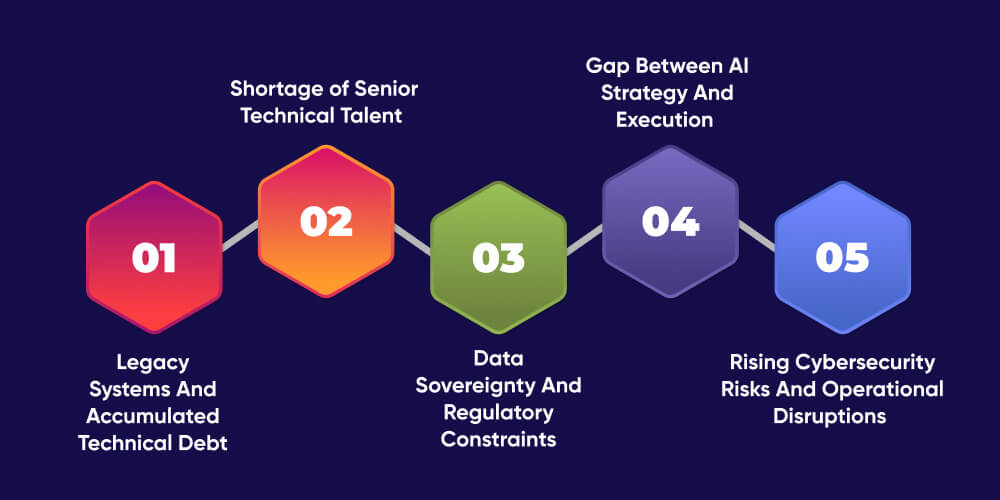
Operations in the Middle East struggle because growth outpaces systems, skills, and structures. Many organizations are running world-class businesses on foundations built a decade ago. And the cracks show up daily.
Legacy Systems And Accumulated Technical Debt
Walk into a regional bank or a large retail group, and you’ll often find the same story. Core systems that still work, but only just. They were never designed to support real-time data access, automation, or AI-driven interactions.
Common symptoms include:
- Multiple logins just to complete one task
- Manual data re-entry between systems
- Weekly operational slowdowns caused by system limitations
In Saudi Arabia alone, a majority of enterprises report regular business disruption due to foundational IT issues. The problem isn’t that these systems are broken. It’s that modern tools don’t speak their language anymore. Every integration is challenging as the new software are usually not compatible with old systems.
Shortage of Senior Technical Talent
Hiring hasn’t kept pace with transformation goals. Junior developers are entering the market, but experienced architects and DevOps leaders are scarce.
Here’s what that looks like in practice:
- Senior engineers are spending time on basic support issues
- Delayed modernization projects due to a lack of leadership bandwidth
- Smaller teams are stretched thin while expectations keep rising
Large national initiatives and energy giants can afford top talent, but mid-sized enterprises often cannot. And when one senior engineer leaves, knowledge walks out the door with them. That loss hits operations hard.
Data Sovereignty And Regulatory Constraints
Regulations across the GCC are clear. Sensitive data must stay within national borders. For many businesses, this has turned cloud adoption into a careful balancing act.
Operational challenges include:
- Hybrid environments that are costly to maintain
- Delays in rolling out automation due to compliance reviews
- Confusion over where data lives and who can access it
What should speed things up often slows them down. Teams hesitate, projects stall, and efficiency takes a back seat to risk avoidance.
Gap Between AI Strategy And Execution
Almost every leadership team talks about AI. Fewer can point to results beyond pilot projects.
Why?
- Data scattered across departments
- Inconsistent formats and poor quality
- No clear ownership once pilots go live
AI initiatives start strong, then quietly fade into “phase two.” Meanwhile, daily operations continue to rely on manual processes. The opportunity cost is real. Time, money, and momentum are lost.
Rising Cybersecurity Risks And Operational Disruptions
Cyber threats in the region are not theoretical. They are frequent, targeted, and increasingly sophisticated.
Operational impact shows up as:
- Unexpected downtime
- Emergency response efforts pulling teams off core work
- Increased internal friction around access and approvals
On top of that, qualified security leadership is hard to find. Without strong governance, even simple digital interactions become risky. And nobody likes costly surprises, especially when clients are waiting.
These challenges don’t exist in isolation. They pile up. And together, they slow businesses down at the exact moment speed matters most.
Looking to Modernize Without System Disruption?
See how AI chatbots integrate with existing infrastructure while supporting data sovereignty and operational continuity.
How AI Chatbot Development Middle East Addresses Core Technical Barriers
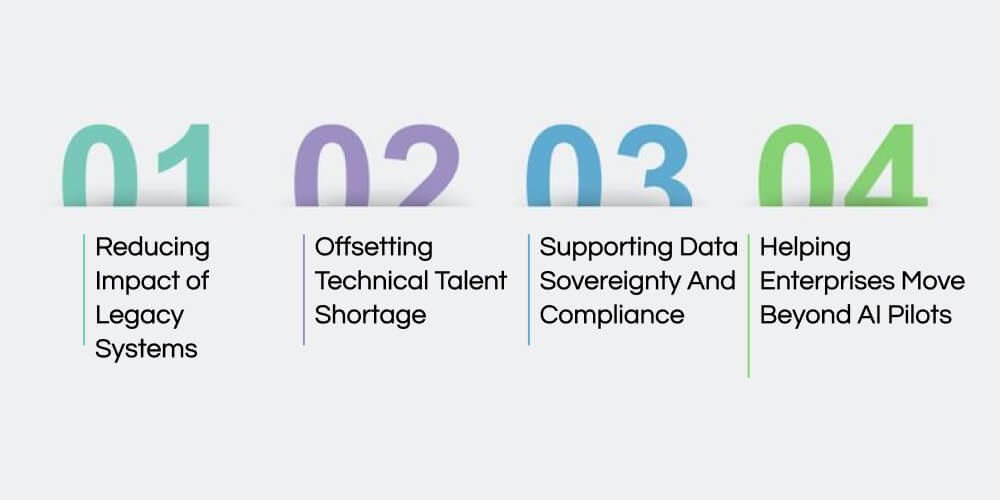
Most efficiency problems don’t come from one big failure. They come from dozens of small blockers that slow teams down every single day. This is where well-planned AI chatbot development Middle East starts doing the heavy lifting quietly and consistently without forcing dramatic change.
Reducing Impact of Legacy Systems
Legacy platforms aren’t going away anytime soon. And honestly, many don’t need to. They just need a better way to interact with people.
AI chatbots create that bridge.
Instead of employees logging into outdated interfaces or calling internal teams for simple data, chatbots fetch information directly through secure integrations. The result feels almost immediate.
Business impact looks like this:
- Faster access to reports and records
- Fewer manual workarounds
- Less dependency on tribal system knowledge
Teams stop fighting the system and start using it.
Offsetting Technical Talent Shortage
Here’s a familiar scenario. A senior engineer spends half the day answering repetitive questions. Password resets. Status checks. Basic system guidance.
That’s expensive talent doing low-value work.
Chatbots absorb those Tier-1 and Tier-2 interactions. Over time, this reduces burnout and frees senior staff to focus on migrations, performance tuning, and architecture decisions. Knowledge stays within the organization rather than walking out with resignations.
Supporting Data Sovereignty And Compliance
Compliance requirements in the region aren’t flexible. Data must stay local. Access must be controlled. Audits must be clean. AI chatbot software can be deployed within localized infrastructure, aligned with in-country cloud environments. Access rules are enforced at the interaction level, not left to chance.
Operationally, that means:
- Faster approvals from compliance teams
- Lower risk during automation rollouts
- More confidence to scale digital initiatives
Efficiency improves when teams stop second-guessing compliance.
Helping Enterprises Move Beyond AI Pilots
Many AI projects stall after proof of concept. Not because the idea was wrong, but because scaling felt risky.
Chatbots change that dynamic.
They offer repeatable, visible use cases that leadership understands. Each interaction improves data quality. Each rollout builds confidence. Over time, AI stops being a side project and becomes part of daily operations. That’s when returns finally show up on balance sheets.
Complementary Software Solutions That Amplify AI Chatbot Impact
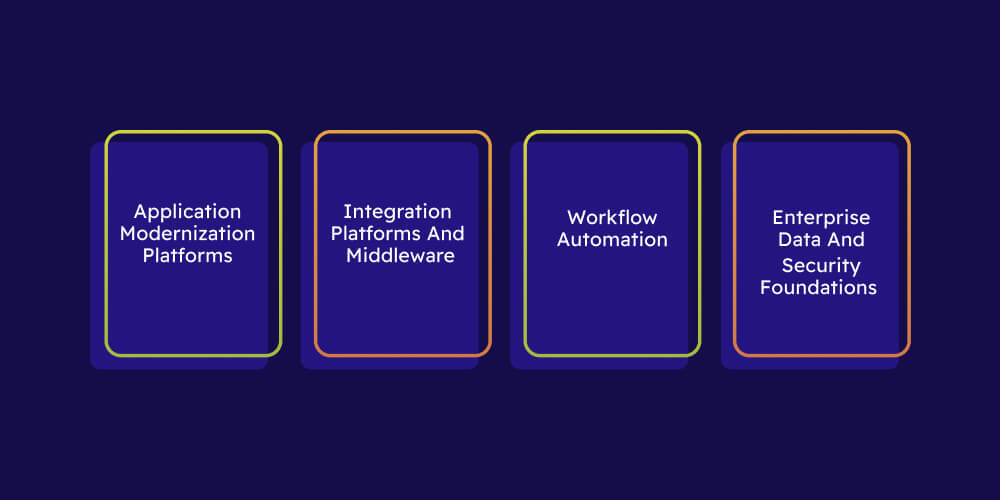
AI chatbots work best when they are not operating alone. They act as the front desk of a smart building. Useful on their own, yes. But far more powerful when connected to what’s happening behind the scenes. This is where a few supporting software layers make a noticeable difference.
Application Modernization Platforms
Many Middle East companies are modernizing in phases. Not everything moves at once. And that’s fine.
Modernization platforms help expose older systems through APIs, making them easier to connect with conversational tools. Instead of rebuilding a core system, businesses modernize only what’s necessary.
This is where legacy modernization services quietly support chatbot initiatives. They reduce friction, simplify integrations, and make legacy platforms usable without disruption. The result feels modern, even if the core isn’t brand new.
Integration Platforms And Middleware
Here’s a common bottleneck. Data exists. Systems exist. But they don’t talk.
Integration platforms fix that.
They connect on-premise systems with cloud tools and allow chatbots to trigger actions across multiple applications. One request, one response, several systems working together.
Operational teams notice this immediately. Tasks that once took minutes or hours now complete in seconds.
Workflow Automation
Speed matters when talent is limited. Low-code platforms allow teams to build workflows quickly, without heavy engineering involvement.
Chatbots become the entry point. Workflow engines do the rest.
This approach supports business workflow automation across departments, especially HR, finance, and operations. Changes that once required weeks of development now happen in days.
Enterprise Data And Security Foundations
None of this works without clean data and controlled access.
Data management tools improve accuracy. Identity and access systems ensure the right people see the right information. Together, they make chatbot interactions reliable and safe.
Efficiency improves when teams trust what they see.
Need Scalable Support Without Hiring More?
Deploy AI-driven chatbots that enhance service quality, reduce overhead, and strengthen operational resilience across departments.
Why Choose DITS For AI Chatbot Development
Choosing the right AI chatbot development company matters just as much as choosing the technology. At DITS, AI chatbot projects are approached with one clear focus: real business outcomes, not experiments that look good on paper. Every solution is built to fit existing systems, operational realities, and regional compliance needs.
The team has successfully delivered multiple AI chatbot projects for global clients across different industries, helping organizations streamline operations, reduce response times, and scale support without adding overhead. This experience shows in solutions that work reliably in real business environments.
What further sets DITS apart is how AI is embedded throughout the delivery lifecycle. We use AI in software development, quality assurance, maintaining code quality, and deep customization. That discipline shows up in chatbot solutions that are stable, secure, and scalable from day one.
More importantly, DITS doesn’t build chatbots in isolation. Our teams align AI chatbot development with broader operational goals, system integrations, and long-term growth plans. The result is a chatbot that actually gets used, improves workflows, and delivers measurable efficiency, not just a demo that fades after launch.
Conclusion
AI chatbots are demonstrating their worth by addressing real-life issues in their areas. They are the intermediaries between humans and machines. They minimize the reliance on the already burdened teams. Moreover, they accompany the organizations in their modernization process without the necessity of taking the risky large-scale replacements.
In addition, when integrated with the right supporting layers like integration platforms, automation tools, and secure cloud computing services, they scale in a manner that is trustworthy for the leadership.
The improvement of productivity does not result from one big transformation moment. Rather, it is the result of the collaboration of many small improvements. If managed with the right strategy, AI chatbots can become one of those imperceptible advantages that businesses frequently rely on without even recognizing it.
FAQs
1. How does AI chatbot development improve operational efficiency for Middle East businesses?
The growth of organizations leads to the manual processes creating delays, mistakes, and cost inefficiencies. AI chatbots help in centralizing communication, automating workflows, and providing real-time information to the customers and employees. The management of the companies still are able to control the operations while accommodating the growth in terms of the different regions, languages, and business units.
2. Can AI chatbots help reduce operational costs while improving service quality?
Certainly. AI chatbots not only cut costs but also provide the service quality of instant responses, standard information delivery, and availability around the clock which leads to more satisfied customers and less escalation.
3. What operational processes can AI chatbots automate beyond customer support?
AI chatbots are capable of making HR inquiries, ticket creation to IT helpdesk, qualifying leads, checking invoice statuses, internal approvals, and managing access to knowledge automated. By connecting with ERP, CRM, and workflow systems, chatbots become the endpoint for all operations, thus lessening the need for emails, calls, and using multiple tools which can be disorganized.
4. How can DITS help businesses in the Middle East implement AI chatbot solutions effectively?
DITS encompasses all aspects of AI chatbot development, such as discovering use cases, designing conversations, integrating systems, and planning for scalability. Their method is to ensure that the chatbot functions at the level of real operational difficulties, so that the solution provides significant efficiency gains rather than mere automation.
5. Why do Middle East enterprises choose DITS for AI chatbot development services?
Enterprises choose DITS for the company's background in providing secure, scalable, and business-oriented AI chatbots. The company takes care of integrating chatbots into existing enterprise platforms, applying AI wisely to operational workflows, ensuring compliance, managing performance, and adapting for the long run.

Dinesh Thakur
21+ years of IT software development experience in different domains like Business Automation, Healthcare, Retail, Workflow automation, Transportation and logistics, Compliance, Risk Mitigation, POS, etc. Hands-on experience in dealing with overseas clients and providing them with an apt solution to their business needs.
Recent Posts
Explore how intelligent document processing for insurance helps businesses automate document workflows, reduce processing costs, improve accuracy, and strengthen operational efficiency across insurance functions.
Discover how automated medical claims processing reduces delays, manual rework, claim denials, and administrative costs while improving reimbursement speed and operational efficiency.
Learn how to build medical billing software with essential features, integrations, security, and development costs.