25+ years of IT software development experience in different domains like Business Automation, Healthcare, Retail, Workflow automation, Transportation and logistics, Compliance, Risk Mitigation, POS, etc. Hands-on experience in dealing with overseas clients and providing them with an apt solution to their business needs.
AI agents that were used as experimental tools are now becoming core business assets. Companies now rely on them to handle customer interactions, automate decisions, and support operations. But when leadership teams begin planning adoption, one question surfaces immediately. What will be the cost of the AI agent?
Understanding AI agent development cost early helps prevent budget shocks later. Many organizations assume AI agents are plug-and-play solutions, only to discover hidden dependencies, integration challenges, and ongoing expenses that were never part of the initial estimate. That gap between expectation and reality is where projects lose momentum.
This blog breaks down the real cost drivers behind AI agent development to help decision-makers plan smarter, invest with clarity, and avoid surprises that slow growth.
Why Understanding AI Agent Cost Matters for Businesses
AI agents are no longer limited to innovation labs or pilot programs. They are actively supporting customer service teams, assisting operations managers, and reducing manual work across departments. As adoption grows, so does the financial impact of getting it wrong.
For most businesses, a moderately capable AI agent typically requires an initial investment of USD 30,000 to 80,000. Enterprise-grade agents that support multiple workflows, integrations, and compliance requirements usually start from USD 100,000, excluding ongoing operational costs. Without clear cost visibility, leadership teams frequently underestimate the total ownership expense.
Most cost overruns come from improper planning. Organizations often budget only for development; while recurring costs such as infrastructure (USD 3,000 to 10,000 per month), model updates (USD 10,000 to 30,000 annually), and ongoing support are overlooked.
Cost clarity allows companies to align AI investments with measurable business outcomes. When leaders understand what an AI agent will cost at launch and over time, they can decide whether to build in phases, limit early integrations, or plan for scalability from day one. Many organizations also engage structured IT consulting services at this stage to validate assumptions and avoid unnecessary spend.
What are AI Agent Applications in Business
An AI agent is a software-based system designed to observe information, make decisions, and take action with minimal human involvement. Unlike traditional automation that follows fixed rules, AI agents adapt. They learn from data, respond to inputs, and improve over time. That difference matters when business conditions are rarely static.
It's like a customer support setup that does more than answer predefined questions. An AI agent can analyze intent, pull data from internal systems, and resolve issues end-to-end. This is where it goes beyond standard AI chatbots and becomes a decision-support asset rather than just a communication tool.
Across enterprises, AI agents are now supporting operations, analytics, internal workflows, and customer engagement. They reduce response time, lower operational load, and improve consistency. When designed well, they feel less like software and more like a reliable digital teammate.
Ready To Plan Your AI Investment Strategically?
Understand development, integration, and ownership costs before committing resources to your AI initiative.
An AI agent development cost breakdown depends on what the agent is expected to do, how deeply it connects with existing systems, and how critical it is to daily operations.
For most mid-sized to large organizations, the initial investment typically ranges from tens of thousands to several hundred thousand dollars, based on industry benchmarks and typical enterprise AI adoption patterns. A basic internal agent built for one workflow sits at the lower end. Enterprise-grade agents handling real-time decisions, integrations, and compliance requirements push costs higher.
It also helps to separate one-time expenses from ongoing ones. Design, development, and integration form the upfront spend. Maintenance, model updates, infrastructure usage, and performance tuning continue month after month. Understanding this split early prevents under-budgeting and uncomfortable conversations later.
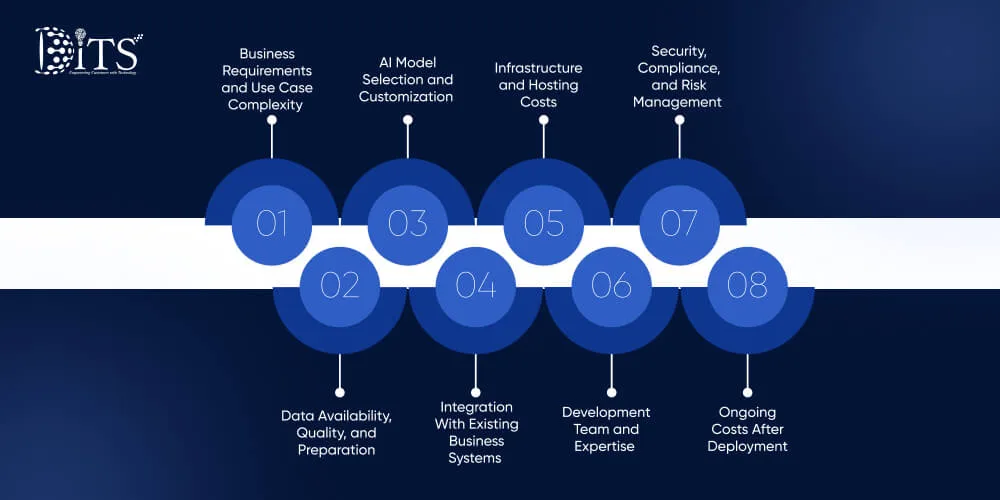
Business Requirements and Use Case Complexity
This stage sets the foundation for the entire initiative. A single-function AI agent designed for one workflow is far less expensive than an enterprise-grade agent supporting multiple departments and decision paths. As the scope expands, effort increases across design, logic, and testing.
Simple task-based AI agent: USD 15,000 to 30,000
Multi-workflow or cross-department agent: USD 30,000 to 80,000
Enterprise-critical AI agent with compliance needs: USD 100,000+
This early scoping decision has a lasting impact on the overall AI agent development cost breakdown.
Data Availability, Quality, and Preparation
Data readiness often determines how smoothly development progresses. When clean, well-structured data already exists, costs remain controlled. When data is scattered across systems or inconsistent, preparation effort increases quickly and timelines stretch.
Using existing structured business data: USD 10,000 to 25,000
Data cleaning, labeling, and normalization: USD 25,000 to 60,000
Ongoing data management and updates: USD 1,500 to 4,000 per month
This stage quietly adds to the AI agent development cost, especially when skipped or underestimated early.
AI Model Selection and Customization
Model selection influences both performance and long-term cost. Off-the-shelf models work well for predictable use cases and controlled environments. As accuracy expectations rise or domain knowledge becomes specialized, customization becomes necessary, and costs increase accordingly. This also aligns with current pricing trends observed in leading AI model providers and API-based architectures.
Pre-trained model configuration and tuning: USD 12,000 to 35,000
Domain-specific fine-tuning for higher accuracy: USD 30,000 to 70,000
Fully custom AI model development: USD 90,000 to 200,000+
This decision directly shapes scalability, reliability, and the total AI agent development cost breakdown.
Integration With Existing Business Systems
Integration is where AI agents become operationally useful. Connecting the agent with CRM platforms, ERP systems, internal tools, or legacy applications increases both effort and coordination. The more systems involved, the higher the testing and security overhead.
Single system or API integration: USD 8,000 to 20,000
Multiple system integrations with workflow orchestration: USD 25,000 to 60,000
Legacy system integration with custom middleware: USD 50,000 to 100,000+
Integration complexity is a major contributor to overall AI agent development cost and often determines deployment timelines.
Infrastructure and Hosting Costs
Infrastructure costs depend on how the AI agent is deployed and how frequently it operates. Lightweight agents with limited usage require minimal resources, while real-time, high-volume agents demand scalable compute and storage.
Cloud infrastructure for low to moderate usage: USD 2,000 to 6,000 per month
High-availability infrastructure with scaling support: USD 8,000 to 15,000 per month
On-premise infrastructure setup and maintenance: USD 40,000 to 120,000 annually
These expenses continue throughout the lifecycle and significantly influence the long-term AI agent development cost breakdown.
Development Team and Expertise
The composition and experience of the development team directly affect cost, speed, and quality. In-house teams offer control but require long-term investment. External specialists reduce hiring overhead but come at a higher per-project rate.
Small dedicated AI development team: USD 30,000 to 60,000
Enterprise-grade team with AI, backend, QA, and PM roles: USD 70,000 to 150,000
Ongoing expert support and optimization: USD 5,000 to 12,000 per month
Team structure plays a critical role in shaping overall AI agent development cost and delivery timelines.
Security, Compliance, and Risk Management
Security is non-negotiable when AI agents handle sensitive business or customer data. Compliance requirements, access controls, and audit readiness add effort but reduce long-term risk exposure.
Basic security controls and access management: USD 7,000 to 15,000
Industry-specific compliance implementation: USD 20,000 to 50,000
Ongoing audits, monitoring, and risk mitigation: USD 2,000 to 6,000 per year
These safeguards are essential and contribute steadily to the overall AI agent development cost.
Ongoing Costs After Deployment
Once the AI agent goes live, costs do not stop. Ongoing expenses come from keeping the system stable, accurate, and aligned with changing business needs. As usage grows, these costs scale quietly but steadily.
Maintenance and performance monitoring: USD 3,000 to 6,000 per month
Model updates and periodic retraining: USD 10,000 to 30,000 annually
Scaling infrastructure and usage growth: USD 2,000 to 8,000 per month
These recurring elements often define the long-term AI agent development cost breakdown, especially for mission-critical deployments.
AI Agent Development Cost Formula
AI agent development cost can be estimated using a structured framework that accounts for both initial build and long-term operational factors.
AI Agent Development Cost = (Development Effort + Data Preparation + Model Costs + Integration Complexity) + Ongoing Operational Costs
Development Effort includes engineering, design, testing, and deployment activities required to build the agent.
Data Preparation covers data collection, cleaning, labeling, and structuring required for accurate performance.
Model Costs include pre-trained model usage, fine-tuning, or custom model development based on business needs.
Integration Complexity reflects the effort required to connect the agent with internal systems such as CRM, ERP, or APIs.
Ongoing Operational Costs include infrastructure, monitoring, updates, and scaling over time.
This framework helps organizations estimate investment more accurately and align AI initiatives with business outcomes.
What Will Your AI Agent Really Cost?
Get a structured cost estimate tailored to your business scope, integrations, and long-term scalability goals.
Understanding cost becomes more actionable when aligned with real business implementations. The following benchmarks reflect typical investment ranges based on complexity, integrations, and operational requirements.
Customer Support AI Agent
These agents handle queries, automate ticket resolution, and integrate with CRM systems. They are often the starting point for AI adoption.
Complexity Level: Low to Medium
Estimated Cost: USD 10,000 to 40,000
Key Cost Drivers: Conversation design, system integration, response accuracy
AI Sales Assistant or Lead Qualification Agent
These agents support revenue teams by qualifying leads, automating outreach, and syncing with CRM platforms.
Complexity Level: Medium
Estimated Cost: USD 25,000 to 80,000
Key Cost Drivers: Personalization logic, data tracking, multi-channel integration
Healthcare AI Assistant
These agents assist with patient interaction, scheduling, and preliminary support workflows. They operate in regulated environments and require higher accuracy.
Complexity Level: High
Estimated Cost: USD 50,000 to 150,000 or more
Key Cost Drivers: Compliance requirements, data security, domain-specific model tuning
Autonomous AI Agent for Workflow Automation
These agents manage multi-step tasks, make decisions, and coordinate workflows across systems with minimal human intervention.
Complexity Level: Very High
Estimated Cost: USD 80,000 to 250,000 or more
Key Cost Drivers: Reasoning capability, system architecture, memory and orchestration layers
AI Agent Development Cost Comparison by Use Case
Use Case
Complexity Level
Estimated Cost Range
Customer Support Agent
Low to Medium
USD 10,000 to 40,000
Sales AI Assistant
Medium
USD 25,000 to 80,000
Healthcare AI Assistant
High
USD 50,000 to 150,000+
Autonomous AI Agent
Very High
USD 80,000 to 250,000+
Complete Cost Breakdown for AI Agent Development
Development Stage
What Happens In This Stage
Estimated Cost Range
Business Requirements and Use Case Complexity
Defining scope, workflows, decision logic, user roles, and compliance needs aligned with business goals
USD 15,000 to 100,000+
Data Availability, Quality, and Preparation
Collecting data from systems, cleaning, labelling, structuring, and preparing it for training and inference
USD 10,000 to 60,000 (plus USD 1,500 to 4,000 per month ongoing)
AI Model Selection and Customization
Selecting pre-trained models or building custom ones, fine-tuning for accuracy and business context
USD 12,000 to 200,000+
Integration With Existing Business Systems
Connecting AI agents with CRM, ERP, internal tools, APIs, and legacy systems securely
USD 8,000 to 100,000+
Infrastructure and Hosting Costs
Setting up cloud or on-premise environments, compute, storage, scalability, and uptime controls
USD 2,000 to 15,000 per month or USD 40,000 to 120,000 annually
Development Team and Expertise
AI engineers, backend developers, QA, and project management executing development and coordination
USD 30,000 to 150,000 (plus USD 5,000 to 12,000 per month support)
Testing, Validation, And Quality Assurance
Validating functionality, accuracy, performance, bias, reliability, and edge cases
USD 8,000 to 45,000 (plus USD 3,000 to 7,000 per release)
Security, Compliance, And Risk Management
Implementing data protection, access control, regulatory compliance, and audit readiness
USD 7,000 to 50,000 (plus USD 2,000 to 6,000 annually)
Ongoing Maintenance and Scaling
Monitoring, retraining, performance tuning, infrastructure scaling, and updates
USD 3,000 to 8,000 per month
How Companies Can Optimize AI Agent Development Costs
Cost optimization does not mean cutting corners. It means making deliberate choices early and revisiting them often. Companies that approach AI agents with a phased mindset usually spend less and achieve faster results.
Start with high-impact, low-complexity use cases to validate value before scaling
Use a phased or MVP development approach instead of building everything at once
Limit early integrations to only business-critical systems
Reuse existing data assets where possible instead of rebuilding pipelines
Many organizations plan for development but overlook indirect cost factors that influence long-term investment.
API and Model Usage Costs
Usage-based pricing increases with scale, especially for real-time agents handling high volumes of requests.
Data Maintenance and Governance
Continuous updates, validation, and quality control are required to maintain performance.
Performance Monitoring and Optimization
Ongoing tuning ensures accuracy and reliability as business conditions evolve.
Security and Compliance Overhead
Regulatory requirements introduce recurring costs related to audits, monitoring, and access controls.
Change Management and Adoption
Training internal teams and aligning workflows also contribute to overall investment.
Accounting for these elements provides a more accurate view of total cost and reduces the risk of underestimating long-term expenses.
Total Cost of Ownership of AI Agents
AI agent development should be evaluated as a lifecycle investment rather than a one-time expense.
Total cost of ownership includes:
Initial development and deployment
Integration with existing systems
Infrastructure and usage-based costs
Maintenance, monitoring, and updates
Scaling and performance optimization
Organizations that evaluate total cost of ownership early are better positioned to align AI initiatives with long-term business goals.
Choosing the Right AI Agent Development Partner
Selecting the right development partner plays a critical role in controlling costs and ensuring long-term success. Organizations should look for teams that understand both technical implementation and business impact.
Key considerations include:
Experience in building AI agents across different industries and use cases
Ability to integrate with existing systems and workflows
Strong approach to security, compliance, and scalability
Proven processes for testing, optimization, and long-term support
An experienced partner helps reduce unnecessary complexity, improves delivery timelines, and ensures that AI investments remain aligned with measurable outcomes. Companies like DITS follow a business-first approach to AI agent development, focusing on scalable solutions that integrate seamlessly into existing operations.
AI Agent Cost Summary
AI agent development costs vary based on complexity, integrations, and scale. The following ranges provide a quick reference for typical investment levels:
Basic AI agents: USD 10,000 to 40,000
Mid-level AI agents: USD 30,000 to 80,000
Enterprise-grade AI agents: USD 100,000 or more
Monthly operational costs: USD 2,000 to 15,000
These estimates help organizations benchmark their expected investment and plan AI adoption with greater clarity. These ranges are derived from common enterprise implementation patterns and typical AI deployment structures across industries.
Conclusion
AI agents can deliver real operational value, but only when costs are understood and managed from the start. Leaders who treat AI as a long-term capability rather than a one-time project avoid most of the surprises that derail adoption.
A clear view of scope, data readiness, integration effort, and ongoing ownership helps organizations plan realistically and invest with confidence. When cost drivers are mapped early, AI initiatives stay aligned with business priorities instead of becoming technical distractions.
The most successful companies view the AI agent development cost breakdown as a planning tool, not a constraint. With the right structure, partners, and expectations, AI agents become assets that scale with the business and deliver measurable returns over time.
Frequently asked questions
For most enterprises, the total investment typically ranges from USD 60,000 to 250,000+, depending on scope, integrations, and compliance needs. Mission-critical agents with advanced decision logic and security controls usually sit at the higher end of this range.
Dinesh Thakur
25+ years of IT software development experience in different domains like Business Automation, Healthcare, Retail, Workflow automation, Transportation and logistics, Compliance, Risk Mitigation, POS, etc. Hands-on experience in dealing with overseas clients and providing them with an apt solution to their business needs.