What is Product Engineering & Its Benefits for Businesses
Table Of Content
Published Date :
09 Dec 2025
Businesses today are increasingly adopting product engineering to build digital products that not only function well but evolve continuously with market demands, user expectations, and emerging technologies. Instead of focusing solely on delivery, product engineering emphasizes innovation, scalability, reliability, and long-term product success, ensuring software grows in value even after launch. This shift helps companies accelerate go-to-market timelines, enhance customer experience, and future-proof their technology investments.
This guide will explore:
- What product engineering means from a business perspective
- Benefits across product lifecycle, from ideation to post-launch enhancement
- Why companies prioritize innovation, scalability, and predictable delivery
- Use cases where product engineering drives measurable business impact
- Cost considerations and ROI expectations for leadership teams
What is Product Engineering?
Product engineering is a full-cycle approach to building and scaling digital products where the goal is not just development, but long-term product success. It combines software engineering with product strategy, user-centric design, DevOps, and AI-driven innovation to create solutions that are market-ready, scalable, and continuously improving.
In practical terms, a product engineering development company ensures a business launches a product that sustains growth, delivers superior customer experience, and evolves with demand.
Product engineering blends:
- Software development + cloud DevOps for stability and performance
- Product strategy + UX for adoption and retention
- AI + automation for smarter workflows and better decisions
- Continuous engineering for updates, iteration, and market responsiveness
Businesses choose product engineering when they want to reduce risk, accelerate innovation, and ensure the product continues delivering measurable business value long after launch.
Transform Your Product Vision Into Reality!
Ready to build a scalable digital product that customers love? Our product engineering team turns ideas into market-ready solutions with faster delivery, predictable ROI, and long-term support.
Lifecycle of Modern Product Engineering
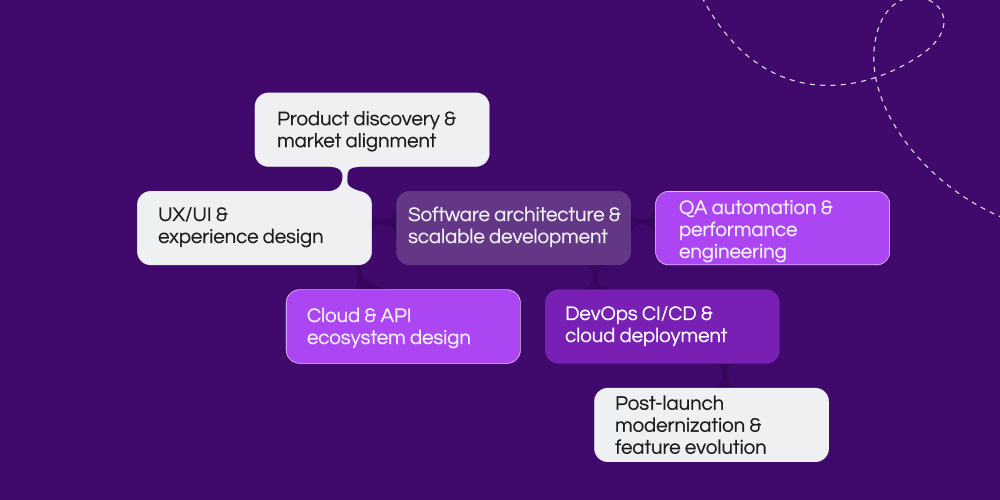
Modern digital product engineering services follow a seamless lifecycle designed to reduce product failure risks, accelerate go-to-market timelines, and ensure long-term business value. Companies researching what is product engineering increasingly expect measurable and outcome-driven delivery. That’s why every stage is built around KPIs, enabling leadership teams to continuously evaluate progress, performance, and ROI, rather than relying on assumptions. This lifecycle reflects what is product engineering services truly mean to deliver: predictable scalability, fast innovation, and sustained product relevance.
Product Discovery & Market Alignment
Identify customer needs, validate demand, research competitors, and define monetization paths to eliminate early business risks and establish a strong direction. KPIs: validated personas, market-fit score, risk assumptions cleared.
UX/UI & Experience Design
Design intuitive user journeys and friction-free interfaces that drive high retention, usability, and conversions, ensuring the product feels meaningful from day one. KPIs: task completion rate, session duration, design approval cycle time.
Software Architecture & Scalable Development
Build a secure, modular, and future-ready foundation that enables fast feature releases, low technical debt, and sustainable engineering costs. KPIs: scalability score, reusability index, tech debt level, and engineering velocity per sprint.
Cloud & API Ecosystem Design
Adopt cloud-native infrastructure and high-availability APIs to support ecosystem scalability, third-party integrations, and multi-platform expansion. KPIs: API success rate, latency benchmarks, cloud cost efficiency, system uptime.
QA Automation & Performance Engineering
Utilize automated test suites and continuous performance monitoring to detect defects early and maintain reliability at any scale. KPIs: defect escape rate, automation coverage, performance score, time-to-resolution.
DevOps CI/CD & Cloud Deployment
Implement automated pipelines for builds, testing, and deployment to ship releases faster with minimal downtime and rollback risk. KPIs: deployment frequency, lead time for changes, rollback rate, release stability metrics.
Post-launch Modernization
Leverage user analytics and market signals to roll out enhancements, optimize underperforming modules, and keep the product competitive over time. KPIs: feature adoption, churn reduction, usage growth, time-to-innovation.
Benefits of Product Engineering for Businesses
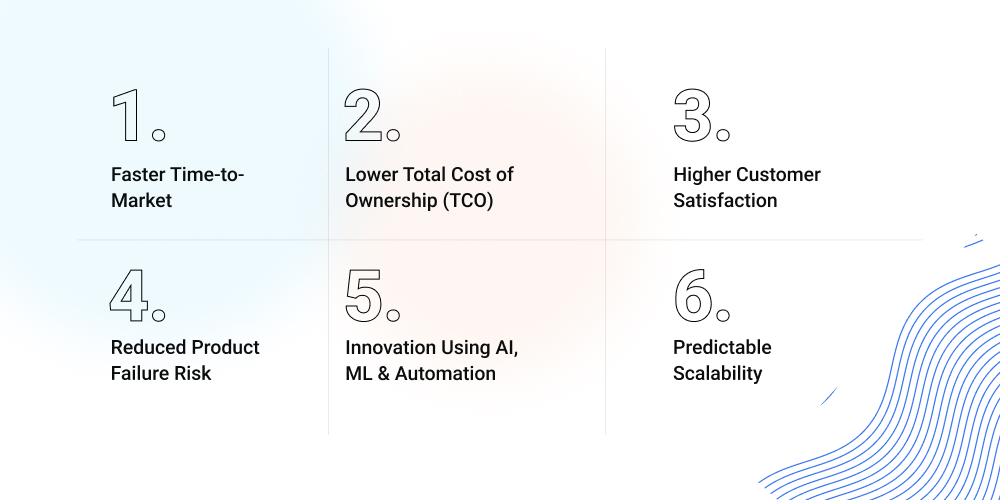
Modern enterprises are moving toward strong product thinking to overcome slow delivery cycles, rising technical debt, and unpredictable scaling costs. Instead of treating development as a one-time project, they are partnering with experts who understand what is product engineering and how to apply it to accelerate innovation and market success. With the support of experienced product engineering services, companies gain the ability to build market-aligned products faster, introduce features based on real customer behavior, and optimize performance without disrupting business continuity.
Faster Time-to-Market
By using agile discovery, rapid prototyping, and CI/CD pipelines, businesses shorten release cycles and launch products ahead of competitors. This enables faster revenue capture, quicker customer feedback loops, and rapid iteration based on market needs.
Lower Total Cost of Ownership (TCO)
Modular architecture, cloud optimization, and automation dramatically reduce long-term infrastructure and maintenance expenses. Companies avoid expensive rebuilds while ensuring every new feature is added without disrupting core systems.
Higher Customer Satisfaction
Human-centered UX, frictionless digital journeys, and performance-driven engineering ensure customers experience reliability and convenience across every interaction, driving repeat usage, referrals, and long-term loyalty.
Reduced Product Failure Risk
Early discovery, MVP validation, and analytics-backed decision-making prevent businesses from investing heavily in unvalidated ideas. Risks, assumptions, and adoption barriers are eliminated before full-scale development begins.
Innovation Using AI, ML & Automation
Built-in AI capabilities enhance personalization, automation, and predictive intelligence, enabling companies to stay relevant and competitive while continuously improving efficiency and customer value delivery.
Predictable Scalability
A cloud-first microservices architecture ensures that user volume, new geographies, and feature expansion can scale seamlessly, safeguarding performance even during rapid business growth.
Key Pillars That Drive Successful Product Engineering
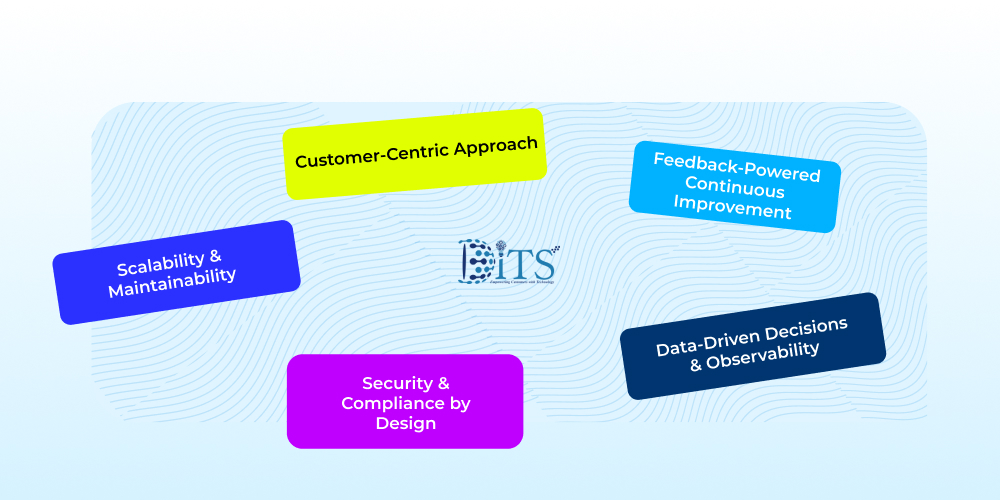
Sustainable digital products demand more than just high-quality development; they require a structured engineering ecosystem that aligns user needs, business objectives, and future scalability. Leading product design engineering services and product engineering services companies in USA prioritize principles that reduce failure risks, support rapid iteration, and ensure long-term product value.
Customer-Centric Approach
Every feature, workflow, and user journey is prioritized based on real customer pain points and behaviors. This ensures market relevance, reduces usability barriers, and strengthens product adoption from day one.
Scalability & Maintainability
Architectures are designed to support seamless growth, whether it’s increased users, features, or new geographies, while keeping tech debt minimal and operational costs predictable over the product lifecycle.
Security & Compliance by Design
Security is embedded at every development layer, safeguarding data privacy, regulatory alignment, and system integrity. This prevents legal and operational risks while enhancing customer trust and platform reliability.
Data-Driven Decisions & Observability
Measurable insights rather than assumptions guide engineering and product decisions. Real-time monitoring, analytics, and performance metrics strengthen product reliability and speed up response to bottlenecks.
Feedback-Powered Continuous Improvement
User behavior, marketplace trends, and usage analytics drive the product roadmap. Real-time feedback loops ensure the product evolves rapidly, resulting in higher retention, faster innovation, and reduced feature wastage.
Consult With Product Engineering Experts!
Not sure where to start or what’s technically feasible? Book a no-cost consultation and get a clear roadmap, budget estimation, and solution strategy based on your business goals.
Real-World Use Cases by Industry
Product engineering plays a critical role in helping industries modernize operations, improve reliability, and accelerate innovation. By combining strategy, design, cloud, and intelligent automation, it enables companies to launch secure digital products that scale with market needs.
Healthcare — Intelligent Care Delivery
AI-enabled patient apps, connected EHR platforms, and remote care systems streamline clinical workflows and reduce delays. Product engineering improves diagnosis support, data accuracy, and patient experience while meeting strict compliance standards.
Finance — Secure & Scalable Digital Banking
Digital banking apps, automated trading platforms, and fraud-analytics systems ensure faster transactions and safer financial operations. Product engineering focuses on security, performance, and high availability for large-volume financial environments.
EdTech — Smart & Adaptive Learning
Learning management systems, AI tutors, and personalized assessment tools enhance learning outcomes and accessibility. With scalable AI chatbot development & engineering, education businesses deliver high-quality, multilingual digital experiences to students worldwide.
Mining
Product engineering enables real-time site monitoring, predictive maintenance, workforce safety systems, and automated resource tracking. These solutions improve productivity, reduce downtime, and help mining companies operate safely under extreme and unpredictable conditions.
Retail & eCommerce — Omnichannel Growth
Unified shopping platforms, demand forecasting tools, and smart inventory automation increase sales efficiency. Product engineering enables brands to provide frictionless customer journeys while improving operational margins.
SaaS & B2B — Automation & Monetization
Workflow automation systems, AI agents, and subscription management platforms reduce manual tasks and elevate user productivity. Companies achieve faster onboarding, stronger retention, and predictable revenue growth.
Automotive & Manufacturing — Smart Production
IoT analytics, predictive maintenance, and automation platforms optimize production lines and reduce downtime. Product engineering enhances machine reliability, worker safety, and data transparency across global operations.
In-Demand Digital Technologies in Product Engineering
Modern product engineering relies on a fusion of advanced digital technologies that enhance scalability, security, and speed of innovation. By integrating cloud, AI, analytics, and automation, businesses build resilient digital products that stay competitive and future-ready.
Cloud-Native Systems & Microservices
Cloud-native architectures replace monolithic systems with scalable microservices, improving agility and deployment speed. This approach reduces downtime, ensures faster releases, and supports continuous innovation across large and distributed products.
AI & Machine Learning for Personalization and Automation
Intelligent algorithms automate repetitive operations, personalize user experiences, and support predictive decision-making. AI software adoption helps companies increase efficiency, optimize customer journeys, and generate higher lifetime value from digital products.
Multi-Platform Product Design (Web + Mobile + IoT)
Cross-platform engineering enables a consistent user experience across devices and operating environments. It helps companies scale offerings globally and reach customers wherever they interact, with minimal redevelopment effort.
Big Data & Analytics
Advanced analytics transform raw data into actionable business insights. With real-time dashboards, forecasting models, and behavioral analytics, organizations make smarter decisions and reduce uncertainty in fast-moving markets.
Cybersecurity & GRC
Security frameworks integrated from day one protect digital products against modern threats and compliance risks. Encryption, zero-trust models, and automated monitoring ensure safe user operations and regulatory confidence.
DevOps + GitOps Automation
Automated CI/CD pipelines, version control, and continuous testing accelerate releases without compromising reliability. These practices improve developer efficiency, reduce rollbacks, and deliver stable product upgrades frequently.
API-First Ecosystem
API-first engineering ensures seamless communication between internal systems, third-party tools, and partner ecosystems. It future-proofs digital products and enables faster innovation through modular integrations.
Product Engineering Outsourcing Cost, Timelines & Team Size
| Project Scale | Estimated Cost Range (USD) | Estimated Timeline | Typical Team Size (FTE) | Key Focus |
| Small MVP / PoC | $30,000 – $60,000 | 2 – 4 months | 2-4 People (1 PM/BA, 1-2 Developers, 1 QA/Designer) | Core functionality, user validation, rapid market entry. |
| Mid-size SaaS Product | $60,000 – $100,000+ | 4 – 9 months | 4-8 People (PM, UI/UX Designer, 2-4 Developers, QA, BA) | Scalable architecture, key features, early integrations, security/compliance foundation. |
| Enterprise-scale Digital Platform | $100,000 – $200,000+ | 9 – 18+ months | 8-15+ People (Sr. PM, Solution Architect, Multiple Dev Teams, DevOps, Security, QA) | Complex integrations (ERP, CRM), high scalability, advanced security, AI/ML features, custom workflows. |
The total cost of your outsourced product engineering project is driven by several critical factors:
- Complexity & Feature Scope: The number of unique features and the difficulty of implementing them (e.g., real-time data processing, complex algorithms) directly determine the required development hours.
- Geographical Location of Vendor: This is one of the biggest cost drivers.
- Offshore (e.g., India, Southeast Asia): Lowest hourly rates ($25 - $50/hr).
- Nearshore (e.g., Eastern Europe, Latin America): Mid-range rates ($40 - $80/hr).
- Onshore (e.g., US, Western Europe): Highest rates ($80 - $200+/hr).
- Security Requirements: Adherence to standards like HIPAA (healthcare), GDPR (data privacy), or PCI DSS (payments) requires specialized security architects, rigorous testing, and more development time, increasing cost.
- Integrations: The number and complexity of Third-Party Integrations (APIs for payment gateways, CRM, ERP, analytics, etc.) add significant development and testing effort.
- AI/Machine Learning: Implementing custom AI/ML models, data science pipelines, or real-time predictive analytics requires highly specialized, high-cost engineering talent.
- Scalability: Building an architecture (like a microservices-based system) capable of handling millions of users/transactions (high scalability) is more expensive than a simple MVP, as it requires senior architects and advanced cloud infrastructure (DevOps).
- Team Seniority: Senior developers and architects cost more per hour but often deliver faster, higher-quality, and more sustainable code, which can reduce long-term maintenance costs.
- Technology Stack: Niche or cutting-edge technologies can be more expensive than well-established, open-source stacks.
Scale Smarter With a Dedicated Engineering Partner!
Stop expanding headcount, expand capability. Partner with DITS to accelerate innovation, reduce development risk, and launch future-ready digital products without overstretching internal teams.
In-House vs Dedicated Product Engineering Partner
Choosing between building an internal engineering team and collaborating with a dedicated product engineering partner directly impacts speed, innovation, cost, and risk. For companies aiming to scale efficiently, partnering with specialists delivers faster outcomes without the operational burden of expanding headcount. This approach ensures access to cross-functional product engineering services while keeping focus on business growth.
Speed
A dedicated partner accelerates delivery through pre-built processes, reusable components, and ready-to-deploy talent. Companies avoid long hiring cycles and begin execution immediately, cutting time-to-market significantly.
Expertise Access
Instead of relying on limited internal skill sets, businesses benefit from multidisciplinary experts, including product strategists, UX, engineers, cloud architects, and AI specialists, ensuring a complete digital product engineering scope from day one.
Innovation Pace
Partners bring exposure to multiple industries and cutting-edge tech stacks, enabling continuous innovation. They experiment, validate, and prototype faster, helping businesses stay ahead in competitive markets without slowing internal operations.
Hiring Overhead
Companies eliminate the need to recruit, train, retain, and upskill talent for every new product milestone. The partner manages workforce expansion and contraction without HR or administrative burden.
TCO (Total Cost of Ownership)
A dedicated partner reduces long-term expenses by minimizing technical debt, maximizing scalability, and optimizing cloud costs. Businesses pay for outcomes, not resource bench time, resulting in clearer financial predictability.
Risk & Accountability
While in-house teams distribute responsibility, product engineering partners operate under shared KPIs and contractual accountability. They align with measurable outcomes, delivery timelines, product stability, user experience, and adoption.
Why DITS Should Be Your Product Engineering Partner
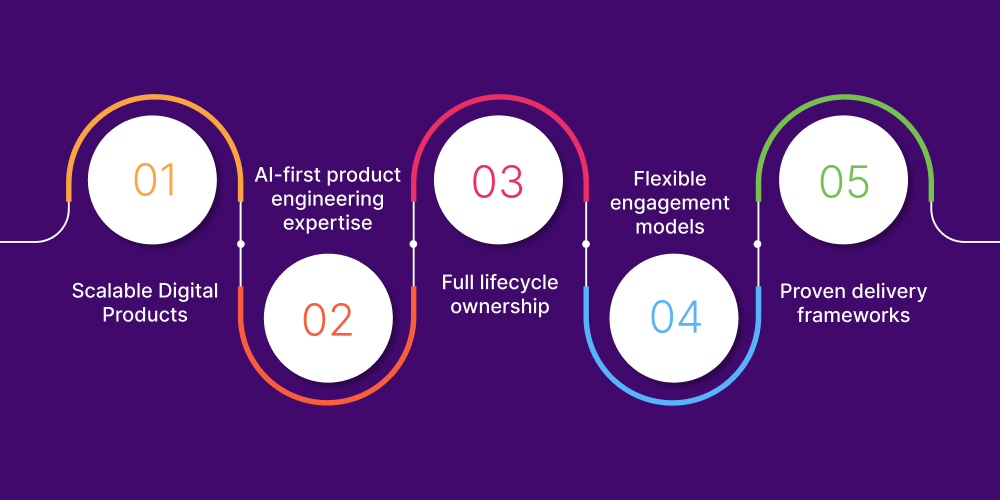
Choosing the right partner determines how fast a digital product can scale, compete, and generate ROI. At Ditstek Innovations (DITS), we combine technology excellence, product thinking, and AI-driven innovation to help businesses build and modernize products that succeed in real markets. Our approach to product engineering services is driven by business outcomes, operational efficiency, user adoption, and long-term scalability, not just delivery milestones.
Scalable Digital Products
DITS has a consistent record of architecting enterprise-grade platforms engineered for high performance, maximum security, and continuous evolution. Every product is built to support scale, ensure compliance, adapt to market shifts, and sustain revenue growth across industries.
AI-first Product Engineering
We embed AI across product workflows, from predictive analytics and personalized user journeys to automation and decision-support capabilities. This AI-powered foundation reduces operational effort, enhances customer experience, and increases value realization from existing data ecosystems.
Full Lifecycle Ownership
Our teams take responsibility from discovery and MVP to SaaS scaling and post-launch modernization. This lifecycle accountability reduces technical debt, accelerates iteration cycles, and keeps the product competitive without disrupting business operations, answering the critical question many enterprises have today: what is product engineering when it comes to long-term business impact?
Flexible Engagement Models
Every initiative has its own pace and investment strategy. Whether a business is validating an MVP or expanding to global markets, our engagement models align with budgets, evolving priorities, and roadmaps, ensuring agility at every stage.
Proven Delivery Frameworks
With deep cross-industry execution experience, we proactively anticipate UX challenges, compliance requirements, and integration risks, shortening delivery timelines and increasing product success rates. Each solution is engineered for measurable business impact and rapid adoption.
DITS helps global companies answer what digital product engineering truly means in practice, sustainable innovation, resilient architecture, and profitability backed by continuous evolution. For enterprises evaluating what is product engineering beyond software development alone, our delivery philosophy ensures that their products become enduring market leaders, not short-term launches.
Conclusion
Product engineering is no longer just a technology function; it has become the foundation of sustainable business growth in a digital-first economy. Today, market leaders succeed not because they launch fast, but because they build products engineered for scalability, security, innovation, and rapid response to market shifts. With the right partner, businesses don’t have to rebuild or reinvent repeatedly, they can evolve confidently, innovate continuously, and stay ahead of demand without inflating operational overhead.
At Ditstek Innovations (DITS), we merge engineering excellence, product strategy, and AI-powered modernization to help organizations convert ideas into market-ready, revenue-driven products. Whether it begins with an MVP, platform enhancement, or enterprise-level scaling, our proven product engineering services ensure predictable delivery, faster time-to-market, and long-term ROI aligned with business objectives. For enterprises trying to understand what is product engineering, our approach demonstrates that success goes far beyond coding, it is about designing products that endure and outperform in competitive environments.
For organizations evaluating what is digital product engineering from a strategic angle, the answer lies in building products that last, adapt, and thrive rather than simply launch. If the goal is to own a product that keeps evolving, keeps generating value, and keeps your business ahead of the curve, now is the right time to invest in modern and future-ready product engineering.

Dinesh Thakur
21+ years of IT software development experience in different domains like Business Automation, Healthcare, Retail, Workflow automation, Transportation and logistics, Compliance, Risk Mitigation, POS, etc. Hands-on experience in dealing with overseas clients and providing them with an apt solution to their business needs.
Recent Posts
Discover how chronic care management software uses algorithmic triage to identify patient risk, prioritize care, and improve care team efficiency.
Explore how intelligent document processing for insurance helps businesses automate document workflows, reduce processing costs, improve accuracy, and strengthen operational efficiency across insurance functions.
Discover how automated medical claims processing reduces delays, manual rework, claim denials, and administrative costs while improving reimbursement speed and operational efficiency.