Water Utility Asset Management Software
Table Of Content
Published Date :
10 Dec 2025
Water utilities rarely get a quiet day. One leak in the wrong spot, a pump slowing down, can throw an entire network off balance. Many of these issues don't show up until they become expensive emergencies. That is where structured planning and more innovative tools become essential for effective functioning.
Most utility teams still rely on outdated methods such as spreadsheets to track critical assets. It works for some time, but as things get busy, the gaps start showing. Modern utilities use more robust systems to stay ahead. A clear view of every asset, backed by real-time information, helps leaders make accurate decisions more quickly.
It brings control back into daily operations. Businesses also rely on utility management software to streamline monitoring and improve coordination, especially when networks grow wider and more complex.
This blog shares why asset management matters and how water utility asset management software helps service providers run optimally and provide better services.
If you’re thinking about upgrading your utility operations, our team can walk you through what a tailored system could look like for your network.
What is Water Utility Asset Management?
Water utility asset management helps leaders plan ahead instead of waiting for something to break. When you know the age of each asset, how often it fails, how critical it is, or how much it costs to maintain, investment decisions become clear. Utilities can schedule repairs, plan replacements, and avoid spending money in the wrong places.
Proper asset planning also strengthens compliance efforts. Audits become less stressful when data is organized and up to date, and as the industry shifts toward more data-driven decisions, utilities that adopt better systems find it simpler to track performance and justify budgets.
With clearer visibility, teams can make better decisions, and with a focused approach, utilities operate with fewer surprises.
Key Challenges Water Utilities Face Today
Water networks deal with problems that keep stacking up. Some issues are predictable. Others appear out of nowhere. Either way, they slow down operations and stretch budgets.
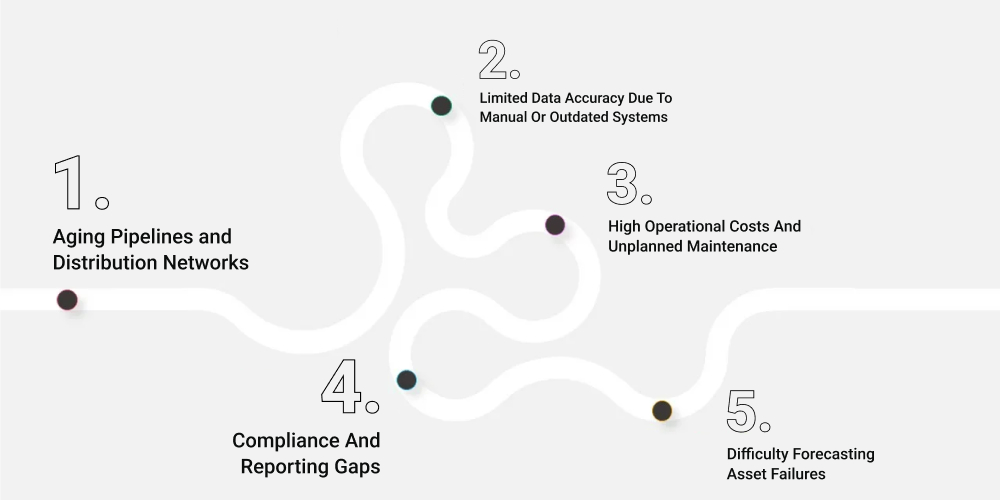
Aging Pipelines and Distribution Networks
Many systems run on infrastructure installed decades ago. Older pipes weaken, pumps lose efficiency, and fittings corrode quietly over time. A minor fault today can turn into a major failure next season. Utilities that don’t track age and condition closely often end up in constant repair mode.
Limited Data Accuracy Due To Manual Or Outdated Systems
Paper logs or outdated tools miss details. Someone forgets to update a record. Another person notes a reading incorrectly. Those tiny errors build up, and suddenly the team cannot rely on the information in front of them. Decisions get slower, and maintenance becomes reactive.
High Operational Costs And Unplanned Maintenance
Unexpected failures can drain budgets quickly. Nobody likes costly surprises, especially when urgent repairs eat into funds meant for upgrades. When maintenance teams do not have reliable insights into asset behavior, they spend more time fixing things after they fail instead of preventing problems early.
Compliance And Reporting Gaps
Regulatory reports demand accuracy. Missing data, inconsistent records, or unclear maintenance history can create stress during audits. Utilities without a structured system often scramble to collect the right information, which leaves room for mistakes.
Difficulty Forecasting Asset Failures
Predicting which asset might fail next sounds simple until you look at the volume of equipment involved. Without clear trends or past performance insights, utilities end up guessing. And guessing rarely saves money. A well-organized approach turns raw data into real signals, helping teams act before trouble hits.
Each of these challenges pushes utilities to find stronger ways to manage their networks. And that’s usually the moment businesses consider a modern utility asset management approach.
Not sure where AI fits into your network? We can help you map out the right use cases without overcomplicating things.
Core Components Of Effective Water Utility Asset Management
Strong asset management is more than a checklist. It is a coordinated system that keeps utilities informed and prepared to act at the right time. When each component works together, long-term planning becomes far easier.
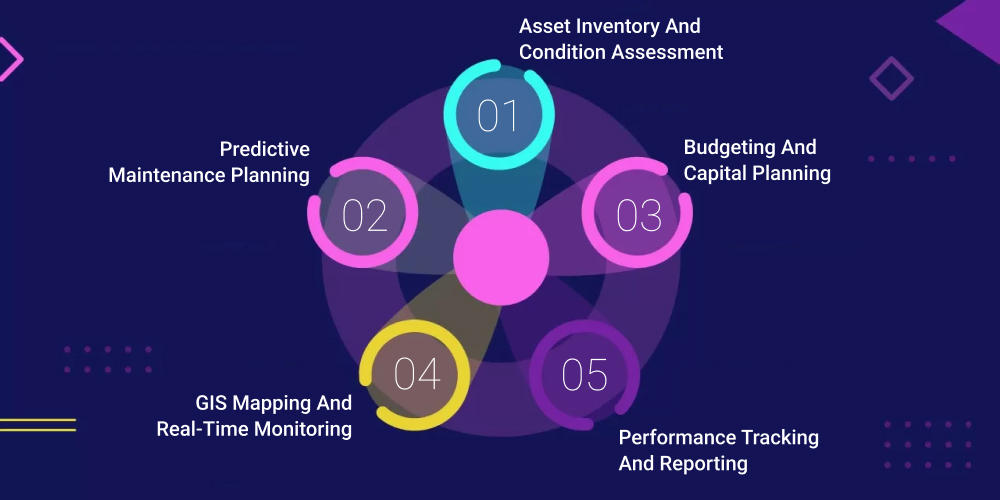
Asset Inventory And Condition Assessment
Everything starts with knowing what you have. A clear, updated inventory lists each asset, its location, age, condition, and history. Without this foundation, decisions drift into assumptions. With it, teams get a reliable picture of the entire network and identify which assets need attention first.
Predictive Maintenance Planning
Instead of waiting for an unexpected outage, utilities can use past performance and condition data to predict when an asset might fail. It saves time, reduces panic repairs, and prevents service disruptions. Here’s the kicker: planned maintenance almost always costs less than emergency fixes.
Budgeting And Capital Planning
When leaders know how long each asset will last and how much it will cost to maintain or replace, financial planning becomes more practical. This clarity helps utilities allocate money wisely, avoid overspending, and justify investments with real data instead of rough estimates.
GIS Mapping And Real-Time Monitoring
Seeing assets on a map offers context that plain lists cannot. Teams spot patterns, track incidents geographically, and respond to issues with better awareness. When paired with live monitoring tools, utilities gain quick visibility into problem areas before they escalate.
Performance Tracking And Reporting
Utilities need accurate insights to keep improving. Performance dashboards, trend reports, and logs make it easier to monitor progress and stay aligned with regulatory expectations. Over time, this consistent tracking helps teams uncover hidden inefficiencies and refine their strategy.
These components form the backbone of reliable utility asset management. When implemented together, they bring structure, speed, and clarity to operations that once felt unpredictable.
How Water Utility Asset Management Software Helps Utilities Operate Smarter
Modern utilities are under pressure to move faster, catch problems earlier, and keep costs under control. That becomes a lot easier when daily work is supported by the right digital tools. This is where utility asset management software steps in, giving teams a cleaner, more organized way to run operations.
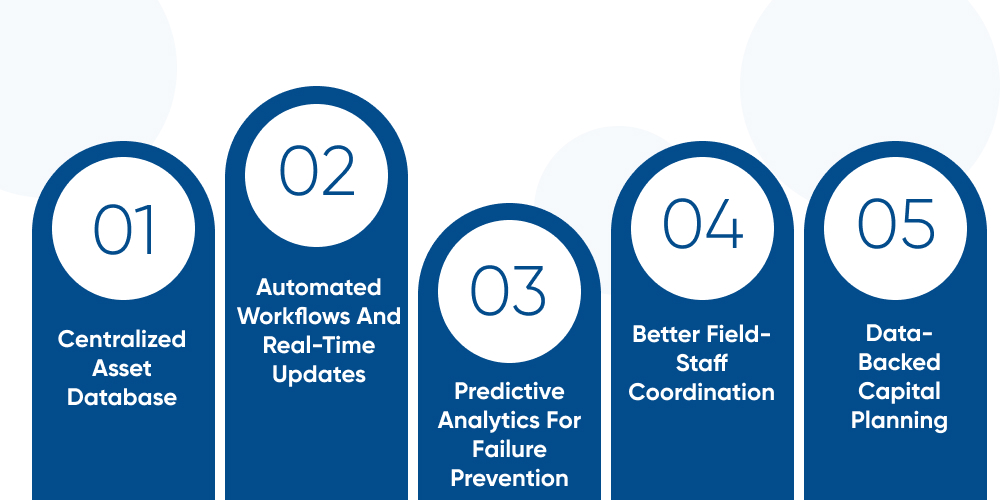
Centralized Asset Database
Instead of chasing information through spreadsheets, emails, or separate logs, everything lives in one place. Teams can check asset details, maintenance history, or current status without digging around. It cuts confusion and speeds up decision-making.
Automated Workflows And Real-Time Updates
Here’s the shift water utilities appreciate. Routine tasks no longer need manual handling. The system triggers reminders, updates records, and keeps everyone in sync. Real-time updates mean supervisors know what’s happening in the field without having to make constant calls.
Predictive Analytics For Failure Prevention
With performance patterns and historical data, the software predicts which assets may fail soon. Utilities get the chance to act early rather than deal with costly breakdowns later. Fewer emergency repairs also improve network stability.
Better Field-Staff Coordination
Field teams receive clear instructions, job details, maps, and updates right on their devices. No delays or mixed messages. And the office can see progress instantly, making it easier to manage workloads.
Data-Backed Capital Planning
Instead of guessing which assets deserve replacement or upgrades, leaders rely on data. They can compare asset conditions, evaluate long-term costs, and plan budgets that actually hold up. These insights often reveal minor issues before they grow into expensive projects.
All these capabilities make utility management software far more than a digital tool. It becomes a strategic partner that helps utilities operate with confidence, clarity, and fewer disruptions.
Business Benefits Of Modern Asset Management Solutions
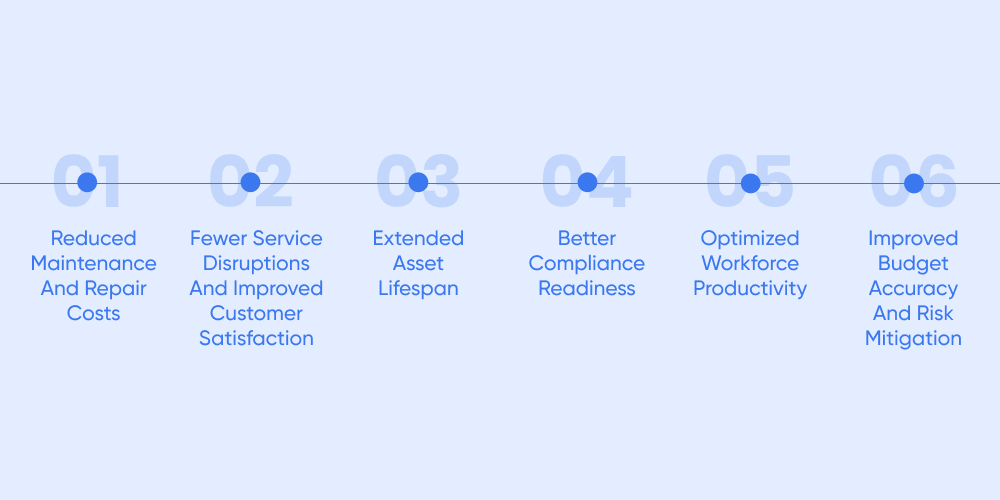
When utilities shift from scattered tracking to structured digital systems, the improvements show up quickly. Some changes are subtle. Others reshape how the entire network operates. Either way, the benefits stack up in ways that matter to both the team and the community relying on the service.
Reduced Maintenance And Repair Costs
Unexpected failures drain budgets fast. With clear insights, utilities can fix issues early and avoid emergency repairs. Planned maintenance is almost always kinder to the wallet than last-minute fixes.
Fewer Service Disruptions And Improved Customer Satisfaction
Nobody likes receiving calls about water outages. A well-managed system helps teams prevent breakdowns before they hit households or businesses. Stable service builds trust, and trust is something every utility aims to protect.
Extended Asset Lifespan
Pipes, pumps, and meters last longer when they are monitored properly. Regular checks and timely repairs help utilities squeeze more life out of their investments. Over time, this reduces the need for large replacement projects.
Better Compliance Readiness
Audits turn stressful when records are scattered and data is placed in different locations. With everything organized and updated, utilities generate accurate reports faster. It saves time and lowers the chances of compliance issues slipping through the cracks.
Optimized Workforce Productivity
When teams know exactly what to do, where to go, and which tools to carry, productivity rises. A structured system removes guesswork from daily operations. This is also where workflow automation supports staff by eliminating repetitive tasks that slow them down.
Improved Budget Accuracy And Risk Mitigation
Accurate data leads to more realistic budgets. Leaders can justify funding, plan for replacements, and avoid the unpleasant surprise of sudden capital expenses. Predictive insights also help utilities reduce risk because they can see trouble before it gets expensive.
Modern tools bring all these advantages together, creating an easy path for long-term growth. For many utilities, this becomes the moment they begin considering utility management software as part of their core operational strategy.
Plan Your Custom Asset Management System!
Start building a solution tailored to your utility network and operational needs.
Why Choose DITS For Water Utility Asset Management Software Development
Choosing the right technology partner matters just as much as choosing the right system. Utilities need a team that understands both the technical side and the realities of day-to-day operations. That is where DITS fits in.
DITS builds custom platforms designed specifically for utility networks. Our team focuses on solutions that match how utilities actually work in the field, whether it involves complex distribution networks, varied asset types, or strict reporting demands.
We bring experience in automation, smart integrations, and advanced analytics. From GIS mapping to SCADA connectivity, from condition tracking to mobile inspection tools, every part of the system is crafted to give teams clearer visibility and more control.
Businesses also rely on DITS when handling modernization projects because we handle legacy system modernization without interrupting ongoing operations.
Another advantage comes from how we build our software. At DITS, we use AI for software development, quality checks, code accuracy, and customization. We also integrate AI into every platform we create, so utilities benefit from sharper predictions and better decision support.
And it doesn’t end after delivery. Our team provides end-to-end development plus long-term support, ensuring that your utility asset management software stays reliable, secure, and ready for future upgrades. The result is a system built for real-world performance, not just theory.
Cost Of Developing Custom Water Utility Asset Management Software
The investment for a custom platform depends on how complex the utility’s network is and how deep the required features go. Smaller systems with essential tracking tools cost far less than advanced platforms loaded with analytics, integrations, and field-level automation. Still, businesses usually want a ballpark figure before moving forward, so here is a clear, realistic breakdown.
Basic platforms built for simple asset tracking, maintenance logging, and standard reporting typically range from 12,000 to 25,000 USD. These systems work well for smaller utilities or those just beginning to digitize their operations.
Mid-level solutions with GIS mapping, mobile field operations, automated workflows, and structured maintenance planning usually fall in the 30,000 to 55,000 USD range. This bracket suits growing utilities that need sharper visibility and better coordination between office and field teams.
Advanced platforms with predictive analytics, SCADA integrations, sensor-based monitoring, risk scoring, and multi-department dashboards often range between 60,000 and 120,000 USD, depending on how large the network is and how many modules are included. Projects that involve wider smart-monitoring networks may extend slightly beyond this range, especially when custom integrations require additional engineering tied to IoT software development.
Another factor influencing cost is intelligence. If a utility wants AI-driven forecasting, automated failure prediction, or optimized planning tools, the development effort increases. This is where our expertise in AI Software development becomes valuable because AI features demand deeper analysis, testing, and fine-tuning to ensure accuracy.
Conclusion
Strong water networks rely on clear visibility, steady planning, and tools that help teams respond before problems grow. That is exactly what modern asset management delivers. With structured tracking, smarter maintenance, and real-time awareness, utilities move from reactive work to data-supported decisions. And when everything runs smoothly, communities notice the difference.
Custom platforms play a big role in this shift. They adapt to the way each utility operates, whether the network is compact or spread across large service zones. The right system cuts downtime, improves coordination, and brings long-term savings that outlast the initial investment. For many teams, adopting a modern solution becomes the turning point that stabilizes operations and supports future growth.
At DITS, we help utilities reach that point with software built for real operational challenges. Our tools combine structured planning with advanced intelligence, giving teams the clarity they need to stay ahead. Reliable systems. Scalable foundations. And support that lasts beyond launch. That is how stronger utility networks begin.
FAQs
Q1. What Does Water Utility Asset Management Include?
It covers everything a utility needs to track, maintain, and plan for its physical network. This includes pipelines, pumps, meters, valves, treatment equipment, and supporting infrastructure. The approach focuses on understanding asset condition, scheduling maintenance, organizing field work, and using data to guide long-term decisions. A strong system also helps reduce failures and improves the reliability of daily operations.
Q2. Why Should Utilities Invest In Custom Asset Management Software?
Custom tools match the way a utility actually works. Instead of adjusting processes to fit a generic system, teams get features built around their network, asset types, reporting needs, and internal workflows. This improves accuracy, reduces manual errors, and speeds up decision-making. It also supports future growth because new modules or integrations can be added without disrupting existing operations.
Q3. How Much Does Water Utility Asset Management Software Cost?
Basic systems usually start around 12,000 USD, while mid-level platforms with mapping and workflow features fall between 30,000 and 55,000 USD. Advanced tools with predictive analytics, SCADA integrations, mobile capabilities, and smart monitoring range from 60,000 to 120,000 USD. The final cost depends on the number of modules, integrations, and users involved.
Q4. How Does DITS Support Utilities In Building Digital Asset Management Solutions?
DITS designs software tailored to utility operations, offering end-to-end development plus long-term support. We handle integrations such as GIS, SCADA, and sensor networks and provide systems that improve visibility and decision-making. Our team also uses AI internally for development, testing, customization, and code accuracy, which helps utilities get smarter and more dependable systems.
Q5. What Integrations Are Possible With Utility Asset Management Platforms?
Most utilities connect their platform with GIS mapping tools, SCADA systems, maintenance applications, and sensor networks. These integrations help consolidate data from different sources into one reliable view. They also enable faster responses and better long-term planning, especially when utilities start expanding their monitoring capabilities.

Dinesh Thakur
21+ years of IT software development experience in different domains like Business Automation, Healthcare, Retail, Workflow automation, Transportation and logistics, Compliance, Risk Mitigation, POS, etc. Hands-on experience in dealing with overseas clients and providing them with an apt solution to their business needs.
Recent Posts
Explore how intelligent document processing for insurance helps businesses automate document workflows, reduce processing costs, improve accuracy, and strengthen operational efficiency across insurance functions.
Discover how automated medical claims processing reduces delays, manual rework, claim denials, and administrative costs while improving reimbursement speed and operational efficiency.
Learn how to build medical billing software with essential features, integrations, security, and development costs.