Why Tech Businesses Need Software Product Management Consulting
Table Of Content
Published Date :
17 Feb 2026
Technology products are no longer problem-solving tools. They are ecosystems that must balance user expectations, market timing, operational constraints, and long-term business goals. Many companies assume that strong engineering alone will carry a product forward. However, in reality, even well-built software can fail when priorities drift, customer needs change, or decisions are made too late.
This is where software product management consulting becomes relevant. As product scope grows, teams often struggle to connect vision with execution, especially when speed, quality, and revenue pressures collide. The result is delayed launches, bloated features, and missed opportunities.
The success of a product depends less on how fast teams can build and more on how well they decide what not to build. This blog shares the key challenges businesses face with product management
Key Challenges Businesses Face Without Product Management Expertise
Organizations face plenty of challenges without product management expertise, including budget overruns, delays, misaligned vision, and communication gaps.
Misaligned Product Vision
Many tech teams start with a strong idea, but over time, the vision gets diluted. Leadership drives growth, sales request custom features, and engineering focuses on technical stability. Without a single owner shaping priorities, roadmaps may turn into wish lists. Teams move fast, yet direction may not be clear.
Lack of Market Validation
Features are often built because they sound good internally, not because customers asked for them. A SaaS firm once spent six months shipping enhancements, only to learn adoption barely moved. The effort was real, but it failed to create the desired impact.
Budget Overruns and Delays
When everything feels important, teams spend money chasing parallel initiatives, timelines slip, and leadership loses confidence in forecasts. Nobody likes costly surprises, especially late in the quarter.
Communication Gaps
Decisions usually stop when a proper context is missing. Engineers wait, leaders assume progress, and misalignment quietly grows. And by the time it surfaces, fixing it becomes expensive.
Is Your Product Strategy Delivering Results?
Unclear priorities and shifting roadmaps slow growth. Align vision, execution, and measurable outcomes with expert product guidance.
How Software Product Management Consulting Solves These Challenges
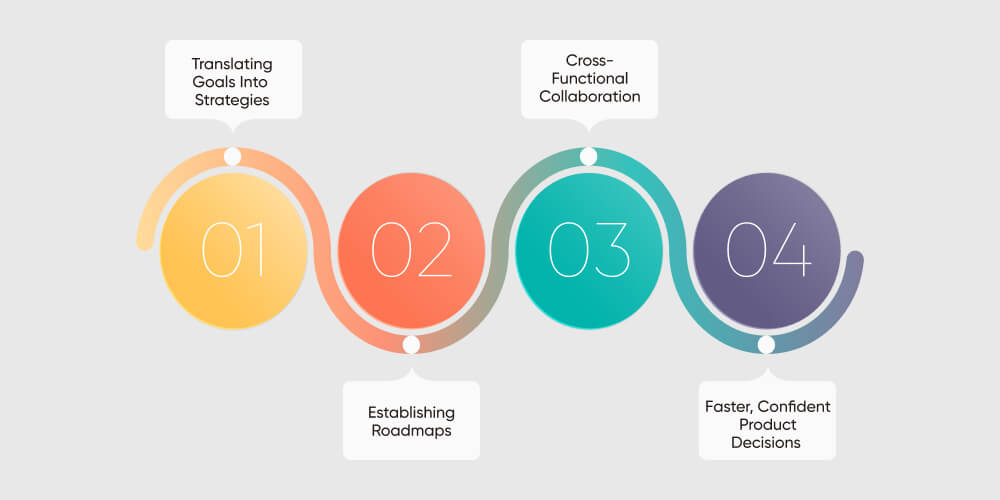
The goal is not to slow teams down with process but to remove uncertainty so execution becomes sharper and more predictable.
Translating Goals Into Strategies
Consulting starts by asking the necessary questions. What problem would the product solve? Who is accountable for outcomes? Business goals are broken down into clear product objectives that teams can act on without constant escalation.
Establishing Roadmaps
Roadmaps become decision frameworks. Each initiative is linked to a business outcome, a timeline, and a clear reason for prioritization. This makes trade-offs explicit and defensible. When leadership asks why something is delayed or deprioritized, the answer is rooted in impact, not opinion.
Cross-Functional Collaboration
One of the quiet wins of Product Management Consulting Services is shared context. Engineering understands the why they are building the product, and leadership sees real constraints early. Decision-making becomes convenient, and alignment improves without forcing consensus.
Faster, Confident Product Decisions
Decisions no longer stall waiting for perfect data. Teams use structured inputs, defined ownership, and clear escalation paths. Progress feels steady for teams, and confidence in product delivery returns.
When Tech Businesses Should Consider Software Product Management Consulting
Leadership teams need to identify the inflection points where external product guidance delivers the highest return. Consulting is most effective when timing is deliberate.
Product Ideation and Market Validation
In the early stages, momentum often feels more important than structure. But this is also where the cost of wrong decisions is lowest, and the value of clarity is highest. Product direction defined too loosely can lock teams into assumptions that are hard to unwind later. Engaging software product management consulting at this stage helps founders validate demand, shape scope, and avoid building features customers never asked for. A few weeks of focused discovery can save months of rework.
Expanding Into New Markets
Growth introduces complexity fast. New users, regions, and integrations bring competing priorities. Without a clear product operating model, teams struggle to decide what scales and what breaks. Consulting helps reset priorities, align teams around outcomes, and ensure expansion efforts support long-term revenue, not short-term noise.
Modernizing Legacy Software
Legacy systems rarely fail overnight. They erode speed, flexibility, and confidence over time. Consulting brings a structured lens to modernization, helping leaders decide what to refactor, what to retire, and what to rebuild without disrupting business continuity.
Addressing Stalled Growth or Product Failures
When launches miss targets repeatedly or adoption plateaus without explanation, the issue is rarely effort. It is direction. External product expertise surfaces blind spots and restores focus before confidence erodes further.
Planning To Scale Your Software Product?
Expansion demands sharper prioritization, clearer ownership, and validated roadmaps that support sustainable long-term growth.
Benefits of Software Product Management Consulting
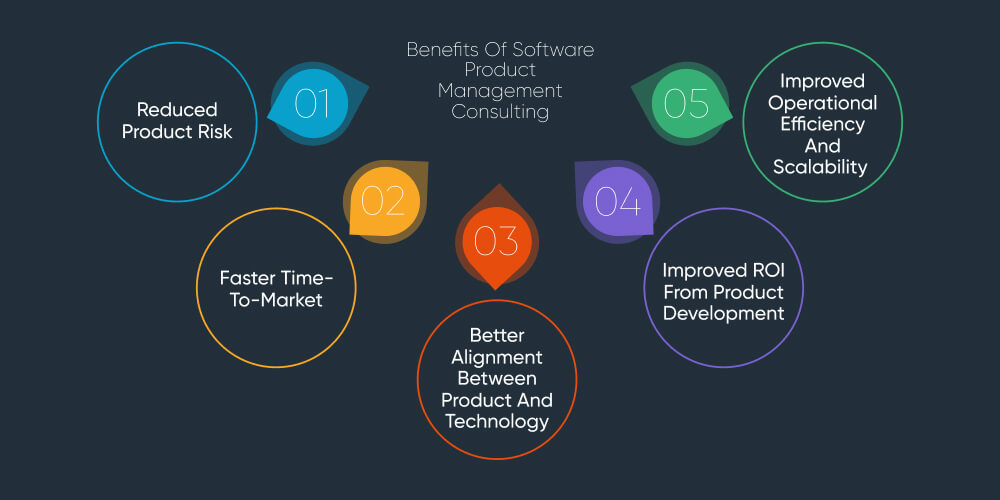
Now, as we know different scenarios, when tech companies should start considering product management consulting, let us explore the business benefits of the same.
Reduced Product Risk
Every product decision carries some level of risk. The difference is whether that risk is visible early or discovered after months of development. Consulting introduces validation checkpoints that reveal weak assumptions before they become expensive.
Faster Time-to-Market
Speed improves when teams know what matters most. Clear priorities reduce context switching and rework, allowing releases to move forward with confidence. Delivery becomes more predictable because scope decisions are intentional. That balance of pace and quality is where competitive advantage begins to take shape.
Better Alignment Between Product and Technology
One common frustration is seeing strong delivery without a commercial impact. Consulting connects product decisions directly to revenue drivers, customer retention, and operational efficiency. Technology choices support business goals, not the other way around. This alignment turns product development into a growth engine rather than a cost center.
Improved ROI From Product Development
When teams focus on fewer but high-impact initiatives, returns improve naturally. Leadership gains clearer visibility into why investments are made and what success looks like. Over time, confidence in forecasting improves, and product investment decisions feel less risky.
Improved Operational Efficiency and Scalability
Clear product priorities also create downstream operational efficiency. When product decisions are aligned early, organizations are better positioned to enable business workflow automation initiatives that reduce manual effort, improve consistency, and support scalable growth without increasing operational overhead.
Software Product Management Consulting for Different Types of Companies
A single product approach does not work for different business models. The value of consulting lies in its ability to adapt frameworks, and depth based on organizational maturity and risk tolerance capability.
Startups Building First Scalable Product
Early-stage teams move fast, but speed without structure creates hidden debt. Consulting helps teams test assumptions, define scope, and build a product foundation that can scale without rewrites. Teams spend energy on validation and traction, not firefighting decisions that surface too late.
SaaS Companies Optimizing Product-Market Fit
For SaaS businesses, growth depends on retention as much as acquisition. Consulting sharpens prioritization around features that drive adoption and improve lifetime value. Instead of reacting to every customer request, teams learn to invest in changes that move core metrics. That discipline compounds quickly, and focus on building a product that satisfies market demand perfectly.
Enterprises Managing Multiple Products
Enterprises that manage multi-product ecosystems often struggle with coordination. Consulting introduces governance models that minimize duplication, clarify ownership, and align portfolios around shared business goals. Decisions become consistent across teams, even when products serve very different markets.
Digital-First Organizations Undergoing Transformation
Transformation creates pressure to modernize fast, often while maintaining existing operations. Consulting brings structure to that transition, helping leaders balance innovation with stability and ensure product initiatives deliver measurable business value, not just technical upgrades. In many cases, this work aligns closely with broader IT consulting services and operational improvements where product decisions directly influence efficiency and scalability.
Struggling With Product Direction And Growth?
When launches stall or adoption slows, structured product leadership can restore clarity, speed, and confident decision-making.
Why Choose DITS for Software Product Management Consulting
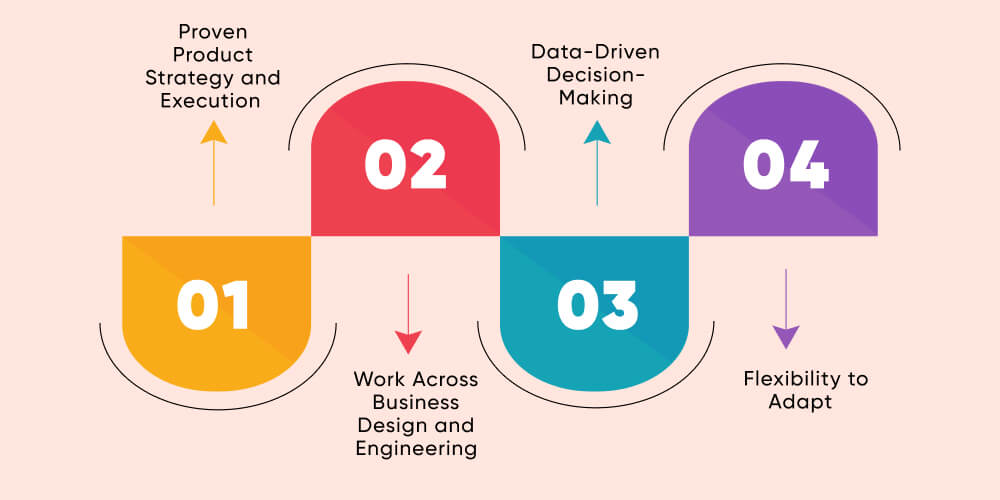
Execution matters as much as strategy when selecting a consulting partner. Many firms offer frameworks. Fewer stay accountable once real-world constraints appear.
Proven Product Strategy and Execution
At DITS, product decisions are shaped by hands-on delivery experience. We work closely with leadership teams to define product direction that teams can realistically execute. The emphasis stays on adoption, scalability, and long-term sustainability.
Work Across Business Design and Engineering
Product decisions fail when teams operate in silos. DITS acts as a connective layer between business stakeholders, designers, and engineering teams, ensuring shared context and fewer handoffs. This reduces friction, shortens decision cycles, and keeps everyone aligned on what success looks like.
Data-Driven Decision-Making
Our approach relies on evidence, not assumptions. We help organizations establish metrics that guide prioritization and validate direction early. This supports leadership with clear reasons behind every major product choice.
Flexibility to Adapt
DITS adapts engagement models to fit startups, growing SaaS businesses, and large enterprises alike. As part of broader Agile Product Management Consulting Services, we also support teams looking to modernize delivery practices without disrupting operations.
We also integrate AI software development practices into how we build, test, and customize solutions, using AI to support quality assurance, code consistency, and long-term maintainability across products.
Conclusion
Product success is defined by how software solutions move a business forward. As products become more complex and markets less forgiving, product management has evolved into a leadership responsibility rather than a supporting function.
The right consulting approach bridges the gap between ambition and execution. It helps leaders make fewer but better decisions, align teams around outcomes, and reduce the risk that comes with scale and change. Over time, this clarity compounds. Roadmaps become credible. Teams regain confidence. Investments deliver measurable returns.
For tech businesses willing to invest early, software product management consulting becomes a strategic advantage, not a corrective measure. It turns product vision into consistent business results.
Frequently Asked Questions (FAQs)
What Does Software Product Management Consulting Include?
Software product management consulting typically covers product discovery, roadmap planning, prioritization frameworks, stakeholder alignment, and execution support. At DITS, our software product management consulting services extend beyond strategy into execution, ensuring product plans are realistic, measurable, and aligned with long-term business growth.
How Long Does A Typical Consulting Engagement Last?
The duration depends on product maturity and business objectives. Some engagements last a few weeks to support market validation or roadmap definition, while others run for several months during scaling or modernization phases. DITS structures engagements to deliver value early, allowing leadership to see progress without long-term lock-ins.
Can Consulting Support Both New And Existing Products?
Yes. Consulting is valuable for new products where direction is still forming and for existing products that need refinement, optimization, or realignment. Whether launching something new or correcting course, the focus remains on improving outcomes, not adding unnecessary process.
What Software Product Management Consulting Services Does DITS Offer?
DITS provides end-to-end software product management consulting services that cover product discovery, market validation, roadmap definition, prioritization, and execution governance. Our teams work closely with business leaders, product owners, and engineering teams to translate business goals into actionable product strategies. The focus remains on measurable outcomes such as faster releases, reduced development waste, and stronger alignment between product, technology, and revenue objectives.
How Does DITS Deliver Value Through Software Product Management Consulting Engagements?
DITS combines strategic product thinking with hands-on execution support. We stay involved through planning and delivery to ensure decisions hold up under real-world constraints. Our consultants embed proven frameworks, support cross-functional alignment, and help organizations build internal product capability while delivering immediate business impact. This approach allows leadership teams to see results early, not months down the line.

Dinesh Thakur
21+ years of IT software development experience in different domains like Business Automation, Healthcare, Retail, Workflow automation, Transportation and logistics, Compliance, Risk Mitigation, POS, etc. Hands-on experience in dealing with overseas clients and providing them with an apt solution to their business needs.
Recent Posts
Explore how intelligent document processing for insurance helps businesses automate document workflows, reduce processing costs, improve accuracy, and strengthen operational efficiency across insurance functions.
Discover how automated medical claims processing reduces delays, manual rework, claim denials, and administrative costs while improving reimbursement speed and operational efficiency.
Learn how to build medical billing software with essential features, integrations, security, and development costs.