With more than 20 years of experience - I represent a team of professionals that specializes in the healthcare and business and workflow automation domains. The team consists of experienced full-stack developers supported by senior system analysts who have developed multiple bespoke applications for Healthcare, Business Automation, Retail, IOT, Ed-tech domains for startups and Enterprise Level clients
Key Takeaways
High-volume communication workflows offer fastest ROI.
Healthcare executives across the United States are under pressure to reduce operational costs while improving patient access and service quality. Call centers, front desks, and clinical staff spend valuable time answering routine questions. In this environment, conversational AI in healthcare serves as a practical tool for operational control.
The shift toward value-based care has forced organizations to rethink how they manage communication, follow-ups, and administrative workflows. Digital interaction is now expected. Patients want quick responses, not long hold times. Healthcare leaders want measurable efficiency. This is where intelligent, AI-driven conversations begin to show real business value.
What is Conversational AI In Healthcare
Conversational AI refers to smart systems that understand natural language, respond to queries, and complete defined tasks without human intervention. Unlike basic scripted chatbots that follow fixed decision trees, modern AI solutions interpret intent, maintain context, and improve through data.
In healthcare settings, these systems operate across multiple formats:
Patient-facing virtual assistants on websites and mobile apps.
Voice-based systems for call centres.
Internal support tools for staff queries.
Messaging integrations within patient portals.
Here’s the distinction that matters. A rule-based chatbot can answer “What are your clinic hours?” An advanced system can reschedule an appointment, verify insurance eligibility, and update records in real time. That’s the real difference between a simple chatbot and intelligent system.
From a digital transformation perspective, this technology becomes a communication layer that connects scheduling systems, EHR platforms, billing software, and CRM databases. When implemented correctly, it removes repetitive workload so teams can focus on clinical and strategic priorities.
High Impact Use Cases for Healthcare Organizations
When executives evaluate investment, they look for practical outcomes. Not trends. Not hype. Real operational lift. For many leadership teams, the turning point comes when they move from discussing theoretical automation to mapping real conversational AI in healthcare use cases within their own workflows.
Once scheduling, billing, discharge follow-ups, and eligibility checks are examined closely, it becomes clear how much operational bandwidth is being consumed by repeatable interactions that technology can manage more efficiently.
Here are some high-impact conversational AI in healthcare use cases that are already delivering measurable value across U.S. providers.
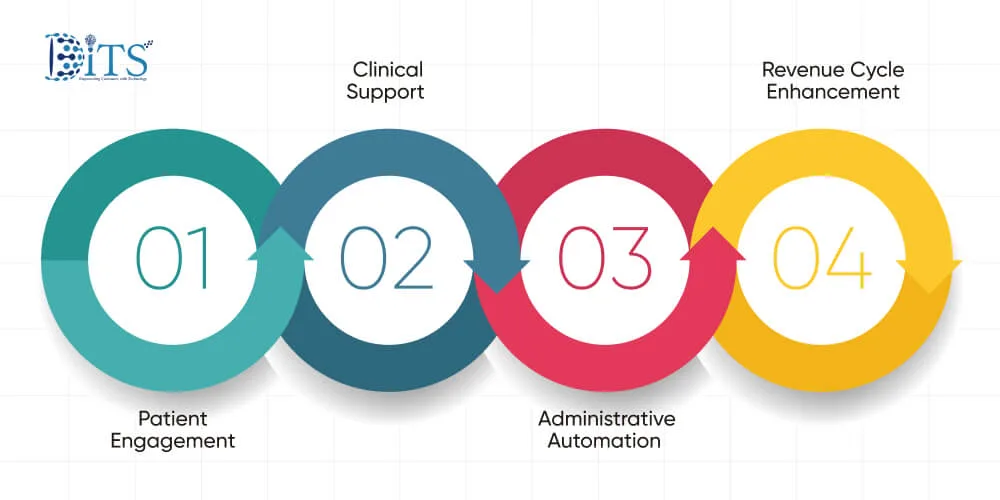
Patient Engagement
Front-desk congestion is expensive. Missed calls translate into missed revenue.
Common deployment areas include:
Appointment scheduling and automated reminders
Insurance coverage questions
Location, service, and provider availability queries
Prescription refill coordination
A mid-sized clinic handling 800 calls per day can automate nearly 60 percent of routine inquiries within three months of deployment. That alone can reduce staffing strain without reducing service quality. On top of that, automated reminders have shown to reduce no-shows by 20 to 30 percent in outpatient settings.
Clinical Support
Clinical teams spend significant time on non-critical follow-ups.
AI-driven systems now assist with:
Symptom triage questionnaires
Post-discharge check-ins
Chronic care monitoring reminders
Here’s the kicker: A structured digital follow-up within 48 hours of discharge can reduce readmission risk while improving patient satisfaction scores. When these interactions are automated but intelligently monitored, outcomes improve without adding new staff layers.
Administrative Automation
Revenue leakage often hides in small operational gaps.
Automation can support:
Billing inquiries
Insurance eligibility verification
Internal IT or HR request handling
Organizations that deploy conversational AI for healthcare industry operations typically see faster response times and fewer claim-related delays. And fewer delays mean stronger cash flow stability.
Revenue Cycle Enhancement
Revenue cycle teams face constant pressure to accelerate collections.
AI assistants can:
Send payment reminders
Provide claim status updates
Answer coverage-related billing questions
If even 15 percent of delayed payments are resolved through automated reminders, the financial impact becomes noticeable within a single quarter. Nobody likes chasing payments manually. Smart automation changes that equation.
In practical terms, the use of AI in healthcare is not limited to experimental projects. They are controlled, measurable deployments aligned with operational metrics.
Regulatory And Compliance Considerations in U.S.
Technology in healthcare operates inside strict regulatory boundaries. That reality cannot be ignored.
Key compliance priorities include:
HIPAA-aligned data handling
End-to-end encryption for data in transit and at rest
Role-based access controls
Detailed audit logs
Signed Business Associate Agreements with vendors
But compliance is not only about meeting minimum standards. It is about reducing liability exposure. A poorly secured messaging system can create reputational damage that far outweighs implementation cost.
This is why architectural planning matters. Data storage policies must define retention timelines. Escalation protocols must define when AI hands control to human staff. Every workflow needs validation before deployment.
Structured governance protects both patients and business continuity.
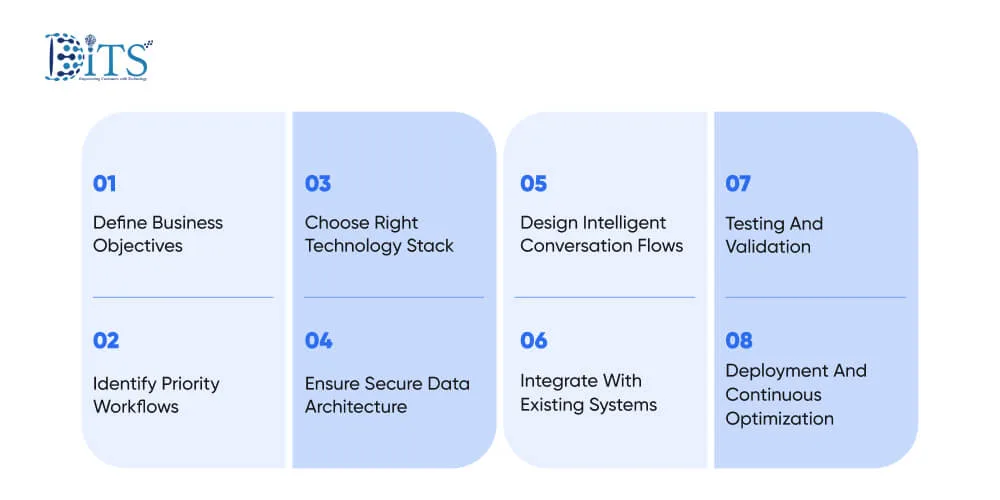
Step By Step Guide to Build Conversational AI in Healthcare
Building intelligent automation in clinical environments requires structured planning. Rushing implementation often leads to fragmented systems and poor adoption. Below is a practical roadmap designed for healthcare leadership teams.
Step 1: Define Business Objectives
Start with measurable intent. Are you reducing call center costs by 25 percent? Improving patient response time from 12 minutes to under 2 minutes? Increasing collections speed by 15 percent?
Clear KPIs prevent scope creep and help align executive stakeholders. Without defined metrics, technology becomes a cost center instead of a performance driver.
Step 2: Identify Priority Workflows
Focus on high-volume, repetitive interactions first. Appointment booking, billing questions, insurance verification, and follow-up reminders usually offer the fastest ROI.
Mapping patient journey bottlenecks often reveals hidden inefficiencies. And guess what? Many of them are communication-based.
Step 3: Choose Right Technology Stack
Selecting the right NLP engine is only one part of the equation. Integration capabilities matter more.
Evaluate:
Compatibility with EHR and practice management systems
CRM and billing platform integration
API flexibility
Cloud versus on-premise infrastructure
Organizations often underestimate integration complexity. That’s where experienced partners or an established AI healthcare software development company can reduce risk and shorten deployment timelines.
Step 4: Ensure Secure Data Architecture
Security cannot be layered on later. It must be embedded at design stage.
Define:
Data encryption standards
Access control structures
Retention and deletion policies
Escalation governance
A compliance-first architecture prevents expensive retrofitting down the line.
Step 5: Design Intelligent Conversation Flows
Technology may be advanced, but language must remain simple. Patients do not interact in clinical jargon.
Effective flow design includes:
Clear, patient-friendly wording
Multilingual capability
Human escalation triggers
Context retention for multi-step interactions
Poorly designed flows reduce trust. Thoughtful design increases adoption.
Step 6: Integrate With Existing Systems
This is where many projects slow down.
Systems must sync with:
EHR platforms
Scheduling tools
Revenue cycle management systems
Real-time data exchange ensures that when a patient reschedules through AI, records update instantly. No duplicate entries. No confusion.
Organizations that treat deployment as a learning cycle see compounding efficiency gains within 6 to 9 months.
At DITS, we build and integrate AI into all kinds of healthcare software solutions, not only for patient-facing solutions but also for code quality monitoring, automated quality assurance, and system customization. This approach ensures stability and performance from the foundation level onward.
Measuring ROI Of Conversational AI In Healthcare
Investment decisions at executive level are driven by measurable outcomes. The benefits of conversational AI in healthcare become visible when performance metrics are tracked consistently over two to three quarters.
Key ROI indicators include:
40 to 60 percent reduction in routine call center volume
20 to 30 percent decrease in appointment no-shows
Faster patient response times, often under 60 seconds
10 to 18 percent acceleration in payment collections
Lower administrative overtime expenses
But numbers alone do not tell full story. Improved responsiveness strengthens patient trust. Staff morale improves when teams are not buried under repetitive queries. Operational friction declines.
When conversational AI in healthcare is integrated properly with scheduling, billing, and CRM systems, it creates a communication backbone that scales with patient volume. That scalability matters for growing networks and multi-location providers.
Why Partnering with Experienced Healthcare AI Development Company Matters
Healthcare environments are complex. Systems rarely operate in isolation. Legacy software, compliance requirements, and workflow dependencies demand precision.
An experienced AI integration services provider understands regulatory nuance, EHR interoperability, and enterprise-grade security architecture. This reduces implementation risk and accelerates time to value.
At DITS, we approach development with a structured engineering framework. We embed AI capabilities not just at user interface level but within backend systems to maintain code quality, automate quality assurance processes, and allow deep customization. This ensures scalability and long-term maintainability.
A capable partner also anticipates challenges before they surface. Integration delays. Data inconsistencies. Performance bottlenecks. Proactive planning avoids operational disruption.
Want to Reduce Call Center Pressure Fast?
Identify high-volume workflows suitable for automation and unlock measurable efficiency gains without disrupting clinical operations.
Why Choose DITS For Conversational AI Software Development in Healthcare
DITS approaches conversational AI software development with a healthcare-first mindset. Our teams understand EHR ecosystems, revenue cycle dependencies, and regulatory frameworks specific to U.S. providers. That context matters because conversational systems must do more than respond. They must transact securely across scheduling, billing, and clinical platforms.
We design solutions that integrate deeply, not superficially. From API architecture to secure data pipelines, every layer is built with HIPAA-aligned controls and performance monitoring in place. And we do not treat AI as an add-on. At DITS, we use AI across the development lifecycle itself, strengthening code quality, automating quality assurance processes, and enabling scalable customization tailored to each healthcare organization.
Healthcare organizations do not need experimental development partners. They need a technology partner capable of aligning intelligent automation with operational reality. That alignment is where long-term value is created.
As digital adoption accelerates, conversational ai for healthcare industry environments is shifting from optional enhancement to operational infrastructure. Providers that align intelligent automation with compliance, integration, and measurable KPIs are building scalable communication ecosystems that support long-term growth without increasing staff.
But there is a catch. Technology without alignment becomes overhead. Technology aligned with strategy becomes advantage.
Healthcare leaders who approach implementation with clear objectives, secure architecture, and experienced development support can transform communication into performance leverage.
Partnering with an AI software development company like DITS with years of experience in developing software for healthcare industry can help businesses achieve that level of performance and efficiency.
Looking to Improve Patient Engagement Metrics?
Explore secure conversational AI strategies that enhance responsiveness, reduce no-shows, and improve satisfaction scores.
For small to mid-sized practices, a focused deployment covering scheduling and billing inquiries can go live within 8 to 12 weeks. Larger hospital systems with multi-platform integration may require 4 to 6 months, depending on EHR complexity and compliance validation requirements. Proper planning shortens timelines significantly.
Nidhi Thakur
With more than 20 years of experience - I represent a team of professionals that specializes in the healthcare and business and workflow automation domains. The team consists of experienced full-stack developers supported by senior system analysts who have developed multiple bespoke applications for Healthcare, Business Automation, Retail, IOT, Ed-tech domains for startups and Enterprise Level clients