How can Generative AI be Used in Cybersecurity
Table Of Content
Published Date :
25 Feb 2026
Key Takeaways
- Generative AI improves threat detection by identifying unusual patterns, even in unknown attacks.
- Response time becomes faster, reducing financial and operational impact.
- Risk prioritization gets smarter, based on business impact, not just technical severity.
- Security teams become more efficient with fewer false alerts and less manual effort.
- Compliance reporting is streamlined with automated documentation support.
- Security can be embedded early in software development, lowering long-term exposure.
- Human oversight remains critical to ensure accuracy and governance.
Cybersecurity is a crucial in any organization a single breach is enough to halt operations, and damage reputation. Attackers are moving faster, automating their methods, and using intelligent tools like generative AI to bypass traditional defenses used by organizations. That reality forces a serious question: how can generative AI be used in cybersecurity to protect modern enterprises?
Using generative AI for cybersecurity is about strengthening detection, accelerating response, and reducing business exposure. Leaders want to know whether this technology reduces risk, improves operational control, and supports long-term resilience.
In this article, we will examine practical, business-focused applications of generative ai in cybersecurity and what they mean for executive decision-making.
What Is Generative AI In Simple Terms
Generative AI is a form of artificial intelligence that can create content, analyze patterns, and generate responses based on large volumes of data. Unlike traditional systems that follow fixed rules, it learns context. It interprets signals. It produces outputs that resemble human reasoning.
In cybersecurity, that difference matters.
Traditional security tools rely heavily on predefined signatures and known attack patterns. Generative models, on the other hand, can review millions of log entries, user activities, and system behaviors, then highlight what feels “off” even if the threat has never been seen before.
And that shift, from manual triage to intelligent assistance, is where real impact begins.
Why Cybersecurity Needs Generative AI Now
Most mid-sized enterprises run cloud workloads, remote teams, third-party integrations, and multiple SaaS platforms. Each layer generates data. Each data stream introduces exposure. Security teams are expected to monitor everything in real time, often with limited staff and budgets.
Here is the pressure point:
- Attack cycles are shrinking from weeks to hours
- Security talent shortage continues to widen
- Alert fatigue leads to missed threats
- Compliance requirements are becoming stricter
Generative AI development in cybersecurity addresses these constraints by analyzing large-scale data faster than any human team could manage. It generates context-aware insights and supporting faster decision-making.
Is Your Cybersecurity Strategy Future-Ready?
Evaluate your threat detection maturity, response speed, and AI readiness to strengthen enterprise resilience against evolving cyber risks.
How Can Generative AI Be Used in Cybersecurity for Real Business Impact
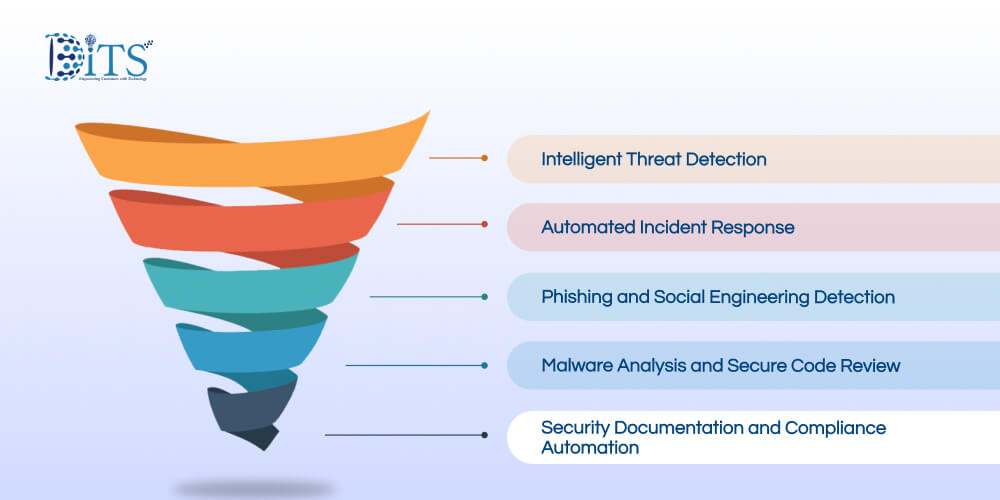
Businesses want measurable outcomes, reduced incident cost, and fewer compliance surprises. Here are some focused, high-impact applications where generative models are delivering value.
Intelligent Threat Detection
Most enterprises generate terabytes of log data every day. Network traffic, Endpoint activity, Access records, Cloud events. No human team can meaningfully analyze that volume in real time.
Generative systems process this data continuously and identify unusual behavioral patterns. For example, if a senior finance executive suddenly logs in from a new geography at 3:17 a.m. and attempts bulk file access, the system flags the context, not just the login.
The result:
- Earlier detection of zero-day attacks
- Reduced false positives
- Clearer risk prioritization for SOC teams
- And fewer missed red flags that later become headlines.
Automated Incident Response
Speed determines damage. When ransomware enters a network, minutes matter. Generative AI can instantly draft containment steps and recommend isolation strategies based on real-time analysis.
Instead of analysts spending 40 minutes compiling an incident report, the system generates a structured summary within seconds.
Here’s the kicker. Organizations that shorten response time by even 30 percent often reduce financial impact significantly, especially in regulated sectors.
Phishing and Social Engineering Detection
Phishing is evolving. Attack emails are now personalized, context-aware, and sometimes indistinguishable from legitimate emails.
Generative AI analyzes tone, intent, and behavioral context across communications. It identifies subtle inconsistencies such as domain anomalies or phrasing patterns tied to impersonation attempts.
This becomes particularly valuable in finance, healthcare, and enterprise procurement functions where a single compromised account can trigger major financial loss.
Malware Analysis and Secure Code Review
Generative AI can examine suspicious code, identify potential malicious behaviour, and even suggest remediation. It can also assist internal teams by reviewing proprietary code for vulnerabilities before deployment.
At DITS, we integrate AI into every software we build, using it for development support, quality assurance, maintaining code quality, and deep customization. As an AI software development company, we see firsthand how embedding intelligent review mechanisms into products reduces long-term exposure and improves resilience.
Security, when built into software from day one, becomes a competitive advantage rather than a compliance burden.
Security Documentation and Compliance Automation
Generative systems can compile compliance documentation, summarize policy adherence, and generate structured audit reports aligned with frameworks such as ISO or SOC standards. Instead of manual compilation taking weeks, documentation can be prepared in hours with expert validation.
But there is a catch. Oversight remains critical. Human review ensures contextual accuracy and prevents blind reliance on automation.
Proactive Defense with Generative AI
Most organizations still operate in reactive mode. Something breaks. Teams investigate. Damage control begins. That cycle is expensive and exhausting.
Forward-looking enterprises are using intelligent to predict the possibility of cyberattacks.
Simulating Cyberattacks Before Attackers Do
Red teaming used to require dedicated specialists running manual penetration exercises over weeks. Now, generative models can simulate attack paths based on system architecture, access roles, and historical vulnerabilities.
For example, an enterprise rolling out a new cloud-based customer portal can test thousands of potential exploitation scenarios in days rather than months. Fixing a vulnerability during testing costs a fraction of resolving a live breach.
This approach supports structured security-by-design principles, especially when combined with disciplined MVP development cycles where risk assessment happens early instead of post-launch.
Predictive Risk Assessment and Prioritization
Security teams often struggle with prioritization. Hundreds of vulnerabilities. Limited bandwidth. Which one actually threatens revenue?
Generative models analyze historical incident data, and system dependencies to rank risks based on impact likelihood. Instead of patching blindly, leadership gains clarity on what truly matters.
Here is how predictive insight changes board-level discussions:
| Traditional Approach | AI-Driven Risk Approach |
| Patch based on severity score | Patch based on business impact probability |
| Static vulnerability list | Dynamic, context-aware risk ranking |
| Delayed executive visibility | Real-time risk dashboards |
| Reactive compliance audits | Continuous risk evaluation |
Organizations leveraging structured IT consulting services are increasingly embedding such intelligence layers into broader digital transformation programs. Security becomes part of enterprise architecture planning.
Proactive defense does not eliminate risk entirely, but it dramatically narrows the attack surface and reduces uncertainty.
Is Your Enterprise Prepared for AI-Driven Threats?
Benchmark your cybersecurity readiness and explore how proactive intelligence can reduce exposure and improve long-term resilience.
Business Benefits of Generative AI In Cybersecurity
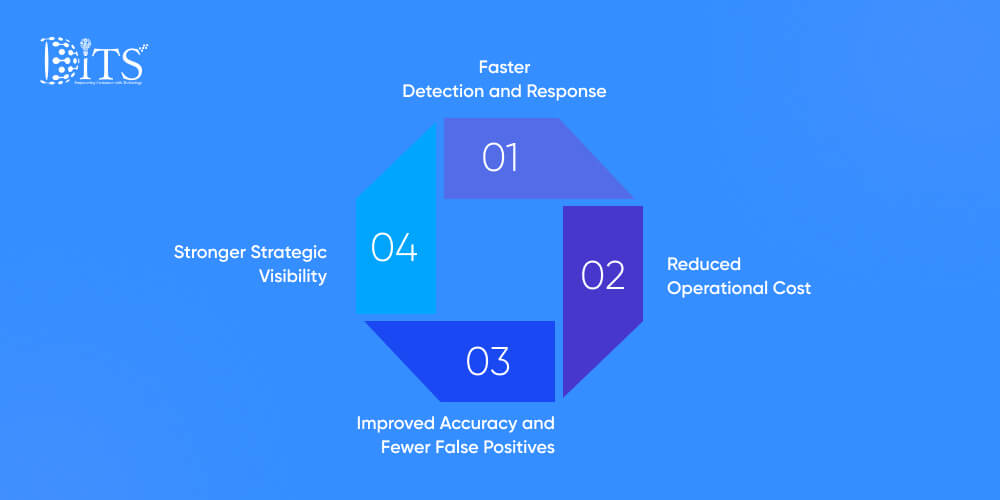
When deployed strategically, generative systems reshape security operations in measurable ways.
Faster Detection and Response
Incident response windows shrink. Instead of identifying suspicious activity after hours of manual log review, anomalies surface in near real time. That time reduction directly impacts financial exposure.
A global services firm recently reduced average incident triage time from 90 minutes to under 25 minutes after embedding AI-driven summarization inside its SOC workflow. Fewer delays. Faster containment. Lower recovery cost.
Reduced Operational Cost
Security teams often scale headcount to manage alert volumes. Generative systems reduce noise and prioritize meaningful alerts, allowing existing teams to handle more complexity without proportional hiring.
It does not eliminate talent requirements. It makes teams more productive.
Improved Accuracy and Fewer False Positives
False alarms drain morale and attention. When analysts repeatedly chase non-issues, real threats can slip through.
Context-aware models assess behavior patterns, not just isolated signals. That layered understanding significantly lowers false positive rates, especially in high-transaction environments such as fintech and enterprise SaaS platforms.
Stronger Strategic Visibility
Leadership gains clearer reporting. AI-generated executive summaries translate technical incidents into business language. Impact, scope, and mitigation steps are articulated quickly.
Security conversations move from reactive explanations to forward-looking risk posture discussions.
Organizations investing in AI agent development are extending this concept further by deploying intelligent monitoring agents that operate continuously across infrastructure layers.
Real World Business Use Cases of GenAI in Cybersecurity
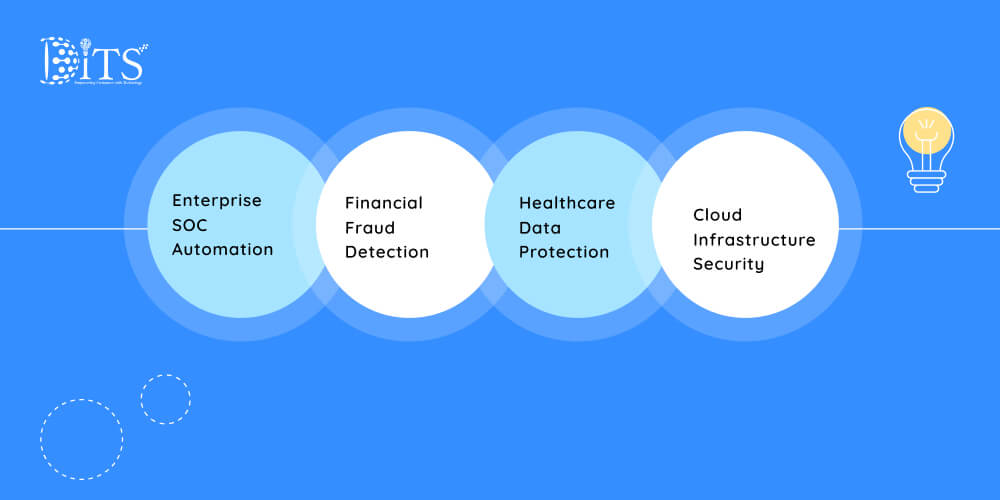
Theory is useful. Outcomes matter more. Below are practical scenarios where generative models are already influencing enterprise security posture.
Enterprise SOC Automation
Large organizations often process over 100,000 security events daily. Analysts spend hours correlating logs and drafting reports.
Generative systems now summarize alerts, cluster related incidents, and recommend next steps automatically. In one multinational environment, alert investigation workload dropped by nearly 35 percent within six months. Analysts shifted focus from manual triage to strategic threat hunting.
Financial Fraud Detection
Banks and fintech firms operate in high-volume transaction ecosystems. A single compromised credential can trigger cascading losses.
Generative intelligence analyzes transaction behavior patterns, cross-references device activity, and flags abnormal sequences in real time. Instead of blocking every unusual transaction, systems assess contextual probability. Fraud teams intervene only when meaningful risk exists. The precision protects both revenue and customer trust.
Healthcare Data Protection
Healthcare institutions manage sensitive patient information across distributed systems. Compliance violations carry heavy penalties.
Generative tools monitor access patterns, detect abnormal data retrieval, and generate automated compliance documentation aligned with regulatory standards. Audit preparation time reduces significantly, sometimes from weeks to days.
Nobody in healthcare wants an unexpected compliance notice. Predictive monitoring lowers that anxiety.
Cloud Infrastructure Security
Enterprises migrating workloads to cloud platforms face configuration complexity. Misconfigured permissions or exposed storage buckets create silent vulnerabilities.
Generative models evaluate infrastructure configurations, simulate attack paths, and suggest remediation steps before exposure escalates. When integrated during MVP development phases, security becomes embedded into product architecture rather than bolted on later.
That early alignment saves cost and preserves brand credibility.
Across industries, one theme repeats. When organizations move beyond experimentation and integrate intelligence into structured security programs, value becomes measurable.
Why Choose DITS For Generative AI In Cybersecurity
Technology alone does not create resilience. Execution discipline does.
At DITS, our approach goes beyond deploying intelligent models into isolated security layers. We integrate AI directly into software architecture, development workflows, quality assurance, and optimization cycles. Security intelligence is not treated as an add-on, but engineered into the foundation of every solution.
What differentiates our model is structured alignment between cybersecurity strategy and business objectives. We begin by understanding operational risk exposure, compliance requirements, and system dependencies. From there, we design intelligent monitoring, automated validation mechanisms, and context-aware response frameworks tailored to enterprise environments.
Our teams use AI-assisted development practices to maintain code integrity, improve testing coverage, and reduce hidden vulnerabilities before deployment. That proactive integration reduces long-term risk and avoids costly remediation cycles later.
Clients choose DITS because we balance innovation with governance. Intelligent systems accelerate detection and response, while our oversight frameworks ensure transparency, accountability, and compliance alignment.
Want Smarter Threat Detection and Faster Response?
Leverage generative AI capabilities to modernize monitoring, automate investigations, and embed predictive security into core systems.
Conclusion
Cybersecurity can no longer rely on static defenses and manual workflows. Threat actors are automating. Attack windows are shrinking. Risk exposure moves at digital speed.
So, how can generative AI be used in cybersecurity in a way that truly strengthens business resilience? The answer lies in intelligent detection, accelerated response, predictive risk modeling, and embedded security within software architecture. When deployed with governance and executive oversight, generative ai in cybersecurity shifts organizations from reactive firefighting to structured, data-driven protection.
This is not about replacing security teams. It is about amplifying their capability and improving decision clarity at the leadership level.
For enterprises evaluating modernization strategies, the opportunity is clear. Integrate intelligence early. Align it with business objectives. Build systems that anticipate rather than merely respond.
Frequently Asked Questions
How can generative AI be used in cybersecurity for mid sized and large enterprises?
Generative AI strengthens cybersecurity by analyzing massive volumes of logs, user behavior, and network activity in real time, identifying anomalies that traditional systems may overlook. It accelerates incident investigation, generates structured response recommendations, and supports predictive risk assessment. For mid sized and large enterprises managing distributed infrastructure, this significantly improves detection speed and reduces operational strain on security teams.
Is generative AI reliable enough for critical security operations?
Yes, when implemented with proper governance. Generative systems should operate with human oversight and validation checkpoints. Leading organizations use AI as a decision-support layer rather than a fully autonomous controller. This approach enhances speed and analytical depth while maintaining executive accountability and compliance alignment.
How does DITS generative AI for cybersecurity differ from standard AI tools?
DITS Generative AI for Cybersecurity is designed as an integrated capability rather than a standalone tool. We embed intelligence directly into development workflows, security monitoring systems, and quality assurance pipelines. This ensures that risk detection, secure coding practices, and compliance validation operate together as a unified framework, reducing long-term exposure instead of merely reacting to incidents.
Can generative AI reduce cybersecurity costs?
In many cases, yes. By minimizing false positives, automating incident summaries, and prioritizing vulnerabilities based on business impact, organizations reduce manual workload and avoid unnecessary escalation. Over time, this improves team productivity and lowers the cost of breach response, particularly in high-risk sectors.
Why should enterprises consider DITS generative AI for cybersecurity now?
Cyber threats are evolving rapidly, and attackers are already using intelligent automation. DITS Generative AI for Cybersecurity enables organizations to modernize their defense posture with predictive monitoring, faster containment strategies, and embedded security within software systems. Acting early allows enterprises to strengthen resilience before risk becomes disruption.

Dinesh Thakur
21+ years of IT software development experience in different domains like Business Automation, Healthcare, Retail, Workflow automation, Transportation and logistics, Compliance, Risk Mitigation, POS, etc. Hands-on experience in dealing with overseas clients and providing them with an apt solution to their business needs.
Recent Posts
Explore how intelligent document processing for insurance helps businesses automate document workflows, reduce processing costs, improve accuracy, and strengthen operational efficiency across insurance functions.
Discover how automated medical claims processing reduces delays, manual rework, claim denials, and administrative costs while improving reimbursement speed and operational efficiency.
Learn how to build medical billing software with essential features, integrations, security, and development costs.