25+ years of IT software development experience in different domains like Business Automation, Healthcare, Retail, Workflow automation, Transportation and logistics, Compliance, Risk Mitigation, POS, etc. Hands-on experience in dealing with overseas clients and providing them with an apt solution to their business needs.
As businesses realize the transformative impact of AI in increasing efficiency, reducing operational costs, and improving customer experiences, organizations have started investing in AI custom software development.
However, the cost of developing AI software is a crucial factor in creating a balance of innovation and ROI. The cost also affects the overall business strategy, budget, and competitiveness. Organizations need a transparent pricing structure to evaluate costs across data, their models, talent, and infrastructure.
The average AI software development cost can range anywhere between $50k to $250k or more, depending on the functionalities, features, and complexities of the tool. The market for AI technologies is already growing and, according to Statista, it is expected to grow beyond 800 billion USD by 2023.
This blog shares the key factors determining the AI software development cost, typical ranges for small, mid-level, and enterprise-level products, and ways to reduce the overall cost.
Start With the Business Objective Before Estimating Cost
Before deciding on budgets or timelines, it is essential to define the project's purpose. Every AI project behaves differently, so the first checkpoint is understanding what you actually want it to do.
Define Core Problem AI Needs To Solve
Most companies look for ways to minimize customer support delays. They assume that using a simple automation tool will do the job. But once the discovery begins, the team finds scattered chat logs, inconsistent tagging, and outdated scripts. What looked like a quick win suddenly demands deeper work. That’s how costs rise quietly.
A clear problem statement doesn’t just guide development, but keeps the team from drifting into features that are not required. And that alone saves money and weeks of effort.
Identify Expected Outcomes And Success Metrics
Once the problem is set, the next question is: what does success look like? You might want a 15 percent cut in manual effort. Or maybe the system should classify incoming requests with 90 percent accuracy. These small markers help you understand the real scope.
When metrics are sharp, the development partner can estimate resource hours and effort more accurately.
Key Factors That Determine AI Software Development Cost
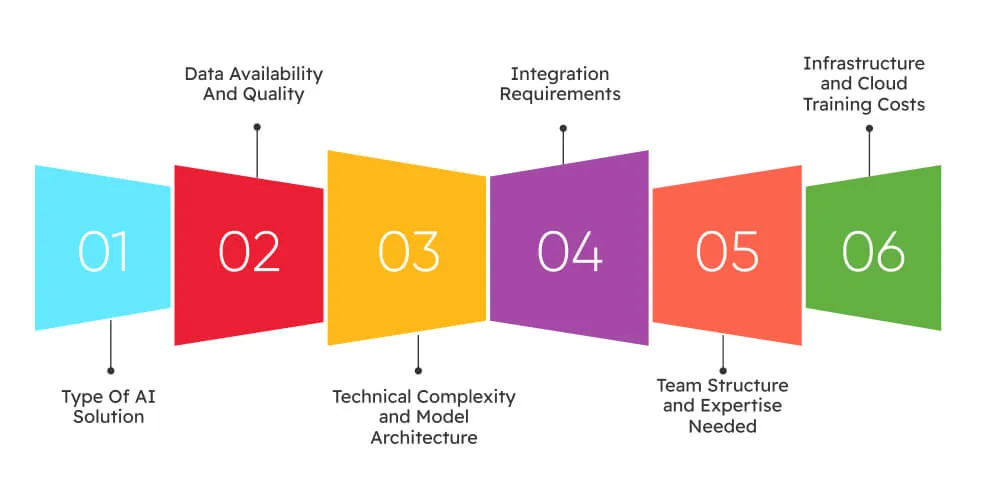
Now that the purpose is clear, the next stage is understanding what actually drives the numbers. Let's explore the key factors that affect the AI software development costs.
Type Of AI Solution
Different AI systems carry different levels of effort. A basic text classifier behaves differently from a model that analyses product images. And a conversational engine for customer queries won’t share the same workload as a recommendation engine for retail.
NLP models need consistent language patterns. Computer vision tools depend heavily on image quality.
So before estimating anything, you need clarity on the type of solution you’re targeting. It shapes everything, architecture, hours, and even the level of talent required.
Data Availability And Quality
Most teams underestimate this part. They think they “have enough data,” but once the project starts, the actual files tell a different story. Sometimes the data is locked in multiple systems that don’t talk to each other.
Fixing isolated or scattered data takes a lot of time. Data cleaning, labelling, or restructuring can easily stretch a project by weeks. It’s not ideal, but it’s reality for many tech businesses still dealing with older tools or manual data entry habits.
Technical Complexity and Model Architecture
A simple model might take a few weeks of tuning. A deeper system that uses multiple neural layers can take months. Add experimentation rounds, and timelines shift even more. This is why two projects with the same idea can end up with very different budgets. The effort lies in crafting a dependable model, not just a functional one.
Integration Requirements
AI technology rarely works alone. It has to fit into existing systems: CRM, ERP, mobile apps, or internal dashboards. Connecting all of these pieces smoothly requires careful planning by the development team.
Legacy tools make this tougher. Most of them might not be ready for automation. Others may need extra layers or API work. This integration phase often becomes one of the biggest cost influencers, sometimes bigger than the model itself.
Team Structure and Expertise Needed
Building AI requires a team of specialists in specific areas. There’s usually a data scientist, someone for integration, and another for deployment and monitoring. If the project is large, you may even need an architect to stitch everything together.
Experience of the team members also matter a lot in AI software development. Senior teams move faster, catch issues early, and prevent rework. Junior-heavy teams may cost less upfront, but often extend timelines. It's best to hire a mix of senior and junior developers for AI development projects.
Infrastructure and Cloud Training Costs
Training models eats compute power. GPUs run the meter quickly. Cloud platforms charge by usage, so long experiments or multiple training cycles can add costs quietly in the background.
Besides training, you also need storage, monitoring tools, and pipelines to keep the model in good health. This ongoing structure often surprises those who expected a one-time setup.
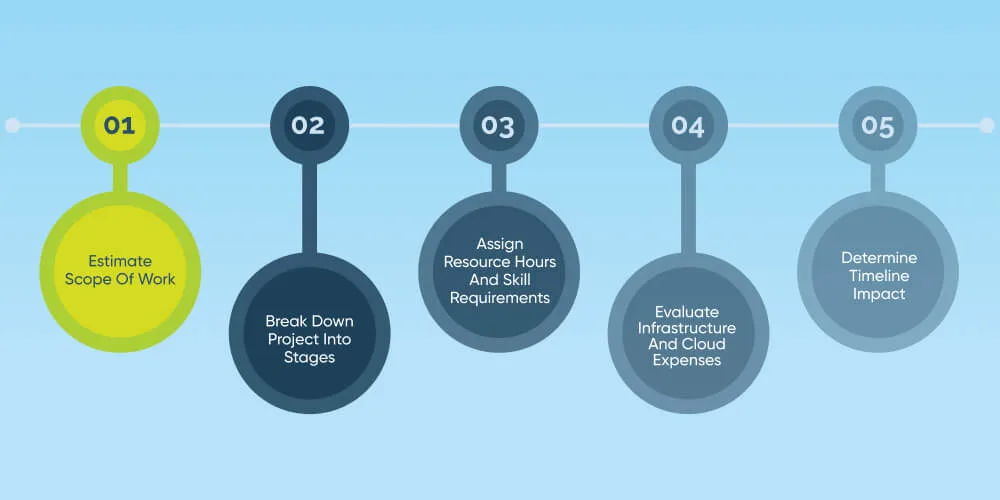
Every variable creates a ripple effect, that is why estimating the cost of AI software development needs a structured approach.
Step-By-Step Process To Calculate AI Software Development Cost
Once you understand what affects the pricing, the next step is to create a practical estimate that makes further steps easier.
Estimate Scope of Work
Start with what you want to build. Lay out the features, identify the datasets. Map where the AI model will plug into your existing workflow.
A small forecasting model might need only a few inputs. A more advanced decision engine might require multiple data pipelines, checkpoints, and a dashboard. Scope sets the baseline for everything that follows.
Break Down Project Into Stages
Every AI project moves through a set of predictable stages. Even though the workload varies from one solution to another, the flow rarely changes. What shifts is the effort inside each stage, and that’s exactly where costs rise or fall.
When you break the project this way, estimating the investment becomes far less stressful. You can actually see where the money goes instead of guessing blindly.
Below is a practical breakdown that aligns with how most tech teams build modern AI systems.
Discovery And Scoping
This is where the team studies your goals, reviews available data, and maps out the architecture. It’s not a long stage, but it’s crucial. A sharp discovery phase prevents rework later, which saves weeks of cost.
Data Preparation
Here’s where reality hits. Data comes in all shapes: clean, messy, outdated, duplicated. Preparing it takes time, and that directly affects the overall budget. If the data is already structured, this stage moves quickly. If not, it needs dedicated effort.
Model Development
This is the heart of the project. Engineers choose the right model type, experiment with variations, and build the core logic. Complexity plays a huge role here. Simple models train fast. Advanced ones demand several iterations.
Training And Tuning
Training eats compute power. And tuning eats time. Some models behave perfectly on the first attempt. Others need multiple rounds of adjustments. Each cycle adds a little more to the overall investment.
Testing And Validation
Before integrating the model into a live environment, the team tests accuracy, consistency, and edge-case behavior. It’s a safety net that prevents bigger problems later.
Integration And Deployment
Connecting the model to your existing tools: CRM, ERP, internal dashboards, mobile apps; requires careful planning. Older systems usually take longer. Modern ones fall into place quickly.
Support And Optimization
Once the AI is live, you still need health checks, monitoring, and occasional tuning. Not heavy work, but important for keeping accuracy high.
Breaking it down like this lets you see which areas need more resources or time. Some phases move quickly. Others, especially training, can stretch depending on how the model behaves.
Stage-Wise AI Cost Overview
Development Stage
Estimated Cost (USD)
Typical Duration
Discovery & Scoping
$2,000 – $8,000
1–2 weeks
Data Preparation
$5,000 – $30,000
2–6 weeks
Model Development
$10,000 – $50,000
3–8 weeks
Training & Tuning
$8,000 – $40,000
2–6 weeks
Testing & Validation
$3,000 – $15,000
1–3 weeks
Integration & Deployment
$10,000 – $60,000
3–8 weeks
Support & Optimization
$2,000 – $20,000 per cycle
Ongoing
Assign Resource Hours And Skill Requirements
Each stage needs people, data specialists, ML engineers, and integration developers. Each role comes with a different hourly rate. And the hours vary based on complexity.
Instead of guessing, match the tasks to the specific skills needed. You’ll notice the total starts to feel more grounded, almost predictable.
Evaluate Infrastructure And Cloud Expenses
Cloud costs can feel like a moving target. Training cycles may run for a few hours or a few days, depending on how demanding the model is. You also need storage, development environments, and monitoring tools once the system goes live.
If planned early, they stay manageable. If not, they creep up quietly, and nobody wants to deal with that surprise mid-project.
Determine Timeline Impact
AI work isn’t linear. Sometimes the work is done in a few weeks. Sometimes it slows down because the model needs more adjustments than expected. Short deadlines often create more pressure, which leads to rushed development and rework later.
Longer timelines give room for iterative improvements, and AI thrives in that space.
So when you calculate the AI software development cost, include time as a real factor. It shapes the experience just as much as the technical effort.
When these pieces come together, your estimate stops being a guess and starts becoming a realistic projection, the kind leaders can confidently plan around.
Typical Cost Ranges For AI Projects With Examples
Once you break down the stages, the next logical question is: what does it actually cost? Every project falls into a range depending on its depth, data needs, and integration workload. They reflect what tech teams usually experience when moving from planning to full deployment.
A small proof of concept might run smoothly with a lean dataset. But a mid-size recommendation system or a vision model for product quality checks can take several weeks of structured effort. Enterprise setups, especially ones that rely on multiple models working together, naturally move into higher brackets.
To make this clearer, here’s a practical table you can actually use during planning:
AI Project Cost Overview
Project Type
Example Use Case
Approx Cost (USD)
Typical Timeline
What Drives This Range
Small AI Project
Basic forecasting model or simple classifier
$15,000 – $40,000
3 to 6 weeks
Clean dataset, minimal integrations, limited model tuning
Multiple datasets, training cycles, dashboards or API integrations
Enterprise-Grade AI Product
Multi-model architecture, real-time AI engine, automated workflows
$120,000 – $350,000+
4 to 8 months
Complex infrastructure, scalability requirements, continuous optimization and monitoring
Complex infrastructure, scalability requirements, continuous optimization and monitoring
Small projects offer a quick way to test an idea. Mid-level builds become part of daily operations. Large systems, though, demand serious planning, but they also deliver the most significant long-term impact.
If you map your project against these ranges early, the entire planning phase becomes smoother. You won’t underestimate hidden work, and you’ll know exactly where your investment is going.
How DITS Helps Businesses Estimate And Optimize AI Development Cost
Many companies know what they want from an AI solution, but they’re unsure how to map the journey from idea to a dependable system without overspending. That’s usually where DITS steps in.
Our development team studies your goals, data maturity, and the level of intelligence your product actually needs. That way, you’re not paying for a heavy setup when a lighter, smarter approach would work better.
DITS uses AI inside the development cycle, too. From generating cleaner code to improving quality checks, the workflow is designed to remove unnecessary steps. The team doesn’t just build the model. They shape the full ecosystem around it: data pipelines, integrations, dashboards, and automation layers. So your AI behaves like part of your business, not a separate add-on.
For complex use cases, especially ones that need orchestrated logic or automated decision pathways, DITS supports AI agent development and modern architectures that keep maintenance predictable.
Every solution follows a structured plan: early discovery to avoid scope creep, transparent cost mapping, and an implementation timeline that doesn’t strain your internal team.
When you know what you’re investing in, AI starts feeling like a solid, long-term asset for your business.
Need Clarity on Your AI Budget?
Access a structured assessment that highlights effort hours, model complexity, data needs, and integration variables.
AI can feel overwhelming when you're trying to nail down the numbers. But with the right structure, a clear objective, and a partner who actually understands how AI behaves in real operations, the entire process becomes far more predictable.
And once you add proper monitoring and a clean development pipeline, scaling becomes easier too, whether you're building a retail tool, an automation engine, or a Healthcare software solution that needs long-term stability.
The good news? AI doesn’t have to be complicated. It just needs to be approached with clarity and the right expectations. When that happens, the investment feels controlled, the results feel meaningful, and the journey feels a lot less stressful.
Planning an AI Project This Quarter?
Unlock a precision estimate built on your use case, data readiness, and operational workflows.
The simplest way is to start with clarity. Define the problem, list the essential workflows, and identify the data you already have. With this information, your development team can map effort hours, model needs, integration points, and cloud usage more precisely. Clear inputs reduce vague estimates.
Dinesh Thakur
25+ years of IT software development experience in different domains like Business Automation, Healthcare, Retail, Workflow automation, Transportation and logistics, Compliance, Risk Mitigation, POS, etc. Hands-on experience in dealing with overseas clients and providing them with an apt solution to their business needs.