Staff Work Across Too Many Systems
Providers and administrators may move between EHRs, scheduling platforms, billing applications, spreadsheets, communication tools, and department-specific systems to complete one workflow.
We help hospitals, clinics, medical groups, specialty practices, and healthcare organizations improve how care and administrative operations work together. Our healthcare operations consulting combines workflow analysis, healthcare provider solutions, automation, integration, modernization, data, and engineering to turn provider operations transformation into measurable operational improvement.
Assess Your Healthcare OperationsEffective healthcare operations consulting starts by understanding how people, information, systems, and decisions move through the organization. We assess where fragmented digital healthcare operations, manual work, disconnected applications, and operational dependencies create unnecessary effort before recommending technology.
Providers and administrators may move between EHRs, scheduling platforms, billing applications, spreadsheets, communication tools, and department-specific systems to complete one workflow.
Provider availability, rooms, appointments, patient needs, cancellations, and operational priorities can become difficult to coordinate when scheduling does not connect with the wider care workflow.
What happens during care may not flow cleanly into documentation, billing, reporting, follow-up, or administrative processes, creating duplicate work and information gaps.
Calls, messages, spreadsheets, emails, and individual knowledge can become the unofficial workflow when formal systems do not reflect how staff actually operate.
Leadership may have access to reports but still lack timely visibility into workload, capacity, bottlenecks, service activity, workflow exceptions, or cross-department performance.
Business-critical systems may continue performing essential functions while making integration, workflow changes, mobile access, automation, reporting, or new digital experiences difficult.
More patients, locations, clinicians, services, partners, and operating models can increase administrative effort unless workflows and systems are designed to scale.
A hospital may request another application when the underlying problem is actually workflow design, integration, data access, process ownership, or a limitation in the existing platform.
Successful provider operations transformation improves the operating environment around care. Our healthcare workflow optimization approach focuses on the activities, decisions, handoffs, information, and systems that affect productivity, patient access, care coordination, financial workflows, and staff experience.
Simplify repetitive tasks, duplicated entry, manual follow-ups, status checks, and unnecessary handoffs that consume time without improving the care process.
Give clinical and administrative teams better tools, clearer workflows, and easier access to information so less effort is spent navigating the technology around the work.
Connect workflow and system data into dashboards that help managers understand activity, capacity, delays, exceptions, and other meaningful operational conditions.
Create clearer ownership, task routing, alerts, escalation paths, and shared context between clinical, administrative, financial, and operational teams.
Connect scheduling, registration, documentation, care activity, communication, and follow-up so patients move through the healthcare journey with fewer avoidable operational gaps.
Standardized, configurable workflows help new locations, providers, departments, programs, and services scale without recreating processes from the beginning.
We evaluate whether each proposed change should improve time, capacity, cost, visibility, staff experience, scalability, risk, or another agreed operational objective.
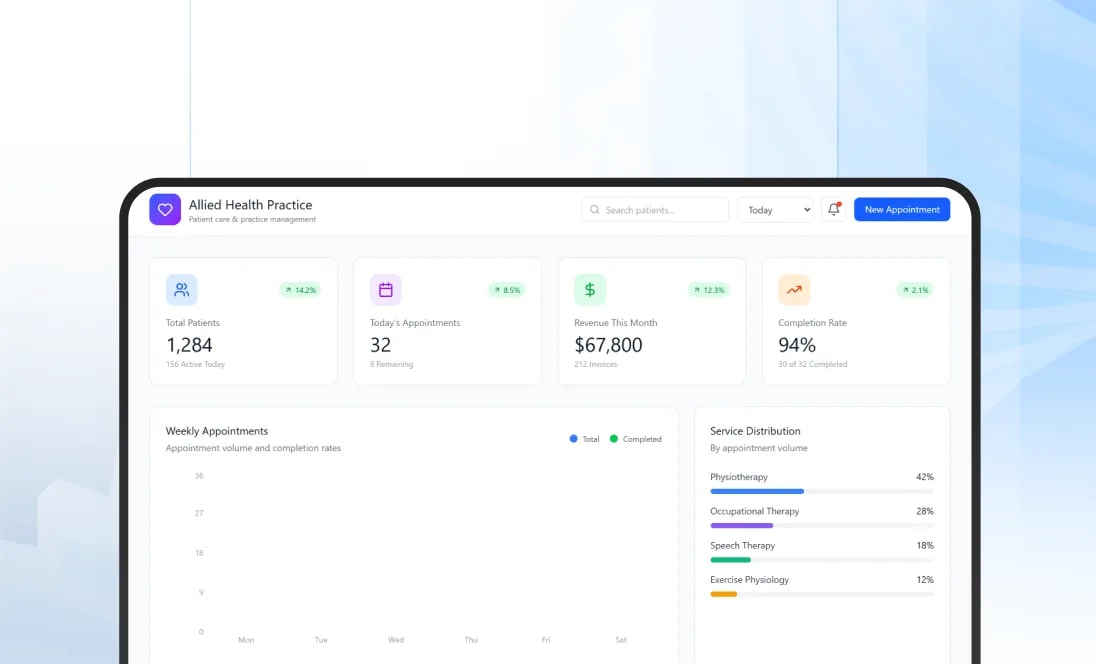
Outcome: DITS developed an allied-health practice management platform that brings scheduling, patient records, clinical documentation, billing, payments, telehealth, and reporting into one connected environment. By replacing fragmented point solutions with centralized, role-based workflows, the platform supports smoother coordination between clinicians and administrative teams across solo and multi-location practices.
Read Full Portfolio: /portfolios/allied-healthcare-practice-management-platform
DITS strengthened a behavioral-health EHR platform supporting 35,000+ daily users across 30+ agencies by addressing data collisions, access-control gaps, fragmented storage, billing limitations, architectural constraints, and care-team communication. The platform improved data integrity, clinical documentation, case management, secure communication, reporting, and coordination across a large distributed behavioral-health workforce.
View Portfolio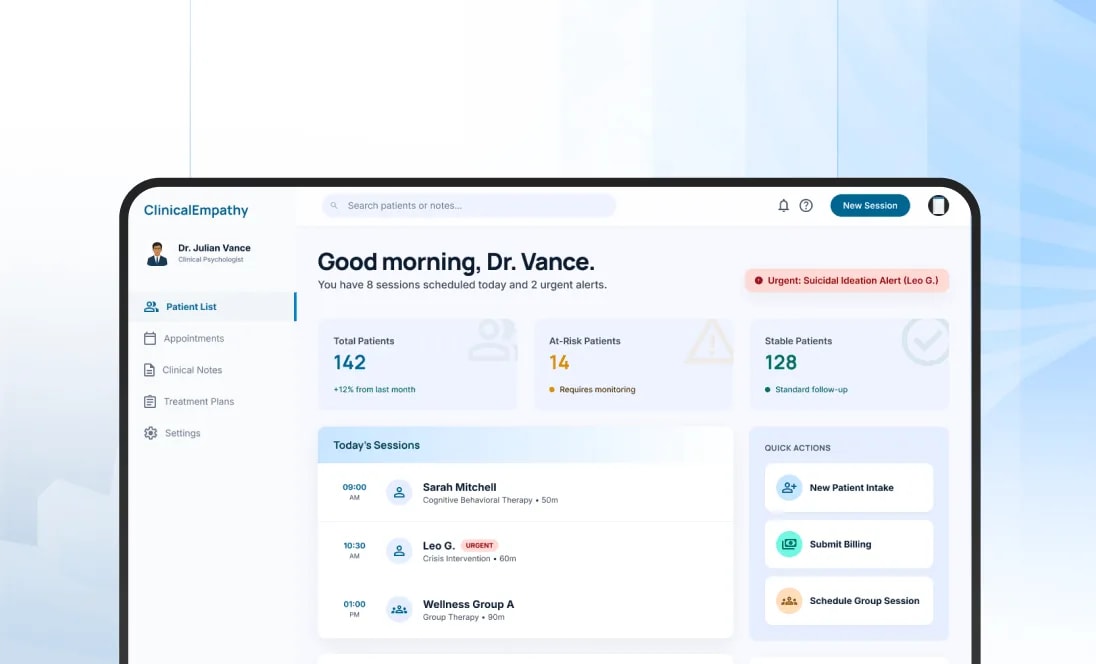
DITS transformed provider credentialing and payer enrollment from spreadsheet- and email-heavy processes into structured digital workflows covering provider intake, verification, enrollment, task management, follow-ups, approvals, SLA tracking, dashboards, and reporting. The platform reduced rework and turnaround time while improving operational visibility, scalability, workflow control, and compliance across provider enrollment operations.
Explore Portfolio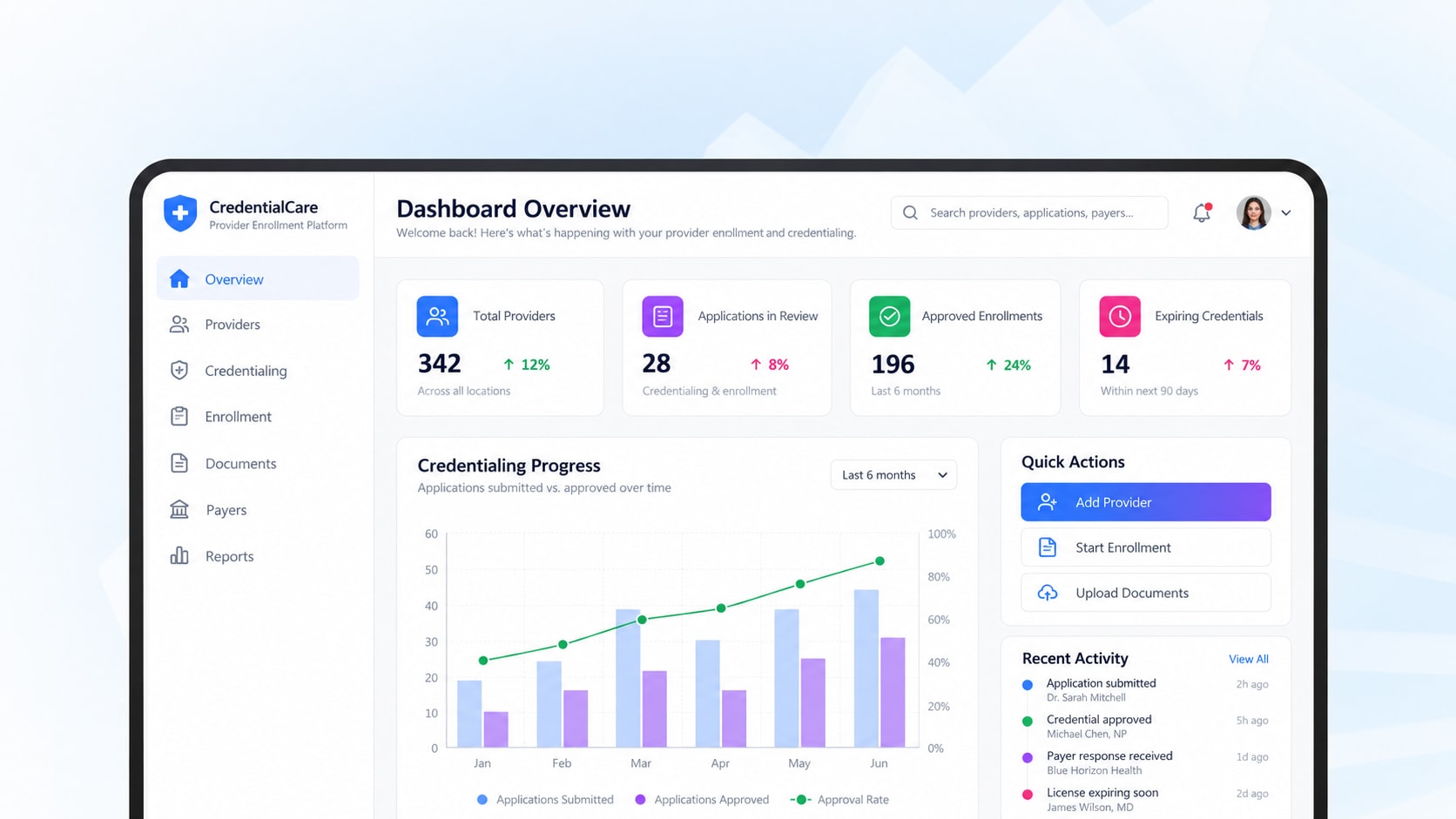
DITS built a remote patient monitoring platform connecting patient onboarding, connected devices, care-team assignments, communication, escalations, billing, and multi-program management across diverse care environments. Supporting 700+ active users, the implementation achieved 60% lower onboarding time, 3× faster escalation response, 40% higher billing accuracy, and deployment across 10 clinics, demonstrating measurable improvements in connected care operations.
Read Portfolio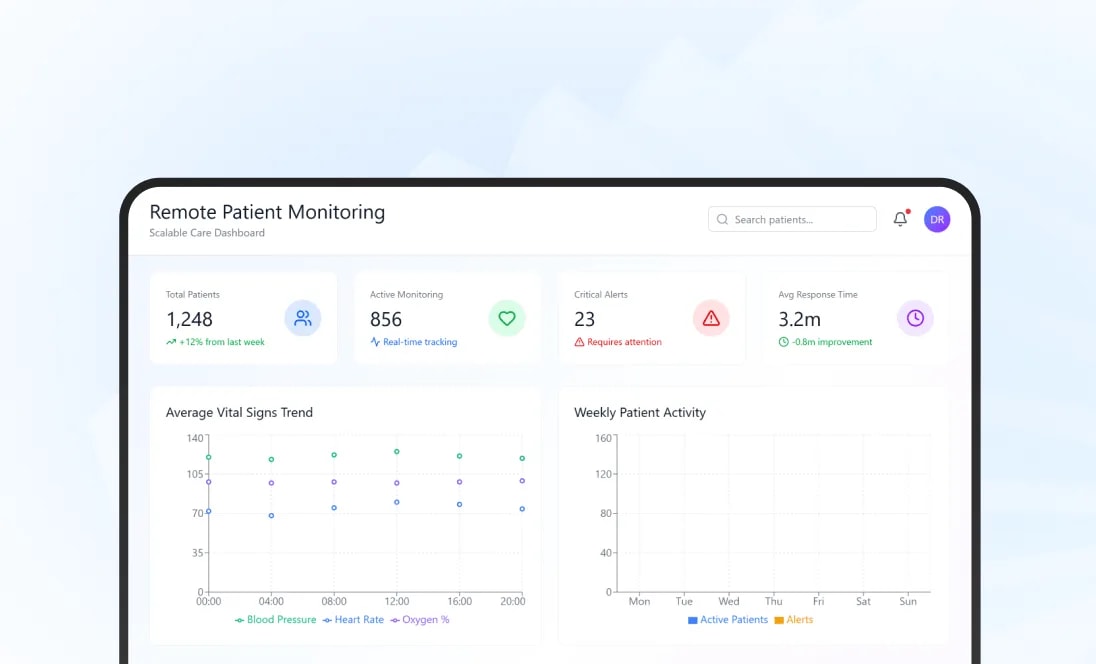
Our healthcare operations consulting approach separates the business problem from the requested technology. A provider operations transformation programme may require improvement, integration, automation, modernization, new software, or several interventions working together.
Remove unnecessary steps, duplicated approvals, repeated data entry, or operational rules that no longer serve the workflow.
Create consistent process stages, ownership, information requirements, and operating rules where different teams perform the same activity differently.
Integrate systems and data when employees are manually bridging applications that should exchange information directly.
Use workflow automation for predictable tasks, routing, notifications, validation, and other repeatable activities.
Improve applications, architecture, interfaces, databases, APIs, or infrastructure when existing technology is limiting operational change.
Engineer new capability when the organization has a validated requirement that existing applications cannot reasonably support.
Introduce AI where information processing, classification, summarization, prediction, or decision support can create measurable value.
Preserve appropriate human accountability in clinical, financial, regulatory, and exception-heavy decisions.
Our healthcare provider solutions connect clinical, administrative, financial, patient, and technology workflows. DITS can address an individual operational bottleneck or support a broader provider operations transformation where several functions need to improve together.
Support provider scheduling, practice management, patient registration, team coordination, workload management, operational workflows, and administrative reporting.
Connect documentation, assessments, patient records, clinical tasks, care activities, alerts, treatment workflows, and appropriate decision-support capabilities.
Improve intake, appointment booking, registration, digital forms, communication, navigation, reminders, portals, and other front-door workflows.
Support care plans, referrals, case management, transitions, assignments, alerts, handoffs, and longitudinal coordination across care teams.
Connect clinical activity with coding, claims, payments, accounts receivable, reimbursement, and related financial workflows.
Digitize provider onboarding, credentialing, payer enrollment, renewals, license tracking, provider data, and administrative follow-up.
Create role-specific operational dashboards for administrators, clinical leaders, finance teams, program managers, and executives.
Connect EHRs, payer systems, labs, pharmacies, medical devices, external platforms, APIs, FHIR, and HL7-based workflows.
Healthcare workflow optimization becomes especially valuable where patient demand, provider availability, staffing, facilities, and administrative dependencies intersect. We improve the flow around scheduling rather than treating the calendar as an isolated system.
Maintain clearer visibility into provider schedules, locations, specialties, service types, and operational constraints.
Match appropriate appointment types, durations, resources, and providers according to the organization’s scheduling model.
Turn cancellations into structured actions so available capacity can be reused where appropriate.
Support providers, departments, and services operating across multiple sites without forcing staff to maintain separate manual calendars.
Connect reminders, confirmations, instructions, and appointment changes with the scheduling event rather than managing them separately.
Monitor appointment demand, scheduling patterns, service activity, and other relevant measures to support better operational decisions.

Care coordination is not only a clinical issue. It also depends on tasks, communication, scheduling, information access, follow-ups, referrals, and system connectivity. Our healthcare provider solutions bring those dependencies together so digital healthcare operations support continuity rather than create more interfaces.
Track referral intake, documentation, status, assignment, communication, and downstream actions.
Connect patients and programs with the appropriate clinicians, coordinators, specialists, or administrative support roles.
Translate care plans into structured activities with ownership, status, due dates, and appropriate visibility.
Ensure urgent or unresolved conditions are routed to the correct person instead of remaining hidden within inboxes or disconnected systems.
Connect discharge, post-acute, remote monitoring, follow-up, referral, and other transition workflows where information can otherwise become fragmented.
Give authorized teams a clearer view of what has happened, what is pending, and what should happen next.
Provider operations transformation also includes the administrative work required before clinicians can effectively operate. Provider onboarding, credentialing, enrollment, profile management, and renewals can create substantial friction when teams rely on email and spreadsheets.
Create structured intake, profile, document, checklist, task, and status workflows for new providers.
Connect primary-source verification, documentation, reviewer activities, missing-item follow-up, and audit trails.
Manage payer-specific submissions, requirements, statuses, follow-ups, and exceptions through a visible workflow.
Track expiration dates, certification requirements, renewals, and related administrative actions.
Maintain provider demographic, professional, location, and organizational information across relevant systems.
Track turnaround time, workload, bottlenecks, missing information, productivity, and other management indicators.
Modern digital healthcare operations depend on information moving between applications without requiring employees to become the integration layer. DITS uses healthcare workflow optimization to identify which systems, APIs, records, and events must connect for the process to work end to end.
Connect patient, clinical, scheduling, documentation, and related operational information with the workflows surrounding the core record system.
Use appropriate healthcare interoperability standards where systems need structured, governed exchange of clinical or administrative information.
Connect eligibility, claims, reimbursement, authorization, provider, or other payer-related workflows where operations depend on external information.
Move orders, results, status, or other appropriate information between clinical and diagnostic environments.
Connect medication-related workflows with prescribing and pharmacy systems where required.
Bring appropriate device and monitoring information into care or operational workflows rather than leaving it isolated in separate platforms.
Connect healthcare applications with finance, CRM, document, communication, identity, and other systems supporting the wider organization.
AI should support healthcare operational efficiency, not become another technology layer teams need to manage. We use provider workflow automation and AI selectively where information processing, prioritization, prediction, or knowledge access can improve a defined operational condition.
Support drafting, summarization, structured information preparation, or other documentation activities where appropriate human review remains in place.
Extract, classify, validate, and route information from forms, clinical documents, administrative records, or correspondence.
Help teams identify tasks, cases, or exceptions that may require faster attention based on defined criteria and available data.
Give staff faster access to approved procedures, policies, workflow guidance, and organizational knowledge.
Use agents for bounded activities such as gathering information, preparing tasks, updating statuses, or coordinating cross-system actions under defined controls.
Apply predictive models where historical and real-time data can support validated forecasting, risk, demand, or operational use cases.
Keep consequential clinical, financial, compliance, and operational decisions with accountable people where judgment remains essential.

Technology decisions improve when we understand the healthcare setting in which people actually use them. Our healthcare operations consulting combines business, workflow, product, and technology perspectives across different provider operating models.
Address workflows spanning patient access, care delivery, departments, administration, reporting, billing, integrations, and enterprise applications.
Improve scheduling, intake, documentation, patient communication, billing, provider workflows, reporting, and multi-location operations.
Support clinical documentation, intake, care plans, scheduling, case management, communication, compliance reporting, and reimbursement workflows.
Adapt workflows and applications around specialty-specific forms, scheduling, treatment processes, documentation, billing, and patient journeys.
Connect workforce activity, care plans, EVV, remote monitoring, patient documentation, billing, and coordination outside traditional facilities.
Coordinate devices, patient data, alerts, care teams, follow-ups, patient communication, and reimbursement within connected-care programs.
Help product companies improve workflows, scalability, integrations, data, AI readiness, and enterprise capabilities used by provider organizations.
Frontend
We define healthcare operational efficiency around the business condition that justified the programme. Successful healthcare workflow optimization should create observable improvement in how people, information, systems, patients, and work move through the organization.
Measure repeated entry, manual follow-ups, unnecessary handoffs, document processing, reconciliation, and other avoidable work.
Track how long targeted processes take, where work waits, and whether important stages move more consistently.
Assess whether clinicians and administrative teams spend less time navigating operational friction and more time on higher-value responsibilities.
Evaluate task ownership, escalation response, communication continuity, follow-up completion, and cross-team visibility.
Monitor appropriate measures around scheduling, intake, onboarding, digital completion, communication, and access-related friction.
Determine whether managers can identify bottlenecks, exceptions, workload, and service activity sooner.
Track availability, incidents, performance, integration reliability, deployment quality, and other technical indicators relevant to operational continuity.
Evaluate whether the organization can support additional users, providers, patients, services, locations, or programmes without equivalent growth in administrative complexity.
Our approach connects healthcare operations consulting with engineering execution. DITS combines domain understanding, healthcare provider solutions, modernization, integration, automation, data, AI, and continuous improvement so strategy does not become disconnected from implementation.
We look beyond the feature request to understand the workflow, users, dependencies, information, decisions, and business condition behind it.
Our portfolio spans practice management, behavioral health, provider enrollment, RPM, telehealth, billing, claims, clinical documentation, scheduling, and care coordination.
The right path may be integration, process improvement, modernization, configuration, automation, or better use of an existing platform.
Operational transformation often crosses care delivery, administration, billing, reporting, compliance, and technology rather than staying inside one department.
The same engagement can progress from assessment and roadmap through architecture, integration, engineering, modernization, testing, and rollout.
DITS does not treat AI as a mandatory part of every transformation. We use it where information, reasoning, classification, or workflow support can create defensible value.
Provider organizations continue changing after launch. We support the ongoing evolution of products, workflows, integrations, data, and operating models.
You do not need to determine whether your organization needs another platform, integration, workflow redesign, automation, or modernization before speaking with us. DITS brings healthcare operations consulting and engineering together to understand the operating problem, evaluate the options, and define the healthcare provider solutions most likely to improve performance.
Talk to Our Healthcare Team