DITS Logo
Connect With Us

HealthTech Software Development Services for Scalable Digital Care

Turn healthcare ideas, fragmented platforms, and evolving market needs into digital products built for real care environments. DITS combines product strategy, healthcare workflows, experience design, engineering, integration, data, and AI to help HealthTech organizations launch, modernize, and scale platforms around measurable business and user outcomes.

Discuss Your HealthTech Product

HealthTech Software Development Services Start With the Healthcare Problem

Strong HealthTech software development services begin by understanding the healthcare workflow, user, product opportunity, and business model before deciding what to engineer. Our digital health consulting helps determine whether the right path is a new product, integration, modernization, automation, reusable capability, or targeted product improvement.

01

The Product Idea Is Clear but the Workflow Is Not

A product concept may sound valuable until patient, provider, administrative, reimbursement, or operational workflows reveal important dependencies that were not considered during initial feature planning.

02

Different Users Need Different Products Inside One Platform

Patients, clinicians, administrators, care coordinators, payers, program managers, and partners can interact with the same healthcare platform while requiring very different information, permissions, workflows, and experiences.

03

Healthcare Integrations Become Product Dependencies

EHRs, payer environments, devices, laboratories, pharmacies, communications, identity, claims, and third, party services often determine how useful a digital, health product becomes in real operations.

04

Compliance Is Considered Too Late

Teams can validate an attractive interface only to discover later that data handling, permissions, auditability, software function, integration, or regulatory requirements materially affect the product design.

05

The MVP Cannot Scale Beyond the Pilot

A prototype may work for one customer, clinic, program, or workflow but struggle when the product needs multiple organizations, roles, locations, configurations, integrations, and greater data volume.

06

Product Growth Exposes Architecture Debt

Established HealthTech platforms often reach a stage where new releases, customer configurations, integrations, data workloads, and enterprise requirements become increasingly difficult to support.

07

Healthcare Data Remains Fragmented

The product may need information held across EHRs, monitoring devices, administrative systems, payer environments, documents, and external applications that were never designed to work together.

08

AI Becomes the Roadmap Before the Product Is Ready

HealthTech organizations may want AI features while data access, workflow ownership, integration, user trust, governance, and product architecture first need attention.

Digital Health Software Development Should Create More Than Working Software

Effective digital health software development should create a product people can adopt, healthcare organizations can integrate, and product teams can continue evolving. Our HealthTech product engineering approach connects healthcare context with product, UX, architecture, engineering, interoperability, quality, and scale.

Improve Workflow Fit

The product should reflect how care, administration, reimbursement, communication, monitoring, or another healthcare process actually operates rather than forcing users into unnecessary workarounds.

Improve Product Adoption

Reduce avoidable friction across onboarding, navigation, workflows, configuration, communication, and information access so users can get value without excessive training.

Strengthen Enterprise Readiness

Prepare products for more demanding organizations through stronger roles, permissions, configuration, integration, security, reporting, reliability, and operational controls.

Support Product Scale

Build architecture capable of supporting additional users, customers, programs, facilities, integrations, workloads, and product modules without continual redesign.

Accelerate Product Evolution

Improve architecture, design systems, DevOps, testing, and engineering practices so product teams can respond more effectively to changing customer and market requirements.

Improve Connectivity

Make interoperability and API strategy part of the product foundation instead of treating integrations as custom projects added after every new sale.

Build Trust Into the Product

Address security, privacy, permissions, auditability, quality, reliability, and appropriate human oversight as product characteristics rather than post, development tasks.

Create a Foundation for AI

Make relevant data, workflows, APIs, architecture, and controls ready before adding intelligent features simply because AI has entered the roadmap.

SaaS RPM & Public Health Platform

We enhanced a public health and remote monitoring platform connecting medical devices, care teams, EHR workflows, telehealth, billing, and reporting. Our work addressed architecture and performance constraints, reducing mobile vital update times from 12–13 seconds to 2–3 seconds while supporting scalable infrastructure and configurable healthcare programs.

Read Full Portfolio
SaaS RPM & IoT Platform for Public-Health Programs

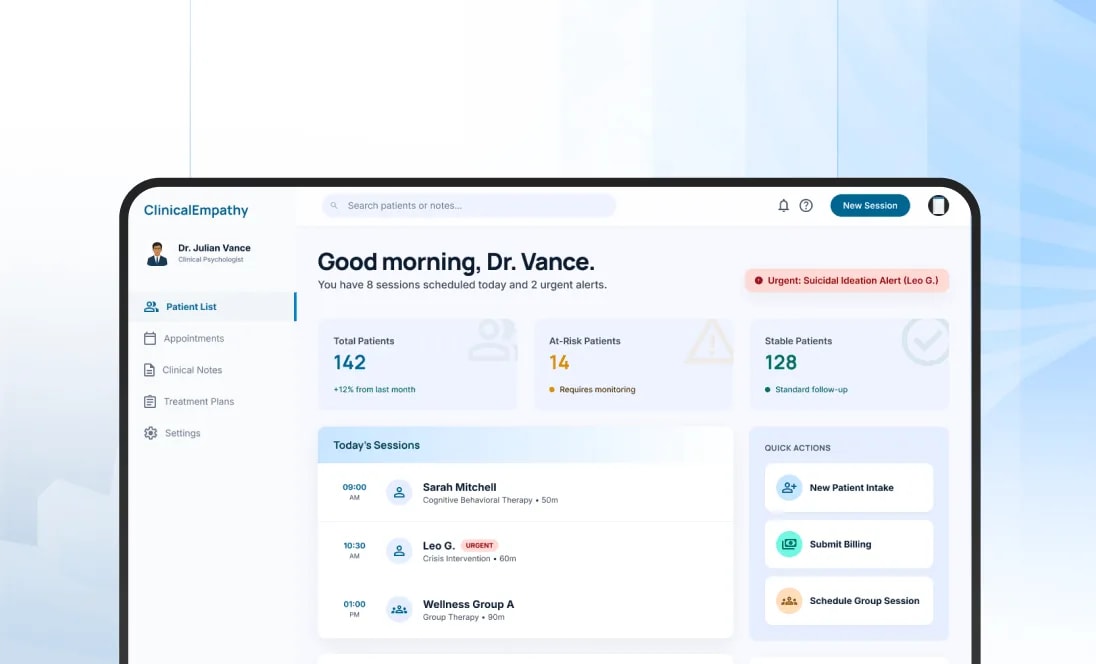
Behavioral Health EHR Platform

Our team modernized a behavioral health EHR supporting more than 30 agencies and 35,000 daily users. We addressed architecture constraints, clinical data integrity, documentation, billing, and communication through autosave, configurable workflows, centralized storage, and HL7 exchange, strengthening the foundation for coordinated care across multiple agencies.

Explore Portfolio
Scalable Behavioral Health EHR Platform

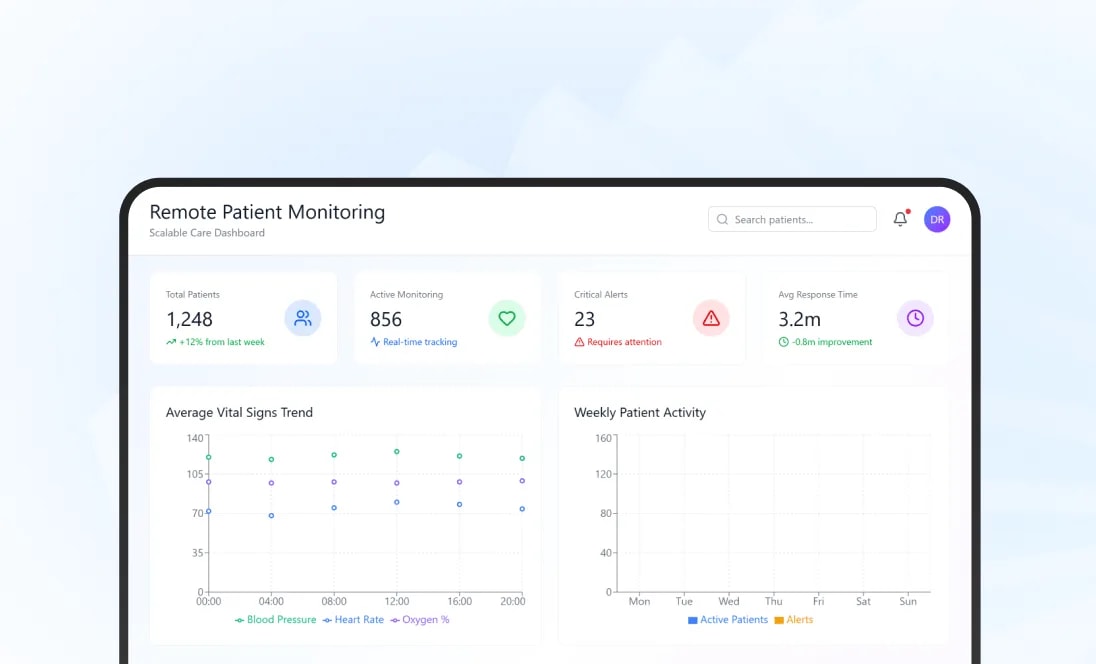
Modular Remote Patient Monitoring Platform

We engineered a modular remote care platform connecting patient onboarding, devices, vital signs, alerts, care teams, documentation, and billing across multiple care programs. Built around configurable workflows and multi-tenant architecture, the platform supports more than 700 active users and reports a 60% reduction in onboarding time.

Read Full Portfolio
Remote Patient Monitoring Software for Scalable Care

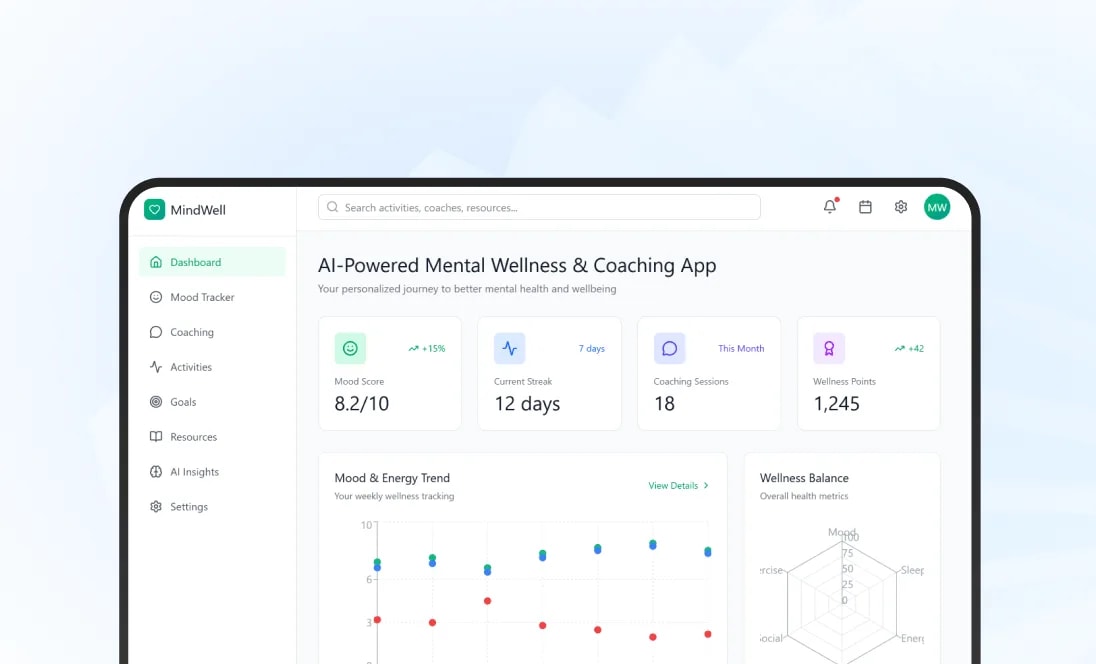
AI-Powered Mental Wellness Product

DITS developed mobile and web experiences combining AI-assisted interaction, habit tracking, behavioral reminders, subscriptions, and administrative analytics for a mental wellness product. The engagement reports 70% trial-to-paid conversion, a 22% increase in daily active users, and 40% faster support response following implementation of these product capabilities.

Explore Portfolio
AI-Powered Mental Wellness & Coaching App

Digital Health Consulting Before Healthcare Product Development Begins

Our digital health consulting starts with the healthcare opportunity rather than assuming new development is automatically required. Before healthcare product development, we evaluate users, workflows, existing systems, alternatives, differentiation, integration, data, risk, and the operating model behind the product.

  • Validate

    Confirm that the problem, user, workflow, buyer, business value, and intended product outcome are sufficiently clear before major engineering investment.

  • Reuse

    Use existing platforms, services, APIs, frameworks, or reusable capabilities where they can satisfy non, differentiating requirements more effectively than rebuilding them.

  • Integrate

    Connect existing healthcare and business systems when the problem is fragmented information rather than missing software.

  • Build

    Engineer differentiated product capability when existing solutions cannot reasonably support the intended workflow or business model.

  • Modernize

    Improve an established healthcare product when technical debt, architecture, performance, UX, integration, or data constraints are limiting its next stage.

  • AI-Enable

    Introduce AI when language, prediction, knowledge, personalization, assistance, or intelligent automation creates a defensible product benefit.

  • Scale

    Strengthen architecture, security, reliability, configuration, integrations, analytics, and engineering practices as customer and workload demands increase.

  • Evolve

    Continue improving the product as healthcare workflows, users, regulation, integrations, competitors, and market priorities change.

Healthcare Product Development Across the Complete Product Lifecycle

Our healthcare product development approach supports both new opportunities and established products. HealthTech software development services can begin with discovery, enter during scale, or focus on modernization depending on the product's current stage.

  • Product Discovery

    Clarify the healthcare problem, target user, buyer, workflow, value proposition, competitive alternatives, assumptions, dependencies, and success criteria.

    • Workflow & Service Design

      Map how patients, clinicians, administrators, partners, systems, data, communications, and decisions interact around the product.

      • Product Strategy

        Define which capability differentiates the product, what should be built first, what can be reused, and what can wait until evidence supports additional investment.

        • UX & Prototype

          Translate workflows into product journeys and prototypes that allow users and stakeholders to react before large engineering commitments are made.

          • Architecture & Technical Validation

            Validate integrations, data, scale, security, architecture, device connectivity, third, party services, and other technical assumptions early.

            • MVP or Pilot

              Build enough capability to validate the healthcare workflow and product proposition without mistaking a large first release for an MVP.

              • Launch & Enterprise Readiness

                Strengthen reliability, security, QA, support, integrations, analytics, documentation, configuration, and operational processes required for broader adoption.

                • Continuous Product Evolution

                  Improve the product using user feedback, workflow evidence, technical health, customer priorities, analytics, new integrations, and changing healthcare requirements.

                  Digital Health Platform Development for Connected Healthcare Models

                  Our digital health platform development work connects product capability with the wider healthcare environment. Digital health software development can span patient, provider, administrative, device, financial, and information workflows inside one platform or connected ecosystem.

                  • Patient Platforms

                    Build patient experiences for registration, records, assessments, communication, scheduling, monitoring, education, payments, care plans, and appropriate self, service.

                  • Provider Platforms

                    Create role, aware workspaces for patient information, caseloads, documentation, alerts, tasks, communication, programs, reporting, and care coordination.

                  • Remote Patient Monitoring

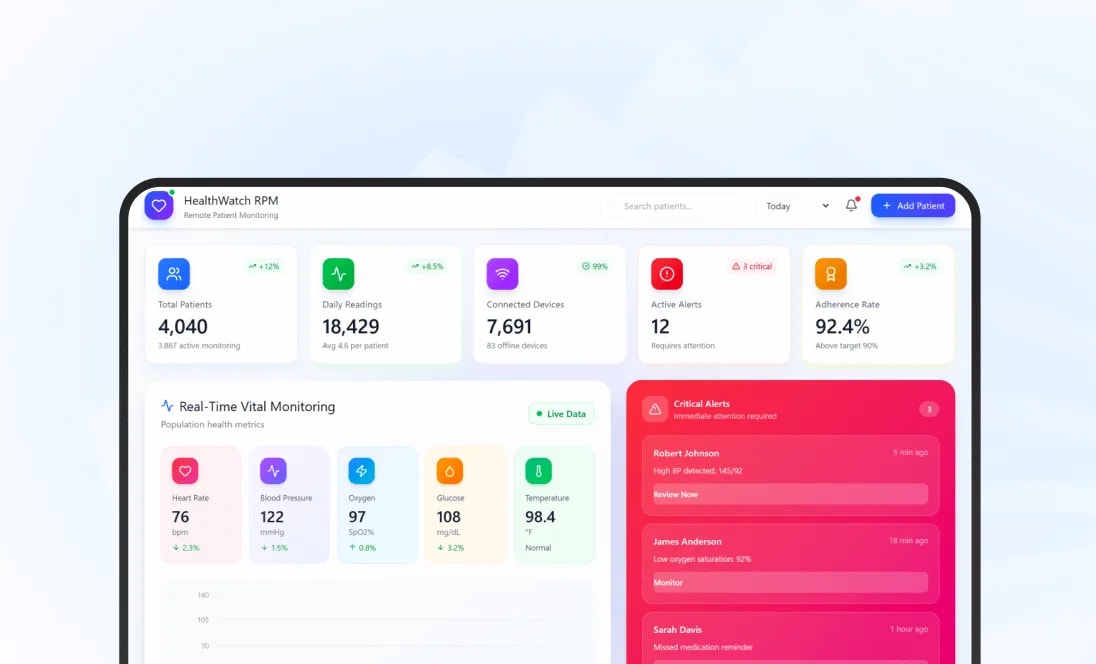
                    Connect devices, patient, generated data, thresholds, alerts, escalation, care teams, engagement, documentation, and billing into scalable monitoring products.

                  • Telehealth & Virtual Care

                    Support scheduling, video, forms, communication, documentation, care plans, follow, up, and related virtual, care workflows.

                  • Care Coordination

                    Bring care teams, assignments, referrals, patient information, alerts, tasks, plans, handoffs, and communication into a connected workflow.

                  • Patient Engagement

                    Build communication, reminders, education, assessments, behavior tracking, adherence, self, management, and other engagement experiences.

                  • Healthcare Administration

                    Support scheduling, provider operations, credentialing, claims, billing, documents, reporting, and other workflows around care.

                  • Analytics & Operational Intelligence

                    Give healthcare and product teams visibility into usage, workflows, program activity, product performance, operational conditions, and selected healthcare measures.

                  Turn Your Healthcare Opportunity Into a Clear Product Roadmap

                  Whether you are exploring a new digital health product or extending an existing platform, we help clarify the users, workflows, integrations, and priorities behind it. Define what to validate first and where engineering investment can create meaningful business and user value.

                  Discuss Your HealthTech Product

                  Custom Healthcare Software Development When Standard Products Cannot Fit

                  Custom healthcare software development is most valuable when the organization has a workflow, business model, integration requirement, or differentiated product proposition that standard platforms cannot support effectively. Our HealthTech software development services start by proving that custom engineering is justified.

                  • Differentiated Healthcare Workflow

                    A unique clinical, care, administrative, device, or patient workflow may form part of the product's competitive advantage.

                  • Integration, Heavy Environment

                    The product may need to orchestrate EHRs, devices, payers, clearinghouses, labs, communication systems, data platforms, and other specialized services.

                  • Configurable Healthcare Programs

                    Organizations may need configurable workflows, assessments, forms, programs, rules, permissions, or reporting without creating separate codebases for every customer.

                  • New Digital Business Model

                    Subscription, managed, service, white, label, B2B2C, network, provider, sponsored, or other models may require product workflows that standard applications were not designed to support.

                  • Existing Product Extension

                    A HealthTech company may need new modules, mobile experiences, APIs, AI capabilities, interoperability, or enterprise functionality without replacing the current product.

                  • Specialized Data Requirements

                    The product may need domain, specific data models, analytics, event processing, connected, device information, or external data integration.

                  • Complex User and Permission Models

                    Healthcare products commonly span several organizations, roles, facilities, patients, clinicians, administrators, and partners with different access requirements.

                  • Long, Term Product Differentiation

                    Custom capability should be reserved for areas where ownership of the experience, workflow, data, or intelligence creates meaningful strategic value.

                  Healthcare SaaS Development for Multi, Organization Product Growth

                  Our healthcare SaaS development approach considers how the product will serve more customers without becoming harder to operate. Strong digital health platform development requires architecture and configuration that can support organizational variation without uncontrolled customization.

                  • Multi, Tenant Architecture

                    Design appropriate isolation across customers, organizations, facilities, programs, users, and information.

                  • Configurable Workflows

                    Allow customer, specific rules, programs, forms, alerts, permissions, or features to be configured where those differences do not justify separate product forks.

                  • Role & Permission Models

                    Support patients, providers, administrators, managers, partner organizations, and internal teams through clear access boundaries.

                  • Customer Onboarding

                    Reduce the effort required to configure organizations, users, programs, integrations, devices, and product settings.

                  • Feature Management

                    Introduce functionality progressively across customers or product tiers without creating uncontrolled deployment complexity.

                  • Product Administration

                    Give appropriate internal and customer administrators tools to manage settings, roles, content, configurations, operational status, and other product controls.

                  • Usage & Product Analytics

                    Understand adoption, feature usage, workflow completion, product performance, and selected business measures as the customer base expands.

                  • SaaS Reliability

                    Build monitoring, deployment, backup, recovery, scalability, and support processes suitable for a product relied upon by multiple healthcare organizations.

                  HealthTech Product Engineering for Products That Need to Scale and Evolve

                  HealthTech product engineering is not limited to creating new applications. Our HealthTech software development work also helps established products address technical debt, growth constraints, customer requirements, and product, roadmap pressure.

                  • Product Modernization

                    Improve established applications without losing the workflows, data, customer configurations, integrations, and business logic that already create value.

                  • Architecture Evolution

                    Move tightly coupled environments toward clearer modular or service boundaries when product scale and engineering needs justify the change.

                  • UX Modernization

                    Simplify user journeys, improve accessibility, introduce reusable design systems, and modernize frontend technology where the existing experience limits adoption or productivity.

                  • Performance & Scalability

                    Address slow APIs, data workloads, application bottlenecks, infrastructure limitations, and other conditions affecting product growth.

                  • Integration Expansion

                    Create reusable API and interoperability capability so new customer integrations do not become one, off engineering projects.

                  • Data & Analytics Evolution

                    Improve pipelines, models, reporting, operational intelligence, and product analytics as information becomes more important to the product proposition.

                  • DevOps & Quality Engineering

                    Strengthen CI/CD, test automation, observability, environments, release practices, and engineering controls so roadmap execution becomes more reliable.

                  • AI Product Integration

                    Embed AI into established HealthTech products where it can enhance a defined user journey or workflow rather than creating an isolated AI experience.

                  HealthTech Software Development Services Built Around Interoperability

                  Modern HealthTech software development services increasingly need to connect with the healthcare systems already surrounding patients and providers. Our digital health software development approach treats interoperability as part of product architecture rather than a custom integration added only when enterprise customers request it.

                  FHIR Integration

                  Use appropriate FHIR resources and APIs where modern healthcare, data exchange is required by the product environment.

                  HL7 Integration

                  Support established healthcare messaging where hospital, laboratory, clinical, or legacy environments continue to depend on HL7, based exchange.

                  EHR & EMR Integration

                  Connect relevant patient, clinical, scheduling, documentation, and operational information with health, record platforms where suitable interfaces are available.

                  Device Integration

                  Connect wearables, medical devices, monitoring equipment, gateways, and patient, generated data with product workflows.

                  Payer & Claims Integration

                  Support eligibility, claims, remittance, authorization, and other payer interactions where they form part of the product.

                  Lab & Pharmacy Integration

                  Connect orders, results, medications, prescriptions, and related workflows where the use case requires them.

                  Healthcare APIs

                  Create governed interfaces allowing applications, partners, customers, and downstream services to interact with product capabilities securely.

                  Identity & Data Mapping

                  Address users, organizations, patients, providers, identifiers, code systems, data mappings, and context required for meaningful exchange.

                  Digital Health Software Development With Responsible AI and Automation

                  AI can strengthen digital health software development when it solves a defined user or workflow problem. We bring AI into healthcare product development selectively, with clear data requirements, permissions, review boundaries, and measurable product value.

                  Documentation Assistance

                  Support appropriate drafting, structuring, summarization, or extraction tasks while retaining professional review where the context requires it.

                  Healthcare Knowledge Assistance

                  Help users find relevant approved information across policies, workflows, documents, product knowledge, or other governed sources.

                  Intelligent Document Processing

                  Classify, extract, validate, summarize, and route information from forms, records, reports, claims, enrollment documents, or other healthcare content.

                  Patient Communication Support

                  Assist with bounded communication, education, reminders, or navigation where messaging can be governed appropriately.

                  Operational Intelligence

                  Surface patterns, exceptions, priorities, or recommendations that help healthcare teams focus attention where it is most useful.

                  Predictive Capabilities

                  Use validated data and models where forecasting, risk signals, anomalies, or prioritization provide genuine product value.

                  Workflow Agents

                  Use agents for bounded information retrieval and approved workflow actions where permissions, tools, and escalation rules can be clearly defined.

                  Human, Governed Decisions

                  Keep consequential clinical, financial, safety, or other high, impact judgment with appropriately accountable people whenever the product context requires it.

                  HealthTech Product Engineering With Security, Privacy and Regulatory Readiness

                  HealthTech product engineering should account for security, privacy, data use, quality, and applicable regulatory obligations early enough to influence architecture and product decisions. Our custom healthcare software development approach maps these requirements to the actual product rather than claiming every health application follows the same regulatory path.

                  • Regulatory Scope

                    Identify the product's users, functions, data, claims, markets, and intended use so the organization can determine which regulatory obligations apply.

                  • Privacy by Design

                    Consider what health information the product collects, why it needs it, where it moves, who can access it, and how long it should be retained.

                  • Identity & Access

                    Apply appropriate authentication, role, based permissions, tenant isolation, privileged, access controls, and other access protections.

                  • Data Protection

                    Protect sensitive information during storage and transmission using appropriate security architecture and operational safeguards.

                  • Auditability

                    Record important access, changes, system events, administrative actions, and workflow activity where traceability is required.

                  • Quality Engineering

                    Test critical workflows, integrations, permissions, data behavior, performance, edge cases, and regression conditions according to product risk.

                  • Product Security

                    Include secure engineering practices, dependency management, secrets handling, monitoring, incident readiness, and relevant security testing.

                  • Clinical or Safety Boundaries

                    Determine whether the software simply supports healthcare operations or whether specific functions may fall into regulated medical, device territory.

                  Technology Foundation for HealthTech Software Development

                  Frontend

                  • React.js
                  • Next.js
                  • Angular
                  • Vue.js
                  • TypeScript
                  • Tailwind CSS
                  • Material UI

                  Resolve the Constraints Holding Your HealthTech Product Back

                  Fragmented integrations, difficult workflows, and architecture limitations can slow product growth. Our team assesses the current platform and identifies where modernization, integration, automation, or targeted engineering can strengthen performance, usability, and readiness for your next stage.

                  Assess Your HealthTech Platform

                  Healthcare Product Development Across Real HealthTech Environments

                  HealthTech & Digital Health Companies

                  Build, scale, modernize, integrate, and continuously evolve products whose commercial value depends on healthcare workflows and domain understanding.

                  Healthcare SaaS Companies

                  Support multi, tenant product architecture, customer configuration, enterprise readiness, integrations, product analytics, performance, and continuous evolution.

                  Connected Care & RPM Companies

                  Engineer device connectivity, patient data, monitoring, alerts, engagement, care, team workflows, reporting, reimbursement, and scalable program operations.

                  Behavioral Health Technology

                  Support EHRs, care coordination, clinical documentation, assessments, billing, patient engagement, communication, and multi, agency environments.

                  Provider, Sponsored Digital Products

                  Build applications used by hospitals, clinics, medical groups, specialty providers, or care networks to extend workflows beyond existing clinical systems.

                  Payer & Revenue Technology

                  Develop or modernize products supporting claims, eligibility, authorization, provider operations, billing, member workflows, and payer connectivity.

                  Chronic Care Platforms

                  Connect enrollment, care planning, monitoring, risk, coordination, engagement, medication, transitions, and long, term patient, management workflows.

                  Public Health Platforms

                  Support programs, monitoring, reporting, devices, population, health workflows, provider collaboration, and multi, organization data requirements.

                  Move Digital Health Platform Development From Discovery to Continuous Evolution

                  Our digital health platform development methodology keeps product decisions connected to users and business outcomes. HealthTech product engineering continues after launch because healthcare products must evolve with users, customers, technology, integrations, regulation, and the operating environment.

                  Understand

                  Clarify the product ambition, healthcare problem, users, buyer, business model, existing environment, risk, and expected outcome.

                  Map

                  Understand workflows across users, information, systems, devices, decisions, integrations, data, and organizational stakeholders.

                  Prioritize

                  Identify the product capabilities and constraints where investment can create the strongest combination of user and business value.

                  Validate

                  Test workflows, product concepts, prototypes, architecture, integrations, technical risks, or a controlled proof of value before wider investment.

                  Engineer

                  Design, build, modernize, integrate, automate, or AI, enable the product capabilities required by the validated direction.

                  Adopt

                  Support implementation, onboarding, product operations, users, documentation, customer configuration, and organizational transition.

                  Measure

                  Evaluate agreed business, product, user, operational, and technical outcomes rather than defining success as software delivery alone.

                  Evolve

                  Continue improving workflows, product capability, integrations, architecture, data, intelligence, reliability, and the operating model.

                  Measure Healthcare Product Development by What Actually Changes

                  We evaluate healthcare product development against the condition that justified the investment. Successful HealthTech software development services should create observable improvement in the product, user experience, operating model, or commercial capability.

                  • Product Validation

                    Determine whether target users, buyers, and stakeholders demonstrate meaningful evidence that the product addresses the intended healthcare problem.

                  • User Adoption

                    Measure whether intended users begin and continue using the workflows and capabilities created for them.

                  • Workflow Performance

                    Evaluate whether the product reduces unnecessary steps, waiting, duplicate entry, manual coordination, or other targeted friction.

                  • Release Velocity

                    Measure whether engineering teams can deliver validated product improvements more efficiently as architecture, testing, and delivery practices mature.

                  • Reliability

                    Track availability, incidents, errors, failed transactions, performance, recovery, and other measures relevant to a production HealthTech product.

                  • Integration Efficiency

                    Evaluate how much time and engineering effort is required to connect new healthcare systems, partners, customers, devices, or data sources.

                  • Product Scalability

                    Determine whether the platform can support additional organizations, users, programs, locations, transactions, devices, and data without disproportionate complexity.

                  • Enterprise Readiness

                    Measure progress across controls, configuration, reporting, reliability, interoperability, security, and operational requirements needed by larger healthcare customers.

                  • Cost of Product Change

                    Understand whether new features, integrations, customer requirements, and platform evolution become easier to deliver over time.

                  • AI Readiness

                    Determine whether product workflows, data, APIs, governance, and architecture support selected intelligent capabilities responsibly.

                  Why HealthTech Companies Bring DITS Into Digital Health Software Development

                  Our digital health software development model combines healthcare understanding with product strategy and engineering. DITS brings HealthTech product engineering, modernization, interoperability, cloud, data, AI, UX, quality, and long, term product evolution together around the product problem.

                  We Start With the Healthcare Problem

                  We examine users, workflows, buyers, systems, and desired outcomes before turning a feature request into an engineering backlog.

                  We Think Like a Product Partner

                  Our role includes questioning priorities, evaluating alternatives, identifying dependencies, and determining what should be built now versus later.

                  We Work Across the Full Product Lifecycle

                  DITS can support discovery, prototypes, MVPs, platform engineering, scaling, modernization, AI enablement, and continuous product evolution.

                  We Understand Healthcare Workflows

                  Our experience spans connected care, behavioral health, EHRs, RPM, public health, billing, claims, patient engagement, provider operations, and interoperability.

                  We Build and Modernize

                  A client may need a new digital product, or an established product may need architecture, UX, integrations, performance, cloud, or data modernization instead.

                  We Connect Products to Healthcare Ecosystems

                  FHIR, HL7, EHRs, payer systems, devices, data platforms, and external services are considered as part of the product environment rather than separate afterthoughts.

                  We Use AI Selectively

                  AI is introduced where it makes a product or workflow meaningfully better, not simply to position every HealthTech product as AI, powered.

                  We Stay for Product Evolution

                  Our teams can continue building product knowledge and supporting roadmap execution after the first launch instead of treating deployment as the end of the relationship.

                  Bring the HealthTech Opportunity. We’ll Define the Right Product Path.

                  You do not need to decide whether the answer is custom healthcare software development, healthcare SaaS development, integration, modernization, AI, or a completely new platform before speaking with us. Bring the healthcare problem, existing product, or market opportunity; DITS will evaluate the workflows, users, systems, and options and define the most relevant path forward.

                  Discuss Your HealthTech Product

                  Questions Leaders Ask About HealthTech Software Development Services

                  HealthTech software development services combine product strategy, healthcare workflow understanding, software engineering, UX, architecture, interoperability, cloud, data, quality, security, and ongoing product evolution for healthcare technology products.