Teams Re-enter Same Information
Clinical and administrative teams may repeatedly copy patient, provider, payer, billing, or operational data between applications because systems do not exchange information effectively.
We help healthcare organizations reduce repetitive work, connect fragmented processes, and improve operational execution through healthcare automation solutions built around real workflows. Our approach combines healthcare workflow automation, healthcare process automation, integration, modernization, data, and selective AI to automate the right work while keeping people accountable where judgment matters.
Assess Your Healthcare Automation OpportunitiesEffective healthcare automation solutions start by understanding how people, information, systems, rules, and decisions move through the organization. We identify where healthcare workflow automation or healthcare process automation can remove unnecessary work before recommending bots, AI, new platforms, or additional technology.
Clinical and administrative teams may repeatedly copy patient, provider, payer, billing, or operational data between applications because systems do not exchange information effectively.
Inboxes, trackers, shared files, and personal follow-up lists often become unofficial workflow systems when existing applications do not support the complete process.
Employees spend valuable time checking statuses, routing documents, validating information, sending reminders, and moving data instead of focusing on work requiring experience and judgment.
When every case follows the same queue, teams spend equal effort on predictable transactions and situations that genuinely require investigation.
Information may enter an EHR, billing platform, payer portal, CRM, or other system without automatically initiating the next task, approval, communication, or escalation.
Managers may know a process is slow without being able to see where work is waiting, which exceptions repeat, or who owns unresolved activity.
Successful healthcare process automation should improve more than task speed. Our healthcare workflow automation approach focuses on how work moves across people, systems, information, rules, and exceptions so automation improves capacity, visibility, consistency, and operational control.
Remove repeated entry, status checking, manual handoffs, routine follow-ups, and other low-value activity surrounding healthcare work.
Move predictable work automatically between stages instead of waiting for someone to recognize that the next activity is ready.
Assign requests, tasks, approvals, queues, and exceptions to accountable users rather than leaving work hidden in personal inboxes.
Use common workflow stages and business rules for repeatable activities while preserving appropriate paths for exceptions.
Allow relevant clinical activity to trigger appropriate documentation, billing, communication, reporting, or follow-up workflows without repeated data entry.
Use automation to reduce routine coordination so healthcare professionals can dedicate more time to work requiring expertise, context, or human interaction.
Give teams better visibility into processing status, queues, turnaround, exceptions, workload, and other conditions that influence performance.
Standardized and connected workflows can help additional users, locations, programs, providers, and transaction volumes scale without equivalent growth in administrative complexity.
DITS modernized a claims-administration environment for TPAs, insurers, and Medicare Advantage organizations where legacy AS/400 infrastructure, batch processing, manual reporting, and disconnected back-office workflows restricted operations. The new environment introduced automated claims adjudication and reconciliation, real-time analytics, and more than 400 REST and EDI APIs connecting clearinghouses, banking systems, and portals. The published engagement reports payer onboarding reduced from 14–16 months to 3–4 months, alongside real-time KPI reporting and architecture designed to scale to millions of claims.
View Portfolio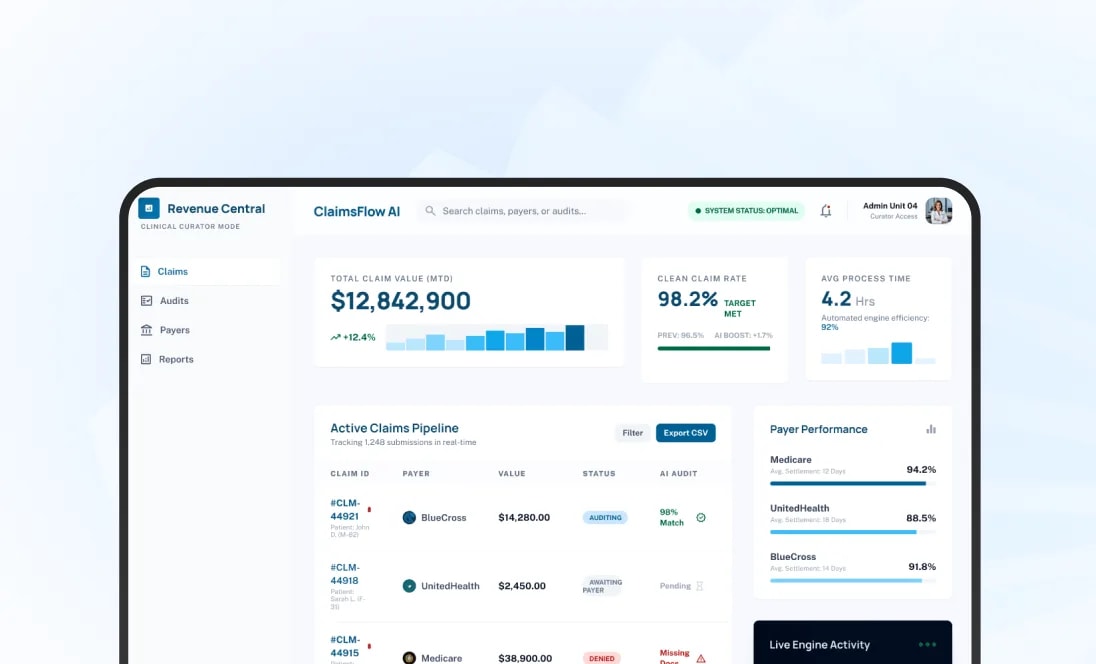
Our team transformed spreadsheet- and email-heavy credentialing into structured workflows covering provider intake, verification, enrollment, validations, task ownership, follow-ups, SLA tracking, audit trails, and reporting. The published project describes reduced turnaround time and rework, improved First Pass Rate, better workflow visibility, and higher enrollment capacity through automation and structured task management.
Read Full Portfolio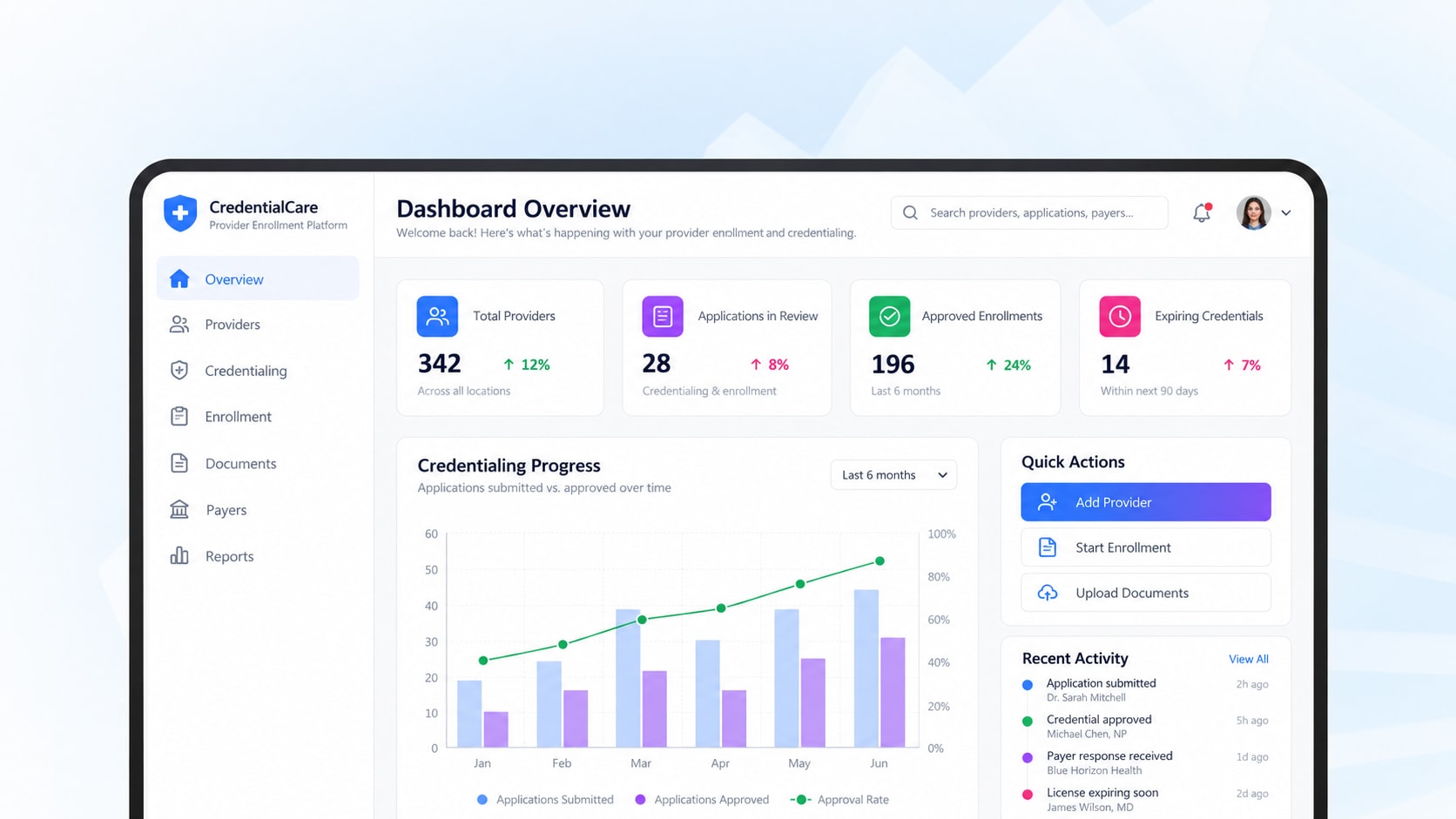
Ditstek Innovations built a connected platform combining workforce activity, task management, billing logic, approvals, compliance controls, and operational analytics. Automated task-to-billing workflows linked recorded activity directly with financial processes, while dashboards improved visibility into workload and utilization. The published case reports a 70% improvement in billing accuracy, an 80% reduction in manual errors, and 50% better team productivity within that implementation.
Explore Portfolio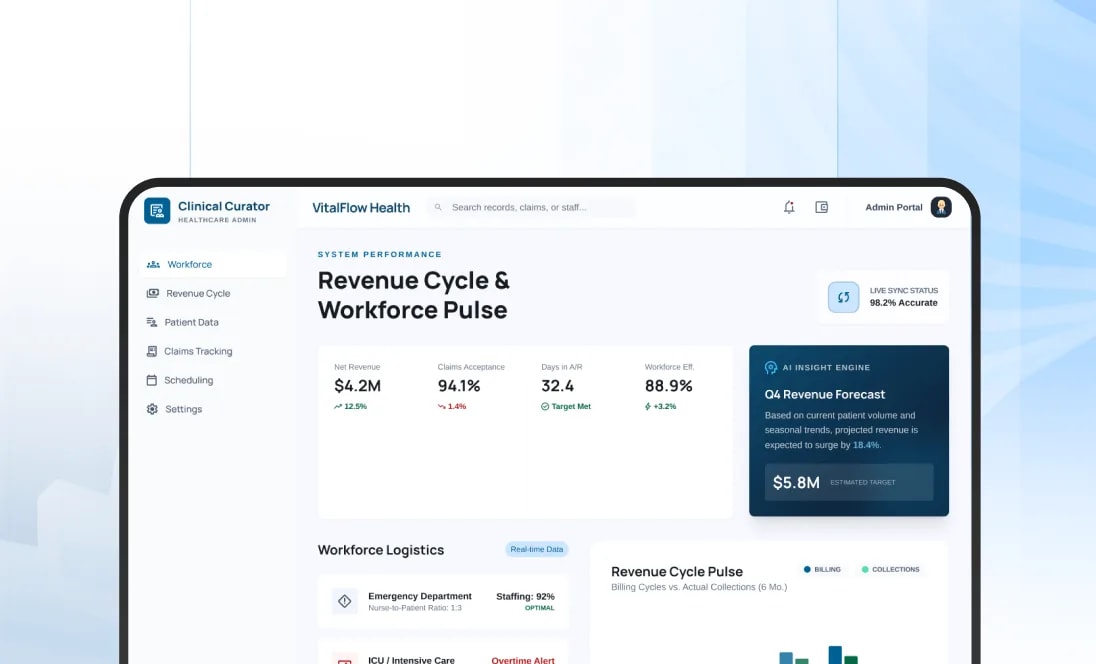
DITS modernized a connected-care platform combining remote monitoring, program management, patient assessments, alerts, tasks, claims, billing, reporting, EHR integration, and role-based operations. The solution includes automated abnormal-reading alerts, reimbursement logic, claims generation, task management, and FHIR-based synchronization that reduces duplicate entry and reconciliation effort.
Read Full Portfolio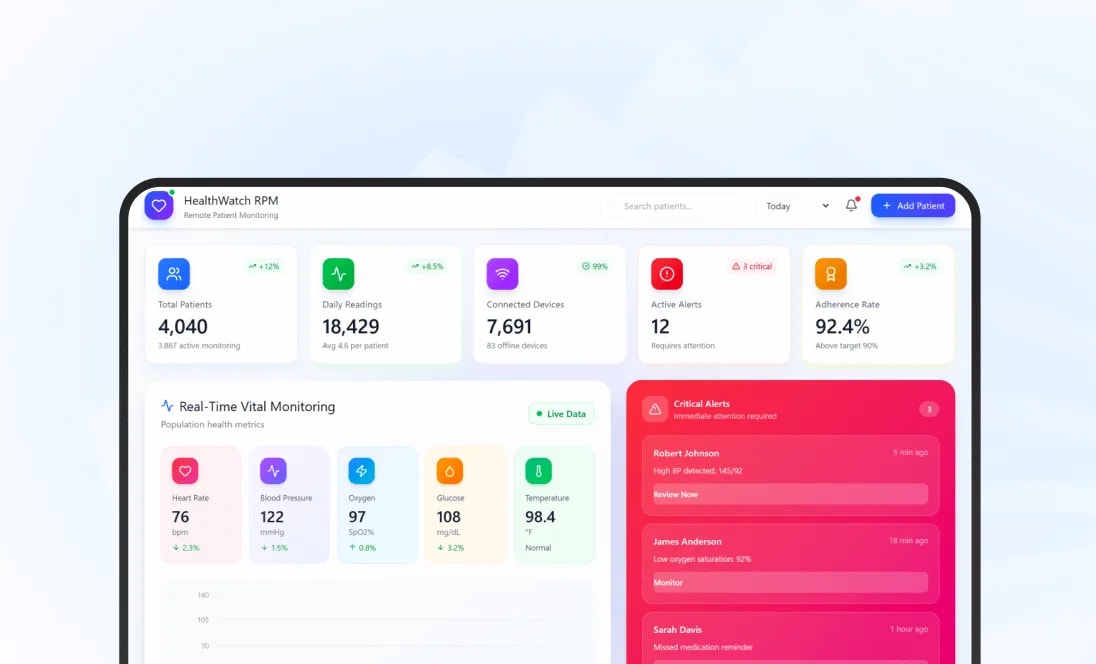
Our healthcare process automation approach starts with the process rather than a predetermined RPA tool, workflow platform, or AI model. DITS determines whether the right intervention is elimination, simplification, integration, automation, modernization, or human-led improvement before implementation begins.
Remove activities that no longer create meaningful clinical, operational, financial, regulatory, or business value.
Reduce unnecessary steps, duplicate fields, repeated approvals, and avoidable handoffs before automating them.
Define clear inputs, ownership, stages, rules, outputs, and exception conditions for repeatable work.
Integrate applications and information when employees currently act as the bridge between systems.
Apply deterministic automation to predictable tasks, rules, notifications, validation, routing, and other repeatable activity.
Introduce AI when users need help with documents, classification, summarization, prioritization, retrieval, or contextual information.
Route uncertain, complex, sensitive, or high-impact situations to accountable people rather than forcing them through automation.
Evaluate whether automation actually changes time, effort, throughput, visibility, accuracy, capacity, or another agreed business measure.
Our healthcare automation solutions can address a targeted bottleneck or connect workflows across a broader healthcare operation. We combine healthcare workflow automation, product engineering, integration, modernization, data, and AI according to what the process actually requires.
Automate registration, digital intake, information validation, forms, document collection, eligibility-related activity, and structured routing.
Connect reminders, confirmations, cancellations, rescheduling, provider availability, waitlists, tasks, and downstream follow-up.
Support structured onboarding, credentialing, enrollment, renewals, document follow-up, provider-data maintenance, and status management.
Automate bounded activity around documentation, clinical tasks, alerts, assessments, referrals, follow-up, and information routing.
Connect eligibility, authorization, coding, claims, denials, payment posting, reconciliation, accounts receivable, and reporting workflows.
Trigger tasks, alerts, follow-ups, handoffs, assignments, and escalations across multidisciplinary care environments.
Extract, classify, validate, route, and track information from clinical and administrative forms, reports, records, and correspondence.
Automate operational data collection, report preparation, audit evidence, status monitoring, and role-specific dashboards where appropriate.
Healthcare administrative automation focuses on repetitive work surrounding care rather than clinical judgment. We connect healthcare process automation with the underlying applications and process owners so healthcare teams do not simply replace manual work with disconnected bots.
Digitize demographic capture, forms, insurance information, required documents, validation, missing-information checks, and workflow routing.
Automate reminders, confirmations, rescheduling triggers, waitlist activity, instructions, and routine status communication.
Classify documents, extract relevant information, validate completeness, index records, create review queues, and route items to the appropriate workflow.
Support predictable provider onboarding, credentialing, payer enrollment, license renewal, document requests, and follow-up activities.
Reduce repetitive data movement, status checking, validation, reconciliation, and routine coordination between operational and financial teams.
Route routine patient, provider, payer, or internal requests to the right queue or owner based on defined categories and business rules.
Bring workflow data into dashboards and reports without requiring teams to repeatedly assemble information in spreadsheets.

Clinical workflow automation should improve information flow, task coordination, documentation, and follow-up without removing appropriate professional oversight. We use healthcare workflow automation to support the work around clinical decisions while keeping consequential judgment with qualified people.
Assign tasks according to patient, provider, program, specialty, location, urgency, or other defined workflow conditions.
Trigger forms, completeness checks, structured data requirements, documentation workflows, and appropriate review steps around clinical events.
Support questionnaires, structured scoring, thresholds, follow-up tasks, alerts, and review requirements within the wider care process.
Route relevant alerts to the appropriate users with priority, ownership, acknowledgment, and escalation rules.
Create structured next steps after encounters, assessments, monitoring events, referrals, or changes in patient condition.
Coordinate documentation, assignments, statuses, communication, and downstream tasks across referrals and care transitions.
Keep higher-impact, uncertain, or context-dependent clinical decisions with qualified healthcare professionals.
Revenue cycle automation can create stronger value when financial processes are connected across the full revenue cycle rather than automated as isolated billing activities. Our healthcare process automation approach links patient access, documentation, payer activity, claims, exceptions, payments, and reporting.
Automate appropriate coverage checks, payer queries, response handling, information validation, and exception routing.
Structure authorization intake, documentation requirements, payer rules, submissions, status tracking, follow-up, and exceptions.
Support documentation completeness, structured information extraction, coding preparation, validation, and missing-information workflows.
Automate claim edits, required-field validation, payer-rule checks, missing-information detection, submission, and status handling.
Classify denials, create work queues, prioritize activity, gather supporting information, track root causes, and manage appeal workflows.
Connect remittance, payment posting, adjustments, variance handling, reconciliation, and exception workflows.
Prior authorization automation should reduce repetitive administrative coordination while preserving appropriate payer, clinical, and operational decision boundaries. We treat authorization as a connected healthcare workflow automation problem involving information, rules, documentation, system exchange, status, follow-up, and human escalation.
Capture the requested service, patient and coverage information, relevant context, and other required data at the start of the workflow.
Gather and organize supporting documentation rather than forcing employees to repeatedly search disconnected systems.
Connect payer-specific requirements and workflow rules with each request so teams know what information is needed before submission.
Send authorization information electronically where appropriate interfaces and standards support the transaction.
Bring request status into the operational workflow rather than depending on repeated portal checks, calls, or spreadsheets.
Create tasks and alerts when additional information is required and route them to the accountable user.
Effective healthcare workflow automation depends on connectivity. Our healthcare automation solutions integrate with the systems healthcare teams already use so automated work remains part of the real operational environment rather than becoming another standalone destination.
Connect clinical, patient, scheduling, documentation, and operational events with downstream automation workflows.
Connect appropriate eligibility, authorization, claims, remittance, enrollment, and provider-related information with administrative processes.
Exchange relevant claims and revenue-cycle information while maintaining status, validation, and exception visibility.
Use appropriate interoperability standards where structured healthcare data needs to move between systems and workflows.
Connect digital interactions with scheduling, support, communication, follow-up, and operational activities.
Trigger appropriate workflow actions as orders, statuses, results, or other information move through diagnostic processes.
Turn relevant monitoring data into alerts, tasks, follow-ups, documentation, billing activity, or care-team workflows.
Connect healthcare applications with finance, identity, documents, analytics, communication, and other enterprise systems.

We use AI automation in healthcare where documents, language, patterns, prioritization, or context make deterministic rules insufficient. Our healthcare automation solutions place AI inside governed workflows rather than allowing the model to operate without defined ownership and boundaries.
Extract, classify, structure, validate, and route information from clinical, billing, enrollment, credentialing, and administrative documents.
Use AI to interpret appropriate clinical text and prepare structured coding information while maintaining validation and downstream review.
Prepare concise context from longer records, correspondence, cases, or documents so users can review information more efficiently.
Categorize incoming documents, requests, denials, cases, or messages before assigning them to the appropriate workflow.
Help teams identify cases or tasks that may require faster attention according to agreed criteria and available data.
Give staff faster access to approved procedures, policies, workflow guidance, payer information, and organizational knowledge.
Use agents for bounded activities such as gathering information, preparing tasks, updating statuses, and coordinating cross-system actions under defined controls.
Keep consequential clinical, financial, compliance, and operational decisions with accountable people where professional judgment remains essential.
Workflow & Automation
Automation decisions improve when we understand where and how people use them. Our healthcare automation solutions combine workflow, domain, product, and technology understanding across different healthcare environments rather than treating healthcare process automation as an industry-neutral implementation exercise.
Automate administrative, clinical-support, scheduling, revenue, reporting, and cross-department workflows where disconnected work creates operational friction.
Improve intake, appointments, documentation, provider administration, billing, follow-up, and multi-location workflows.
Apply revenue cycle automation across eligibility, authorization, claims, denials, appeals, payment posting, reconciliation, AR, and reporting.
Automate provider intake, verification, enrollment, follow-up, renewals, documents, task ownership, and operational reporting.
Support claims, authorization, provider data, member administration, integration, reporting, and other high-volume payer operations.
Connect workforce activity, scheduling, EVV, care documentation, billing, monitoring, patient communication, and care coordination.
Embed workflow orchestration into healthcare products while modernizing data, APIs, applications, and architecture around changing operational requirements.
Coordinate monitoring, devices, assessments, programs, alerts, reporting, tasks, claims, and multi-organization workflows.
Our role goes beyond implementing healthcare automation solutions. DITS combines workflow consulting, healthcare context, engineering, integration, modernization, AI, and continuous improvement so clients can determine what should be automated, what should be simplified first, and what should remain human-led.
We look beyond a request for RPA, AI, or workflow software to understand the business condition creating the need for change.
Our experience spans claims, billing, credentialing, remote monitoring, behavioral health, public health, clinical workflows, provider operations, and connected care.
A business rule may be better than AI. An API may be better than RPA. Process redesign may be better than both.
Automation is designed around EHRs, billing platforms, payer environments, databases, documents, APIs, and other systems already supporting the organization.
Higher-impact clinical, financial, compliance, and exception-heavy decisions remain under appropriate human oversight.
When legacy architecture or fragmented applications prevent meaningful automation, our team can improve the underlying technology instead of adding another workaround.
The same reasoning developed during workflow assessment can continue through architecture, engineering, integration, QA, deployment, and adoption.
DITS treats automation as an operating capability that should improve as workflows, data, rules, user needs, and business priorities change.
You do not need to decide whether your organization needs healthcare RPA solutions, AI automation in healthcare, new workflow software, integration, or modernization before speaking with us. We start with the workflow, evaluate what is creating friction, and define the healthcare automation solutions most likely to improve the operation without automating what should remain human-led.
Talk to Our Healthcare Automation Team