Resident Information Lives Across Systems
Care information, service preferences, family contacts, billing, activities, medication information, documents, and operational records can be spread across multiple platforms and manual files.
Improve how senior care organizations coordinate residents, staff, services, workflows, and operational information. DITS helps modernize senior care technology across workflow automation, system integration, resident engagement, operational analytics, and digital experiences to strengthen visibility, reduce administrative complexity, and support more scalable care operations.
Discuss Your Senior Care PrioritiesEffective senior care software starts with understanding how residents, care teams, operations staff, families, systems, and information interact. Our senior care workflow automation approach identifies where fragmented processes and technology are creating unnecessary work before we recommend what should change.
Care information, service preferences, family contacts, billing, activities, medication information, documents, and operational records can be spread across multiple platforms and manual files.
Phone calls, messages, spreadsheets, paper logs, and individual knowledge often become the unofficial workflow between care, administration, activities, finance, and community operations.
Resident assessments and plans may exist digitally while daily tasks, observations, updates, and exceptions are recorded elsewhere, reducing visibility into whether planned support actually occurred.
Families may contact staff for schedules, activities, service updates, documents, billing questions, or resident information that could be communicated through more structured digital experiences.
Absences, shift changes, uneven workload, open assignments, and incomplete handoffs can quickly affect resident services when workforce information is not connected.
Multi-community senior living organizations can struggle with inconsistent processes, local workarounds, separate systems, and reporting approaches that make enterprise visibility difficult.
Older systems may continue supporting important functions while making integrations, mobile experiences, reporting, automation, cloud adoption, or new resident services increasingly difficult.
Organizations may already have several applications but still rely on employees to move information between them because the technology stack was purchased system by system rather than designed around the complete resident journey.
The value of senior care technology solutions should appear in how people work and how residents experience the community. Our senior living software approach connects workflow, information, automation, engagement, and operational visibility rather than measuring success by the number of features delivered.
Remove repetitive data entry, status checks, manual routing, follow-ups, schedule coordination, and information transfers where technology can perform predictable work.
Give care, administrative, activities, finance, and community teams clearer ownership of tasks, resident information, exceptions, and follow-up.
Bring relevant care, service, engagement, communication, and operational information together so staff have better context when supporting residents.
Provide appropriate digital access to approved information, communication, activities, updates, and service interactions without making families depend entirely on phone or email.
Reduce avoidable administrative work so staff can spend more time on resident-facing and higher-value responsibilities.
Help community and enterprise leaders understand staffing, occupancy, engagement, service activity, exceptions, billing, and other important operating conditions.
Create repeatable and configurable workflows that can support additional communities without forcing every location into the same rigid operating process.
Improve workflows, data access, integration, and governance first so future intelligent capabilities have a reliable operating foundation.
DITS built a configurable remote-care platform used by 700+ users across 10 clinics, connecting monitoring, care-team assignment, caregiver access, escalation, documentation, and billing. The published project also reports improved senior-patient engagement through simplified mobile experiences and caregiver support, making it directly relevant to technology supporting aging populations.
Read Full Portfolio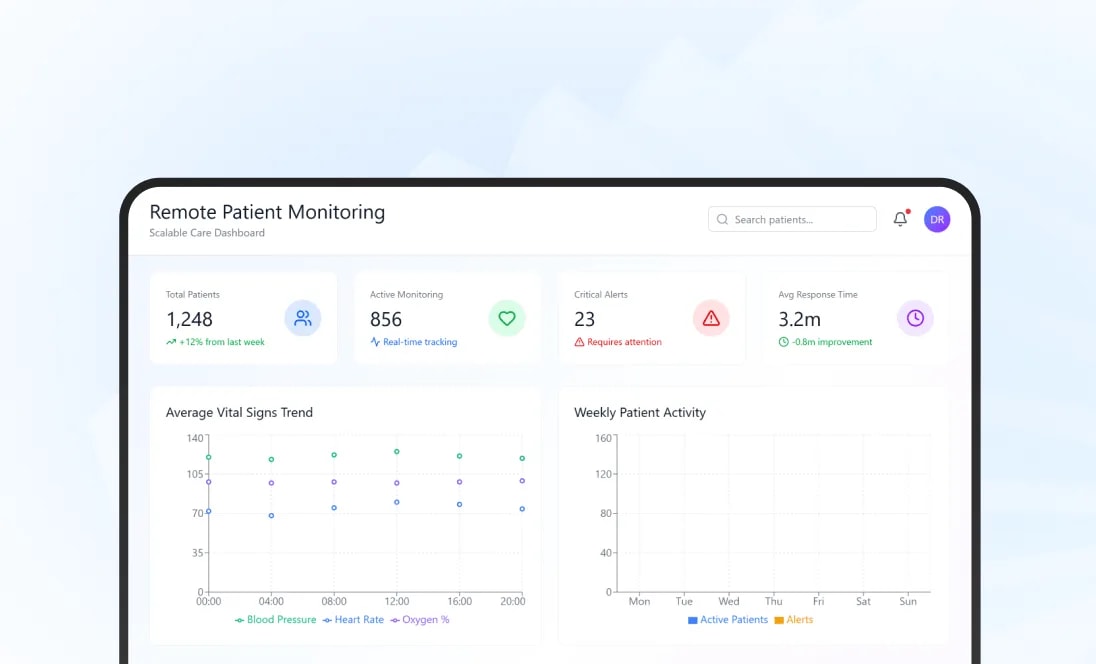
Our team developed a cloud platform connecting shift planning, employee availability, task tracking, timesheets, healthcare billing, and operational dashboards for distributed care teams. Its workflow model is relevant to senior living operators coordinating staffing, services, financial activity, and multi-role operations without relying on disconnected scheduling and reporting processes.
Explore Portfolio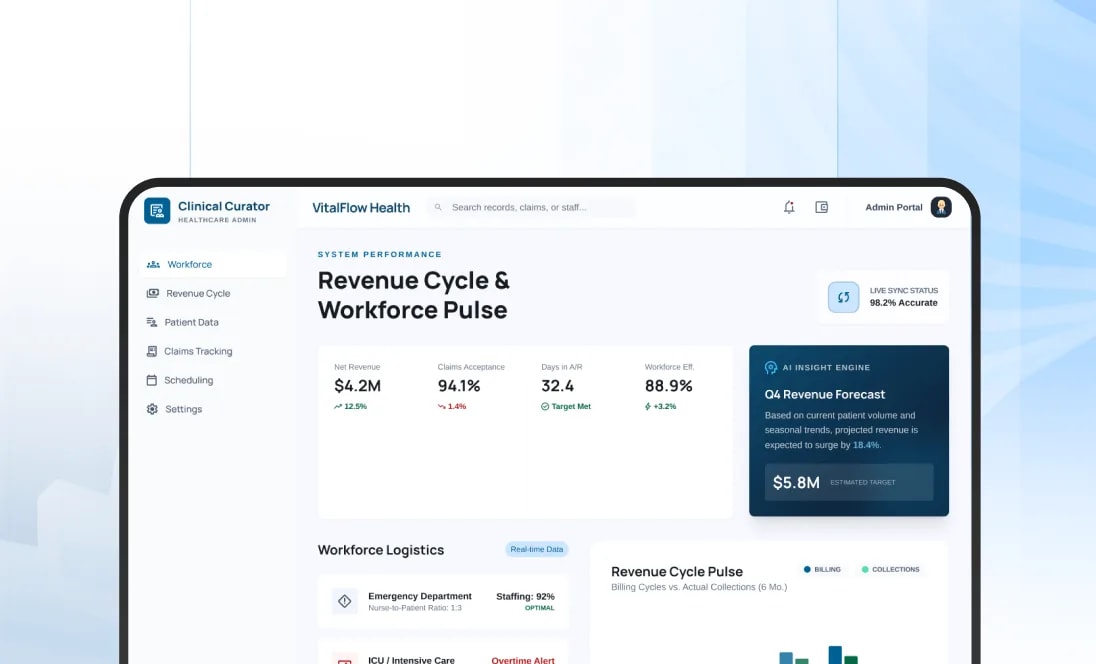
DITS evolved a cloud behavioral-health EHR with bedboard and census management, scheduling, documentation, claims, reporting, and AI-assisted notes. While not a senior-living implementation, it provides relevant engineering proof for residential environments requiring occupancy visibility, coordinated records, multi-role workflows, structured documentation, and operational reporting.
Read Full Portfolio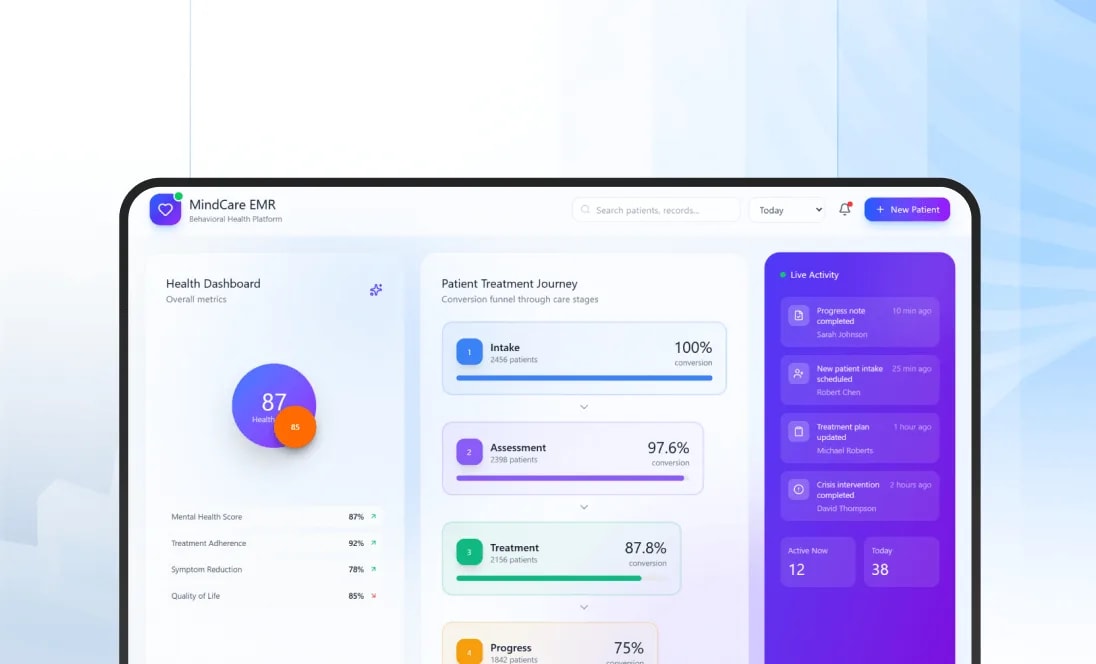
Our approach to senior living software begins by separating the operational problem from the requested system. Senior care technology solutions may require process improvement, integration, automation, modernization, configuration, or selective product engineering rather than automatically replacing the current platform.
Remove unnecessary process steps, duplicate information, repeated approvals, and workarounds before digitizing them.
Create clearer stages, ownership, information requirements, operating rules, and exception paths where inconsistent processes are preventing reliable execution.
Integrate applications and information where employees currently move data manually between care, finance, workforce, engagement, or administrative systems.
Automate predictable routing, reminders, notifications, validations, task creation, reconciliation, and follow-up.
Improve architecture, interfaces, mobile experiences, data, cloud infrastructure, APIs, or individual modules when the existing platform still contains useful capabilities.
Add new resident, staff, family, analytical, integration, or workflow capability when the core application remains strategically useful.
Introduce intelligence where knowledge access, documentation, prediction, prioritization, personalization, or workflow assistance creates enough business or resident value.
Engineer a new platform or module only when the required operating model cannot be supported effectively through configuration, integration, reuse, or modernization.
Effective senior living management software connects resident-facing and operational functions without assuming one monolithic system must perform every task. We help determine what should sit within the core platform, what should integrate, and where specialized applications still make sense.
Maintain structured resident profiles, contacts, preferences, services, relevant care information, documents, history, and relationships with authorized family or responsible parties.
Coordinate enquiries, assessments, documentation, resident setup, service requirements, room or unit assignment, communication, and internal preparation before arrival.
Connect assessments, resident needs, planned services, daily responsibilities, changes, follow-ups, and appropriate documentation.
Manage roles, availability, shifts, assignments, workload, qualifications, communication, and operational responsibilities.
Coordinate transportation, activities, maintenance requests, housekeeping, dining-related requests, appointments, or other community services according to the operating model.
Provide approved updates, messages, schedules, activities, notices, documents, and service information through structured communication experiences.
Connect resident services with applicable charges, invoices, payments, billing workflows, financial records, and reporting.
Give leadership visibility across communities, residents, workforce, services, engagement, finance, and operational exceptions.
Assisted living software needs to support both resident care and the community operations surrounding it. Our senior care software solutions can connect resident needs, staff responsibilities, medication-related workflows, documentation, communication, and administration while remaining configurable around the organization's actual service model.
Digitize structured intake and reassessment workflows so changing resident needs can be captured and reflected in the operating process.
Translate assessments and service requirements into structured responsibilities that care teams can access and update.
Give staff clearer visibility into assigned resident activities, required services, completion status, exceptions, and follow-up.
Support appropriate medication lists, reminders, documentation, pharmacy connectivity, administration-related workflows, and exception handling according to the organization's responsibility.
Capture incidents, assign follow-up, maintain supporting records, document actions, and track closure through structured workflows.
Route requests for assistance, transportation, community services, activities, maintenance, or other support to the appropriate staff.
Make appropriate service, scheduling, care, documentation, or community information accessible through controlled communication workflows.
Standardize core operating processes while preserving configuration for community-specific staffing, services, programmes, and local requirements.

Senior living resident engagement software should make it easier for residents to participate in community life while giving teams better visibility into preferences, communication, activities, and service interactions. Strong senior living software connects engagement with the operational environment instead of maintaining another isolated resident app.
Publish activity calendars, registrations, reminders, attendance, capacity, and resident preferences through accessible digital experiences.
Share community announcements, updates, notices, schedules, service information, and approved personalized communication.
Provide authorized family members with relevant communication, activities, updates, and service information without exposing unnecessary resident information.
Track participation in appropriate wellness, social, recreational, or community programmes where engagement information supports better resident experiences.
Coordinate approved transport requests, schedules, assignments, notifications, and changes through structured workflows.
Support relevant meal preferences, dining communication, reservations, and service information according to the community model.
Collect feedback, requests, concerns, surveys, and experience information and route issues to accountable teams.
Design mobile and portal experiences around readability, clear navigation, reduced interaction complexity, and the needs of older users.
Resident engagement, staff workflows, care information, and administrative systems should not operate independently. Bring us the workflow creating friction, and we can assess what should be simplified, integrated, automated, or improved before you commit to another senior living technology platform.
Talk to Our Healthcare TeamWorkforce capacity directly affects resident experience. Our senior care technology solutions can improve scheduling, communication, workload visibility, and operational coordination while keeping managers responsible for staffing decisions requiring context, resident familiarity, or human judgment.
Maintain clearer visibility into availability, planned leave, assigned shifts, qualifications, and workload.
Support recurring schedules, open shifts, staff allocation, rotations, and changes through structured digital workflows.
Identify overlapping assignments, unavailable staff, missing coverage, or other schedule conflicts before they affect community operations.
Create defined workflows for identifying, publishing, assigning, accepting, and escalating uncovered shifts.
Use role, qualification, service requirements, community context, and approved operating rules to narrow appropriate staffing options.
Keep schedule changes, task updates, operational notices, and handoff information connected with the relevant workflow.
Give managers greater insight into assignments, hours, open work, staffing pressure, and resource distribution.
Keep leadership in control when resident continuity, personal relationships, care complexity, or unusual conditions matter more than scheduling efficiency alone.
Senior care workflow automation should connect the events surrounding each resident rather than automate isolated administrative tasks. Our team maps people, systems, documents, decisions, and exceptions so automation improves continuity across the resident journey.
Connect prospective resident information, assessments, documents, decisions, communications, approvals, and move-in preparation.
Trigger resident profiles, staff tasks, service plans, communication, billing setup, and other onboarding activity once admission is confirmed.
Route assessment information into care planning and assigned responsibilities while maintaining appropriate review.
Translate approved support requirements into staff responsibilities, schedules, documentation, and follow-up.
Prompt appropriate records, notes, incidents, service updates, or care-plan changes following relevant resident interactions.
Route missed tasks, incidents, incomplete documentation, resident concerns, or other exceptions to accountable people.
Connect approved resident services and service changes with downstream financial workflows where the business model requires it.
Track outstanding actions until the relevant care, communication, administrative, or service issue has been addressed.
Modern senior living software should help teams understand what residents need, what has happened, and what requires follow-up. Within assisted living software, medication and care coordination work best when they connect with the wider resident record rather than operate through isolated logs.
Maintain appropriate medication lists, schedules, instructions, related documentation, and responsible-party information.
Connect with pharmacy or medication systems through appropriate interfaces where information exchange reduces re-entry and improves workflow continuity.
Surface missed, delayed, changed, or review-required activity according to the community's operational and care responsibilities.
Assign and track care activities, service responsibilities, follow-up, reviews, and exceptions with clear ownership.
Create workflows for documenting and escalating relevant changes in resident condition, behavior, needs, preferences, or service requirements.
Connect appointments, transportation, responsible staff, family communication, documentation, and follow-up.
Exchange appropriate resident information with physicians, pharmacies, therapy providers, home health teams, or other healthcare partners where required.
Give authorized users visibility into what has occurred, what is pending, and which activity needs attention next.
Senior living management software should connect resident services with financial processes without forcing finance teams to reconstruct activity manually. Our senior care software solutions can integrate resident accounts, recurring charges, service changes, billing, payments, and reporting according to the organization's commercial model.
Maintain financial information associated with residents, responsible parties, applicable services, and account relationships.
Manage repeatable accommodation, service, care, or programme charges where recurring billing forms part of the senior living model.
Connect approved additional services with financial workflows rather than relying on manual notes and later reconciliation.
Generate appropriate resident or responsible-party invoices from structured financial and service information.
Connect approved payment gateways or financial systems where digital payment processing is required.
Identify missing information, unusual charges, unpaid balances, reconciliation issues, or other conditions requiring review.
Exchange approved information with accounting, ERP, payment, billing, or financial-reporting environments.
Give leadership appropriate visibility into charges, payments, receivables, community performance, and other selected financial indicators.
Senior care software integration helps prevent staff from becoming the bridge between separate systems. We connect appropriate applications and information so senior living software can operate as part of a wider technology ecosystem rather than another isolated platform.
Exchange appropriate resident, health, care, scheduling, or documentation information when senior living workflows interact with healthcare providers.
Connect medication-related information and approved pharmacy workflows where suitable interfaces exist.
Integrate resident billing, payments, financial records, purchasing, or other business information with finance systems.
Connect enquiry, prospective resident, admission, communication, and move-in information with community operations.
Exchange staffing, scheduling, time, or approved workforce information with HR and payroll systems.
Connect activities, communications, family experiences, service requests, and relevant resident information.
Bring appropriate safety, monitoring, environmental, wellness, or connected-device information into operational workflows where a validated use case exists.
Move care, staffing, engagement, operational, and financial information into reporting environments so leadership can understand the wider organization.
Understand application architecture, modules, users, workflows, data, integrations, technical debt, performance, and operational dependencies.
Address reliability, security, performance, testing, documentation, observability, or supportability problems that make the current system risky to change.
Expose valuable existing capabilities through controlled interfaces when system isolation is the primary problem.
Improve high-friction staff, resident, family, and administrative experiences while retaining useful backend functionality.
Reduce coupling and technical debt where system structure is limiting new services, integration, scale, or release speed.
Improve databases, reporting, data structures, access, and analytical foundations where fragmented information is restricting operational visibility.
Move or replatform suitable workloads where cloud infrastructure creates meaningful benefits for resilience, scalability, deployment, or operations.
Replace selected modules progressively when the complete application cannot reasonably be modernized in one safe step.
Senior living analytics should help managers identify conditions requiring attention while there is still time to respond. Our senior living management software approach brings relevant information together around decisions rather than creating dashboards filled with measures nobody owns.
Track occupancy, available capacity, move-ins, transitions, departures, and relevant resident-lifecycle measures across communities.
Understand staffing levels, shifts, workload, hours, open coverage, utilization, and other selected workforce indicators.
Monitor participation, activities, communication, service use, or other engagement measures appropriate to the community's objectives.
Track assigned, completed, overdue, exception-based, or escalation-required care and service activity.
Identify repeated incidents, unresolved conditions, workflow exceptions, or operational patterns requiring management review.
Understand which resident and community services are being requested, delivered, underused, or creating operational pressure.
Connect relevant billing, payments, receivables, service, or community-level financial information with operational context.
Allow enterprise leaders to compare communities, workflows, operating conditions, and agreed performance measures without manually consolidating separate reports.
A growing senior living organization may not need another platform. DITS can assess your senior care software integration, workflows, existing systems, technical debt, and data to determine whether the strongest path is modernization, automation, better connectivity, or targeted new capability.
Discuss Your Modernization Priorities
AI can strengthen senior care workflow automation when it improves a defined activity. We use intelligence within senior care technology solutions selectively, keeping resident-sensitive, safety-related, financial, and other consequential decisions under appropriate human oversight.
Support drafting, summarization, classification, or information preparation where staff remain responsible for reviewing important records.
Help employees find approved policies, procedures, resident-service information, operational guidance, or organizational knowledge without repeatedly searching through documents.
Classify requests and route them to the right team where predictable request categories can reduce manual coordination.
Use defined rules and available information to help managers identify staffing options without removing human judgment from final assignments.
Surface incidents, tasks, requests, service issues, or workflow exceptions that may deserve faster attention.
Support appropriate communication, content, activity recommendations, or personalization where residents remain in control of participation.
Apply predictive models where sufficiently reliable historical data can support validated staffing, maintenance, operational, or resident-service use cases.
Use agents for bounded activities such as gathering information, preparing tasks, updating approved systems, or coordinating defined workflows within clear permission boundaries.
Senior care software solutions can involve personal, financial, operational, and sometimes health information. Our approach to senior care software integration considers access, auditability, privacy, data boundaries, and applicable regulatory requirements based on the actual organization and service model.
Ensure residents, family members, care staff, administrators, managers, finance teams, and integrations receive only the access required for their responsibilities.
Control what information is visible, transferable, or shareable across staff, families, external providers, and connected systems.
Record important access, changes, approvals, workflow events, administrative actions, and system activity where traceability is required.
Use authenticated and controlled interfaces when exchanging information with healthcare, pharmacy, financial, workforce, or external platforms.
Apply appropriate encryption, credential handling, access control, backup, and other security protections based on the information involved.
Define how operational or technology incidents are documented, escalated, investigated, and resolved.
Avoid hard-coding one compliance model into a platform when organizations may operate across communities, services, or jurisdictions with different requirements.
Control what AI can access, recommend, generate, or change and maintain accountable human oversight around consequential decisions.
Frontend
The right senior living software depends on the community, level of care, resident population, business model, and operating responsibilities. We adapt senior care software solutions to those differences instead of assuming every senior-care setting needs the same workflow.
Support resident information, community communication, activities, service requests, transportation, dining, billing, amenities, and family interaction where clinical workflows are limited.
Connect assessments, care plans, daily support, medication-related workflows, staff responsibilities, documentation, resident engagement, family communication, billing, and community operations.
Support structured resident information, routines, care-team communication, safety workflows, activities, responsible-party communication, and appropriate documentation around specialized resident needs.
Create connected resident journeys across different service levels while allowing community, care, financial, engagement, and operational workflows to remain appropriately separated.
Standardize enterprise data and core workflows while allowing communities to configure staffing, programmes, services, communication, and local operating requirements.
Build, modernize, integrate, and scale SaaS products serving senior-living organizations rather than only working directly with operators.
Integrate remote monitoring, virtual care, devices, healthcare partners, care coordination, and resident experiences where the operating model extends beyond the physical community.
Our senior care software modernization methodology keeps resident, operational, and business context connected to engineering. Senior care technology solutions become an intervention within the transformation journey rather than the starting assumption.
Clarify the organization's ambition, resident model, operational pressure, existing systems, risk, users, and expected result.
Understand the complete workflow across residents, staff, families, systems, information, decisions, services, and external partners.
Identify where fragmentation, manual work, technical debt, poor visibility, or experience friction is creating the strongest constraint.
Test workflows, integrations, prototypes, architecture, automation, or a proof of value before making a larger investment.
Modernize, integrate, automate, connect, or build only the capabilities required by the validated direction.
Support staff, residents, operating processes, training, governance, rollout, and organizational transition.
Evaluate agreed operational, resident-experience, workforce, financial, product, and technical outcomes against the starting point.
Continue improving workflows, applications, information, integration, engagement, and intelligent capabilities as community requirements change.
We evaluate senior care technology solutions against the business or resident-service condition that justified the initiative. Senior living analytics helps make those improvements visible instead of measuring success by software implementation alone.
Measure repeated entry, manual reporting, follow-ups, status checking, reconciliation, and other avoidable staff activity.
Track how long move-ins, service requests, documentation, approvals, follow-up, or other priority processes take.
Evaluate whether managers understand staffing availability, assignments, workload, open activity, and exceptions earlier.
Track appropriate participation, communication, service adoption, feedback, or other measures associated with the resident-experience objective.
Evaluate whether families have clearer access to approved information and require less manual intervention for routine communication.
Determine whether leadership can identify occupancy, staffing, service, care, financial, and workflow conditions without manually combining several reports.
Track application performance, integration failures, downtime, incidents, deployment issues, and other relevant technical measures.
Measure whether new services, communities, integrations, reports, workflows, and product features become easier to introduce.
Determine whether connected and governed information can support more useful analytics, automation, and future intelligent capabilities.
We approach senior care software as part of the operating environment, not as an isolated development project. DITS combines healthcare understanding, consulting, product engineering, automation, modernization, data, integration, UX, cloud, and AI around the business problem that needs to change.
Our team understands residents, staff, families, services, workflows, systems, and organizational priorities before recommending technology.
A request for a new application may actually require integration, workflow redesign, better analytics, modernization, or configuration of what already exists.
Resident-support workflows and wider community operations should not become separate digital islands when the same teams and information connect them.
DITS can assess what should remain, integrate, modernize, or be replaced rather than assuming older technology has no continuing value.
We can support senior-living operators as well as technology companies building platforms for the senior-care market.
Senior living increasingly operates as a technology ecosystem, making reliable data exchange across care, workforce, resident, finance, and engagement platforms an important architecture decision.
AI should improve a defined resident, staff, or operational workflow—not become another disconnected feature.
Our teams can continue supporting product changes, integrations, modernization, analytics, automation, and new service models after the initial implementation.
You do not need to decide whether the answer is new senior care software, assisted living software, workflow automation, better senior care software integration, or modernization before talking with us. Bring the resident, workforce, engagement, operational, or technology problem; DITS will assess the environment and define what should change.
Discuss Your Senior Living Technology