Clinical Documentation Creates Too Much Work
Providers may spend unnecessary time navigating forms, entering repetitive information, recovering lost work, or adapting clinical processes to software that no longer reflects how care is delivered.
Clinical teams lose time and continuity when patient information remains fragmented across systems. Our EHR solutions connect records, workflows, integrations, and interoperability through EHR modernization, FHIR integration, and system connectivity to improve information access and support more coordinated care delivery.
Review Your EHR EnvironmentThe need for better EHR solutions usually becomes visible through workflow friction rather than the technology alone. We assess whether EHR modernization, integration, workflow redesign, or targeted engineering can solve the underlying constraint before recommending another platform.
Providers may spend unnecessary time navigating forms, entering repetitive information, recovering lost work, or adapting clinical processes to software that no longer reflects how care is delivered.
Patient information may sit across EHR modules, external platforms, diagnostic systems, billing applications, devices, or department-specific software without moving where the workflow needs it.
Years of point-to-point connections can leave organizations dependent on fragile interfaces that are difficult to monitor, modify, or extend as new applications are introduced.
Clinical and administrative forms may contain significant organizational knowledge but become tightly coupled with application logic, making updates expensive and risky.
When clinical workflows no longer fit the platform, employees create parallel processes through spreadsheets, messages, documents, and external applications.
Clinical, financial, compliance, and administrative data may exist inside the system while leaders still depend on delayed or manually prepared reports.
Remote monitoring, telehealth, patient apps, connected devices, analytics, and AI may require information that an established EHR was never designed to expose easily.
A full replacement can threaten established clinical logic, integrations, workflows, user familiarity, historical data, and continuity of care even when the existing environment clearly needs improvement.
Effective EHR modernization should change more than the underlying codebase. We combine EHR integration services and electronic health record solutions with workflow, data, architecture, UX, and interoperability improvements so clinical technology becomes easier to use, connect, maintain, and evolve.
Improve forms, navigation, task flow, information access, and repetitive interactions that add effort to clinical or administrative work.
Strengthen data integrity, access controls, recovery mechanisms, record handling, and other safeguards around sensitive clinical information.
Connect documentation, communication, tasks, referrals, care plans, and other information used by multidisciplinary teams.
Use EHR integration services to connect labs, pharmacies, payers, digital-health applications, monitoring platforms, billing environments, and other healthcare systems.
Move organization-specific forms, rules, workflows, and settings away from tightly coupled application logic where possible.
Strengthen architecture, deployment, testing, observability, performance, and other technical foundations that influence day-to-day care operations.
Create a stronger foundation for remote care, mobile experiences, patient access, analytics, automation, and other digital-health capabilities.
Improve data access, workflow ownership, integrations, and governance before introducing AI into documentation, knowledge, administrative, or decision-support workflows.
DITS supported a behavioral-health EHR used by more than 35,000 daily users across 30+ agencies. The existing platform faced data-loss risks, reporting-access issues, architectural constraints, billing limitations, and fragmented care coordination. Our work introduced autosave, stronger role-based filtering, improved financial workflows, centralized cloud storage, secure communication, and architectural improvements while retaining the operational continuity required by the agencies using the system.
Explore Portfolio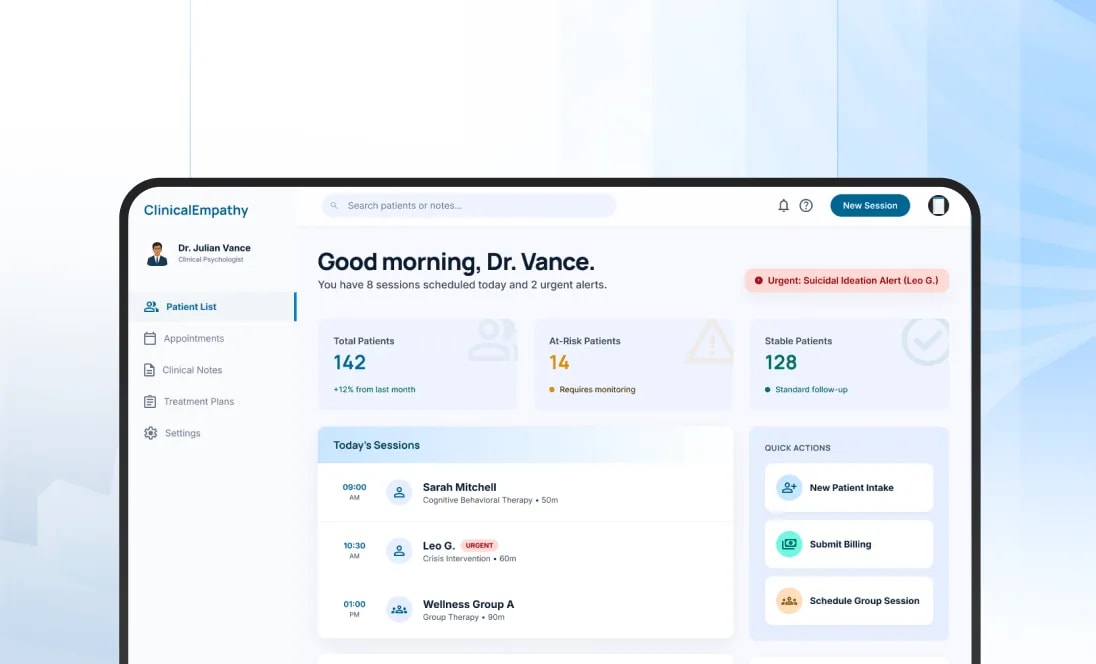
Ditstek Innovations enhanced a cloud behavioral-health EHR spanning clinical documentation, patient access, claims, medication management, crisis workflows, state reporting, and AI-assisted documentation. The work included automated compliance pipelines, privacy controls, high-volume reporting, contextual AI documentation, and secure data-exchange capabilities designed around complex behavioral-health operations.
Read Full Portfolio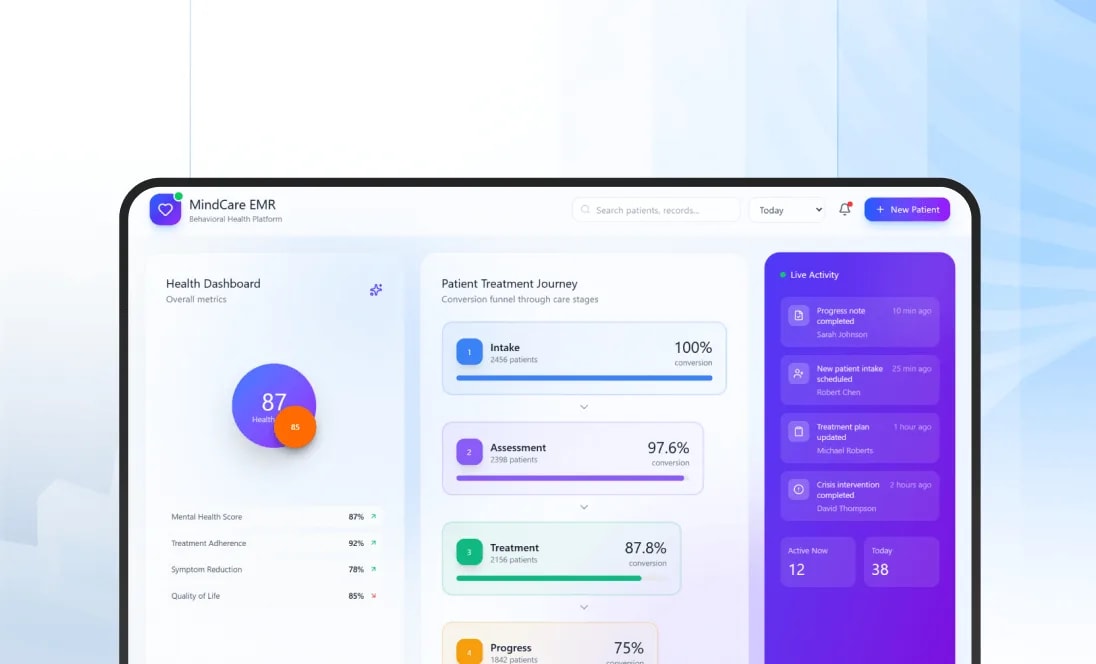
A DITS public-health and remote-monitoring platform required patient, service, and reimbursement information to move more reliably between connected-care workflows and external EHR environments. Our team implemented secure FHIR integration using FHIR R4 to synchronize healthcare-service information and automatically associate claims with corresponding clinical records, reducing duplicate entry and reconciliation effort.
Explore Portfolio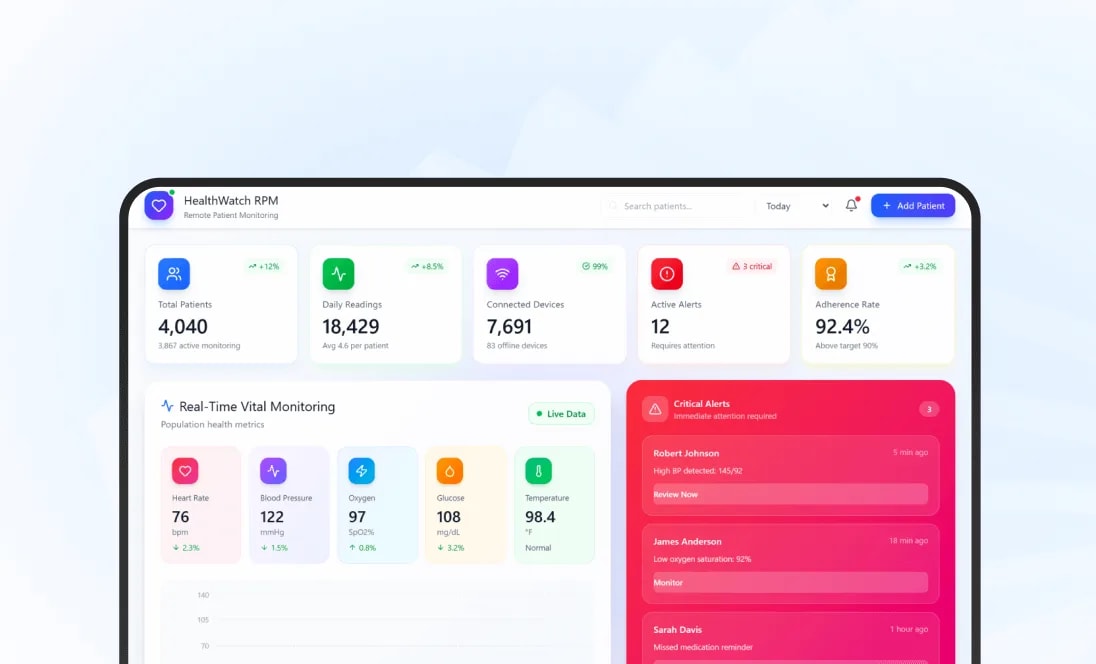
Our healthcare RCM work also demonstrates the importance of connecting clinical and financial systems. DITS implemented payer integrations and automated 835/277 processing while centralizing claims and patient information across more than 140 behavioral-health facilities, improving the flow of information between operational and reimbursement workflows.
Read Full Portfolio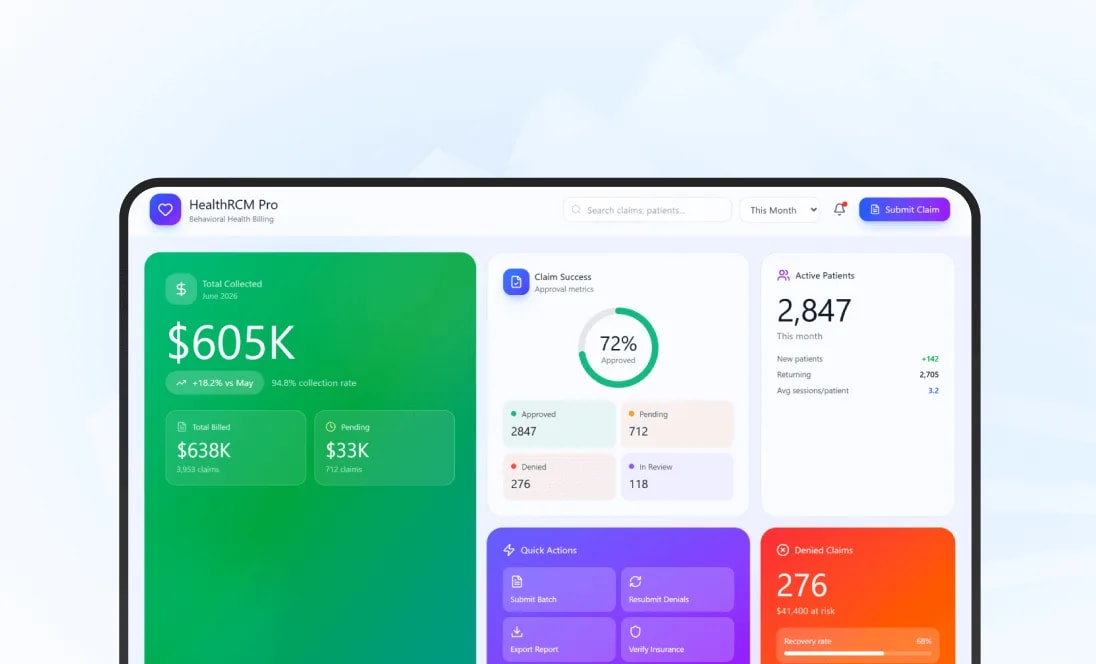
A request for new electronic health record solutions does not automatically mean the existing system should be replaced. Our EHR integration services and EHR modernization approach evaluates business value, clinical workflows, architecture, dependencies, interoperability, data, risk, and cost before defining the intervention.
Keep modules or workflows that continue to perform their business and clinical role effectively.
Address immediate reliability, security, data integrity, performance, testing, documentation, or operational risks before pursuing larger change.
Connect useful existing capabilities with new applications through APIs, HL7, FHIR integration, or other appropriate exchange patterns.
Modernize high-friction clinical and administrative workflows without requiring the entire backend environment to change at once.
Restructure high-risk modules, forms, services, databases, or application boundaries when technical debt makes future change too difficult.
Move selected applications, services, infrastructure, or data to modern environments where migration creates a clear operational or technical advantage.
Replace components that can no longer economically support the required workflow, scale, reliability, or integration model.
Introduce AI after the workflow, data, decision boundaries, and human-review requirements have been defined.
Our electronic health record solutions can improve a targeted module or support broader EHR solutions transformation. DITS' healthcare strategy explicitly treats clinical systems as more than patient records, covering EHR/EMR, clinical documentation, decision support, clinical alerts, patient records, and diagnostic or treatment-support workflows.
Support patient profiles, longitudinal records, encounter information, histories, permissions, clinical data, and related chart workflows.
Build and improve configurable assessments, progress notes, forms, templates, care documentation, signatures, and supporting clinical workflows.
Connect patient appointments, provider availability, program schedules, locations, resources, and operational follow-up.
Support care plans, case management, multidisciplinary tasks, communication, referrals, transitions, and other cross-team workflows.
Connect documented services with appropriate coding, claims, accounts receivable, remittance, reimbursement, and reporting processes.
Extend appropriate records, scheduling, documents, communication, telehealth, and self-service functionality through patient-facing experiences.
Provide clinical, financial, operational, compliance, and executive visibility through governed reporting and analytics.
Support roles, permissions, organization-specific configuration, forms, programs, workflow rules, tenant settings, and other administrative controls.
Our EHR integration services connect clinical platforms with the systems surrounding care. Effective EHR interoperability services should reduce manual information transfer and allow external data to become part of the correct clinical, operational, financial, or patient workflow.
Exchange appropriate orders, results, statuses, and diagnostic information with systems used by clinicians and downstream workflows.
Connect medication and prescription workflows with pharmacy and e-prescribing environments where required.
Link clinical activity with eligibility, claims, reimbursement, remittance, authorization, or other administrative processes.
Bring relevant patient-generated and device information into appropriate monitoring, review, alert, and follow-up workflows.
Connect portals, mobile apps, telehealth products, communication systems, and digital-care experiences with authorized EHR information.
Support information exchange beyond the local organization where providers need access to external patient information for continuity and coordination of care.
Move approved clinical and operational information into reporting, analytics, population-health, or other downstream data environments.
Give healthcare SaaS products and partner applications controlled access to the capabilities and information required by their workflows.
The strongest EHR modernization programs preserve valuable clinical knowledge while changing the technical constraints around it. Our electronic health record solutions approach considers forms, data, integrations, architecture, workflows, and continuity together rather than treating modernization as a simple code rewrite.
Move tightly coupled applications toward clearer service, domain, module, or architectural boundaries where that improves maintainability and changeability.
Separate organization-specific forms, rules, and configuration from core application code where possible to make updates easier and safer.
Evaluate infrastructure, storage, deployment, reliability, scaling, and cloud services according to the operating requirements of the EHR.
Improve databases, data access, synchronization, historical records, validation, and data movement where legacy structures restrict new capabilities.
Introduce governed APIs around valuable existing functions so digital applications can connect without directly depending on older internal architecture.
Improve high-friction clinician, administrative, and patient workflows without requiring every backend component to be changed simultaneously.
Strengthen autosave, recovery, performance, logging, observability, automated testing, deployment, and production support.
Modernize high-risk components progressively rather than forcing care organizations through an unnecessary big-bang replacement.
Our EHR interoperability services connect systems while preserving the meaning and workflow context of the information being exchanged. EHR integration services should address standards, mapping, identity, security, monitoring, and downstream actions, not simply whether a message successfully reaches another application.
Support established message-driven exchange for healthcare systems that continue to depend on HL7-based clinical and administrative interfaces.
Use modern healthcare APIs where FHIR integration provides a stronger fit for applications, data access, patient experiences, payer connectivity, or interoperability modernization.
Define how patient, encounter, provider, clinical, financial, and other information corresponds between different systems.
Address matching and identity requirements so exchanged information is connected to the correct patient, clinician, organization, or workflow.
Preserve appropriate clinical meaning when systems use different codes, values, structures, or terminology.
Use messages, APIs, events, or subscriptions to trigger appropriate downstream activity rather than simply copying information.
Track failed messages, unavailable endpoints, mapping errors, rejected transactions, latency, and other conditions affecting operations.
Define access, ownership, auditability, permissions, security, and exception handling around connected clinical information.
FHIR integration can help modernize how healthcare applications access and exchange information, but the API alone does not solve the workflow. Our EHR interoperability services combine resource design, security, mappings, application behavior, validation, and integration architecture around the business or clinical use case.
Map patient, practitioner, encounter, observation, medication, condition, care-team, and other relevant information into appropriate FHIR resources.
Build or connect REST-based APIs that expose approved healthcare information to authorized systems and applications.
Introduce a FHIR layer around useful legacy capabilities where full replacement would create unnecessary cost or operational risk.
Support appropriate application authorization patterns where SMART on FHIR and OAuth-based access are required by the ecosystem.
Use events, subscriptions, or supporting workflow patterns when connected applications need to react to changes rather than continually query for updates.
Design appropriate high-volume exchange patterns when population, analytics, reporting, or other workflows require more than transaction-level access.
Validate resources, mappings, authorization, error handling, conformance, and integration behavior before production use.
Design FHIR integration so implementation guides, resources, workflows, and exchange requirements can evolve without forcing large-scale redevelopment.
We apply AI to EHR solutions where it can reduce information burden, assist users, or automate bounded workflow activity. EHR modernization often needs to improve data access, integration, process ownership, and governance before advanced AI becomes dependable in production.
Use AI to support drafting, structuring, summarization, or preparation of clinical documentation while keeping appropriate professional review in place.
Condense relevant chart, case, document, or workflow information so clinicians and staff can review context more efficiently.
Support extraction and preparation of structured coding information where validated workflows and human review make the use case appropriate.
Classify documents, extract relevant information, identify missing inputs, and route records into appropriate administrative or clinical workflows.
Help staff retrieve approved clinical, operational, payer, or organizational information without manually searching multiple knowledge sources.
Create tasks, route information, trigger follow-ups, update statuses, and manage predictable administrative activity surrounding the EHR.
Use agents for bounded multi-step activities such as collecting context, preparing work, coordinating approved actions, or supporting staff workflows under defined permissions.
Keep consequential clinical, compliance, financial, and other judgment-heavy decisions with accountable professionals.
Technology decisions depend on where and how the platform is used. Our EHR solutions and EHR modernization work consider the clinical, administrative, financial, interoperability, and user requirements of different healthcare operating environments.
Support assessments, care plans, progress notes, case management, behavioral-health workflows, scheduling, billing, reporting, patient access, and multidisciplinary coordination.
Connect clinical systems with departmental workflows, external applications, patient experiences, analytics, and enterprise integration requirements.
Improve patient records, scheduling, documentation, provider workflows, billing, reporting, referrals, and operational administration.
Support organization-specific configurations, forms, permissions, programs, reporting requirements, and data separation while maintaining a common platform foundation.
Extend EHR information into monitoring, telehealth, device, patient-engagement, alert, and follow-up workflows through EHR integration services and FHIR integration.
Connect EHR data with program management, reporting, patient monitoring, reimbursement, analytics, and other public-health workflows.
Build electronic health record solutions and integrations that can scale across multiple provider customers without recreating the entire architecture for each organization.
Connect documented care with coding, eligibility, claims, reimbursement, remittance, and financial reporting where clinical and financial workflows depend on shared information.
Frontend
Our role goes beyond building EHR solutions. DITS combines workflow understanding, EHR integration services, EHR modernization, product engineering, interoperability, cloud, data, and AI so healthcare organizations can determine what should change before committing to a large technology programme.
We look beyond the requested feature to understand why users, workflows, information, or the underlying architecture are creating pressure for change.
An established EHR may contain years of clinical logic, forms, integrations, configuration, user knowledge, and operational dependency worth preserving.
Our experience covers patient records, clinical documentation, behavioral health, care coordination, billing, scheduling, reporting, connected care, and interoperability.
Architecture improvement and EHR interoperability services are evaluated together so technical modernization does not leave the platform isolated from the wider healthcare ecosystem.
DITS can work across forms, UX, architecture, APIs, data, cloud, integration, workflow automation, and reliability instead of requiring a greenfield rebuild.
AI is introduced where information, workflow, governance, and measurable value support it rather than making AI mandatory in every EHR programme.
The reasoning established during assessment can continue into architecture, implementation, integration, testing, rollout, and ongoing improvement.
Our teams can continue improving the platform as workflows, interoperability requirements, data, integrations, and clinical operating needs evolve.
You do not need to decide whether the answer is new EHR solutions, EHR modernization, EHR integration services, EHR interoperability services, or FHIR integration before speaking with us. Bring the clinical, operational, integration, or platform constraint, and our team will assess what should be retained, improved, connected, modernized, or rebuilt.
Discuss Your EHR Transformation


