With more than 20 years of experience - I represent a team of professionals that specializes in the healthcare and business and workflow automation domains. The team consists of experienced full-stack developers supported by senior system analysts who have developed multiple bespoke applications for Healthcare, Business Automation, Retail, IOT, Ed-tech domains for startups and Enterprise Level clients
Key Takeaways
RCM in medical billing streamlines the entire financial lifecycle of healthcare operations.
AI integration reduces claim denials, improves first-pass acceptance, and accelerates reimbursements.
Custom RCM solutions enhance compliance, auditability, and secure patient data management.
Automated workflows minimize administrative overhead, saving time and reducing staffing costs.
Real-time analytics provide visibility into cash flow, AR days, and revenue performance.
Ditstek Innovations delivers scalable, AI-driven RCM systems for startups to large enterprises.
Revenue cycle management healthcare, or RCM in medical billing, is the backbone of efficient financial operations for medical providers. It covers every step from patient registration, insurance verification, coding, claims submission, payment posting, to denial management.
Proper RCM cycle medical billing ensures accurate claim processing, reduces errors, and accelerates reimbursements, directly impacting cash flow. Healthcare businesses, from startups to large-scale hospitals, require systems that can handle complex insurance rules, patient data security, and multi-payer environments.
AI-integrated RCM healthcare solutions enhance automation in claim adjudication, predictive denial management, and reporting analytics, enabling better decision-making. With custom RCM in medical billing software, businesses can visualize patient payment journeys, track revenue leakage, and optimize operational efficiency.
Partnering with a specialized healthcare software development company like Ditstek Innovations helps healthcare organizations implement scalable, secure, and high-performance revenue cycle workflows that improve revenue capture and financial stability.
Market Stats & Demand of RCM in 2026
Revenue Cycle Management (RCM) in medical billing involves tracking patient care from registration through billing, claims, and payments to optimize reimbursements. Demand is surging due to rising healthcare costs, complex regulations, and need for digital transformation.
Key Statistics of RCM
Common RCM KPIs include clean claim rate (target >90%), days in A/R (under 40 days), denial rate, and net collection rate. Services dominate at 67% market share, hospitals 62%, and integrated solutions 65%. AI adoption exceeds 50% for claims analytics among providers
Market Size of RCM
The global RCM market is projected at around USD 178 billion in 2026, expanding to USD 517 billion by 2033 at a 12.6% CAGR, fueled by automation and IT adoption. In the U.S., estimates vary: USD 72.96 billion in 2026 with 11.6% CAGR to 2035, or USD 57 billion specifically noted. North America holds about 55% global share, driven by advanced infrastructure and payer complexities.
Category
Metric/Stat
Value/Details
Global Market Size
2026 Valuation
~USD 178B
Global Market Size
2033 Projection (CAGR 12.6%)
USD 517B
U.S. Market Size
2026 Valuation
USD 72.96B (11.6% CAGR to 2035)
Market Share
Hospitals
62%
Outsourcing Growth
2025-2033
USD 23.47B to 54.55B
Growth Driver
Asia-Pacific CAGR
~14%
Adoption
AI for Claims Analytics
>50% among providers
2026 Trend
Primary Focus
AI billing, patient tools, predictions
Role of Revenue Cycle Management in Medical Billing
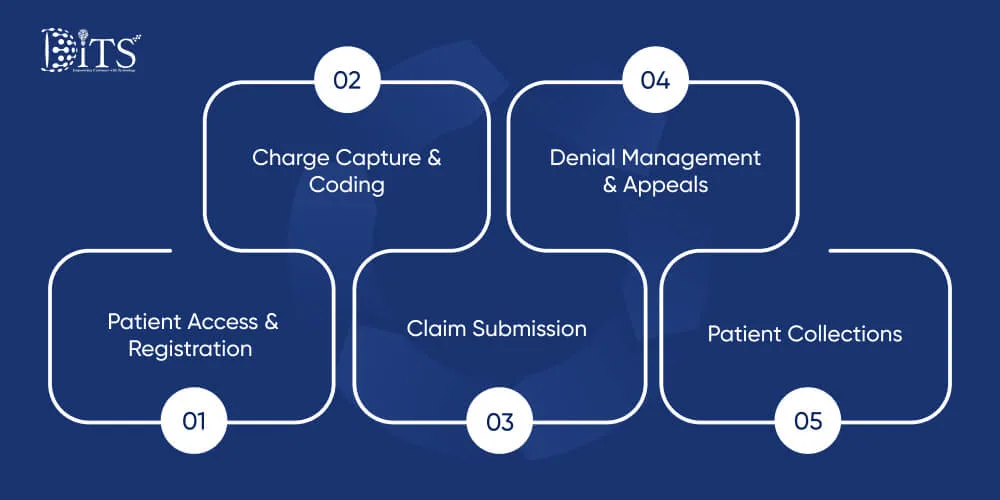
Revenue cycle management healthcare ensures accurate billing, faster reimbursements, and reduced claim denials. From patient access to collections, RCM in healthcare helps businesses maintain financial control, improve compliance, and streamline end-to-end revenue operations.
1. Patient Access & Registration
Accurate patient access and registration initiate a strong RCM cycle medical billing process. Insurance verification, eligibility checks, and demographic validation reduce claim rejections. For example, hospitals capturing real-time payer data during onboarding prevent downstream billing errors and ensure smoother reimbursement workflows.
2. Charge Capture & Coding
Charge capture and medical coding translate clinical services into standardized billing codes. In RCM healthcare, using ICD and CPT coding systems ensures compliance and accuracy. Clinics leveraging automated coding tools reduce manual errors and improve claim acceptance rates, directly impacting revenue cycle efficiency.
Efficient claim submission in RCM in medical billing features ensures timely reimbursement. Electronic Data Interchange integration allows healthcare providers to submit clean claims quickly. For instance, multi-specialty hospitals using automated claim scrubbing tools minimize rejections and accelerate payer processing timelines.
4. Denial Management & Appeals
Denial management is critical in revenue cycle management healthcare to recover lost revenue. AI-driven analytics identify denial patterns, enabling faster corrections and appeals. Businesses can track root causes such as coding errors or missing documentation and improve claim resubmission success rates.
5. Patient Collections
Patient collections close the RCM cycle medical billing loop by ensuring payment realization. Digital payment gateways, automated reminders, and transparent billing systems improve collection rates. Healthcare providers using structured collection workflows reduce outstanding balances and enhance patient financial experience with support from a healthcare software development company.
Get Smart RCM Solution Prototype in 12 Working Days
Connect with our team to modernize your billing systems and improve revenue performance with measurable outcomes.
Benefits of Revenue Cycle Management in Medical Billing
Revenue Cycle Management improves financial performance, reduces billing errors, and strengthens compliance in healthcare operations. It enables faster reimbursements, accurate reporting, and better patient interactions, making it essential for scalable and efficient medical billing systems.
Improved Cash Flow
Efficient RCM cycle in medical billing software ensures faster claim processing and reimbursement cycles. For example, automated eligibility checks and real-time claim validation reduce delays, helping hospitals and clinics maintain steady cash flow and predictable revenue streams.
Reduced Claim Denials
AI-driven claim scrubbing and validation engines identify coding errors before submission. This minimizes rejections and rework. Businesses can visualize fewer denied claims and quicker resubmissions, improving overall financial efficiency.
Enhanced Compliance
Revenue cycle management healthcare systems integrate regulatory frameworks such as HIPAA and ICD standards. Automated audit trails and compliance checks reduce legal risks and ensure accurate billing practices across multi-location healthcare providers.
Reduced Administrative Costs
RCM healthcare automation replaces manual billing, coding, and follow-ups with workflow automation tools. This reduces staffing overhead while improving operational efficiency, allowing healthcare organizations to allocate resources toward patient care and strategic growth.
Improved Patient Experience
Transparent billing systems, digital payment portals, and automated communication improve patient interactions. Patients receive accurate estimates, faster billing cycles, and easy payment options, which builds trust and reduces billing disputes.
Better Data Accuracy & Reporting
Advanced analytics dashboards in RCM cycle medical billing provide real-time KPIs such as AR days, denial rates, and collection ratios. Decision-makers can visualize financial performance and optimize revenue strategies based on accurate, data-driven insights.
Building a Revenue Cycle Management (RCM) system with a custom software development partner like DITS allows you to transition from manual, error-prone billing to a streamlined, automated workflow.
While pre-packaged software often starts with monthly subscriptions, a custom RCM build from DITS typically begins at a base investment of $25,000. This entry point usually covers a Basic RCM framework, focusing on core modules like patient registration, automated claim submission, and HIPAA-compliant data storage.
Component
Description
Estimated Allocation
Frontend Development
Building user dashboards, patient registration forms, and UI for billers.
$8,000 – $12,000
Backend & API Logic
Claim processing logic, server-side rules, and database architecture.
$10,000 – $15,000
EHR/EMR Integration
Connecting the billing system to existing patient health records for data flow.
$5,000 – $8,000
Security & Compliance
Implementing HIPAA-grade encryption, audit trails, and access controls.
$4,000 – $6,000
QA & Testing
Testing for "Clean Claim" rates, security vulnerabilities, and logic errors.
$3,000 – $5,000
Cloud Deployment
Setting up hosting (AWS/Azure) and CI/CD pipelines for updates.
$2,000 – $4,000
Total Starting Range
Base Build (MVP)
$25,000 – $50,000
Key Factors Influencing Your Total Cost
While the service starts at $25,000, the final price depends on the complexity of your practice's needs:
Automation Level: Basic systems handle claim submission; advanced systems use AI software for denial management and predictive analytics (often pushing costs to $70,000+).
Scale: A single-clinic solution is significantly more affordable than a multi-specialty, multi-location hospital platform.
Legacy Software Modernization & Data Migration: Moving years of old patient records into the new RCM system can add $20,000 to $45,000 for full fledged modernization, integration and migration.
Engagement Models
Fixed Price: Best for the $25k or $25/hr. entry-level build where the scope is strictly defined.
Hourly/Time & Materials: Ideal if you want to build the core system first and add features (like AI-coding) iteratively.
Dedicated Team: Best for large healthcare organizations needing ongoing development and maintenance.
Want Faster Reimbursements and Fewer Claim Errors?
Explore AI-enabled revenue cycle workflows that increase clean claim rates, optimize collections, and strengthen compliance across medical billing operations.
Why Custom RCM Over SaaS RCM Platform: Which is Beneficial
For healthcare businesses evaluating long-term ROI, a custom-built RCM platform offers stronger financial and operational control compared to subscription-based SaaS models.
Feature
Custom RCM (Build)
SaaS RCM (Rent)
Upfront Cost
High ($25,000+ initial investment)
Low (Setup fee + monthly subscription)
Ongoing Fees
Low (Maintenance & hosting only)
High (4%–10% of total collections)
Data Ownership
Full Ownership. You control the database.
Limited. Vendor hosts and controls data.
Customization
Infinite. Built around your specific workflow.
Rigid. You must adapt to the software's logic.
Integration
Direct API sync with any EMR/EHR.
Limited to "supported" integrations only.
Scalability
Scale features as you grow without per-user fees.
Scaling often triggers higher "tier" pricing.
Implementation
3–6 months for full development.
Instant to 30 days.
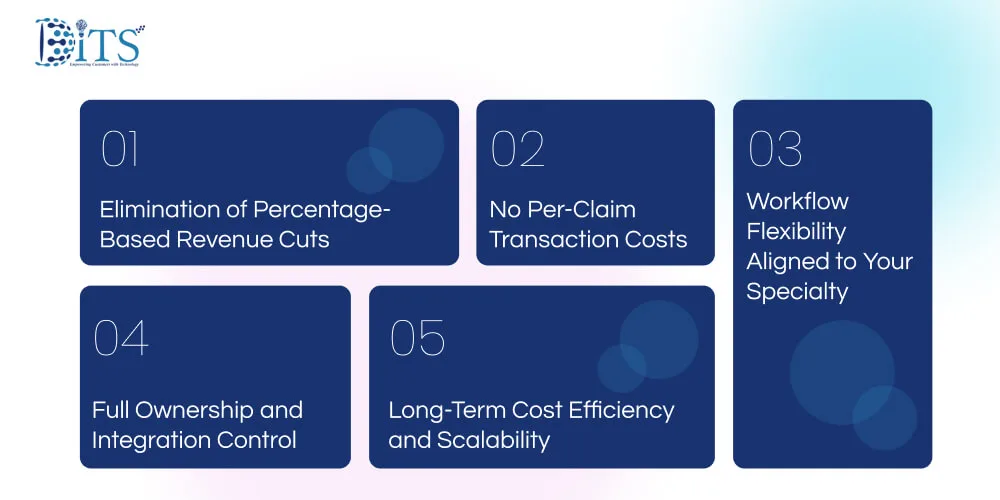
Elimination of Percentage-Based Revenue Cuts
Most SaaS RCM vendors charge 4%–10% of total collections. As your billing volume grows, this becomes a significant recurring expense. A custom solution removes this dependency, allowing you to retain full revenue without ongoing proportional deductions, which directly improves profit margins.
No Per-Claim Transaction Costs
SaaS platforms often charge $4–$7 per claim submission. For organizations processing thousands of claims monthly, this creates unpredictable and compounding operational costs. A custom-built system standardizes costs, enabling better financial forecasting and scalability without penalties for higher volumes.
Workflow Flexibility Aligned to Your Specialty
SaaS products are designed for generalized use cases, often forcing your team to adapt to rigid workflows. A custom RCM platform is built around your specialty, payer mix, and internal processes. This ensures optimized claim routing, faster approvals, and reduced administrative friction.
Full Ownership and Integration Control
With a custom solution, you own the codebase and architecture. This allows seamless integration with EHRs, billing systems, and third-party APIs. You can implement AI modules, automation rules, and compliance updates without waiting for vendor roadmaps.
Long-Term Cost Efficiency and Scalability
While the upfront investment is higher, the absence of recurring fees, combined with improved operational efficiency, delivers a lower total cost of ownership over time. As your organization scales, your software scales with you without incremental licensing costs.
Why Choose Revenue Cycle Management (RCM) in Medical Billing
Revenue cycle management healthcare systems streamline billing workflows, reduce denials, and improve financial visibility. Businesses implementing RCM in medical billing gain structured claim processing, automated compliance checks, and AI-driven insights for better revenue tracking and operational control.
1. Improved Financial Visibility and Cash Flow Control
RCM in medical billing provides end-to-end tracking from patient registration to final payment posting. Businesses can monitor AR days, payer performance, and collection rates in real time, ensuring predictable cash flow and faster reimbursements across the entire RCM cycle medical billing process.
2. Reduced Claim Errors with Automated Validation
Revenue cycle management healthcare platforms integrate rule-based engines and AI validation layers to detect coding errors, missing modifiers, and eligibility mismatches before submission. This reduces rejection rates and improves first-pass claim acceptance, directly impacting revenue performance and operational efficiency.
3. AI Integration in Existing Billing Systems
DITS enables AI integration into existing RCM healthcare systems by embedding predictive analytics, denial forecasting, and automated workflows. For example, AI models can flag high-risk claims before submission, helping billing teams take corrective action and improve reimbursement accuracy without replacing legacy infrastructure.
4. Scalable and Compliance-Driven Operations
Custom RCM cycle medical billing solutions support HIPAA compliance, audit trails, and payer-specific workflows. Whether scaling multi-location practices or handling high claim volumes, businesses can standardize processes, ensure regulatory adherence, and maintain consistent billing performance across departments.
Revenue cycle management in medical billing is a critical system for maintaining financial stability in healthcare businesses. A well-structured RCM process improves claim accuracy, accelerates reimbursements, and reduces administrative overhead. With AI-driven automation and custom-built solutions, businesses can gain better control over revenue workflows, ensure compliance, and scale operations efficiently while minimizing revenue leakage and operational inefficiencies.
Frequently asked questions
RCM in medical billing manages the complete financial lifecycle from patient registration to final payment. It ensures accurate claim processing, faster reimbursements, and better revenue tracking, which helps healthcare businesses maintain steady cash flow and reduce financial leakages.
Nidhi Thakur
With more than 20 years of experience - I represent a team of professionals that specializes in the healthcare and business and workflow automation domains. The team consists of experienced full-stack developers supported by senior system analysts who have developed multiple bespoke applications for Healthcare, Business Automation, Retail, IOT, Ed-tech domains for startups and Enterprise Level clients