With more than 20 years of experience - I represent a team of professionals that specializes in the healthcare and business and workflow automation domains. The team consists of experienced full-stack developers supported by senior system analysts who have developed multiple bespoke applications for Healthcare, Business Automation, Retail, IOT, Ed-tech domains for startups and Enterprise Level clients
Key Takeaways
Care fragmentation in mental healthcare often results from disconnected patient records, inconsistent workflows, communication gaps, and limited visibility across care settings.
AI can support continuity of care through early risk identification, patient engagement, clinical decision support, remote monitoring, care navigation, and workflow optimization.
Successful AI implementation depends on data quality, interoperability, clinical validation, privacy, governance, and appropriate human oversight.
Not every fragmentation problem requires AI. System integration, workflow automation, legacy modernization, and process redesign may offer more effective solutions in certain situations.
Healthcare organizations should evaluate technology investments based on clinical relevance, operational impact, implementation feasibility, and measurable outcomes.
Mental healthcare often involves multiple providers, treatment settings, assessment processes, and patient touchpoints. When the systems supporting these activities operate independently, important patient information can become difficult to access, referrals may go untracked, and follow-up care can become inconsistent.
This creates care fragmentation, affecting patient access, clinical coordination, operational efficiency, and continuity of care. Clinicians may have limited visibility into a patient's treatment history, while administrative teams struggle to coordinate referrals, appointments, and communication across different systems.
Artificial intelligence can help healthcare organizations identify emerging patterns, support patient engagement, streamline clinical workflows, and improve visibility across care journeys. However, AI alone cannot resolve fragmented systems or disconnected processes.
Organizations must first understand where information and workflows break down, then determine whether system integration, automation, modernization, or AI can address the underlying problem.
How Care Fragmentation Disrupts Mental Health Delivery?
Care fragmentation frequently occurs when patient information, clinical workflows, and follow-up activities are distributed across disconnected systems and care teams. In mental healthcare, where treatment may involve multiple professionals and ongoing patient engagement, these gaps can affect both care delivery and operational performance.
Common challenges include:
1. Information Fragmentation
Patient records distributed across multiple systems.
Incomplete visibility into treatment history and previous assessments.
Difficulty accessing relevant information across care settings.
2. Workflow Fragmentation
Manual patient intake and referral processes.
Delays in connecting patients with appropriate providers.
Inconsistent follow-up and communication between appointments.
Disconnected workflows between clinicians and administrative teams.
3. Clinical and Operational Visibility Gaps
Limited visibility into patient progress between appointments.
Inconsistent tracking of treatment outcomes.
Documentation and administrative workloads that reduce clinician capacity.
Difficulty identifying patients who may require additional attention.
These challenges can delay access to appropriate care, increase administrative effort, create communication gaps, and make it harder for healthcare organizations to maintain continuity across the patient journey.
Before implementing AI in mental healthcare, organizations should assess whether their existing data, systems, integration methods, clinical workflows, and governance practices can support its intended application. Without this foundation, AI may introduce additional complexity rather than resolve existing fragmentation.
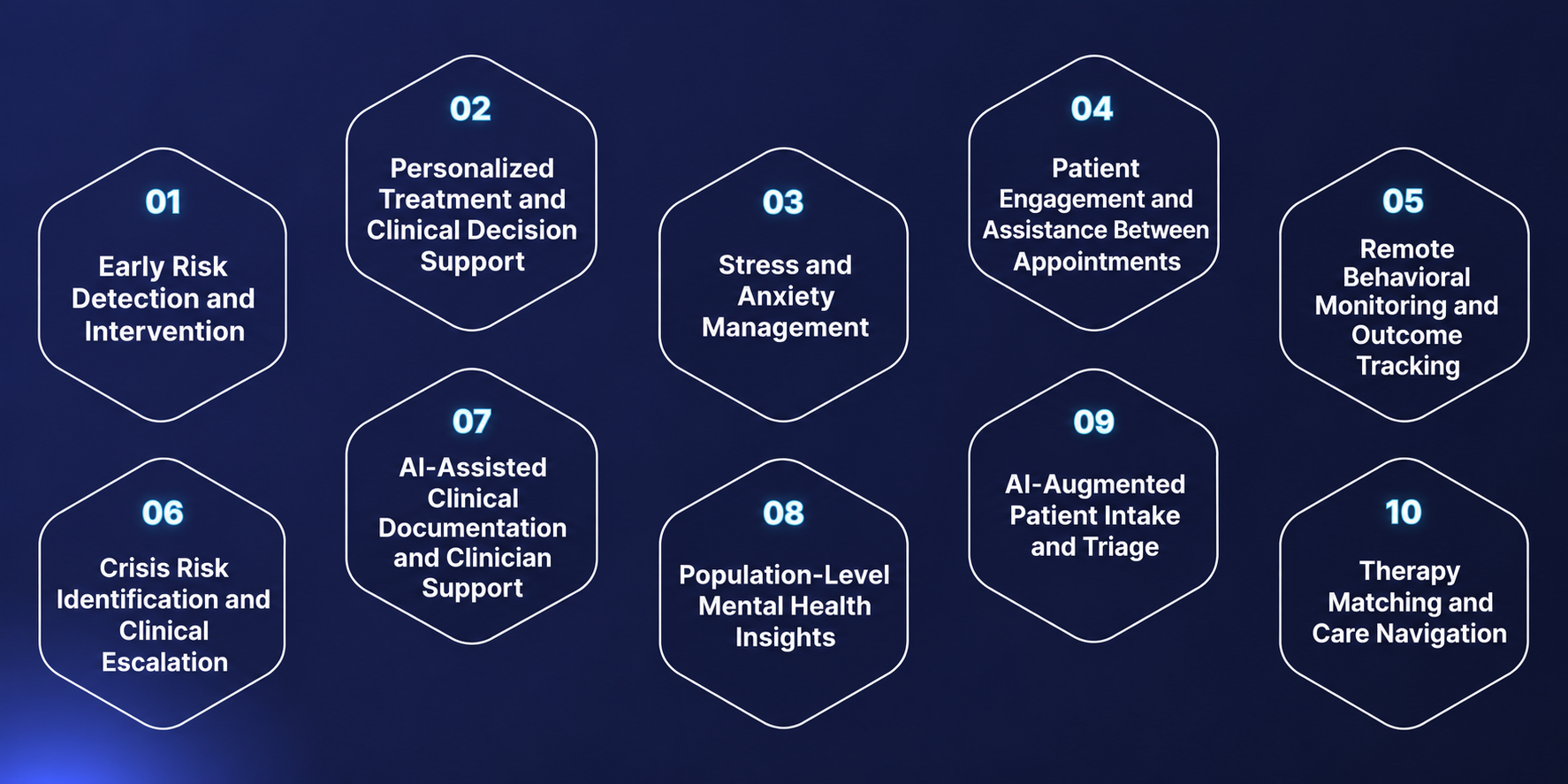
10 AI Use Cases in Mental Healthcare That Reduce Care Fragmentation
The following use cases illustrate how AI can help mental healthcare organizations address information gaps, improve care coordination, and streamline workflows across the patient journey.
According to the World Health Organization (WHO):
One in four people globally will experience poor mental health or mental illness during their lifetime.
Around 350 million people worldwide are currently living with depression.
Tragically, approximately 800,000 people die by suicide each year.
Suicide is the second leading cause of death among 15 to 29-year-olds, with young women and girls particularly affected.
Nearly 90% of people with mental health conditions face stigma and discrimination.
In high-income countries, half of those in need cannot access essential psychological care. This figure rises to 90% in low- and middle-income countries.
About 20% of those impacted by disasters and conflicts are in dire need of psychosocial support.
The global economy bears a heavy burden from poor mental health, with costs reaching an estimated $2.5 trillion each year due to lost productivity and related physical health issues.
Alarmingly, this figure is expected to climb to $6 trillion by 2030, adding to the weight of social problems like poverty, homelessness, and crime.
List of Top 10 Uses of Artificial Intelligence in Mental Health
1. Early Risk Detection and Intervention
The challenge:
Changes in a patient's reported symptoms, screening responses, treatment history, and behavioral patterns may be recorded across different systems. When this information is not consistently available to the care team, potential concerns may go unnoticed between scheduled appointments.
How AI can help:
AI models can analyze relevant longitudinal patient information, validated screening responses, and behavioral indicators to identify patterns that may warrant clinical review. When integrated into existing healthcare workflows, these insights can help care teams prioritize follow-ups and identify patients who may need additional assessment.
Potential benefits:
- Earlier identification of patterns requiring clinical attention.
- Improved visibility into patient progress between appointments.
- More targeted follow-up and monitoring.
- Better-informed clinical review.
Implementation considerations:
Data quality, clinical validation, model accuracy, bias, alert thresholds, integration with clinical workflows, escalation protocols, and appropriate human oversight must be addressed before deployment.
2. Personalized Treatment and Clinical Decision Support
The challenge:
Patient histories, assessment results, reported symptoms, medication information, and treatment outcomes may be distributed across different healthcare platforms. Limited access to this information can make it difficult for clinicians to develop a complete view of a patient's treatment journey.
How AI can help:
AI can assist clinicians by organizing relevant patient information, identifying patterns across available clinical records, and summarizing treatment histories. These insights can support clinical reviews and help professionals evaluate treatment options based on individual patient needs and documented progress.
Potential benefits:
- Better visibility into patient treatment histories.
- More informed clinical reviews.
- Improved access to relevant patient information.
- Greater consistency in treatment monitoring.
Implementation considerations:
Data completeness, healthcare interoperability, clinical validation, explainability, algorithmic bias, privacy, and clinician oversight are essential. AI-generated insights should support professional judgment rather than independently determine diagnoses or treatment plans.
3. Stress and Anxiety Management
The challenge:
Patients experiencing stress and anxiety may need ongoing support beyond scheduled clinical appointments. However, limited access to coping resources, inconsistent self-management practices, and gaps in communication with care providers can make it difficult to maintain progress between sessions.
How AI can help:
AI-powered mental health applications can provide access to guided relaxation exercises, breathing techniques, mindfulness resources, and personalized self-management recommendations. AI can also help track patient-reported stress levels and identify changes in reported patterns that may warrant additional clinical attention.
Potential benefits:
Improved access to stress management resources.
Greater patient engagement in self-management activities.
Better visibility into patient-reported stress patterns.
More structured support between clinical appointments.
Implementation considerations:
Clinical appropriateness of recommendations, accuracy of AI-generated guidance, patient privacy, consent, accessibility, and escalation protocols must be considered. These tools should complement professional mental healthcare rather than replace clinical assessment, therapy, or emergency support.
4. Patient Engagement and Assistance Between Appointments
The challenge:
Mental healthcare often requires consistent engagement beyond scheduled consultations. Patients may need reminders, educational resources, progress check-ins, or guidance on accessing appropriate support. Without structured follow-up processes, communication gaps can affect continuity of care.
How AI can help:
AI-powered patient engagement tools can support scheduled check-ins, appointment reminders, personalized educational content, and follow-up communication. They can also help collect patient-reported information and route responses requiring attention to designated care team members.
Potential benefits:
More consistent patient engagement between appointments.
Improved follow-up coordination.
Better access to relevant educational resources.
Earlier visibility into concerns requiring clinical attention.
Implementation considerations:
Patient consent, privacy, accuracy of AI-generated responses, communication boundaries, escalation protocols, accessibility, and human involvement must be considered. AI-based engagement tools should not be positioned as replacements for professional mental health care or emergency support.
5. Remote Behavioral Monitoring and Outcome Tracking
The challenge:
Important information about sleep patterns, mood, daily functioning, and patient-reported treatment progress may be collected outside clinical settings. When this information is not consistently captured or connected with clinical records, providers may have limited visibility into changes occurring between appointments.
How AI can help:
AI can help organize and analyze longitudinal patient-reported outcomes and relevant monitoring data to identify trends over time. When integrated with appropriate clinical platforms, these insights can support progress reviews and help care teams identify where additional assessment or follow-up may be needed.
Potential benefits:
Improved visibility into patient progress between appointments.
More consistent collection and review of outcome measures.
Better-informed treatment progress assessments.
More structured follow-up planning.
Implementation considerations:
Data accuracy, device compatibility, patient consent, privacy, measurement standardization, representativeness, alert fatigue, and clinical relevance should be evaluated. Monitoring insights must be interpreted by qualified professionals within the appropriate clinical context.
6. Crisis Risk Identification and Clinical Escalation
The challenge:
Information indicating a potential mental health crisis may be shared through patient communications, screening responses, clinical documentation, or monitoring platforms. When these sources are disconnected, relevant information may not reach the appropriate care team in time.
How AI can help:
AI-supported systems can help identify predefined risk indicators in relevant patient information and route alerts through established clinical escalation workflows. When appropriately validated and integrated, these systems can support care teams in prioritizing reviews and coordinating responses to situations requiring attention.
Potential benefits:
Improved visibility into predefined risk indicators.
More structured clinical alert routing.
Better coordination between designated response teams.
Reduced dependence on disconnected manual information-sharing processes.
Implementation considerations:
False positives and false negatives, clinical validation, escalation ownership, response-time requirements, emergency protocols, privacy, and human oversight must be carefully addressed. AI should never be treated as a standalone crisis detection or emergency response mechanism.
7. AI-Assisted Clinical Documentation and Clinician Support
The challenge:
Mental health professionals often work with extensive patient histories, assessment records, consultation notes, and treatment documentation. Retrieving relevant information and maintaining consistent clinical records across different systems can increase administrative workloads and limit the time available for patient care.
How AI can help:
AI-powered tools can assist clinicians by summarizing patient histories, organizing consultation notes, retrieving relevant clinical information, and supporting documentation workflows. When integrated with existing healthcare platforms, these capabilities can help professionals access relevant patient context without manually reviewing multiple disconnected records.
Potential benefits:
Reduced time spent on routine documentation.
Improved access to relevant patient information.
More consistent clinical record management.
Better workflow efficiency for healthcare professionals.
Implementation considerations:
Clinical documentation accuracy, patient consent, data privacy, access controls, EHR integration, auditability, and clinician review are essential. AI-generated notes and summaries must be verified by authorized healthcare professionals before being incorporated into official clinical records.
8. Population-Level Mental Health Insights
The challenge:
Mental healthcare organizations may collect patient information, treatment records, screening results, and outcome measures across multiple systems and service locations. When these datasets are disconnected or inconsistently structured, organizations may struggle to identify population-level trends, evaluate programs, and allocate resources effectively.
How AI can help:
AI-powered analytics can help analyze appropriately governed and aggregated healthcare data to identify patterns in service utilization, patient-reported outcomes, treatment engagement, and population-level needs. These insights can support organizational planning, program evaluation, and resource allocation.
Potential benefits:
Improved visibility into population-level trends.
Better evaluation of mental health programs.
More informed resource planning.
Identification of service gaps and changing care demands.
Implementation considerations:
Data standardization, representativeness, privacy, de-identification, bias, governance, and analytical accuracy must be addressed. Population-level insights should be interpreted carefully and should not be used to make unsupported assumptions about individual patients.
9. AI-Augmented Patient Intake and Triage
The challenge:
Manual intake processes and inconsistent initial assessments can delay access to mental healthcare. Administrative teams may need to collect patient information, review screening responses, verify documentation, and coordinate appointments across different systems before connecting individuals with appropriate services.
How AI can help:
AI-powered intake solutions can help collect and organize patient information, structure responses from approved screening questionnaires, identify missing documentation, and support preliminary routing based on predefined clinical and operational criteria. These capabilities can help streamline intake workflows while allowing qualified professionals to review cases requiring clinical judgment.
Potential benefits:
Faster processing of patient intake information.
Reduced administrative effort.
More consistent information collection.
Improved coordination of initial assessments and referrals.
Implementation considerations:
Clinical validation, screening tool suitability, routing criteria, privacy, accessibility, escalation rules, workflow integration, and human review must be considered. AI-assisted triage should not independently diagnose patients or determine the urgency of care without appropriate clinical oversight.
10. Therapy Matching and Care Navigation
The challenge:
Patients seeking mental health services may face difficulties finding providers who match their clinical needs, preferred treatment approaches, location, availability, and other relevant requirements. Fragmented provider directories, outdated availability information, and manual referral processes can further delay access to appropriate care.
How AI can help:
AI-supported care navigation systems can help organize provider information, identify available services, and assist with matching patients to appropriate care pathways based on predefined criteria. When integrated with referral and scheduling platforms, these tools can also support referral tracking and improve visibility into the care navigation process.
Potential benefits:
Improved visibility into available mental health services.
More efficient provider search and referral workflows.
Reduced administrative effort in care navigation.
Better coordination between patients, providers, and referral teams.
Implementation considerations:
Provider information accuracy, matching criteria, availability updates, accessibility, algorithmic bias, patient preferences, privacy, and clinical oversight should be evaluated. Final treatment and provider selection should remain guided by qualified professionals and patient preferences.
Does Every Mental Healthcare Fragmentation Problem Require AI?
Not every care fragmentation challenge requires an AI-based solution. In many healthcare organizations, the underlying problems may involve disconnected applications, inconsistent data exchange, manual administrative processes, or legacy systems that cannot support evolving clinical workflows.
Introducing AI without addressing these foundational issues can increase system complexity, create additional data dependencies, and make existing workflows harder to manage.
Before investing in AI-driven mental health solutions, healthcare organizations should evaluate whether the problem can be addressed more effectively through the following approaches:
System Integration
When patient information is distributed across EHRs, assessment platforms, scheduling applications, and patient engagement systems, integration can help establish more consistent data exchange and improve information accessibility across care teams.
When administrative teams rely on repetitive manual activities, such as appointment reminders, referral tracking, documentation routing, and follow-up coordination, automation can reduce unnecessary handoffs and improve process consistency.
Legacy System Modernization
When existing healthcare applications cannot support interoperability, evolving data requirements, or changing clinical workflows, modernization can improve system capabilities, maintainability, and scalability without necessarily requiring complete platform replacement.
Process Redesign
When inefficiencies originate from unclear responsibilities, inconsistent procedures, or unnecessary approval steps, workflow redesign can address the underlying operational issues before introducing additional technology.
Artificial Intelligence
When organizations need capabilities such as pattern identification, predictive insights, intelligent information retrieval, decision support, or advanced data analysis, AI may provide additional value when supported by reliable data, appropriate integration, and clinical governance.
The right approach depends on the underlying business problem, data readiness, integration complexity, clinical risk, implementation feasibility, and expected return on investment.
In many cases, a combination of these approaches may deliver better results than implementing AI independently. Healthcare organizations should prioritize interventions based on their operational and clinical requirements rather than adopting technology without a clearly defined purpose.
How DITS Enables Healthcare Organizations to Make the Right AI Choice?
An AI technology evaluation within healthcare needs to take into consideration a business decision and decision about patient care delivery rather than just the technology itself. The DITS approach enables healthcare organizations to assess the impact of fragmentation on access, effectiveness, efficiency, and continuity of care, followed by deciding which intervention would deliver the most valuable impact.
We focus on:
Assess the impact of the fragmented areas on workflow, systems, data, and hand-off areas
Prioritize opportunities for implementation based on their potential business impact, feasibility, readiness, and risk
Decide about building, buying, integrating, automating, modernizing, or retaining existing technologies
Execute an intervention taking into consideration interoperability, compliance, scalability, and workflow adoption
Measure performance based on efficiency, continuity, provider capacity, and outcome visibility
The aim is to minimize unnecessary technology investment in the fragmented environment and enable making the right decisions on AI.
Transform mental health care with AI-driven insights
Contact us today to see how we can support your journey towards better outcomes.
AI-powered mental health apps boost access to services, offer support between sessions, enable early identification of risk factors, enable personalized communication, and monitor behavioral change during treatment.
Nidhi Thakur
With more than 20 years of experience - I represent a team of professionals that specializes in the healthcare and business and workflow automation domains. The team consists of experienced full-stack developers supported by senior system analysts who have developed multiple bespoke applications for Healthcare, Business Automation, Retail, IOT, Ed-tech domains for startups and Enterprise Level clients