With more than 20 years of experience - I represent a team of professionals that specializes in the healthcare and business and workflow automation domains. The team consists of experienced full-stack developers supported by senior system analysts who have developed multiple bespoke applications for Healthcare, Business Automation, Retail, IOT, Ed-tech domains for startups and Enterprise Level clients
Key Takeaways
AI in healthcare is most valuable when solving a clearly identified problem rather than when implemented as a standalone technology project.
Successful AI projects require workflow readiness, data quality, systems interoperability, security, compliance, and proper human intervention.
The organization must first identify the necessity for optimization, integration, automation, modernization, procurement, development, or replacement of existing technologies prior to AI adoption.
The AI project needs to be assessed in terms of feasibility of implementation, required IT infrastructure, long-term value, and potential to facilitate future growth.
ROI needs to be estimated in relation to defined business objectives based on KPIs like administrative time savings, processing speed, error reduction, staffing capacity, workflow improvement, and costs of operations.
The role of AI is rapidly increasing in healthcare as organizations focus on enhancing patient care, lessen administrative burden, and aid in good decision making. However, the chance to increase the use of AI is more than just incorporating more of AI into healthcare practices.
The healthcare leaders must figure out where the use of AI will create value, if the current processes and systems are in place, and any risks or integration issues that have to be dealt with.
Why are Healthcare Organizations Turning to AI?
The healthcare organizations are implementing AI as a solution to their operational pressures, delivery improvement, and utilization of data. These common problems include:
Growing administrative burden and increased expenses
Lack of staffing and available personnel
Fragmented patient data in disparate systems
Inefficiencies in workflows
Access, communications and engagement gaps
Unscalable and non-integrable legacy systems
AI can be used in automation, decision-making, patient engagement and workflow optimization. However, when implemented without solving the process/system issues, AI can only create additional complexity.
AI in Healthcare Market Size
The global AI healthcare market size is anticipated to grow from USD 36.67 billion in 2026 to USD 194.79 billion by 2031, with a CAGR of 39.7% (2026-2031). A key driver for market growth is the ever-increasing demand for AI in healthcare for improved precision, efficiency, and better healing of patients.
Make Healthcare AI Work for Your Business
Identify where AI can create measurable value across healthcare workflows, improve operational efficiency, and support smarter clinical and business decisions.
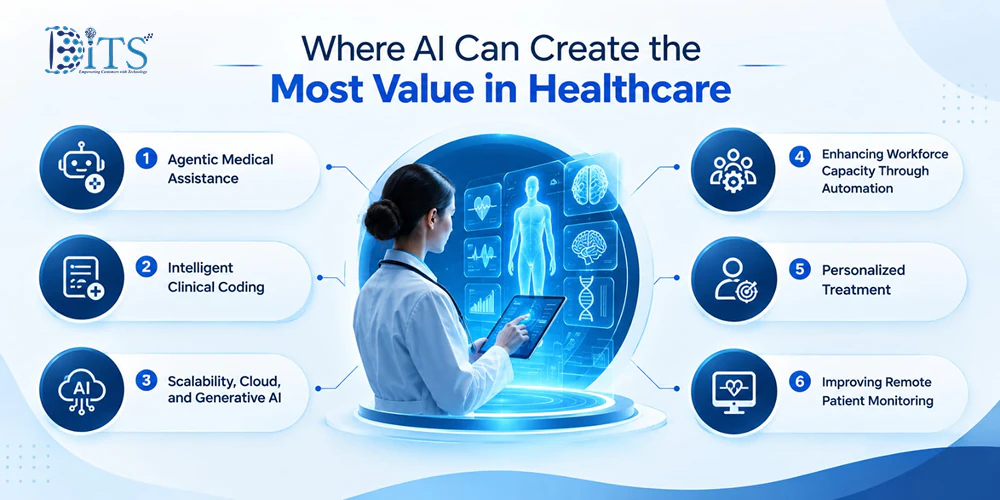
Considering the demand and growth, AI is expected to significantly advance the healthcare industry, allowing for better growth and patient care. Let us explore the areas that are expected to revolutionize in the future scope of AI in healthcare.
Agentic Medical Assistance
In the future, more healthcare organizations are expected to explore agentic AI systems that are capable of making decisions on their own. They will be used as a method for breaking barriers in patient care. These AI-powered enterprise agents could transform processes such as data analysis, interpretation of medical images, or the processing of test results considerably, thus accelerating diagnoses and identifying conditions overlooked by human clinicians.
Agentic AI can also help in drug discovery by enabling the automation of large-scale data analysis. Full autonomy of AI systems may remain in development somewhat longer. However, AI systems are taking on more complex roles, rather than merely assisting in decisions, and extracting important information from patient records. This is a major step towards intelligent, self-driven automation in health care.
Intelligent Clinical Coding
Generative AI will be utilized by healthcare providers to automate medical documentation coding, which decreases errors and speeds up the coding process. It assigns standard codes by analyzing clinical notes, discharge summaries, and other patient documents with great accuracy and efficiency. Coupled with natural language processing, such systems can analyze medical abbreviations and complex patient information, suggesting the most relevant codes.
With the advancement in AI technology, healthcare providers will be able to automate workflows, reduce administrative workload, and increase data accuracy. Over the long run, generative AI tools such as chatbots and automated coding systems will allow doctors to devote more time to patient care and less to paperwork, allowing them to use resources to improve patient care.
Scalability, Cloud, and Generative AI
Healthcare organizations are shifting to cloud services for scalability, consistency, and modernization of their operations. Cloud solutions are used with generative AI to build more responsive healthcare systems. Cloud automation can replace obsolete systems to reduce downtime and improve performance.
A hybrid cloud approach is capable of fetching the benefits of the cloud and upgrading security through on-premises systems. The use of AI tools by service providers will increase interoperability across different healthcare platforms, helping doctors to coordinate with multiple health departments for updated patient information and offer better care. Cloud utilities also resolve matters such as limited access in underserved areas and inefficient record-keeping. Clinicians, given real-time patient records and data access from cloud-based EMRs, can make faster, better decisions and spend more time interacting with patients.
Enhancing Workforce Capacity Through Automation
For future healthcare organizations, it is expected that automation will be applied to lower the burden of limited workforce capacity and workload. AI systems will be able to assist with repetitive processes, including clinical documentation, appointments scheduling, patient intake, medical coding, claims processing, and communication.
These functions will need to be integrated into the workflow process of healthcare organizations. In this case, the organization should consider which functions can be automated to increase efficiency without disturbing the current workflow. The main emphasis is going to be made on combining automation with system integration and human supervision, which will allow employees to devote more time to clinical decisions, patient interactions, and other tasks.
Personalized Treatment
AI is expected to assist healthcare organizations in providing personalized treatment through the use of clinical, behavioral, and patient-generated data. Using the information provided by connected systems, AI systems will be able to recognize risk patterns, provide insights about treatment, and help in the process of planning treatment in accordance with individual patient needs.
The success of personalized care initiatives is going to hinge on availability and quality of data. In this regard, healthcare providers will require more interoperable, governed, and clinically curated data to enable safe use of AI insights in their daily operations and decision-making.
Improving Remote Patient Monitoring
Remote patient monitoring is anticipated to become more intelligent thanks to the use of AI in analysis of patient data continuously to detect any change that might require attention. This will help with chronic disease management, virtual care, and identification of risks in advance as care providers get to focus on high-risk patients.
But the usefulness of AI-powered monitoring is likely to rely on how well it works within the current clinical processes. Healthcare organizations will have to think about how alerts are prioritized, who reviews them, how they relate to EHR systems, and scalability of the technology among other considerations.
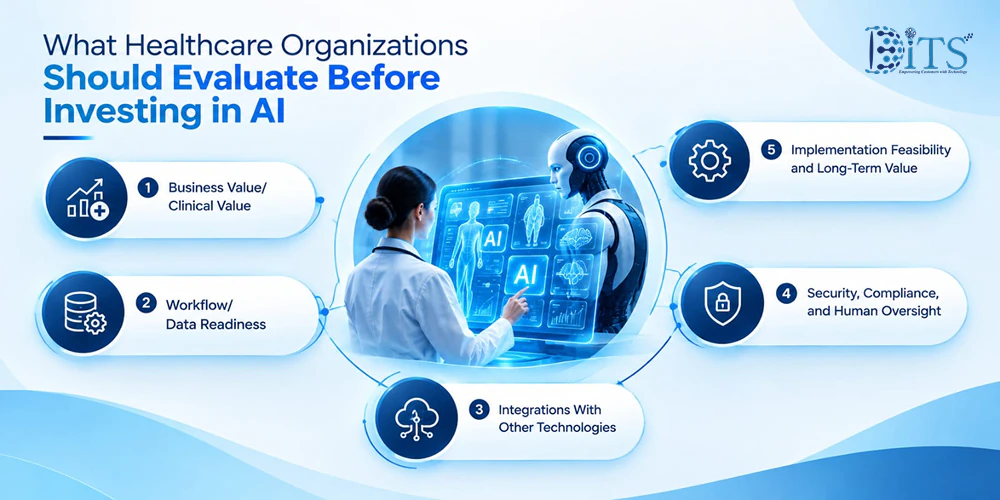
What Healthcare Organizations Should Evaluate Before Investing in AI
Healthcare organizations should consider whether the implementation of AI technology meets the business problem, workflow, data environment, and organization's long-term goals.
Business Value/Clinical Value
Define what the problem AI should solve is.
Describe what outcomes should be achieved.
Establish criteria for successful implementation.
Consider whether the expected benefit outweighs cost and effort.
Workflow/ Data Readiness
Decide whether the current workflow is compatible with AI.
Identify if some processes should be redesigned before implementation of AI.
Check whether the needed data is available, correct, and complete.
Handle problems with data fragmentation before scaling AI.
Integrations With Other Technologies
Examine how AI will interact with EHR systems, billing, scheduling, and mobile apps.
Consider APIs' availability.
Identify limitations of legacy systems that can complicate implementation.
Securely transfer data between systems connected to each other.
Security, Compliance, and Human Oversight
Specify how health data will be accessed, manipulated, and stored.
Assign accountability for outcomes of AI processes.
Decide what will require human interaction.
Integrate governance, monitoring, and privacy into the implementation process.
Implementation Feasibility and Long-Term Value
Consider the difficulty of implementation and the required infrastructure.
Determine the costs involved with maintaining and monitoring.
Consider how much value is gained by the effort of implementing it.
Determine whether the solution will be able to grow in the future without limiting future technology options.
Turn Healthcare Workflow Gaps Into Opportunities
Rethink fragmented processes with intelligent automation, connected systems, and purpose-built technology that helps healthcare teams work more efficiently.
How Healthcare Organizations Should Approach AI Adoption?
AI technologies should be adopted with consideration of the business or clinical problems rather than by starting off with the technology itself. Healthcare organizations should first evaluate their current system, workflows, or processes to identify what is holding them back from reaching the maximum level of efficiency and scalability before adopting an AI technology.
Depending on the need, the proper way to approach AI adoption is to either:
Maintain and optimize their current technology to support the desired workflows
Connect disparate systems to enhance their data flow and interoperability
Automate any repetitive administrative or clinical processes
Implement a pre-existing AI solution if it fulfills the criteria for workflows, security, and business goals
Develop unique AI capabilities if no pre-existing solutions can solve the organizational challenges or
Replace inefficient systems that put limits on future development.
In the end, the choice should take into account the criteria such as business value, time to implement, integration complexity, security, scalability, costs, and ownership.
How to Measure ROI From AI in Healthcare
Healthcare organizations should establish performance metrics before the deployment of AI technology to assess whether the AI is contributing to any improvement either clinically or operationally.
Some ROI measures that can be considered include:
Administrative time savings
Faster processing/response times
Reduced error rates
Increased capacity of staffing
Better patient response time
Coding/claims efficiency
Reduced costs
Increased efficiency of workflow
ROI should be measured based on the original business goal. This will enable organizations to know whether an AI project needs optimization, scaling, or a rethink.
How DITS Helps Healthcare Organizations Make Better AI Decisions?
As a consulting-led technological partner DITS follows its unique approach of tackling business problems by making a thorough analysis of operational issues of each client with special focus on workflow breakdowns, technological pitfalls, gaps in data, and on priorities from operational perspective. Rather than simply offering generic AI-driven solutions, DITS helps the clients to define the issue that hampers their work efficiency and determine where technology can be implemented to add real value in terms of efficiency improvement.
Based on conducted analysis, DITS comes up with the technology solution that addresses the needs of which have been in the list of the newly detected problems. Such a technology solution could deal with integration, automation, updating, cloud and data improvements and can even include AI introduction in those areas where it is possible and valuable.
Overall, DITS assists healthcare organizations in overcoming the barriers of identifying the problem and selecting, launching, and expanding the best possible solution.
Take a closer look at the solutions built to simplify complex workflows, improve system connectivity, and support evolving business needs.
Build a Stronger Foundation for Healthcare Innovation
Modernize legacy healthcare systems, improve interoperability, and create scalable technology foundations that make future AI adoption more effective.
AI is reshaping healthcare by improving diagnostics, reducing administration, and personalizing treatment plans. Machine learning algorithms allow doctors to predict diseases; meanwhile, AI engages in patient care to make interventions more accurate and time-appropriate.
Nidhi Thakur
With more than 20 years of experience - I represent a team of professionals that specializes in the healthcare and business and workflow automation domains. The team consists of experienced full-stack developers supported by senior system analysts who have developed multiple bespoke applications for Healthcare, Business Automation, Retail, IOT, Ed-tech domains for startups and Enterprise Level clients