25+ years of IT software development experience in different domains like Business Automation, Healthcare, Retail, Workflow automation, Transportation and logistics, Compliance, Risk Mitigation, POS, etc. Hands-on experience in dealing with overseas clients and providing them with an apt solution to their business needs.
If you run a business in today’s digital world, you’ve probably heard the term API. APIs (Application Programming Interfaces) are the backbone of modern digital businesses. When you order food from an app, sync your emails, or connect different software tools for your business, an API is running behind the scenes, making it all happen.
They allow different applications to talk to each other, automate tasks, and enhance customer experiences. If you’re thinking about creating one for your business, the first question that probably arises is: What will it actually cost?
The reality is, there’s no one-size-fits-all answer. API development costs can range from a few thousand dollars to six figures, depending on how complex the features are, how much data they handle, and how secure they need to be. And let’s not forget the hidden costs including maintenance, security updates, and scalability. They are just as important as the initial build.
In this guide, we’ll go beyond just numbers. We’ll dive into:
The real factors that drive API costs (it’s not just development time)
How API pricing varies across different regions
Common hidden expenses that businesses overlook
Smart ways to cut costs without sacrificing quality
By the end, you’ll have a clear roadmap to realistically estimate API costs and make well-informed decisions for your business. Let’s get started.
API Development Cost Breakdown
So, how much does it actually cost to build an API? The answer: It depends.
APIs can cost anywhere from $5,000 to $100,000+, depending on the scope, complexity, and level of security required. A simple API for basic data retrieval might only cost a few thousand dollars, while a complex enterprise-grade API with multiple integrations, high security, and scalability requirements could demand six figures.
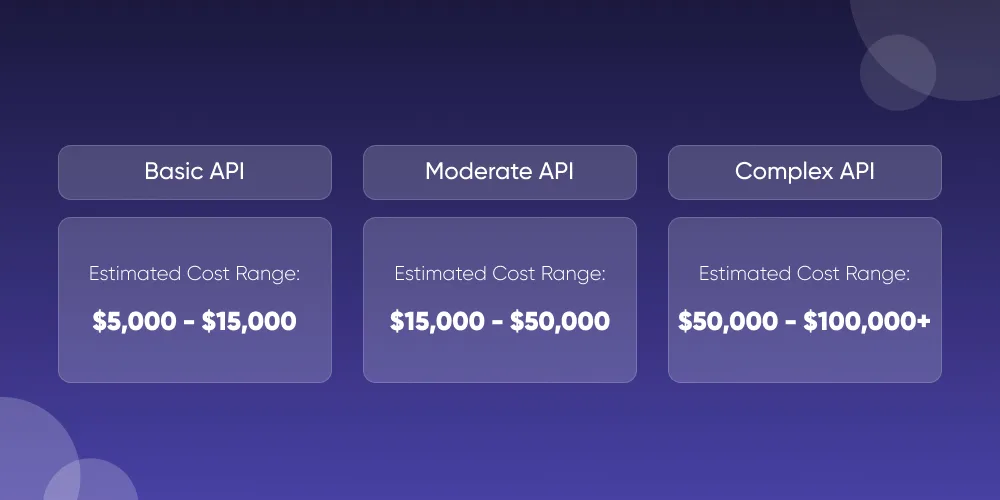
Here’s a quick breakdown of API development costs by complexity:
API Complexity
Estimated Cost Range
Examples
Basic API
$5,000 - $15,000
Fetching simple data from a database, small internal APIs
Moderate API
$15,000 - $50,000
Payment processing, user authentication, integrations with multiple platforms
Get a transparent, detailed breakdown of API development costs—understand what factors impact pricing, optimize your budget, and make informed decisions for your project.
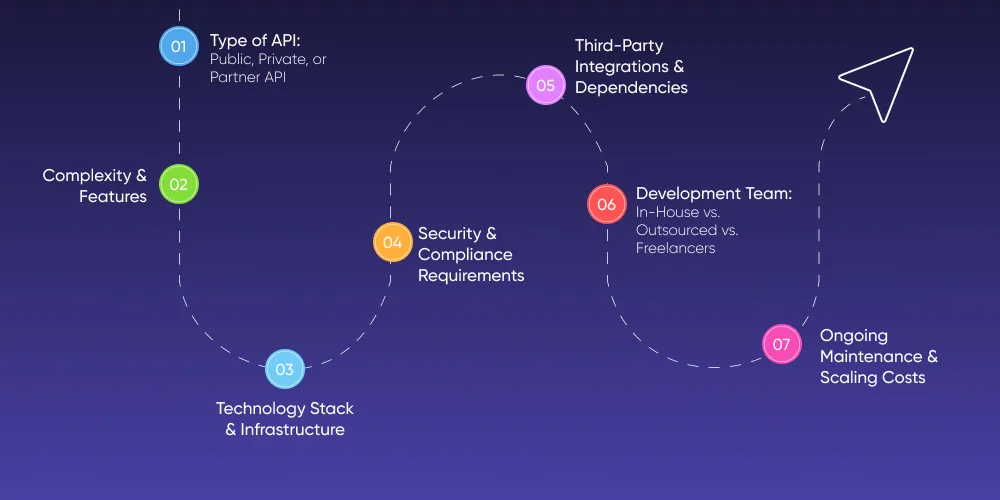
The cost of building an API depends on several factors, from the complexity of features to the technology stack and security requirements. Before diving into the specifics of API development pricing, let’s break down the key elements that influence the cost.
1. Type of API: Public, Private, or Partner API
Not all APIs are built for the same purpose, and the type of API you need affects the overall cost.
Public APIs – Open for external developers, requiring robust security, scalability, and documentation (e.g., Twitter API, Stripe API).
Private APIs – Used internally within an organization, usually less expensive but still needs proper access controls.
Partner APIs – Shared with specific business partners and require custom authentication mechanisms, adding to costs.
2. Complexity & Features
The more complex the API, the higher the cost. Basic APIs that fetch data from a database are inexpensive, but those requiring real-time processing, multi-platform integrations, or AI-powered features increase development costs.
Features that add to cost:
Authentication & Authorization (OAuth, API keys, JWT)
Real-Time Data Processing (stock market APIs, chat apps)
Data Encryption & Security Layers (compliance-heavy APIs)
Third-Party API Integrations (e.g., payment gateways, analytics tools)
A basic API might cost $5,000–$15,000, but adding authentication, real-time processing, and integrations can push costs above $50,000.
3. Technology Stack & Infrastructure
Your tech stack directly impacts development costs. Choosing the right stack involves balancing performance, security, and scalability.
Programming Languages – Python, Node.js, Java (varies based on use case)
Database Choice – SQL vs. NoSQL (PostgreSQL, MongoDB, Firebase)
Hosting – On-premise vs. cloud-based (AWS, Google Cloud, Azure)
Architecture – RESTful vs. GraphQL (GraphQL is often more expensive)
Cloud-based APIs (AWS Lambda, Google Cloud Functions) reduce infrastructure costs but may have long-term usage-based pricing.
4. Security & Compliance Requirements
APIs handle sensitive business and customer data, which means security is non-negotiable. If your API processes financial transactions, healthcare records, or personal user data, expect higher development and maintenance costs due to regulatory compliance.
Common Security Features That Add to Costs:
OAuth 2.0 & Multi-Factor Authentication
Data Encryption (TLS/SSL, AES-256)
Role-Based Access Control (RBAC)
Compliance (GDPR, HIPAA, PCI-DSS, SOC 2)
Compliance-heavy APIs (banking, healthcare) often cost 30-50% more than standard APIs due to rigorous security measures.
5. Third-Party Integrations & Dependencies
If your API needs to connect with external services (e.g., payment gateways, CRM software, analytics platforms), integration costs will increase.
Example: A custom-built payment API vs. Stripe/PayPal integration
Example: A native AI-powered recommendation engine vs. OpenAI API integration
The more third-party services your API interacts with, the higher the cost due to licensing fees, API rate limits, and maintenance overhead.
6. Development Team: In-House vs. Outsourced vs. Freelancers
The team you hire to build your API significantly impacts the total cost.
In-House Development – Expensive but gives full control over quality and security.
Outsourcing to an Agency – Cost-effective for large projects, but pricing varies by region.
Hiring Freelancers – Ideal for smaller projects but requires careful vetting.
API development doesn’t end after launch. Regular updates, bug fixes, performance improvements, and scalability enhancements are crucial for long-term success.
Ongoing Costs Include:
Server & Hosting Fees (AWS, Azure, GCP)
Monitoring & Performance Optimization
Security Patches & Updates
Versioning & Backward Compatibility
Expect to allocate 15-25% of initial API development costs annually for maintenance.!
APIs in Action: Build, Scale & Maximize ROI!
Discover how smart API development fuels business growth, enhances efficiency, and optimizes costs. Get the blueprint to success.
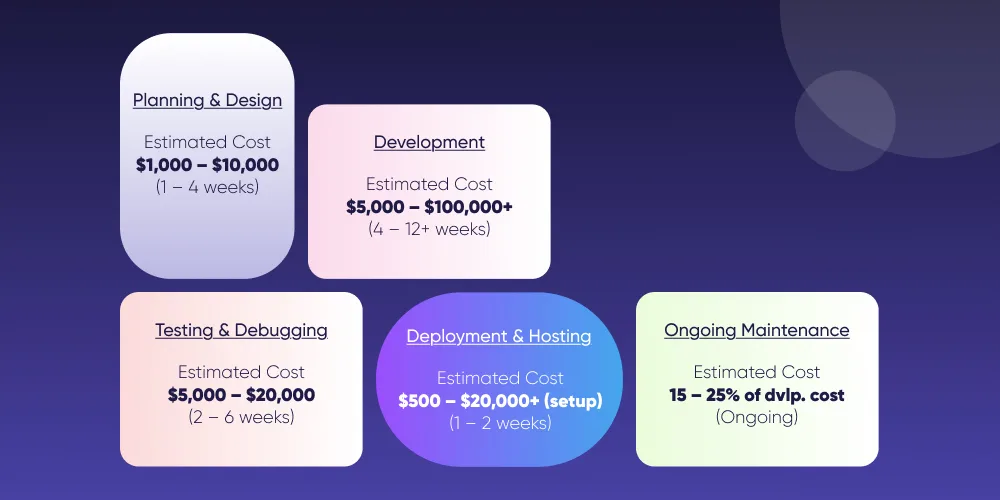
Developing an API is a multi-stage process, with each phase contributing to the overall cost. From planning and development to QA testing, deployment, and ongoing maintenance, every step requires careful budgeting. Below is a breakdown of the costs associated with each stage of API development.
Final Summary of API Cost based on Development Stages
Development Stage
Estimated Cost
Time Required
Planning & Design
$1,000 – $10,000
1 – 4 weeks
Development
$5,000 – $100,000+
4 – 12+ weeks
Testing & Debugging
$5,000 – $20,000
2 – 6 weeks
Deployment & Hosting
$500 – $20,000+ (setup)
1 – 2 weeks
Ongoing Maintenance
15 – 25% of development cost per year
Ongoing
1. Planning and Design
Before coding begins, businesses need a clear API blueprint. This stage ensures that the API is structured correctly, integrates seamlessly with existing systems, and meets security requirements.
Key Cost Factors
Defining API objectives (purpose, expected usage, and data flow)
Choosing the right architecture (REST, GraphQL, SOAP)
Designing the API structure and endpoints
Selecting authentication methods (OAuth, API keys, JWT)
Creating API documentation for developers
Estimated Cost & Timeline
Stage
Estimated Cost
Time Required
Planning & Design
$1,000 – $10,000
1 – 4 weeks
2. Development and Implementation
This is the core phase where the API is built. The complexity of the API, the number of integrations, and security measures significantly impact costs.
APIs must be tested rigorously to ensure they function correctly across different environments. Poor testing can lead to security vulnerabilities, system failures, and integration issues.
Key Cost Factors
Unit testing (validating individual API endpoints)
Load testing (checking performance under heavy traffic)
Security testing (preventing data breaches)
Integration testing (ensuring smooth interaction with other services)
Estimated Cost & Timeline
Stage
Estimated Cost
Time Required
API Testing
$5,000 – $20,000
2 – 6 weeks
4. Deployment and Hosting
Once developed and tested, the API needs to be deployed on a reliable server or cloud platform. The choice between on-premise hosting and cloud-based services significantly affects costs.
Key Cost Factors
Server setup and configuration
Cloud hosting fees (AWS, Azure, Google Cloud)
API gateway setup for performance and security
Load balancing and scaling strategies
Estimated Cost & Timeline
Hosting Type
Estimated Cost
Ongoing Monthly Cost
Basic Cloud Hosting
$500 – $5,000
$50 – $500
Enterprise-Level Hosting
$5,000 – $20,000+
$500 – $5,000
5. Ongoing Maintenance and Scaling
API development doesn’t end after launch. Regular updates, security patches, and performance improvements are essential to keep the API running smoothly.
Key Cost Factors
Bug fixes and feature updates
API versioning and backward compatibility
Security updates and monitoring
Performance optimization for increased traffic
Estimated Cost & Timeline
Stage
Estimated Annual Cost
Time Commitment
Maintenance & Scaling
15-25% of development cost per year
Ongoing
Cost of API Development Based on Different Locations
API development costs vary significantly depending on geographical location, as developer rates, infrastructure expenses, and market demands differ across regions. Businesses looking to build an API must consider whether to hire locally, outsource to offshore teams, or leverage nearshore development for a cost-effective solution.
Below, we explore API development pricing across different regions and what factors impact costs.
Hourly Developer Rates (API Developers by Region)
Below is an estimated breakdown of developer hourly rates and total API development costs based on region.
Region
Junior Developer
Mid-Level Developer
Senior Developer
United States & Canada
$80 – $150/hr
$120 – $180/hr
$150 – $250/hr
Western Europe
$50 – $100/hr
$80 – $150/hr
$120 – $200/hr
Eastern Europe
$30 – $70/hr
$50 – $100/hr
$80 – $150/hr
India & South Asia
$15 – $40/hr
$30 – $70/hr
$50 – $100/hr
Southeast Asia
$20 – $50/hr
$40 – $80/hr
$60 – $120/hr
Latin America
$25 – $60/hr
$50 – $100/hr
$70 – $150/hr
Total API Development Cost Estimates by Region
Region
Basic API ($5,000 – $15,000)
Moderate API ($15,000 – $50,000)
Complex API ($50,000 – $100,000+)
United States & Canada
$20,000 – $40,000
$50,000 – $100,000
$100,000 – $250,000+
Western Europe
$15,000 – $30,000
$40,000 – $80,000
$80,000 – $200,000+
Eastern Europe
$8,000 – $20,000
$20,000 – $50,000
$50,000 – $120,000+
India & South Asia
$5,000 – $12,000
$12,000 – $35,000
$35,000 – $80,000+
Southeast Asia
$6,000 – $15,000
$15,000 – $40,000
$40,000 – $90,000+
Latin America
$7,000 – $18,000
$18,000 – $45,000
$45,000 – $100,000+
Hidden Costs to Consider in Different Locations
Even when choosing a location based on cost, businesses must account for hidden expenses that may arise.
Legal & Compliance Costs – Ensuring the API follows regional data laws (GDPR, CCPA, HIPAA).
Project Management Overhead – Offshore development requires stronger management to bridge communication gaps.
Infrastructure Costs – Hosting fees vary by location, with North America having higher cloud service costs.
Time Zone & Communication Delays – Working across different time zones can slow development if not managed properly.
API Development Done Right: Strategy, Tech & Cost!
Avoid costly mistakes and build APIs that are robust, scalable, and future-ready. Get expert insights on balancing development and budget
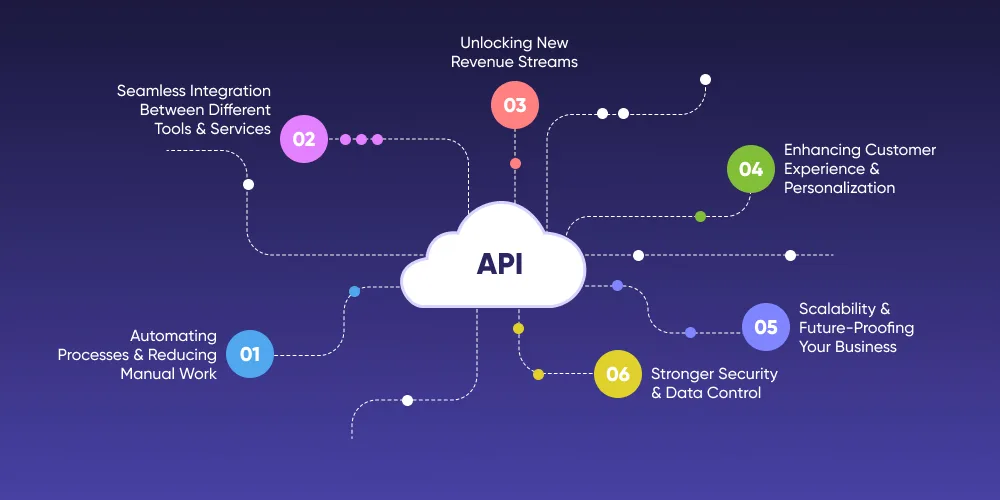
Let’s break down the biggest benefits of developing an API for your business.
1. Automating Processes & Reducing Manual Work
Repetitive tasks slow businesses down. APIs automate data transfers, reporting, and system updates, cutting down manual work and reducing human error. Instead of employees spending hours entering customer details into different platforms, an API can sync that data in real time.
Example: E-commerce businesses use APIs to automate order processing. The moment a customer places an order, APIs trigger inventory updates, payment processing, and shipping requests—all without human intervention.
2. Seamless Integration Between Different Tools & Services
Businesses rarely use just one software. CRMs, ERPs, marketing platforms, payment gateways—they all need to work together. APIs act as the connective tissue between these systems, allowing seamless data exchange and functionality across platforms.
Example: A SaaS company can integrate its enterprise software with third-party tools (like Slack, Zapier, or Stripe) using APIs, making the product more valuable and versatile for customers.
3. Unlocking New Revenue Streams
APIs don’t just improve internal efficiency—they can become a product in themselves. Companies monetize APIs by offering them as a service, charging for access, or creating premium API tiers for advanced features.
Example: Payment providers like Stripe and PayPal make billions by offering APIs that businesses can integrate into their checkout systems.
Customers expect seamless, personalized interactions. APIs allow businesses to offer tailored experiences by connecting customer data from different touchpoints.
Example: Streaming platforms like Netflix use APIs to track viewing habits and recommend personalized content based on user behavior.
5. Scalability & Future-Proofing Your Business
APIs make it easier to scale. Instead of building software from scratch, businesses can add new features, connect with partners, or expand globally just by extending their API capabilities.
Example: Uber’s entire business model runs on APIs—it integrates maps, payments, and driver communication seamlessly, allowing it to scale worldwide without building everything from the ground up.
6. Stronger Security & Data Control
APIs enable businesses to control how data is accessed and shared. With the right security protocols (OAuth, API gateways, encryption), companies can manage access levels, prevent unauthorized data breaches, and comply with industry regulations.
Example: Banks use APIs with multi-layer authentication and token-based security to protect financial transactions while still allowing third-party integrations.
How to Reduce API Development Costs Without Compromising Quality?
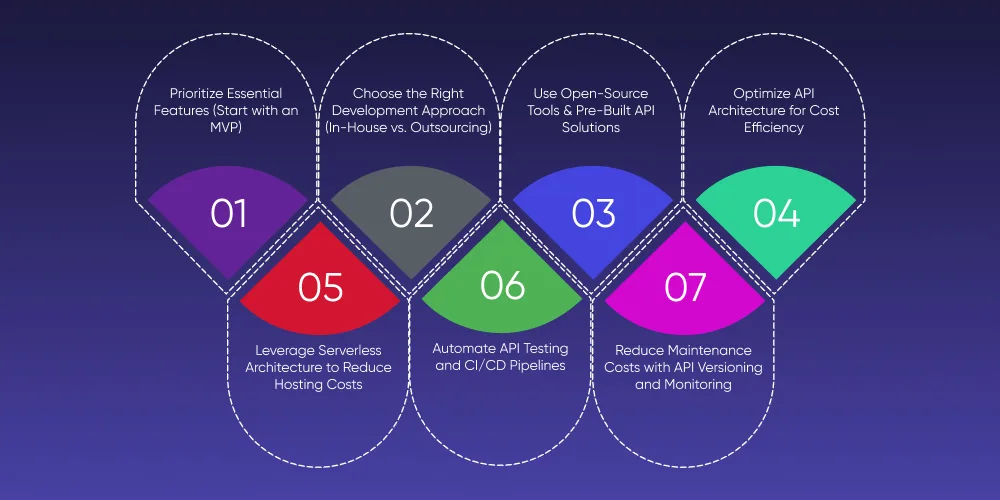
Developing an API can be expensive, but cutting costs shouldn't mean sacrificing security, performance, or scalability. The key is to optimize spending without compromising on critical features. Below are proven strategies businesses can use to reduce API development costs while maintaining high quality.
1. Prioritize Essential Features (Start with an MVP)
Many businesses overcomplicate their APIs by adding unnecessary features in the initial version, leading to higher costs. Instead, start with a Minimum Viable Product (MVP)—a version of the API with only the core functionalities needed to operate.
2. Choose the Right Development Approach (In-House vs. Outsourcing)
The hiring model significantly impacts development costs. Businesses can choose between:
Hiring Model
Pros
Cons
Estimated Cost
In-House Development
Full control, long-term support
High salaries, overhead costs
$80,000 – $250,000+
Outsourcing (Agency)
Skilled teams, structured process
Less direct control, higher initial costs
$20,000 – $100,000
Freelancers
Low cost, flexible hiring
Quality varies, risk of delays
$5,000 – $50,000
3. Use Open-Source Tools & Pre-Built API Solutions
Instead of building everything from scratch, businesses can leverage pre-existing solutions to save time and money.
Ways to Save with Open-Source Tools:
Use API frameworks (Express.js, Django, FastAPI) instead of custom-built solutions.
Implement open-source authentication (OAuth, JWT) instead of creating a proprietary system.
Utilize existing third-party APIs (Stripe for payments, Firebase for authentication) instead of developing similar functionality.
4. Optimize API Architecture for Cost Efficiency
Choosing the right API architecture directly affects performance, scalability, and cost efficiency.
Choosing Between REST, GraphQL, and gRPC
Architecture
Best For
Cost Impact
REST API
Simple, scalable APIs
Lower development cost
GraphQL API
APIs needing flexibility
Higher development time/cost
gRPC API
High-speed communication (IoT, fintech)
More expensive, requires skilled developers
5. Leverage Serverless Architecture to Reduce Hosting Costs
Hosting is a recurring expense, and choosing the right infrastructure can lead to significant savings. Serverless architecture (AWS Lambda, Firebase Functions) eliminates the need for maintaining dedicated servers.
6. Automate API Testing and CI/CD Pipelines
Manual testing is time-consuming and expensive. Automating API testing and deployment ensures fewer errors and faster releases, reducing costs in the long run.
7. Reduce Maintenance Costs with API Versioning and Monitoring
Long-term costs often come from constant fixes and updates. Proper API versioning and monitoring can prevent unnecessary expenses.
Smart API Development: Build Faster, Spend Smarter!
Discover the secrets to efficient API development—balancing performance, scalability, and cost without compromising on quality.
How DITS Can Help You Build a Cost-Effective, High-Quality API?
At DITS, we specialize in building scalable, secure, and high-performing APIs tailored to your business needs. Whether you're a startup looking to build a lightweight API or an enterprise in need of a complex, multi-platform integration, our team of experienced software or mobile app developers Dubai and API architects ensures that your project is delivered on time, within budget, and with long-term scalability in mind.
Why Choose DITS for API Development?
Cost-Effective Development: We offer flexible pricing models, ensuring you get the best value for your investment without unnecessary expenses.
Expert API Architects: Our team designs well-documented, secure, and future-proof APIs tailored to your business.
Global Talent Pool: With developers from cost-efficient regions, we ensure top-notch quality at competitive rates.
Optimized Performance & Security: We implement industry-leading best practices for authentication, encryption, and scalability.
End-to-End API Solutions: From design and development to testing, deployment, and long-term support, we handle everything.
Consultation-Driven Approach: Not sure what you need? Our API experts help define your requirements and recommend the best strategies for cost-efficient development
Frequently asked questions
The cost of developing an API depends on its complexity, features, security requirements, and location of development.
Basic API
Estimated Cost: $5,000 – $15,000
Examples: Simple data retrieval and internal APIs.
Moderate API
Estimated Cost: $15,000 – $50,000
Examples: Payment processing, authentication, and third-party integrations.
Complex API
Estimated Cost: $50,000 – $100,000+
Examples: Enterprise-level APIs, AI-powered APIs, and real-time data processing APIs.
Dinesh Thakur
25+ years of IT software development experience in different domains like Business Automation, Healthcare, Retail, Workflow automation, Transportation and logistics, Compliance, Risk Mitigation, POS, etc. Hands-on experience in dealing with overseas clients and providing them with an apt solution to their business needs.