25+ years of IT software development experience in different domains like Business Automation, Healthcare, Retail, Workflow automation, Transportation and logistics, Compliance, Risk Mitigation, POS, etc. Hands-on experience in dealing with overseas clients and providing them with an apt solution to their business needs.
A delayed shipment is rarely just a transportation problem. It can quickly become an inventory problem, a customer service problem, a warehouse planning problem, and sometimes even a procurement problem.
That is what makes modern logistics difficult. Most businesses already have systems for managing orders, inventory, warehouses, suppliers, and transportation. The real challenge is that these systems often operate separately. A warehouse team may be working in a WMS, procurement in an ERP, transportation in a TMS, and customer service in another platform entirely.
The data exists, but visibility does not. This is where automation in logistics and supply chain management becomes useful. When automation is built around connected workflows, it helps information move between systems without constant manual intervention. It can also help teams identify delays earlier, update inventory faster, coordinate orders more accurately, and respond to exceptions before they affect the customer.
That is the real value of automation. Not simply doing things faster but giving operations teams a clearer picture of what is happening across the supply chain.
What Does Automation Actually Mean in Logistics and Supply Chain Operations?
Automation in supply chain operations can mean many different things. For one business, it may involve automatically updating inventory when goods move out of a warehouse.
For another, it may mean connecting carrier data with a transportation management system so that teams can see delays without checking multiple portals.
In a larger operation, automation may cover procurement approvals, warehouse activities, order allocation, shipment tracking, replenishment, supplier communication, and exception management.
This is why it helps to separate three terms that are often used interchangeably:
Logistics Automation
It usually focuses on activities such as transportation, shipment coordination, routing, delivery, and fulfilment.
Warehouse Automation
It focuses more closely on what happens inside a warehouse or distribution centre, such as scanning, picking, sorting, packing, storage, and inventory movement.
Supply Chain Automation
It is broader term and connects activities across procurement, inventory, warehousing, orders, suppliers, and transportation.
The biggest gains usually appear when these areas stop working independently.
A warehouse should not have to wait for an email to know that a shipment has been delayed. A procurement team should not have to manually check three systems to understand whether a stock shortage is likely. And a customer service team should not need to call operations every time a delivery status changes. A connected digital supply chain reduces those gaps.
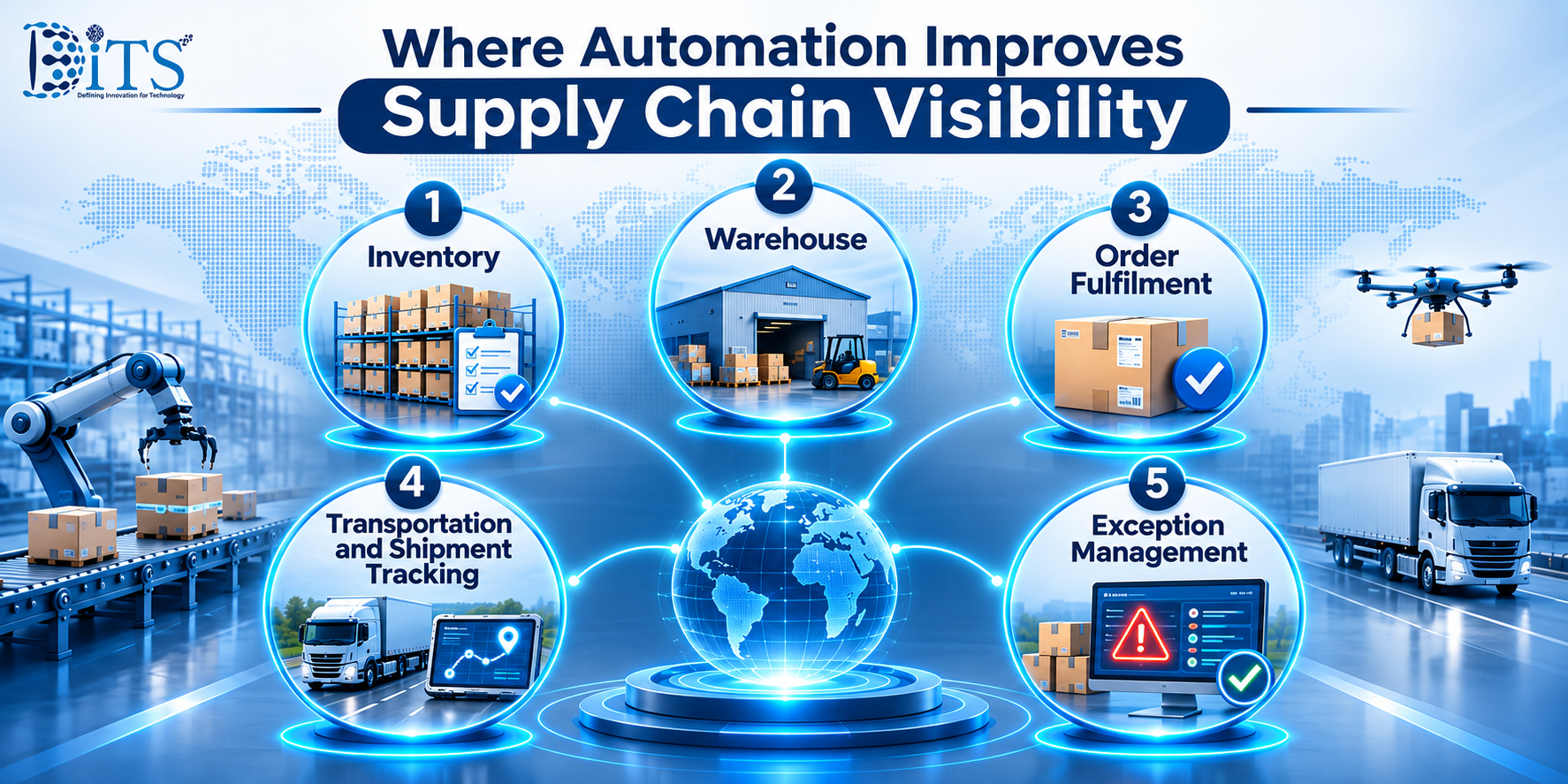
Where Automation Improves Supply Chain Visibility
Supply chain visibility simply means everyone sees the same, current picture of what is happening: what is in stock, where an order is, and what is delayed. Most businesses lose that picture in small, everyday ways. The warehouse system shows 20 units, but the ERP still says 35. An order left the dock this morning, yet customer service tells the buyer it is “still processing.” A picker is working from a list that is two hours old.
None of these is a big failure on its own. But each one leads to a wrong answer, a repeated check, or a decision made on old information.
Inventory
If the system says 40 units and the shelf holds 12, someone is going to make a bad call. Sales promises stock that isn’t there. Procurement reorders what’s already in the building.
It’s usually a timing problem. An item gets picked, moved, returned, or reserved, and the record catches up later. Connecting those movements to the ERP, WMS, and order systems shrinks that gap, so teams see availability closer to real time.
Warehouse
Warehouses don’t sit still. Priorities change by the hour, and exceptions show up constantly. Checking three screens, or walking over to ask, is what visibility loss looks like in practice.
With connected workflows, order status, stock movement, and exceptions update as each step finishes. A supervisor can see where an order is stuck and deal with it without hunting for the answer.
Order Fulfilment
One order passes through several systems before the customer gets it. If they don’t share data, people fill the gap by hand: checking status, retyping details, sending “any update?” messages.
Automation passes order, inventory, warehouse, and shipment updates along at each stage. Problems still happen. But there are fewer blind spots between steps, so they get caught sooner.
Transportation and Shipment Tracking
Shipment updates often come from different carriers and transportation partners. When this information is not connected to the transportation management system, teams may need to check multiple portals to understand shipment progress.
Automation helps consolidate shipment status, estimated delivery updates, and delay notifications across connected systems. This allows logistics teams to identify disruptions earlier and provide customers with more accurate delivery information.
Exception Management
Delays, inventory discrepancies, missed delivery commitments, and order processing issues can disrupt supply chain operations. Without automated monitoring, teams may identify these problems only after they affect other activities.
Automation can identify exceptions through predefined rules and system events, notify responsible teams, and escalate unresolved issues. This helps businesses respond to disruptions earlier and maintain better operational control.
Connect Your Supply Chain Operations
Disconnected systems and manual workflows can limit operational visibility. Let's identify integration gaps and build a roadmap for a more connected, efficient supply chain.
Technologies Behind Logistics and Supply Chain Automation
There is no single technology responsible for supply chain automation.
Most successful environments use a combination of tools.
Technology
Where it helps
AI
Demand forecasting, exception analysis, risk identification, and operational decision support
IoT
Tracking vehicles, shipments, warehouse equipment, and connected assets
Cloud Platforms
Connecting applications, enabling data access, and supporting scalable operations
API integration
Exchanging information between ERP, WMS, TMS, OMS, carrier, and partner systems
Agentic AI
Coordinating multi-step workflows, evaluating available information, determining appropriate next actions, and executing permitted tasks within defined business rules.
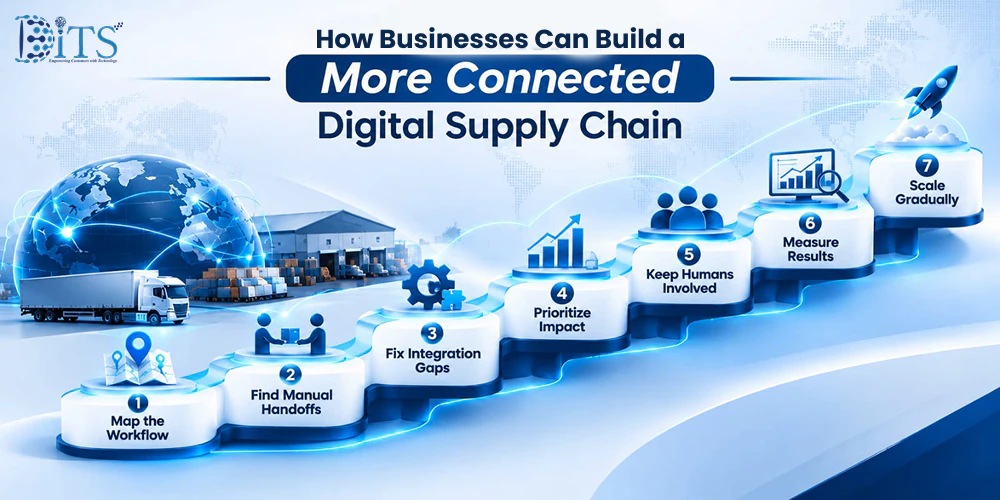
How Businesses Can Build a More Connected Digital Supply Chain
A connected supply chain doesn’t arrive as one big project. It gets built a piece at a time, and the teams that do it well tend to follow the same order.
Map the Workflow
Trace one order from the day it’s placed to the day it lands at the customer’s door. Who touched it? Which systems did it pass through? Where did someone have to stop and ask a question? The map you draw is usually different from the process everyone thinks they have.
Find Manual Handoffs
Look for the spreadsheet that gets updated every morning. The order typed into two systems. The approval stuck in someone’s inbox. These small things add up to a lot of lost hours, and they’re where mistakes sneak in.
Fix Integration Gaps
If two systems swap data every single day, connect them first. It isn’t glamorous work. It often pays back faster than anything else on the list. And AI tools only work as well as the data feeding them, so if that data still moves by hand, fix that before anything advanced.
Prioritize Impact
Pick the area where a change would be noticed: faster fulfilment, accurate stock counts, clearer shipment tracking, quicker handling of exceptions. A modest win there is worth more than a large project nobody feels.
Keep Humans Involved
Some decisions still need a person, especially those involving a key customer relationship, a judgment call, or an outcome someone must be accountable for. Decide which ones those are before you automate anything, not after something goes wrong.
Measure Results
Take the numbers before you start: order cycle time, how long exceptions take to resolve, inventory accuracy, and hours of manual work per order. Without that baseline, you can’t say whether anything improved.
Scale Gradually
Don’t expand a process that’s still shaky, because you’ll only make the problem bigger. Let the first changes settle, fix what the numbers expose, then move to the next area.
Done this way, automation stays tied to how the operation really runs, not to what a plan on paper says it should.
How DITS Supports Connected Supply Chain Operations
For businesses trying to improve supply chain visibility, the challenge is often not a lack of software. It is that existing systems, workflows, and data do not work together well enough.
DITS approaches supply chain modernization from that point of view. The work can begin with a business and technology assessment to understand current workflows, operational bottlenecks, system limitations, and integration gaps.
From there, the solution may involve connecting existing ERP, WMS, TMS, inventory, and order management systems rather than replacing everything.
In other cases, businesses may need custom platforms or applications to support processes that standard software does not handle well.
AI can also support forecasting, exception identification, operational analysis, and decision-making. However, its effectiveness depends on the reliability of the underlying data and workflows.
DITS also supports business and workflow automation, system integration, product engineering, and scalable architecture for businesses that need their supply chain systems to grow with operations.
The goal is not automation for its own sake. It is to make operations easier to see, easier to coordinate, and easier to control.
Conclusion
Supply chain automation is often discussed as a technology initiative. In practice, it is an operations initiative. The businesses that get the most value from it usually start by fixing how information moves between teams and systems.
They look at where delays begin. They identify where people are doing repetitive coordination work. They understand which exceptions matter and who needs to act on them and then they automate things. Because a connected supply chain is not created by adding more tools. It is created by making existing processes, systems, and decisions work together more effectively.
When that happens, visibility improves naturally and with better visibility comes something even more important: better operational control.
Build a More Intelligent Supply Chain
From system integration to AI-driven workflow automation, DITS helps businesses modernize supply chain operations and improve decision-making at scale.
It means taking repetitive work that people usually handle manually and connecting it through systems and workflows. That could be updating inventory, passing an order to the warehouse, tracking a shipment, or alerting a team when something goes wrong.
Dinesh Thakur
25+ years of IT software development experience in different domains like Business Automation, Healthcare, Retail, Workflow automation, Transportation and logistics, Compliance, Risk Mitigation, POS, etc. Hands-on experience in dealing with overseas clients and providing them with an apt solution to their business needs.