With more than 20 years of experience - I represent a team of professionals that specializes in the healthcare and business and workflow automation domains. The team consists of experienced full-stack developers supported by senior system analysts who have developed multiple bespoke applications for Healthcare, Business Automation, Retail, IOT, Ed-tech domains for startups and Enterprise Level clients
Key Takeaways
AI in women’s healthcare can make maternal care more proactive by supporting earlier risk detection, continuous monitoring, and faster escalation.
High-value use cases extend beyond prediction to include remote monitoring, patient triage, document processing, and care coordination.
A strong technology foundation with EHR integration, interoperability, secure data flow, and scalable infrastructure is essential for successful adoption.
AI can reduce operational burden by helping care teams prioritize critical cases, automate repetitive tasks, and improve workflow visibility.
Healthcare leaders should evaluate AI through measurable outcomes such as improved monitoring capacity, faster response times, reduced manual effort, scalability, and ROI.
What would happen if pregnancy and maternal care teams were able to detect new dangers sooner, have visibility between appointments, and react to changes in a patient's condition more quickly?
This is where AI in women's healthcare can bring real value. Through the analysis of medical information, supporting telemonitoring, finding worrisome patterns, and helping to prioritize care duties, AI is able to reinforce maternal and pregnancy monitoring. Its impact, however, depends on how well it integrates with existing systems, fits care workflows, and supports clinicians in making informed decisions.
Why Maternal and Pregnancy Care Monitoring Needs a Smarter Approach?
Maternal and pregnancy care requires timely visibility, especially when patient conditions can change between scheduled visits. Traditional monitoring models often leave care teams working with incomplete or delayed information, which can make it harder to recognize emerging risks and coordinate the right response.
A large 2026 study involving more than 442,760 pregnancies found that machine-learning models could identify risks such as gestational diabetes, gestational hypertension, and preeclampsia as early as the first trimester, demonstrating how AI can support earlier maternal risk monitoring and intervention.
A smarter monitoring approach helps close these gaps by giving care teams more continuous, connected, and actionable insight into patient health.
Limited Visibility Between Appointments
Periodic visits provide only a snapshot of a patient’s condition. More continuous monitoring can help care teams track important changes earlier and make follow-up more proactive.
High-risk Pregnancy Monitoring Challenges
Patients with elevated risk may require closer observation and faster escalation. Better monitoring can help clinicians focus attention where it is most needed without increasing unnecessary workload.
Disconnected Patient and Clinical Data
Information spread across EHRs, devices, forms, and patient communications can slow decision-making. Bringing these data sources together gives care teams a more complete view of the patient journey.
Delayed Identification of Concerning Trends
Subtle changes in blood pressure, glucose levels, symptoms, or other indicators may be difficult to detect when data is reviewed manually or inconsistently. Earlier visibility can support faster clinical assessment and intervention.
Care Coordination Gaps
Maternal care often involves multiple clinicians, coordinators, and support teams. Clearer data flow and task routing can reduce handoff delays, improve accountability, and help ensure important follow-ups are not missed.
Key Use Cases of AI in Maternal and Pregnancy Care
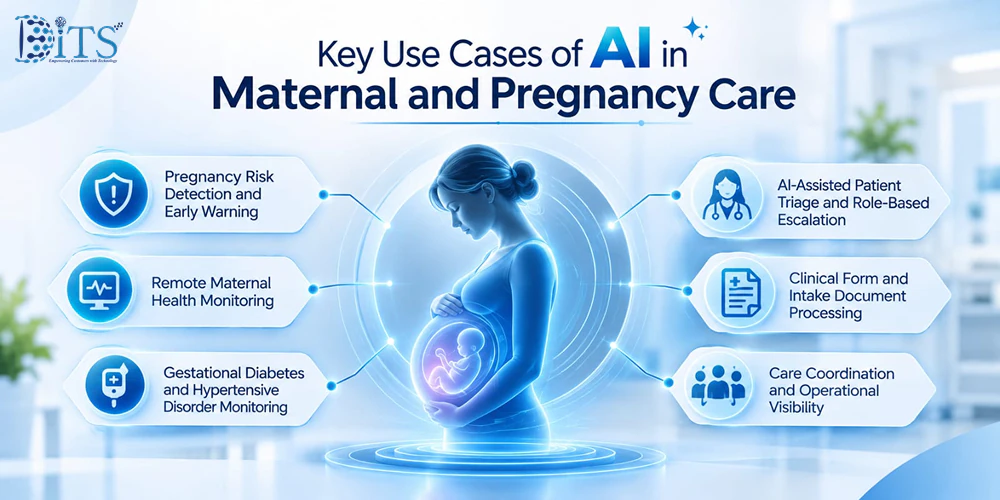
AI in maternal and pregnancy care creates the most value when it improves both patient monitoring and the operational workflows surrounding care delivery. The following use cases show where AI can support earlier intervention, reduce manual effort, and help care teams work with more complete and timely information.
Pregnancy Risk Detection and Early Warning
AI can analyze patient history, vitals, lab results, and ongoing monitoring data to identify patterns that may indicate elevated pregnancy risk. This helps care teams move beyond isolated readings and focus attention on patients who may need earlier review.
Flags Concerning Trends Across Multiple Data Points
Supports earlier clinical review and escalation
Helps prioritize higher-risk pregnancies
Reduces dependence on manual pattern recognition
Remote Maternal Health Monitoring
Remote patient monitoring gives care teams visibility into patient health between scheduled visits. AI can help interpret data from connected devices and patient-reported inputs so clinicians can focus on meaningful changes instead of reviewing every reading manually.
Connects data from blood pressure monitors, glucose devices, and wearables
Highlights abnormal or changing health indicators
Improves visibility between appointments
Supports more proactive follow-up
Gestational Diabetes and Hypertensive Disorder Monitoring
Gestational diabetes and pregnancy-related hypertension often require frequent monitoring and timely intervention. AI can help identify trends in glucose, blood pressure, symptoms, and related patient data that may otherwise be difficult to spot early.
Tracks changes across repeated readings
Helps surface patients who may need closer monitoring
Supports faster escalation when risk patterns emerge
Improves continuity across high-risk pregnancy workflows
AI-Assisted Patient Triage and Role-Based Escalation
Maternal care teams manage a mix of urgent symptoms, follow-up requests, operational queries, and routine patient communication. AI can categorize these requests by urgency and subject matter, then route them to the right person based on role and workflow rules.
Distinguishes urgent care concerns from routine requests
Routes cases to clinicians, coordinators, or administrative teams
Reduces handoff delays
Supports more consistent escalation workflows
Clinical Form and Intake Document Processing
Maternal care workflows often involve intake forms, referral documents, historical records, and uploaded PDFs containing critical patient information. AI-powered document intelligence can extract relevant details and convert them into structured patient data.
Extracts key information from forms and PDFs
Maps unstructured data into patient records
Reduces repetitive manual data entry
Makes important information easier for care teams to access
Care Coordination and Operational Visibility
Maternal care often involves multiple clinicians, specialists, coordinators, and support teams working across different systems. AI can help improve coordination by tracking follow-ups, surfacing delays, and giving leadership visibility into how care workflows are performing.
Tracks response times and pending care tasks
Identifies workflow and handoff bottlenecks
Improves accountability across care teams
Gives leadership better visibility into operational performance
Build Smarter Maternal Healthcare Solutions
Explore how AI, connected monitoring, and healthcare integration can help improve maternal care workflows and patient visibility.
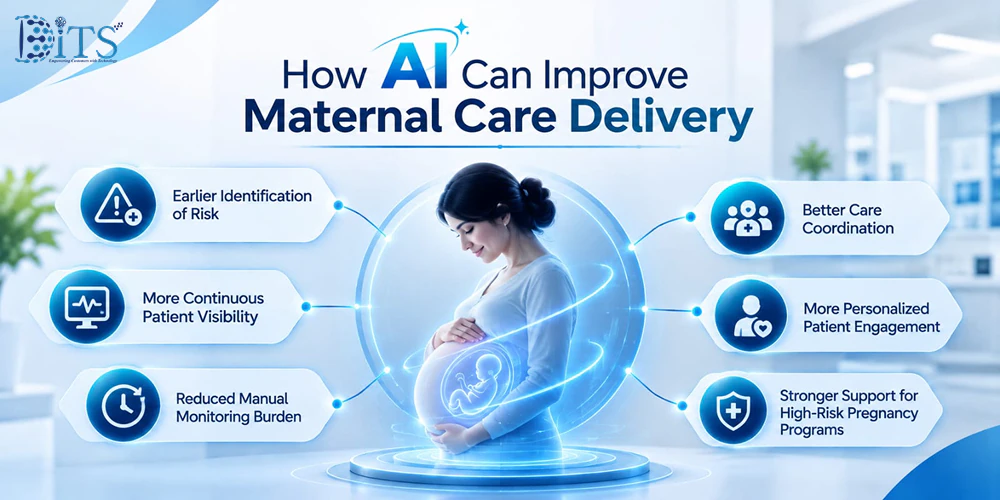
AI in women’s healthcare can improve maternal care delivery by helping healthcare organizations move from reactive monitoring toward more continuous, coordinated, and data-informed care. The value is not simply in generating more alerts or collecting more data, but in helping care teams identify what matters sooner and act with greater efficiency.
Earlier Identification of Risk
AI can analyze trends across vitals, symptoms, lab results, and historical data to help surface potential concerns earlier. This gives care teams more time to review changes, prioritize higher-risk patients, and determine whether intervention is needed.
More Continuous Patient Visibility
Remote monitoring and connected devices can provide health data between scheduled visits, helping care teams maintain a clearer view of patient status over time. This is especially valuable for patients who require closer observation throughout pregnancy.
Reduced Manual Monitoring Burden
AI can help filter large volumes of readings, documents, and patient inputs so clinicians do not have to review every data point manually. This allows care teams to spend more time on cases that require judgment, follow-up, or intervention.
Better Care Coordination
AI-assisted routing, escalation, and task prioritization can help ensure that patient concerns reach the right clinician or care coordinator faster. Better coordination reduces delays, improves accountability, and supports smoother handoffs across maternal care teams.
More Personalized Patient Engagement
AI can support more relevant reminders, education, follow-ups, and monitoring based on pregnancy stage, risk factors, and patient history. This can make digital engagement more useful instead of relying on the same communication for every patient.
Stronger Support for High-Risk Pregnancy Programs
High-risk programs require closer monitoring, timely escalation, and better use of clinical resources. AI in healthcare categorizes patients, highlight emerging concerns, and support more focused care management without adding unnecessary workload.
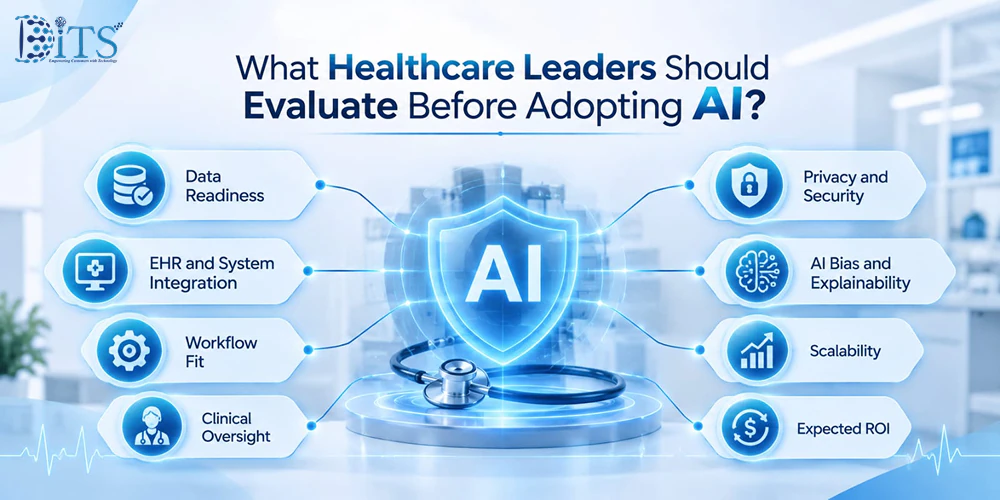
What Healthcare Leaders Should Evaluate Before Adopting AI?
Adopting AI in women’s healthcare should begin with a clear assessment of whether the organization has the right data, systems, workflows, and governance in place to support it. The goal is not to add AI for its own sake, but to determine where it can improve maternal care delivery without creating new operational, clinical, or compliance risks.
Data Readiness
AI is only as reliable as the data it receives. Healthcare leaders should evaluate whether maternal health data is complete, accurate, consistently structured, and accessible across clinical and operational systems.
Assess data quality, completeness, and consistency
Identify gaps across EHRs, devices, intake forms, and patient-reported data
Determine whether historical data is sufficient for meaningful AI use
Improve data governance before scaling AI initiatives
EHR and System Integration
AI in healthcare must work within the existing technology environment rather than operate as a disconnected layer. Integration with EHRs, remote monitoring platforms, laboratory systems, and patient applications is essential for reliable data flow and practical adoption.
Evaluate interoperability across current systems
Review API, HL7, and FHIR readiness
Identify integration gaps that could delay implementation
Reduce duplicate workflows and fragmented patient information
Workflow Fit
An AI solution should make maternal care workflows more efficient, not more complex. Leaders should assess where AI can remove friction, reduce manual effort, or improve escalation without disrupting how clinicians already work.
Map current maternal care workflows
Identify high-friction or repetitive activities
Determine where AI can support rather than interrupt decision-making
Validate workflow changes with clinical and operational teams
Clinical Oversight
AI should support clinical judgment, not replace it. Clear oversight is especially important in maternal care, where risk assessment and escalation decisions can have significant consequences.
Define where human review is required
Establish escalation and validation rules
Clarify accountability for AI-supported decisions
Monitor how AI recommendations are used in practice
Privacy and Security
Maternal health data is highly sensitive, making privacy and security central to any AI initiative. Healthcare organizations should evaluate how data is collected, processed, stored, and shared across the AI ecosystem.
Review access controls and role permissions
Assess data encryption and storage practices
Evaluate third-party AI and cloud vendors
Align implementation with healthcare privacy and security requirements
AI Bias and Explainability
AI models can reflect gaps or imbalances in the data used to build them. In women’s healthcare, this makes bias, transparency, and explainability important considerations before deployment.
Evaluate whether training data represents the intended patient population
Test model performance across relevant demographic groups
Assess whether AI outputs can be understood by clinicians
Establish ongoing monitoring for model drift and bias
Scalability
A pilot may work well with a small patient population, but the underlying platform must be able to support larger volumes of data, devices, users, and care workflows as adoption grows.
Assess infrastructure and cloud capacity
Review system performance under higher data volumes
Plan for multi-location or multi-program expansion
Ensure integrations can scale without creating bottlenecks
Expected ROI
Healthcare leaders should define what success looks like before investing in AI in women’s healthcare. ROI should be measured against practical outcomes such as reduced manual work, faster response times, improved monitoring capacity, and more efficient use of clinical resources.
Establish clear baseline metrics before implementation
Measure operational savings and productivity gains
Track improvements in care coordination and response times
Compare implementation costs with long-term operational value
Building the Right Technology Foundation for AI-Enabled Maternal Care
AI in women’s healthcare delivers more value when it is supported by a connected, interoperable, and scalable technology environment. Healthcare leaders should evaluate these foundational capabilities before expanding AI-enabled maternal care.
Technology Foundation
Why It Matters
Business and Care Value
EHR Integration
Connects AI-enabled maternal care tools with existing patient records and workflows.
Reduces duplicate data entry, improves patient visibility, and supports more informed care decisions.
HL7 and FHIR Interoperability
Enables consistent data exchange across EHRs, labs, monitoring platforms, and other systems.
Reduces silos, improves interoperability, and creates a stronger foundation for future AI initiatives.
Wearable and Device Integration
Connects blood pressure monitors, glucose devices, wearables, and other remote monitoring tools.
Improves visibility between appointments and supports more continuous maternal monitoring.
Real-Time Data Flow
Moves patient data quickly across systems so care teams can act on current information.
Supports faster alerts, timely escalation, and better coordination across care teams.
Cloud and Platform Scalability
Helps platforms handle growing patient volumes, device data, integrations, and AI workloads.
Supports program expansion, improves reliability, and reduces the need for repeated reengineering.
Secure Patient-Facing Applications
Provides patients with a secure way to share data, communicate, and engage with care workflows.
Strengthens patient engagement while protecting sensitive health information.
Identify Where AI Can Improve Your Healthcare Operations
Assess your data, systems, and workflows to identify practical AI opportunities that improve care coordination and operational efficiency.
How DITS Helps Healthcare Organizations Make Better AI Decisions
DITS helps healthcare organizations assess where AI can create practical value across maternal and pregnancy care before committing implementation. This starts with reviewing existing care workflows, identifying monitoring and coordination gaps, evaluating data and infrastructure readiness, and determining which AI use cases are most likely to improve care delivery and operational efficiency.
From there, DITS helps organizations plan the right integration and modernization approach, whether that means connecting AI with EHRs, devices, and patient applications, improving legacy platforms, or building scalable maternal health and FemTech solutions. By combining consulting, interoperability, modernization, and product engineering expertise, DITS helps healthcare leaders reduce implementation risk and make clearer decisions about what to build, integrate, modernize, or scale next.
View our work that brings AI, remote monitoring, and connected care together to support smarter maternal health decisions and more responsive patient care.
Frequently asked questions
AI can add value in risk detection, remote monitoring, care coordination, triage, and workflow automation. The strongest opportunities are those tied to clear clinical or operational gaps and measurable outcomes.
Nidhi Thakur
With more than 20 years of experience - I represent a team of professionals that specializes in the healthcare and business and workflow automation domains. The team consists of experienced full-stack developers supported by senior system analysts who have developed multiple bespoke applications for Healthcare, Business Automation, Retail, IOT, Ed-tech domains for startups and Enterprise Level clients