25+ years of IT software development experience in different domains like Business Automation, Healthcare, Retail, Workflow automation, Transportation and logistics, Compliance, Risk Mitigation, POS, etc. Hands-on experience in dealing with overseas clients and providing them with an apt solution to their business needs.
Key Takeaways
AI agents move beyond task automation and operate with clear business goals in mind
It observes data, decides next steps, and acts without waiting for constant human input
Enterprises use them to reduce delays, improve consistency, and scale operations faster
The real value shows up when agents are tied directly to revenue, cost control, or service quality
Successful adoption depends on governance, system integration, and clarity of intent
Introduction
Almost every business that exists today is using AI in one or another way. Most organizations use it for automation and efficiency. However, AI is no longer limited to dashboards, reports, or isolated automations. Business leaders today are looking at systems that can think through tasks, make decisions, and act with minimal supervision. That is what AI agents can exactly do for them.
When business executives ask what is ai agent and how it works, they are usually trying to understand weather this technology reduce dependency on manual effort while improving operational speed and accuracy?
An AI agent is designed to work toward a goal, not just respond to commands. It observes data, evaluates options, and acts within defined boundaries. This blog breaks down the concept in plain business terms, focusing on how AI agents function inside real workflows, where they create value, and what leaders should expect before investing.
Business Context Behind Rise of AI Agents
For years, companies have been investing in automation to save time. Scripts were written, rules were set, workflows ran faster, but they still broke the moment conditions changed. That limitation created frustration as growth demanded flexibility, not just speed.
This is where AI agents become important and essential for businesses looking for automation, intelligence and speed. Instead of following fixed instructions, they respond to shifting conditions. A pricing model adjusts when demand spikes. A support system escalates an issue before a customer complains. A supply alert triggers action before inventory runs dry. These are not theoretical wins.
AI agents are not just automation tools, but systems you delegate outcomes to. And that changes how work gets done.
Turn automation into outcome ownership!
Discover how AI agents can reduce delays, improve consistency, and unlock scalable growth.
What Is AI Agent And How It Works In Practical Terms
At a business level, an AI agent is a digital system designed to achieve a defined objective with limited supervision. It does not wait for step-by-step instructions. Instead, it evaluates the situation, chooses an action, and executes it within set boundaries.
Take an example of a finance team struggling with delayed monthly closes. An AI agent in this environment monitors incoming data, flags inconsistencies, follows up automatically, and escalates only when human judgment is needed. The outcome is not just faster reporting, but fewer surprises at board meetings.
So, when leaders explore what is ai agent and how it works, the key difference lies in intent. Traditional software reacts while an AI agent acts. It aligns decisions with business goals, not just user prompts. That shift alone explains why adoption is accelerating across operations, sales, and IT functions.
Key Building Blocks Behind AI Agents
An AI agent may look simple from the outside, but its effectiveness depends on how well its internal components work together.
Perception and Data Intake
Every action starts with observation. AI agents continuously pull data from systems such as CRMs, ERPs, ticketing tools, or analytics platforms. If the data is outdated or inconsistent, decisions suffer. That is why organizations investing in AI Agent development often prioritize data hygiene before anything else.
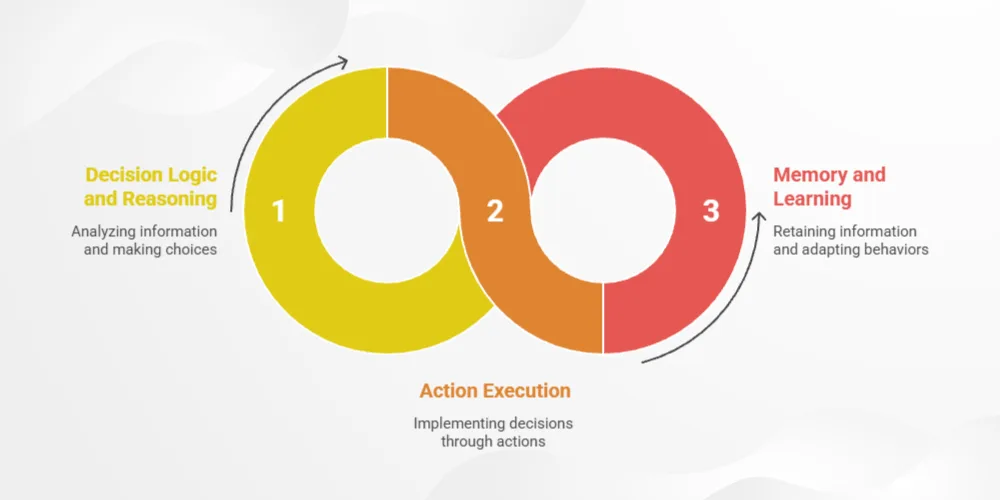
Decision Logic and Reasoning
This layer is where business rules meet intelligence. The agent weighs multiple signals, compares them with historical outcomes, and decides what deserves attention now. For example, it might deprioritize a low-risk anomaly while escalating a high-impact issue within minutes. This ability to judge context separates AI agents from traditional automation.
Action Execution
Once a decision is made, the agent acts. It may update records, trigger workflows, notify teams, or initiate corrective steps across connected systems. No hand-holding required. This is where speed turns into real business value.
Memory And Learning
AI agents do not start from zero every day. They retain context and learn from results. Over weeks, small refinements lead to noticeably better performance. That learning curve is often what drives long-term ROI.
How AI Agent Works Step by Step in Business Workflows
Understanding execution flow helps leadership teams evaluate both risk and readiness. AI agents typically follow a structured cycle that repeats continuously.
Goal Definition
Everything begins with a clear outcome. Reduce response time. Improve forecast accuracy. Lower operational cost.
Environment Analysis
The agent reviews live data and system signals to understand current conditions.
Planning And Task Breakdown
Large objectives are split into smaller, achievable actions. This keeps execution controlled and auditable.
Execution And Monitoring
Actions are performed while performance is tracked in real time. Deviations are flagged early.
Feedback And Optimization
Results feed back into the system, allowing the agent to adjust future decisions.
This loop is why leaders exploring what is ai agent and how it works often see faster stabilization compared to rule-based systems.
Not sure where to start with AI agents?
We help leadership teams evaluate readiness, risk, and ROI before writing a single line of code.
Different business problems require different agent designs. Choosing the wrong type often leads to disappointment, not because the technology failed, but because expectations were misaligned.
Reactive Agents
Designed for immediate response scenarios. Common in monitoring, alerts, and basic incident handling.
Deliberative Agents
These agents plan ahead and evaluate multiple paths before acting. Operations and resource planning teams rely on them for balanced decisions.
Learning Agents
They improve with experience. Sales prioritization and customer engagement teams often benefit most here.
Multi-Agent Systems
Multiple agents collaborate across functions. Large enterprises use this approach to manage complex, interconnected workflows.
Real Business Use Cases That Actually Deliver Value
AI agents create the most impact when they are deployed in areas where delays, inconsistency, or overload directly affect revenue, cost, or customer trust. Here are some use cases where organizations got tangible results.
Customer Support Prioritization and Escalation
AI agents monitor incoming tickets, sentiment, and historical resolution data to prioritize issues in real time. Critical cases are escalated before service levels drop, while routine requests are handled automatically. This reduces response time and prevents customer churn without increasing support headcount.
Sales Pipeline Qualification and Follow-Ups
Instead of relying on manual scoring, AI agents evaluate leads based on behavior, deal velocity, and past conversions. High-potential opportunities receive immediate attention, while low-intent leads are nurtured automatically. Many sales teams report shorter sales cycles and more predictable forecasts within weeks.
IT Incident Detection and Resolution
AI agents continuously scan logs, performance metrics, and alerts to identify anomalies early. In many cases, corrective actions are triggered automatically before users even notice an issue. The result is reduced downtime, fewer escalations, and lower pressure on IT teams.
Operations And Demand Planning
AI agents analyze demand patterns, supplier performance, and operational constraints to recommend adjustments in near real time. This helps businesses avoid stockouts, reduce excess inventory, and maintain smoother production schedules. Nobody likes costly surprises, especially when they disrupt delivery commitments.
Compliance Monitoring and Risk Alerts
In regulated environments, AI agents track transactions, process deviations, and audit signals continuously. Potential risks are flagged early, giving teams time to act before small issues turn into compliance failures or penalties.
Each of these use cases works because the agent is tied to a clear business outcome. That focus is what turns adoption into measurable value.
AI Agents Vs. AI Assistants
This comparison often comes up in boardroom discussions, and the difference matters more than it seems.
Dimension
AI Assistant
AI Agent
Trigger
User request
Business goal
Autonomy
Limited
High
Scope
Task support
Outcome ownership
Impact
Incremental
Structural
AI Assistants help employees work faster. AI Agents help organizations work smarter.
Which business decision are you ready to delegate to an AI agent?
Let’s explore where intelligent execution can create measurable impact in your organization.
Strategic Benefits of AI Agent for Decision Makers
Beyond efficiency, AI agents change how responsibility is distributed across teams. Decisions become less dependent on individual availability. Processes run with greater consistency. Risks surface earlier.
Nobody enjoys last-minute escalations, especially when clients or regulators are involved. AI agents reduce that pressure by acting before issues spiral.
At DITS, AI is embedded across software development, quality assurance, code quality management, and customization. Every solution integrates intelligence from the ground up, ensuring AI-driven systems operate within stable and secure foundations.
Key Challenges Leaders Should Plan For
Despite the upside, adoption requires realism.
Data quality gaps can slow progress
Governance and accountability must be defined early
Legacy systems demand thoughtful integration
Human oversight remains essential for high-stakes decisions
Organizations that address these upfront moves faster with fewer setbacks.
Getting Started with AI Agents
Most companies begin with a focused pilot tied to a single metric. Some partner with an AI software development company to accelerate execution, while others start small through MVP development to validate assumptions.
Whether it is AI chatbot development or more advanced agent-based workflows, success depends on clarity. Not complexity.
Before moving forward, leadership should answer one question honestly. Which decision are we ready to delegate?
Why Choose DITS For AI Agent Development?
Choosing the right partner for AI Agent development is less about tools and more about execution discipline. Many implementations fail because the system was built without enough understanding of real business constraints.
DITS approaches AI agents as part of a broader software ecosystem, not as isolated components. AI is embedded across software development, quality assurance, code quality maintenance, and customization efforts. This ensures that every agent operates on stable, well-architected foundations rather than experimental layers added later.
What differentiates DITS is the focus on outcome ownership. Each agent is designed around a specific business objective, whether it is reducing response times, improving operational visibility, or enabling faster decisions.
For leadership teams, this translates into predictable delivery, lower adoption risk, and faster time to value. AI agents built by DITS are designed to integrate seamlessly with existing systems while remaining flexible enough to evolve as business needs change.
Conclusion
AI agents represent a clear shift in how modern businesses operate. They are systems designed to take ownership of outcomes, reduce operational drag, and bring consistency to decision-making at scale.
For leadership teams, the real question is where it fits first. Organizations that start with focused, high-impact use cases tend to see faster adoption and stronger internal alignment. Those results often unlock broader transformation across departments.
Understanding what is ai agent and how it works gives executives a practical lens to evaluate readiness, risk, and return. When deployed with clear intent, strong data foundations, and defined governance, AI agents move from concept to competitive advantage faster than most expect.
The opportunity is enabling teams to operate with clarity, speed, and confidence in an increasingly complex business environment.
Frequently asked questions
Traditional automation follows predefined rules and breaks when conditions change. An AI agent evaluates context, adapts to new inputs, and acts based on outcomes rather than static instructions. For businesses, this means fewer manual interventions and better performance in dynamic environments.
Dinesh Thakur
25+ years of IT software development experience in different domains like Business Automation, Healthcare, Retail, Workflow automation, Transportation and logistics, Compliance, Risk Mitigation, POS, etc. Hands-on experience in dealing with overseas clients and providing them with an apt solution to their business needs.