25+ years of IT software development experience in different domains like Business Automation, Healthcare, Retail, Workflow automation, Transportation and logistics, Compliance, Risk Mitigation, POS, etc. Hands-on experience in dealing with overseas clients and providing them with an apt solution to their business needs.
Many businesses in the fast-paced digital era continue to rely on legacy software and systems. These are outdated pieces of infrastructure that may have once served them well, but are now unable to keep up with business demands.
Legacy systems are often written using outdated programming languages, are inflexible in their architecture, and are challenging to deploy and maintain. They may perform core business functions, but they are expensive to maintain, difficult to scale, and lack integration with modern technologies.
While the old system could be rewritten or replaced, it is often a risky, costly, and time-consuming process. Docker enables organizations to leverage the potential of their legacy systems and upgrade without having to start from scratch or entirely replace the old system.
In this blog, we will explore some docker use cases that are already being used to change legacy systems across various industries and move old systems towards modern, flexible, and future-proof infrastructures.
The Challenges Legacy Systems Pose
Legacy systems typically employ a monolithic architecture, where all components are tightly coupled and must be upgraded/deployed together. As a result, even the slightest change can be costly and time-consuming. They are also very expensive to run and maintain, not scalable, and lack a defined transition to the cloud, from planning to deployment.
Legacy systems are challenging to integrate with and connect to modern tools and cloud services. Furthermore, businesses that continue to operate legacy systems are less capable of innovating quickly, incur higher operating costs, find it more challenging to adapt to change, and are hindered in their ability to compete in the digital world.
Modernize Legacy Architectures for Agility, Cost Efficiency, and Cloud Readiness!
Transition away from rigid, monolithic systems with DITS’s Docker-based modernization approach, designed to enhance scalability, reduce costs, and enable faster innovation.
Docker plays a crucial role in modernizing legacy systems through a container-based approach to software deployment. Docker provides a lightweight and portable means of packaging applications and their dependencies as containers that can run consistently across various environments. Once the legacy application is running in a Docker image with Docker Engine, it can be isolated from the underlying system, making it more manageable and scalable.
Docker offers several key benefits:
Isolation & Portability: Apps run the same way, anywhere, on-premise or in the cloud.
Faster Development & Deployment: Speeds up releases with consistent environments.
Resource Efficiency: Uses less overhead than traditional virtual machines.
Simplified Testing & Rollback: Easy to test changes and revert to stable versions quickly.
Together, these advantages make Docker a powerful tool for revitalizing aging software.
Docker Use Cases
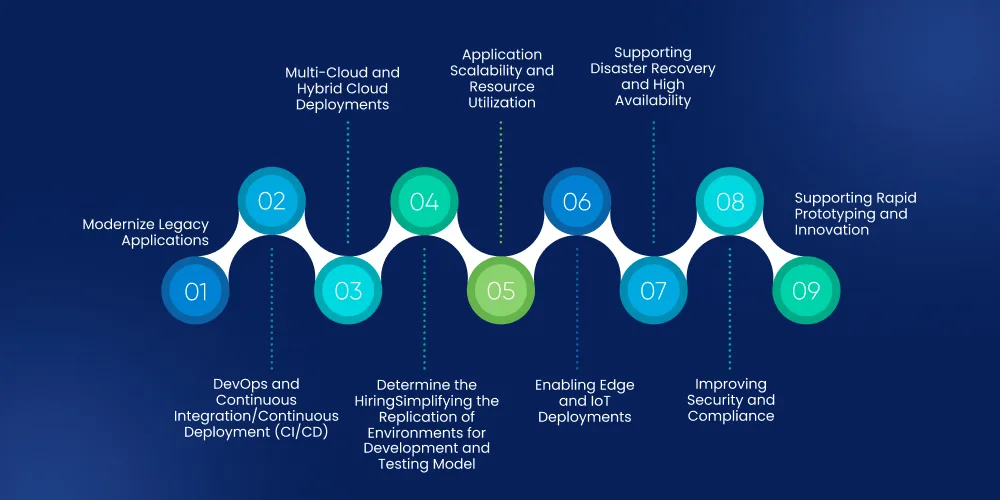
Here are some Docker use cases that highlight the role and importance of Docker in legacy modernization and various other scenarios.
1. Modernize Legacy Applications
Many enterprises still use legacy software that is often troublesome to update and difficult to scale. Docker can be used to update and modernize legacy software by allowing enterprises to containerize software instead of requiring a full rewrite of legacy code. Legacy applications become encapsulated in containers and are run in next-generation environments, thus offering better portability and the benefit of lifting and shifting deployments.
Benefits:
Lowered infrastructure costs
Highest Deployment Speed
More compatible across environments
Example: A financial firm contemplates the intention to migrate its mainframe batch applications, that run on a legacy system, to a modern cloud native stack by leveraging containers with the goal of lowering maintenance cost and downtime.
2. DevOps and Continuous Integration/Continuous Deployment (CI/CD)
Docker has become essential to many of the more modern DevOps practices. Docker works by providing isolated containers for developers, and this allows for consistent environments across development, testing, and production. As such, with Docker, enterprise organizations can create repeatable CI/CD pipelines, automate deployments, and roll back changes when necessary.
Benefits:
Consistent environments
Faster release cycles
Fewer deployment errors
Example: A SaaS provider leverages Docker in its Jenkins CI/CD pipeline to build and deploy code to isolated environments, reducing release times from days to hours.
3. Multi-Cloud and Hybrid Cloud Deployments
Enterprise organizations are increasingly adopting multi-cloud strategies to guard against vendor lock-in and to ensure redundancy. Docker provides a consistent environment in which to run workloads in AWS, Azure, Google Cloud, and on-premises, thus enabling workload portability across cloud platforms.
Benefits:
Vendor-agnostic deployments
Improved disaster recovery options
Improved cost-performance tradeoffs
Example: A logistics company runs its front-end services in AWS and its back-end analytics in Google Cloud using Docker containers, ensuring an overall consistent deployment experience.
4. Simplifying the Replication of Environments for Development and Testing
Replicating a production environment for development or testing is difficult. However, Docker has removed much of this complexity by allowing teams to replicate their production environments locally. This means developers across a team can build, test and debug in an identical environment so that there will be fewer bugs when code gets to production. They also collaborate better when testing to the same environment.
Benefits:
Fewer 'it works on my machine' problems
Faster developer onboarding
Reliable and reproducible test environments
Example: A media company can use Docker Compose to replicate the production environment to a developer's machine to accurately test its streaming services.
5. Application Scalability and Resource Utilization
Docker containers are very efficient. The containers share the host OS kernel, meaning the footprint is smaller than a virtual machine. This means that companies can benefit by running many applications from the same hardware and easily scale them out horizontally. This can be a tremendous boon to organizations, especially during peak traffic times or special events.
Benefits:
Better resource utilization
Ability to scale applications with minimal overhead
Reduced infrastructure footprint
Example: A travel booking site automatically scales its deployment of Docker containers across its cloud infrastructure to handle additional traffic during busy seasons.
6. Enabling Edge and IoT Deployments
Docker's lightweight containers can run on minimal resources while fulfilling the same requirements in various environments, which is beneficial to enterprises deploying an app at the edge or in an IoT ecosystem.
Benefits:
Lightweight containers benefit edge devices
Centralized management for distribution
Reliability under remote conditions
Example: A manufacturing company deploys Docker to run monitoring applications on IoT devices in a variety of factories to achieve real-time analytics for the edge.
7. Supporting Disaster Recovery and High Availability
Docker can speed up disaster recovery when a service fails. If a service goes down, Docker can quickly restore the containers from images and/or stored images and/or volumes, thus releasing little or no downtime or data loss.
Benefits:
Downtime is shorter
Service availability is better
Strategies to backup data services are simplified
Example: A healthcare provider backs up Docker images and volumes in a second cloud region and can qualify its disaster recovery as HIPAA compliant.
8. Improving Security and Compliance
Docker can improve application security if the application is properly configured and container orchestration is used. With Docker, services can run in isolation, which reduces the impact of the vulnerability. The enterprise can enforce compliance using security scans of images of its container, which in turn provides access control.
Benefits:
Better control and isolation
Security policies can be more easily implemented
More easily audited
Example: A fintech startup uses Docker and Kubernetes.
9. Supporting Rapid Prototyping and Innovation
Docker enhances innovation by reducing the time required to prototype and test a new idea. Organizations can rapidly prototype proof-of-concepts, gather user feedback, and iterate the concepts without impacting existing systems.
Benefits:
Fast to market
Agile experimentation with minimal risk
Reduced cost of innovation
For Example: A telecom provider was able within days to spin up a beta customer-facing app with a Docker approach for rapid feedback and testing.
Give Your Legacy Stack a Fresh Docker-Powered Start!
Rebuild performance, reliability, and adaptability into your legacy apps with our proven modernization approach using Docker.
Choosing Ditstek Innovation (DITS) for legacy modernization with Docker enables businesses to achieve a strategic, scalable, and cost-effective transformation of outdated systems. Ditstek specializes in transforming monolithic applications into lightweight, portable Docker containers. This simplifies deployment, improves performance, and enables continuous integration and delivery pipelines.
Our approach is tailored, whether it's lift-and-shift, refactoring, or rearchitecting, using Docker to containerize applications without disrupting business operations. Our team ensures Dockerized applications are integrated with modern CI/CD workflows and DevOps practices, enhancing agility, reducing deployment time, and improving reliability.
We help make legacy systems cloud-native. Docker containers created by Ditstek can run seamlessly on AWS, Azure, or Google Cloud, ensuring businesses are not locked into legacy infrastructure. By containerizing legacy systems, we reduce infrastructure overhead, minimize licensing costs, and optimize resource usage, leading to better ROI and performance.
Our successful delivery of legacy modernization projects for various industries demonstrates our capability to drive transformation while minimizing risks and downtime.
Conclusion
Docker is a valuable asset for organizations seeking to remain competitive in the digital era, and that is proven in the above-mentioned Docker use cases. Docker is not just a tool for containers. Whether you want to legacy applications modernization, adopt microservices, move toward a multi-cloud approach, or enhance the DevOps lifecycle, Docker provides organizations with the flexibility, consistency, and scale that make sense for enterprise IT. As organizations see its value, it makes sense to partner with a Docker service provider that has experience in delivering a successful product and long-term value.
Ready to disrupt your enterprise IT with Docker? Let's discuss how our Docker development and consulting services can help you modernize your infrastructure and accelerate innovation.
Frequently asked questions
Docker is a containerization platform that packages applications and their dependencies into lightweight, portable containers. Unlike virtual machines, Docker doesn’t require a full operating system per instance, making it more efficient in terms of resource usage, speed, and scalability.
Dinesh Thakur
25+ years of IT software development experience in different domains like Business Automation, Healthcare, Retail, Workflow automation, Transportation and logistics, Compliance, Risk Mitigation, POS, etc. Hands-on experience in dealing with overseas clients and providing them with an apt solution to their business needs.