25+ years of IT software development experience in different domains like Business Automation, Healthcare, Retail, Workflow automation, Transportation and logistics, Compliance, Risk Mitigation, POS, etc. Hands-on experience in dealing with overseas clients and providing them with an apt solution to their business needs.
Key Takeaways
AI business process automation reduces the time required to solve shipment errors through enhanced detection, prioritization, decision-making, and communication.
Slow exception resolution does not only mean technology issues but also workflow issues. The industry might face significant delays due to disconnected systems, manual inspection, unclear responsibilities, and various transfers.
AI needs to be applied only in cases where it brings significant value. Routine tasks may require standard automation; however, AI technologies excel at prediction, interpretation, prioritization, and contextual decision-making.
Agentic AI supports complicated error resolution processes by gathering necessary information, coordinating agreed actions, checking the results of the actions taken, and escalating unresolved issues
Small businesses can begin using automation for solving small issue cases such as the use of following up carriers, monitoring shipments, notifying customers and classifying exceptions.
Why does it take so long to resolve shipment exceptions, even with TMS and tracking systems?
In many cases, delays occur because of disconnected systems, manual checks, and numerous handoffs that must be completed before anything can be done. AI business process automation can make your detection, prioritization, decision-making, and communication much faster than they are now.
AI solutions for business process automation help in certain situations, like simplifying workflows, enhancing integrations, or better using the current capabilities of TMS would yield better results.
Why Do Shipment Exceptions Take Too Long to Resolve?
An initial delay in shipments usually doesn't stay alone. It may be caused by a late pick-up or route diversion, but its resolution will often demand to dig out information from different systems, check what happened, determine priority, and make decisions on further actions.
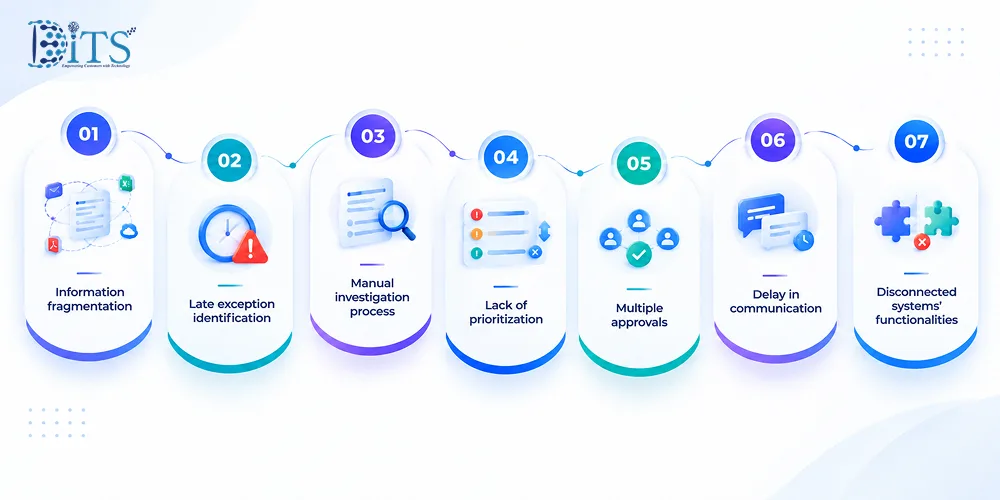
Reasons for such delays include:
Information fragmentation: Shipments' statuses, inventories, carriers, and customers' data might be distributed across TMS, ERP, WMS, telematics systems, carrier portal, and communication platforms.
Late exception identification: The team could recognize the problem when delivery deadlines or service level agreements are already at stake.
Manual investigation process: Operations personnel would have to investigate status update notifications, e-mails, shipment records, and carriers' responses before doing anything about the problem.
Lack of prioritization: Absence of a proper risk-based prioritization mechanism would allow important exceptions to compete with less critical ones.
Multiple approvals: Approval of the actions from dispatch, warehouse, carriers, and customer service departments might delay the resolution.
Delay in communication: Late notifications from carriers, customers, and internal teams could make exception resolution even more difficult.
Disconnected systems' functionalities: Properly configured automation and alerting solutions might be present but are not adequately integrated within the workflow.
Is Your Shipment Exception Workflow Slowing You Down?
Identify process bottlenecks, manual dependencies, and automation opportunities across your shipment operations.
Why Shipment Exception Workflows Struggle to Resolve Issues Faster
The shipment exception workflow fails to proceed at a proper speed when main operation relies on manual action, separated systems, and ambiguous responsibility. To use business process automation AI, businesses must pinpoint exactly where the slowdown occurs.
Slow detection hinders a rapid resolution process
Manual collection of information makes investigation process much slow
Repetitive process checks take up a lot of operational time
Not proper prioritization slows the resolution of important shipment exceptions
Vague accountability raises doubts on timely response
Delay of approvals puts some time-critical corrective actions on hold
Poor communication creates delays in case of coordination
Lack of consistency in escalation cause avoidable delays and confusion
AI for business process automation implementation begins with fixing above-mentioned gaps in workflow. Some of them might need a better system integration or set up of the platform, while others can simply be automated or fulfilled with AI technologies. The key is to fix the process before introducing any more equipment.
How AI-Based Business Process Automation Accelerates Exception Resolution
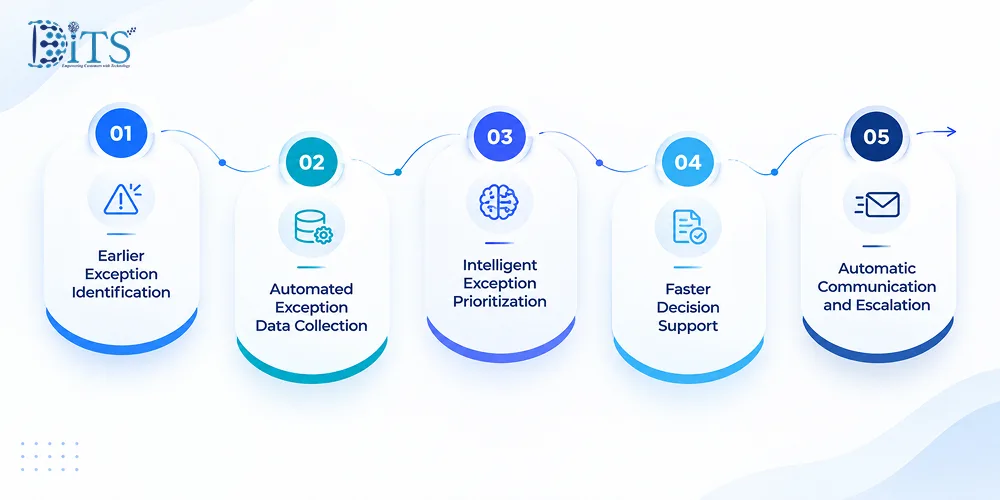
The following ways in which AI-based business process automation may expedite exception resolution include the reduction in manual effort in identifying, understanding, ranking, and responding to exceptions.
Earlier Exception Identification
Keeps real-time monitoring of shipments and business operations.
Identifies possible shipment delays ahead of time.
Gives teams enough time to take necessary action.
Automated Exception Data Collection
Collects shipment data from other systems.
Saves time searching for exceptions across TMS and carrier systems.
Provides teams with complete exception context quickly.
Intelligent Exception Prioritization
Prioritizes exceptions according to their level of urgency and business importance.
Includes SLA risk, customer priority, and freight value.
Facilitates the addressing of important issues first.
Faster Decision Support
Analyzes existing information and the context of the exception swiftly.
Proposes suitable actions depending on current conditions.
Accelerates decisions without sacrificing human intervention, when necessary.
Automatic Communication and Escalation
Ensures that carrier follow-ups and customer notifications are done automatically.
Routes important exceptions to responsible teams.
Eliminates delays caused by human communication and routing.
Ready to Reduce Shipment Exception Resolution Time?
Explore where automation and AI can improve exception detection, prioritization, communication, and escalation.
Impact of AI on Business Process Automation in Exception Management
AI's influence on business process automation extends beyond task automation. It transforms risk identification in shipment exception management, making it easier for teams to analyze facts, organize issues, and take action during resolution.
Transforming reactive monitoring into proactive risk detection: By examining all available data and notifications, AI can identify potential delays long before the service failure occurs.
All necessary data concerning shipments, carriers, routes, SLAs, and customers can be compared to simplify and accelerate the information-gathering process.
AI prioritizes exceptions based on urgency, operational impact, customer importance, and possible disruptions.
The system provides context-based recommendations on rerouting, escalation, rescheduling, and communication with stakeholders.
Automation makes it possible to connect alerts, approvals, communications, and follow-up actions in TMS and other systems.
Such implementations minimize detection-to-action and overall resolution times, limit human input, speed up approvals and escalations, ensure smart decision-making, enhance carrier and customer responsiveness, and improve clarity of exceptions' status and responsible parties.
The true value of AI-driven business process automation lies not in becoming more automated, but in eliminating operational friction that stops teams from resolving critical exceptions effectively.
Business Process Automation With Agentic AI for Complex Exceptions
Agentic AI's business process automation helps automate workflows with multiple decision points and systems involved in complex exceptions. In this case, agentic AI is used not only to process an isolated job but also to control the chain of jobs according to the resolution workflow.
Collect information from different systems: Obtain shipment, carrier, route, SLA, and customer information from TMS, ERP, WMS, telematics, and communication systems.
Analyze the context of the exception: Work with available data to understand the cause of the failure, its significance, and its consequences.
Coordinate the predetermined actions taken to resolve the problem: Execute approved procedures like rerouting requests, rescheduling, internal escalation, and customer notification.
Execute follow-ups with carriers: Make inquiries and keep the process on track without manual intervention.
Monitor corrective procedures: Determine if the action taken is making the matter better or further actions are required.
Escalate unresolved issues: Increase urgency on unresolved issuesx by routing complex or high-stakes exceptions to the right party once agreed-upon thresholds are met.
But then agentic AI is not necessary for all types of exceptions. In many cases, conventional automation delivers better outcomes, and human intervention is necessary for risky and contractual issues. The goal is to use the right amount of automation based on the process's complexity and risk level.
How Does AI Process Automation Help Small Businesses Manage Shipments?
For small businesses, the brokers, and logistics firms, AI process automation is best suited to specific, repetitive exception workflows rather than the entire business.
Workflow Area
How Automation Helps
Shipment status monitoring
Flags delays and delivery risks earlier
Follow-ups with carriers
Automates routine status queries
Exception classification
Categorizes common problems in shipments
Notifying customers
Sends out shipment status notifications
Routing of escalations
Routes serious problems to the appropriate people
Document processing
Pulls shipment data from emails and documents
Before adopting AI process automation, small businesses need to see how far they can go with their current TMS systems, integrations, and automation.
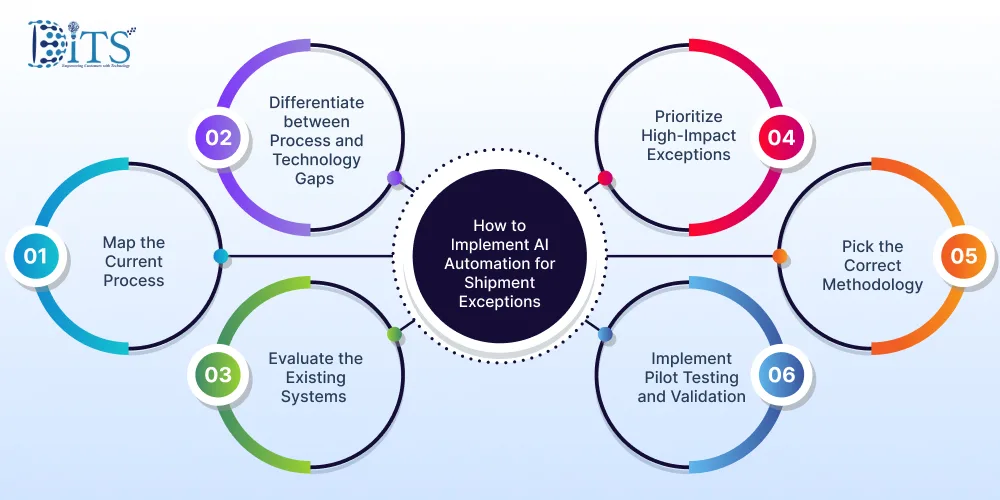
How to Implement AI Automation for Shipment Exceptions?
In a practical application, one must first recognize the bottlenecks in the process of shipment exception and the reasons behind the delay to figure out what would be the correct method to solve the problem.
Map the Current Process
Locate exceptions that cause slowness.
Find repetition and manual connections.
Clarify current ownership and escalation procedures.
Differentiate between Process and Technology Gaps
Identify whether bottlenecks are due to the process itself.
Identify gaps between systems or lack of data connectivity.
Do not attempt to solve process-related problems with technology.
Evaluate the Existing Systems
Determine the capabilities of your existing TMS, ERP, WMS, and telematics.
Identify available integration, API, and automation capabilities.
Find areas for improvement without replacing existing systems.
Prioritize High-Impact Exceptions
Identify repeatable exception cases.
Look at processes causing operational bottlenecks.
Prioritize the issues with customer or SLA impact.
Pick the Correct Methodology
Simplify the process where complexity causes delays.
Integrate systems where there is a data gap.
Leverage conventional automation where the process is known.
Use AI where there is an interpretation or decision-making need.
Implement Pilot Testing and Validation
Perform pilot testing for automation of a selected exception workflow.
Compare against existing benchmarks for the resolution time.
Deploy only if measurable performance increase is validated.
How to Measure Improvement in Shipment Exception Resolution
Proper metrics measurement will allow determining if there is an improvement in exception resolution time due to the use of automation. It is pivotal to compare all these metrics above with the pre-automation baseline to measure the effectiveness of business process automation AI
KPI's
What it tracks
Average exception resolution time
The total time needed for detection and exception closure
Time between detection and action
The speed of initiating actions
Touches per exception
The amount of human intervention needed
Automation ratio
Exceptions that could be handled with minimum involvement
Exception escalation rate
The number of exceptions needing additional intervention
SLA breach rate
If the automation helps with service delivery protection
Why is DITS the Strategic Partner for Shipment Exception Management?
Our methodology focuses primarily on consulting and technology guidance to help transportation companies identify what is preventing effective exception handling across processes, systems, and available data. Our evaluation will determine whether the right approach is process reengineering, connectivity, automation, artificial intelligence, or modernization.
In scenarios where AI can make a difference, we will provide technology advice and enable intelligent prioritization, decision-making, automatic escalations, and workflow orchestration. We will evaluate the solution based on operational key performance indicators.
Find the Right Approach for Your Shipment Operations
From process reengineering and system integration to AI and workflow modernization, identify the approach that fits your operational needs.
The impact of Artificial Intelligence on business process automation lies in its ability to forecast, evaluate, and prioritize automated processes. In the context of shipment exception management, it helps identify risks well in advance and reduces the time spent on manual investigation.
Dinesh Thakur
25+ years of IT software development experience in different domains like Business Automation, Healthcare, Retail, Workflow automation, Transportation and logistics, Compliance, Risk Mitigation, POS, etc. Hands-on experience in dealing with overseas clients and providing them with an apt solution to their business needs.