25+ years of IT software development experience in different domains like Business Automation, Healthcare, Retail, Workflow automation, Transportation and logistics, Compliance, Risk Mitigation, POS, etc. Hands-on experience in dealing with overseas clients and providing them with an apt solution to their business needs.
According to statistics, the average person spends 5 - 6 hours a day using a smartphone. By 2026, more than 268 billion people will use mobile applications worldwide. But, what does it mean for companies and businesses? Joining this trend can unlock game-changing opportunities for businesses, fueling growth and success like never before.
But here's the catch, the success of the development of an app or software lies not only in its ideas but also in the mobile app development team with the required qualifications and experience.
In this article, we will give you an in-depth guide on mobile app development team structures, and mobile app development stages required to help you make the best decision for your future product.
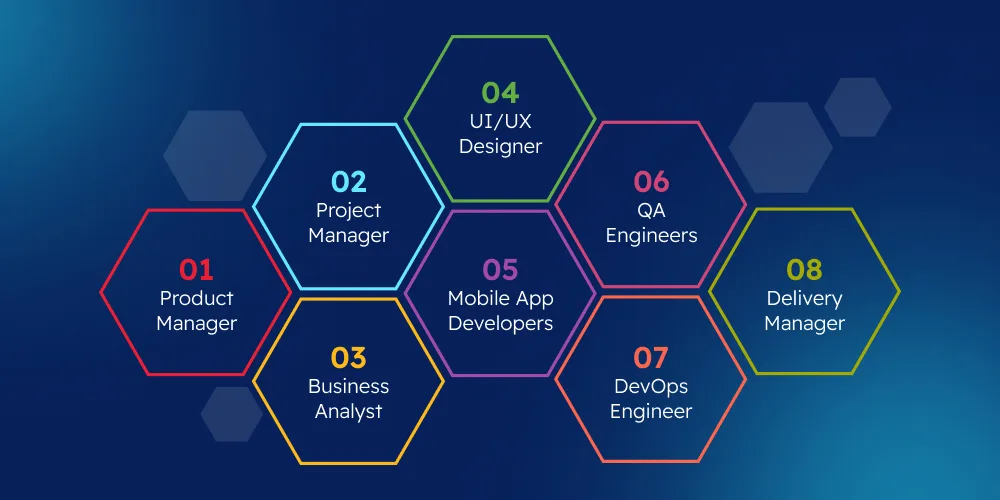
Mobile App Development Team Roles
Knowing the structure of the mobile app development team and their roles and responsibilities will allow you to make the right decision. Let's consider some essential team roles and their responsibilities below.
1. Product Manager
The Product Manager is the backbone of the project. In order to deliver a successful product, the PM helps integrate business and development processes. It is these people who steer the app into success, making sure that the decisions that are being made meet your business expectations and satisfy your target audience.
Key Responsibilities of Product Manager
Define Success: They define key performance indicators and metrics that will help track the success of your application.
Create a Roadmap: PMs map out the steps to get from idea to launch.
Prioritize Features: You cannot pack everything into one version of your app. The Product Manager will help decide which features are worth keeping and which could wait for next updates.
Bridge Business Goals with Market Needs: They will make sure that you develop an app which will be desired by its users.
2. Project Manager
The Product Manager focuses on the “what” and “why” of your app, and the Project Manager (PM) is responsible for the “how” and “when.” They keep the team on track and ensure deadlines are met. Project managers make sure everything happens on time, on budget, and with as few hiccups as possible.
The PM is the glue that holds the team together. They’re the main point of contact, ensuring seamless communication between developers, designers, stakeholders, and the client.
Key Responsibilities of Project Manager
Organizing the Workflow: They set up processes, assign tasks, and ensure that everyone knows what they’re supposed to be doing.
Running the Meetings: From quick daily check-ins to more in-depth planning and review sessions, the PM keeps everyone in sync.
Keeping the Team Motivated: Projects can be stressful, but a good PM knows how to keep spirits high and conflicts low.
Being the Point of Contact: Whether it’s updating the client or relaying feedback to the team, they’re the bridge between business and tech.
A PM doesn’t need to be a coding genius, but they do need top-notch leadership, communication, and problem-solving skills. Bonus points if they know their way around tools like Jira, Trello, or ClickUp.
3. Business Analyst
When it comes to turning your app idea into a reality, the Business Analyst (BA) is the one who takes care of bringing your business idea to life. They ensure that your business vision meets the technical needs of the project. In other words, BA is an expert who can speak both business and IT languages.
Key Responsibilities of Business Analyst
Leading the Discovery Process: As the first phase of the project, BA conducts research to establish the goals and objectives of your future mobile app. BA will define what you want to achieve and how the solution can contribute to meeting those goals.
Researching the Market: Before diving into mobile app development development, the BA makes sure they understand the industry, user needs, and what the competition is doing. This ensures your app is not just another idea but something that stands out.
Gathering Software Requirements: The BA talks to stakeholders, designers, and developers to collect all the details needed to turn your idea into a tangible product.
Creating Documentation: They write up a concise document for the team working on the development. Imagine it to be something like a blueprint of a product. It describes every little aspect including features, deadlines, and so forth.
Managing the Backlog: Not every feature can be built right away, and the BA helps prioritize the important ones. They keep the project focused on delivering what matters most first.
Facilitating Communication: It is one of the main responsibilities of the BA to communicate effectively with various individuals. These include the clients, business analysts, and developers among others.
4. UI/UX Designer
If you’ve ever used an app that just clicked, you have a UI/UX Designer to thank. Both UX and UI are related concepts, and both play an important role in app development. However, UI and UX are two different terms and should not be confused with each other. UX stands for User Experience while UI stands for User Interface. Together, they ensure your app is not only easy to use but also visually appealing and engaging.
Key Responsibilities of UI/UX Designer
User Research: First of all, they conduct user research to understand whom you're targeting and what your users need. It includes conducting research, creating personas, and getting insight about your users.
Designing the User Journey: When your UI/UX designers have figured out who your users are, they will create their journey. This means that each screen and button in your app will be created using wireframes that act like a blueprint for the design.
Building and Testing Prototypes: After the designers have finished creating the designs, the development of prototypes comes next. Here they test the designs to make sure that everything works and looks as intended.
Teamwork Makes the Dream Work: A UI/UX Designer team up with developers to ensure that the visuals look great and they've made the right decisions.
5. Mobile App Developers
When it comes to developing a mobile app, choosing the right team of Atlanta based mobile app developers is important. Depending on whether you want to target a specific platform like iOS or Android, or go for cross-platform development, your team’s skill set will vary.
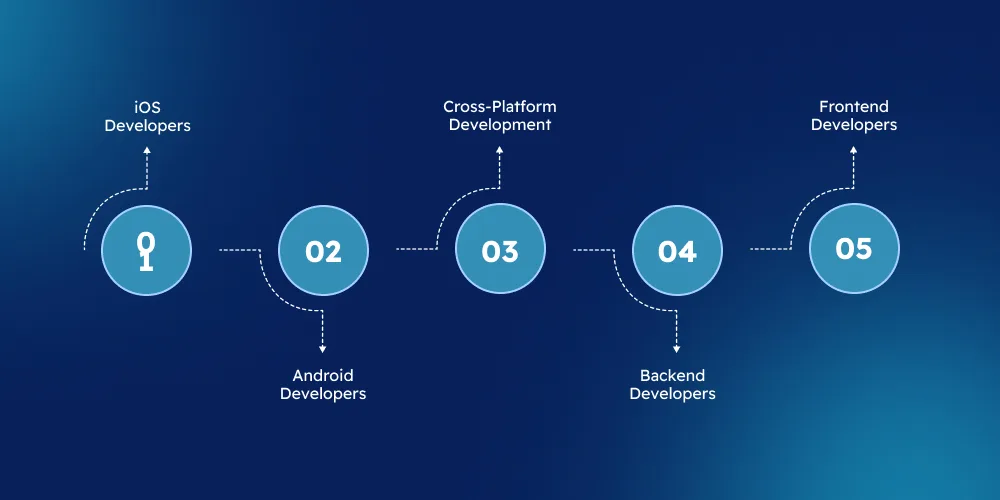
Types of Developers
iOS Developers
To build an app for iOS, you'll need a team that's highly proficient in Swift and Objective-C, and familiar with XCode IDE. iOS applications developers are focused on creating products that offer smooth and intuitive experience which seamlessly integrate into the ecosystem created by Apple. They should be aware of the latest updates in terms of iOS versioning and follow Apple's Human Interface Guidelines in terms of design.
Android Developers
Android developers are masters of Java and Kotlin, and they work closely with Android Studio. Their job is to create apps that work seamlessly across various Android devices with different screen sizes and hardware capabilities. Android developers also need to be familiar with the platform's specific requirements, such as Google Play’s submission guidelines, ensuring that the app complies before it goes live.
Cross-Platform Development
Cross-platform frameworks like React Native and Flutter are gaining popularity for mobile app development. They let developers write one codebase that works across both iOS and Android, making the development process faster and more cost-effective. According to recent surveys, 42% of developers use React Native for creating apps that work on both platforms.
Backend Developers
Backend developers are the behind-the-scenes wizards who make sure your app has all the data it needs to run smoothly. They handle everything from databases to server-side logic, making sure everything is in place for a seamless user experience.
Frontend Developers
Frontend developers are all about the user interface—the part of the app users interact with. They ensure that everything looks beautiful and functions seamlessly, from buttons to animations.
Key Responsibilities of Mobile App Developers
Developers write clean, high-quality code for your app, ensuring it’s fast, responsive, and bug-free.
They keep your app updated and compatible with new devices, operating systems, and updates.
Mobile app developers can help tackle issues as they pop up and make sure the app works smoothly for users, no matter what device they’re on.
They ensure your app passes platform guidelines—whether that’s Apple’s App Store or Google Play.
Developers help create and manage APIs that allow the app to communicate with the server and other services.
They make sure the app is intuitive, responsive, and works perfectly across all screen sizes.
6. QA Engineers
Quality Assurance (QA) Engineers are the backbone of any mobile app development process. They work tirelessly behind the scenes to make sure your product including its design and coding, meets all necessary standards. So, their main objective is to remove bugs before delivering the product to you.
Key Responsibilities of QA Engineers
Test, Test, and Test Some More: QA engineers carry out various types of testing from planning to execution. These may be both manual and automated.
Bug Busters: They track down bugs that can interfere with users' experience and fix them.
Performance Check: They test applications for performance under pressure, in different conditions and on various devices and loads.
Team Players: QA engineers communicate with developers to make sure everything is aligned and that new changes do not ruin anything.
User-Centered: They think like users, testing to make sure the app is easy to navigate, intuitive, and really convenient for them.
Build Your Mobile App with the Right Team!
Set up a high-performing team to accelerate your app’s success.
Your mobile app is running smoothly, and users love it, until, suddenly you notice that something goes wrong, and now users can experience poor performance and annoying bugs. What now? This is where DevOps Engineers step and provide technical support to your software to ensure its efficiency and performance.
Key Responsibilities of DevOps Engineers
Solve Problems, Fast: When your app slow down, DevOps engineers rush in to identify and fix issues before they become bigger problems.
Set the Stage for Success: They create and maintain the perfect development environment. They set up everything from servers to staging environments, ensuring smooth operations from start to finish.
Deploy with Confidence: They handle the deployment process, ensuring your app is pushed to production smoothly, with all the right configurations.
Security First: Keeping your app safe is their top priority. DevOps engineers implement security measures, ensuring your app stays protected against hackers, malware, and vulnerabilities.
Efficiency is Key: Their goal is not only about solving problems but also optimizing the workflow.
8. Delivery Manager
Delivery Manager is a person who connects the development team and its clients ensuring that the project moves smoothly meeting all the clients' requirements and developing all the needed components at the same time.
Key Responsibilities of Delivery Managers
Keep Things Moving: Being the manager of your project, a DM plans, monitors, and manages all its aspects guaranteeing that no deadlines would be missed during the whole process.
Motivate the Team: They coach, mentor, and guide the development team, ensuring everyone is aligned and moving toward the same goal.
Solve Roadblocks: The Delivery Manager helps the team solve all the problems arising during the process so there were no delays.
Understand the Big Picture: They understands the client's needs and designs the project structure taking into account all the factors mentioned.
Ensure On-Time Delivery: A Delivery Manager’s ultimate responsibility is to make sure the project is delivered on time, and to the highest standards, with no surprises.
Find the Perfect Team for Your App Project!
Ensure efficiency and expertise with the right development team structure.
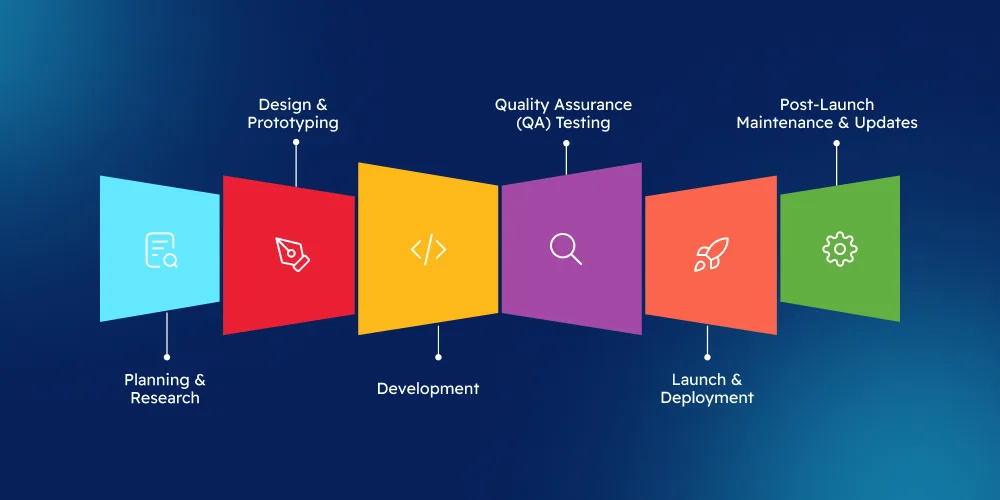
Creating a mobile app requires planning, execution, testing, and constant tweaking. Each stage ensures that the final product meets user expectations and business goals. Here is the development process and the team responsible for the stages of development.
Stages of Mobile App Development
Description
Team Required
Planning & Research
This stage involves understanding the app's purpose, target audience, and key features. A business analyst determine whether the application meets the needs of the company, while the project manager will develop the roadmap.
Project Manager Marketing Specialist
Design & Prototyping
Designing the user interface (UI) and experience (UX) is a crucial stage. In this stage a UI/UX designer ensures that the app is both functional and easy to navigate. A graphic designer may focus on visual elements, while the product designer will help to create an application that meets the user’s requirements.
UI/UX Designer Graphic Designer Product Designer
Development
This is the core of the app-building process. Front-end developers handle the app’s interface, back-end development manage databases and server-side operations, and mobile developers specialize in creating iOS and Android applications.
Front-end Developers Back-end Developers Mobile Developers (iOS/Android) Cross-platform Developers
Quality Assurance (QA) Testing
After development, QA engineers and testers rigorously test the app for bugs and performance issues. They ensure that the app runs smoothly, is free of critical bugs, and meets the required standards for usability and performance.
QA Engineers Testers
Launch & Deployment
Once testing is complete, the deployment specialist ensures that the app is properly deployed on the relevant app stores (App Store/Google Play), and mobile developers ensure the app works seamlessly on user devices.
Deployment Specialist Mobile App Developer
Post-Launch Maintenance & Updates
Even after launch, the work continues. Developers monitor app performance, release updates, and fix bugs. The support team assists users with any issues, and the marketing team works to promote the app and gather feedback for future improvements.
Mobile Developer Support Team Marketing Team
Conclusion
Building a successful mobile app is a complex process that requires proper planning and teamwork. Starting from the very first stages of research and designing up to the app's deployment and subsequent support, all phases of its development play an important role in bringing your product to life.
By assembling the right team of experts such as business analysts, designers, developers, QA engineers, and delivery managers will ensure that every aspect of the app development process is executed smoothly and efficiently. At DITS, our professionals are able to provide you with proper guidance through all the steps of app development.
Whether you're starting from scratch or looking to enhance an existing app, having the right team and a well-structured process is key to success. Ready to transform your app idea into reality? Let’s make it happen!
Maximize ROI with a Skilled App Development Team!
Find the right balance between expertise and cost for your mobile app.
Business Analysts help you understand what should be done and how. They cooperate with developers and help you make sure that the app is developed with a good structure. Moreover, you won't waste your money because they will help you concentrate on the most important features.
Dinesh Thakur
25+ years of IT software development experience in different domains like Business Automation, Healthcare, Retail, Workflow automation, Transportation and logistics, Compliance, Risk Mitigation, POS, etc. Hands-on experience in dealing with overseas clients and providing them with an apt solution to their business needs.