25+ years of IT software development experience in different domains like Business Automation, Healthcare, Retail, Workflow automation, Transportation and logistics, Compliance, Risk Mitigation, POS, etc. Hands-on experience in dealing with overseas clients and providing them with an apt solution to their business needs.
Are you looking for the best backend framework to develop your web application? If yes, this blog is for you. When it comes to choosing web frameworks, there is plenty of choices. But, Django and Laravel are the two widely used technologies for backend development. So, which one makes an ideal choice for your use case? Let’s have a closer look at Django vs Laravel and find out!
Django vs Laravel: A Quick Overview
Before we dig deeper into comparing between Django and Laravel, let’s have an overview first.
Django
Django is an open-source framework written in Python. It follows MVT (Model View Template) architecture that supports rapid web app development, and cleaner code with pragmatic design. According to SimilarTech, 0.2% of all the websites on the internet use this framework. Released in 2005, Django is licensed under 3-clause BSD and is used by some of the prominent websites, including Pinterest, Instagram, Mozilla, etc. It is primarily used for building eCommerce websites, social media platforms, real estate listing platforms, content management systems, and more!
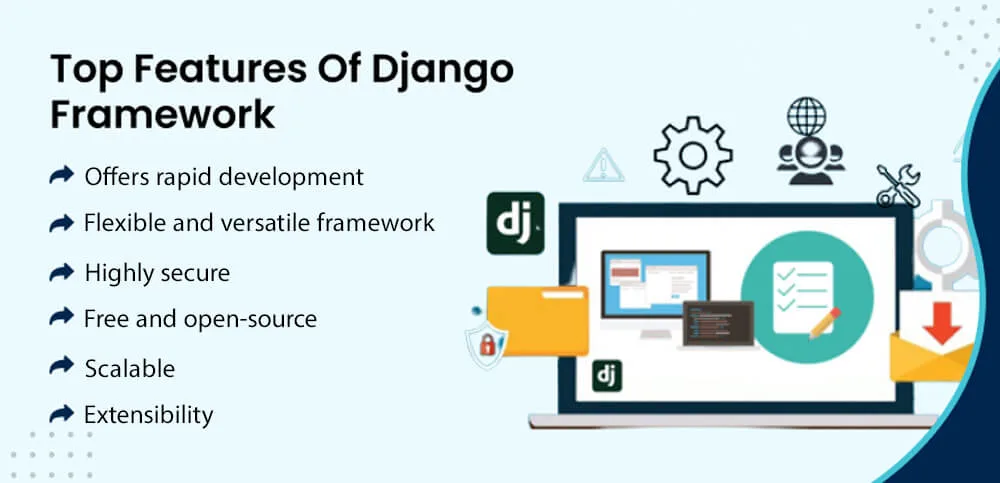
Top features of Django
To ease the development of complex web applications in less time is the main objective of Django. Some of the top features of Django are as under:
PHP-based open-source web framework
Offers Rapid Development: Django enables app developers to carry the development process faster. Designed specifically for rapid development, the framework lets you build a number of applications with a quick turnaround.
Flexible And Versatile Framework: Django has a highly flexible architecture and can be used for building all types of software, including single-page websites, complex applications, etc. across diverse domains.
Highly Secure: Django is a highly secure framework that fills security risks or any harmful attacks. Also, it provides security for managing the account and safeguarding passwords.
Free And Open-Source: Since Django is an open-source and free-to-use framework, you can easily download, install it and use it for development. Clearly, it increases convenience and reduces development costs.
Scalable: Modern applications built with Django are highly scalable and meet heavy traffic demands even during peak periods.
Extensibility: Extensibility is another great feature of Django. It offers thousands of plugins that can be used to customize an application or website the way you want.
Laravel is a PHP-based open-source web framework that follows MVC architecture. As a server-side framework, Laravel enables software developers to build pre-defined architectures, full-stack applications, or web projects. Developed in 2011 by Taylor Otwell, Laravel boasts some excellent features that make web development process completely effortless for web artisans. According to Datanyze, Laravel has a market share of 0.37% among all web frameworks. The framework can be used for building different types of software applications, like SAAS-based web apps, e-learning apps, CMS systems, on-demand streaming web apps, etc.
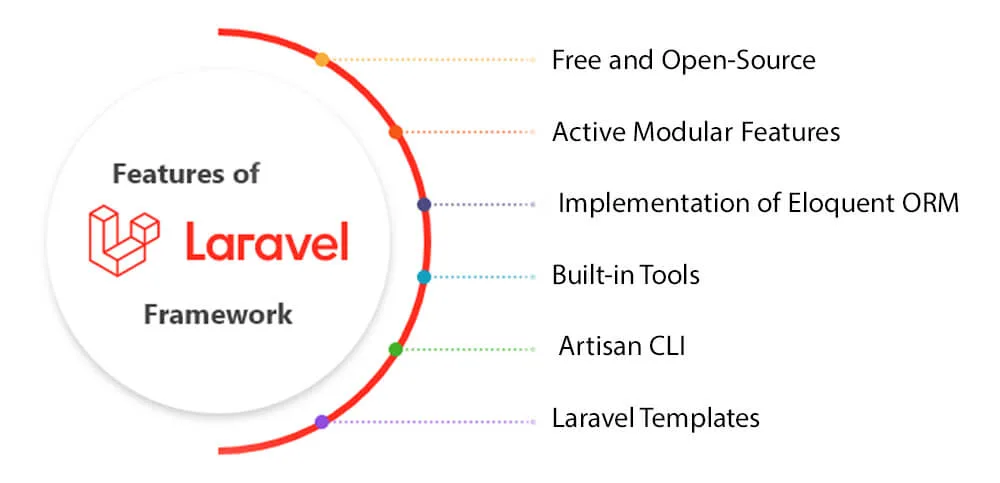
Top features of Laravel
Like Django, Laravel offers a wide array of features allowing the development team to build some of the best scalable apps with lots of functionalities. Here are a few of the features it offers:
PHP-based open-source web framework
Free and Open-Source: Laravel is an MIT-licensed open-source and free-to-use framework that allows developers to change the code the way they want in order to build unique products.
Active Modular Features: Laravel comes with pre-installed object-oriented & modular libraries which eases the development process. With the release of Laravel 3, Bundles have been included in the Modular package. Besides, Laravel 4 leverages Composer and framework-agnostic PHP packages that can be accessed from Packagist.
Implementation of Eloquent ORM: Eloquent Object Relational Mapping is a PHP-based active record implementation that allows PHP developers to create data queries using PHP syntax.
Built-in Tools: Laravel features multiple built-in tools, like IDE, Laravel Tinker, Debugger, etc. that make the software development process easier.
Artisan CLI: The command-line interface or CLI helps in building and managing Laravel-based applications efficiently, as well as database migration, boilerplate coding, and more!
Laravel Templates: There is plenty of Laravel widgets and templates that combine JavaScript with CSS code to create interactive, visually appealing forms.
Your Web Application Deserves the Best!
DITS provides exceptional Django and Laravel development services. Hire our team to build a high-quality, scalable web application. Let’s collaborate!
Moderate; Python is known for readability and simplicity
Moderate; PHP is widely used but Laravel has its own learning curve
Performance
High
Good
Community Support
Large
Large
Built-in Features
Robust ORM, admin interface, authentication, form handling, and more
Authentication, routing, sessions, caching, and more
Template Engine
Django Template Language
Blade
Restful API
Django REST framework
Laravel has built-in support and also offers packages like Dingo
Database Support
Supports multiple databases including PostgreSQL, MySQL, SQLite, and Oracle
Supports multiple databases including MySQL, PostgreSQL, SQLite, SQL Server
Scalability
Highly scalable; used by large-scale applications
Scalable but traditionally used for small to medium-sized applications
Ecosystem
Extensive; numerous third-party packages and integrations
Extensive; numerous packages available via Composer
Security
Excellent; built-in protections against SQL injection, CSRF, XSS
Very good; built-in protections and regularly updated for security
Testing
Built-in testing framework with support for various testing methods
PHPUnit is the standard for testing in Laravel
Hosting
Supported by most major hosting providers
Supported by most major hosting providers
Documentation
Extensive and comprehensive
Extensive and comprehensive
ORM (Object-Relational Mapping)
Django ORM
Eloquent ORM
Migration Support
Built-in migrations
Built-in migrations
Data Serialization
Built-in serializers
Built-in JSON serialization and response handling
Middleware
Flexible middleware architecture
Middleware support for HTTP request/response handling
Routing
URL routing with named routes
Powerful and flexible routing system
Caching
Built-in caching support with multiple backends
Built-in caching mechanisms with drivers for various backends
Task Scheduling
Celery for task scheduling
Built-in task scheduling with Laravel Scheduler
Deployment
Can be deployed on platforms like Heroku, AWS, DigitalOcean
Can be deployed on platforms like Forge, Envoyer, AWS, DigitalOcean
Third-Party Integration
Strong support for integrating with various third-party services
Strong support for integrating with various third-party services
Modularity
Apps within a project can be developed as separate, reusable modules
Modular structure with service providers and packages
Internationalization (i18n)
Comprehensive internationalization and localization support
Built-in support for localization
SEO Friendliness
Good support for creating SEO-friendly URLs and structures
Good support for SEO-friendly URL creation and management
Admin Interface
Django Admin for out-of-the-box admin interface
Nova for customizable admin panel
File Storage
Built-in support for handling file storage and management
Built-in support for file storage with integration options
Microservices Capability
Highly Compatible with microservices architecture and supports versatility and quick deployment.
Laravel is also compatible with microservices but Laravel app can be divided into small blocks that interact with each other via APIs.
Architecture
When it comes to choosing a framework, architectural flexibility is the most important factor to consider rather than any predefined criteria to make a choice. That being said, let’s compare the two frameworks and find out which one is more flexible.
Django: As already discussed, Django follows MVT architecture. MVT comprises three components – Model, View, and Template. While both MVC and MVT are similar, there is a small difference between the two; i.e., the template file with HTML and Django template facilitates the creation of dynamic websites. This makes it easy to provide users with personalized feeds on applications, which makes Django suitable for performing quick modifications.
Laravel: Laravel works on MVC (Model, View, Controller) architecture that allows developers to divide their roles and carry out the development process efficiently. For example, the frontend team works on views, and the backend team can work on the controller. This means you have more control over the website. Also, you can also create a robust app backend support; however, modification is a bit difficult. Consequently, Laravel might not be suitable for developing large applications.
Scalability
Being a Python-based web framework, Django is a highly scalable language with scalable AI-ML capabilities. The framework works seamlessly with different technologies without compromising performance. Further, Django facilitates various operations to optimize elements, like images, CSS, etc., and makes room for cloud implementations. Thus, Django is a great choice for developing scalable web applications.
Similarly, Laravel also uses PHP and offers scalability to support business applications. If combined with a good database, and platforms, like AWS, MySQL, etc. you can scale Laravel-based applications.
Testing
In any application, it’s inevitable to encounter issues in terms of performance, security, user experience, etc. In order to resolve those issues, it makes sense to test the app for bugs or other complexities. Further, the web framework should be flexible enough to provide ease of testing.
There are so many tools available to test a Django-based app and solve the issues. One can directly refer to the framework’s documentation to find out how to test the code and make the application bug-free. Talking of Laravel, it tests codes on two levels, feature tests, and unit tests. Developers can read the documentation to test the code at different levels.
Microservices Capability
Django is highly compatible with microservices architecture and supports versatility and quick deployment. The project can be divided into small microservices with different functionalities. On the other hand, Laravel is also compatible with microservices. Like Django, the Laravel app can be divided into small blocks that interact with each other via APIs which makes it microservice-compatible. Besides, you can also use Lumen to implement microservices in the Laravel application.
Security
Django has built-in features, like CSRF (cross-site request forgery), XSS (cross-site scripting), SQL injection, etc. that provide protection against vulnerabilities. Further, it has a strict review process for packages to ensure safe integration.
Laravel also offers security features, like CSRF, SQL injection, etc. Also, the framework’s ecosystem has reliable packages for third-party integration. Further, there is a dedicated community that shares regular updates to address any kind of vulnerabilities.
REST API
Developers can take advantage of the Django REST framework to simplify the process of building RESTful APIs. Laravel also supports building REST APIs via authentication, response, request handling, etc. However, making REST APIs with Laravel is easier as compared to Django.
Community Support
Django has a large community with more than 80,000 members on Reddit and answers to thousands of questions on Stack Overflow. With PHP ruling 80% of the market in server-side programming, Laravel also enjoys a vast community of users and experts.
Speed
When comparing Django vs Laravel speed, Django is often seen as faster due to its use of Python, which typically outperforms PHP, Laravel's base language. Django’s built-in ORM and streamlined architecture contribute to its performance in high-traffic environments. Meanwhile, Laravel’s caching and flexibility also provide strong speed potential. Ultimately, the choice depends on the specific project requirements and setup.
Maximize Your Web App’s Potential with DITS!
Hire DITS for expert Django and Laravel development. Our experienced developers are ready to take your project to the next level.
Django is a good fit when you are looking to build:
A customizable or dynamic social media website.
CRM for eCommerce platforms.
AI-ML integrated applications.
Apps that are used for data analysis.
Choose Laravel, when you want to build:
SEO-friendly web application.
Interactive layouts for a website.
An advanced application without adding too many complexities.
A web app with an object-oriented library.
Conclusion
Both frameworks have their own pros and cons. Likewise, they have amazing features and functionalities to serve diverse industries like retail, healthcare, transportation with scalable and secure web applications. Everything boils down to a business’s unique requirements, budget, industry, developers’ skill level, etc.
Need assistance on Django vs Laravel for your web development project? Let’s connect!
Dinesh Thakur
25+ years of IT software development experience in different domains like Business Automation, Healthcare, Retail, Workflow automation, Transportation and logistics, Compliance, Risk Mitigation, POS, etc. Hands-on experience in dealing with overseas clients and providing them with an apt solution to their business needs.