25+ years of IT software development experience in different domains like Business Automation, Healthcare, Retail, Workflow automation, Transportation and logistics, Compliance, Risk Mitigation, POS, etc. Hands-on experience in dealing with overseas clients and providing them with an apt solution to their business needs.
Testing is an essential requirement in the software development lifecycle. The later you identify a defect in the software development lifecycle, the more it will cost to repair. Defects found after a release are not just costly to the bottom line; they also carry risk. A simple code fix to correct one defect could quickly cascade into fixes to other areas of the application that are unintentional. Fixing defects that cascade in this manner is costly in that they are not only expensive but also consume team time and productivity.
The testing process aims to identify and fix any bugs or inconsistencies before the software reaches its end users. Testing software not only fixes errors or bugs, but also ensures the software works perfectly and saves costs as any defects are fixed at an early stage before the final deployment.
Testing has several approaches, functional and regression testing being the most important types. In this article, we will look into an important comparison: the difference between functional and regression testing. We’ll break down what each one means, why they matter, and how they fit into quality assurance strategy.
Functional Testing
Functional testing is about validating the behavior of each feature in a software application according to defined requirements. QA engineers replicate real interactions from the user by inputting various values into the software and verifying if they get the desired output. The purpose of functional testing is to validate both intended use cases and edge cases, whether they are positive use cases or negative use cases.
What Functional Testing Validates
Functional testing focuses on
Feature behavior: This means validating that every feature in the application that is facing the user performs its assigned task as expected every time.
Usability: This validates whether the feature is intuitive and that the intent of the UX design was correctly implemented: Does the user experience follow organization standards?
Error handling: Functional testing validates that the system will respond appropriately to invalid inputs or failures, including managing error messages.
Data flow and processing: Validates the application can accurately receive, store, retrieve, or otherwise process data.
At DITS, our development model integrates testing in the software development process to build high-performing, bug-free software.
Catch Bugs Before Your Users Do!
DITS simulates real-world usage to ensure every button, form, and function behaves exactly as it should - no surprises, no frustration.
When does regression testing begin? Whenever something gets changed, whether it's a new feature, a refactor of the code, or a bug fix. It's not about testing what is new, it's about testing to make sure what is old still works. A code change can cause unintended side effects that can alter the expected behavior of an application, and regression testing is meant to catch these undesired effects before they reach our end users.
QA teams will essentially re-run test cases that were passed previously, with the purpose of making sure nothing has regressed. This is increasingly important in agile development, when we can expect change in implemented features from sprint to sprint, but must still be able to deliver a stable product to our customers after every release.
What Regression Testing Is Designed to Check
Focus areas for regression testing include:
Feature integrity: Ensure existing feature/features are not affected by changes / new functionality / refactoring
Bug confirmation: Verify that resolved bugs have not introduced new bugs / regressions
Side effects of performance motivation: Ensure a performance optimization did not break or slow down an entire process.
At DITS, our QA team designs business-specific functional test cases that reflect your goals and user expectations.
Old Features, Still Flawless After Every Update!
DITS ensures that every release respects what already works. Our regression testing protects your product from surprise side effects.
To verify that each feature of the software works as intended
To ensure that new code changes have not negatively affected existing functionality
Primary Focus
Validating individual features and business logic
Rechecking existing features after updates, bug fixes, or enhancements
When it is performed
During the initial stages of the development or after a new feature is added
After any code modification, integration, or release cycle
Test Coverage
Focused on specific modules or features being developed
Broad Coverage: covers previously tested areas across the application
Testing Type
Based on functional specifications or user requirements
Based on previous test cases and existing functionality
Automation
Mostly black-box testing
Can involve both black-box and white-box techniques
Test Case Design
Can be both manual and automated
Typically automated for speed and consistency
Time Consumption
Can be time-consuming for complex or large feature sets
Automated regression tests save time in long-term release cycles
Risks Addressed
Ensures that software meets user and business requirements
Ensures that new updates don't introduce regressions or break stable areas
Outcome
Confirms that the developed functionality works as expected
Confirms that existing functionality remains stable after changes
Ideal Use Case
When launching new features or modules
During frequent releases, updates, or code refactoring
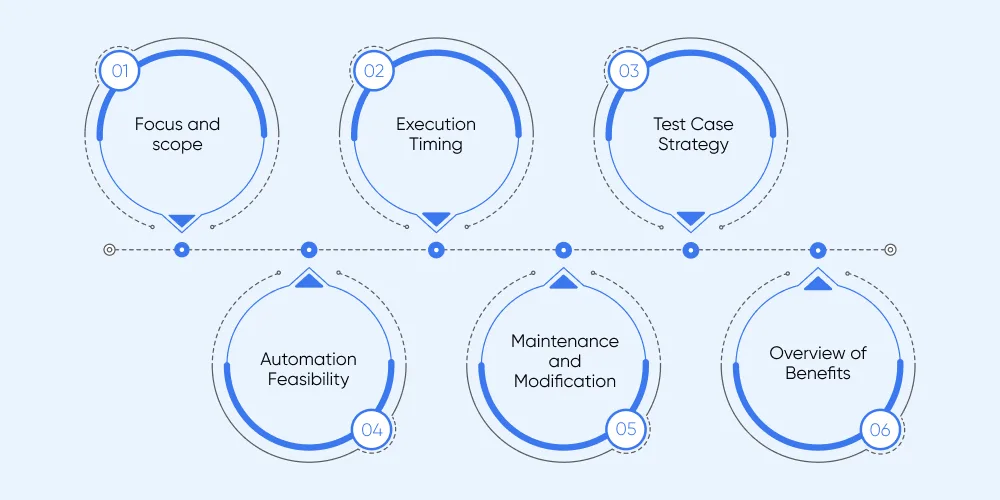
Now, let us explore each difference between functional and regression testing.
Focus and scope
Functional testing helps you verify new features and some aspect(s) of functionality in an application. It focuses on verifying that each function works according to defined requirements. Testers usually create a set of scenarios with multiple user inputs (load, functional, exploratory) to verify how the software responds.
Regression testing focuses on verifying the existing functionality of the system. It is designed to allow testers to identify unwanted side effects from changes made to the code, enhancements, and/or bug fixes. The primary goal is to ensure the application reliably continues to work after changes have been made.
Execution Timing
Functional testing is used in almost every phase of the software development lifecycle. When the team implements new features, each function is immediately evaluated with functional tests to confirm that each component works as intended. These tests are folding into automated environments in order to find problems early in the feedback loops.
Regression testing is often done after a change is deployed. The change could be implemented as a new feature, a patch or portal, or as an enhancement. In CI/CD pipeline, organizations are deploying code changes to production very often. When this is the case, automated regression suites help organizations recall software stability.
Test Case Strategy
Functional testing involves writing test cases from scratch for each new functionality. Since each feature has its own requirements and workflows, it doesn't make sense to refer to existing test scripts. For instance, if a new search filter is added, tests will be created only to verify the performance of this filter.
Regression testing commonly consists of a combination of old test cases and new test cases. For example, adding updates to the new application, such as new fields to a form, use existing tests to validate the unchanged portion of the application, and build additional test cases for the new portion of the application.
Automation Feasibility
In functional testing, testers execute test cases manually. Once a feature becomes stable, testers can automate the test cases. However, in regression testing, manual testing or automation is implemented only on stable test cases. They can be automated as required.
Maintenance and Modification
Functional test cases usually needs less modification as it focusses only on testing specific features. On the other hand, regression suite test scripts need more maintenance as it covers the overall functions of an application. Regression suites may contain past test cases, or cases that test changed functionalities, new features or the ones that have been removed. It is important to update the regression suite after every release to avoid failure of automaton script.
Overview of Benefits
Functional testing verifies that all features work as designed from the user's perspective. Functional testing identifies any issues found early in the life cycle, which reduces time, effort and cost of refixing issues. Functional testing contributes to providing users with reliable software which meets expectations and builds customer trust.
Regression testing is important to ensure that the application remains stable over time. Regression testing identifies any regressions that may be caused from recent changes and allows users to create a timely fix before it affects end users. This allows for a reliable user experience over time and in efficient application maintenance when needing updates, especially in fast-paced development situations.
When and Why You Need Both Functional and Regression Testing
While working on software development, especially in critical areas like financial, healthcare and enterprise applications, there simply isn’t a substitute for either functional or regression testing. Both necessary to deliver stable, high quality software that meets business expectations and user needs.
Use Cases Where Both Testing Types are Required
Certain industries or projects have testing requirements that must be met by law, or due to a need for specialized security, or performance testing. For example:
Financial applications must verify that core capabilities like transactions, fund transfers, or balance calculations are functioning as intended (i.e. a functional test). Also, they need to verify both prior and future functionality of all systems (i.e. regression testing) after making any future updates / patches.
Healthcare applications must verify new features like patient record access or appointment scheduling function as intended (i.e. functional testing), and a change, no matter how small, must not affect business continuity, ongoing operations or compliance with HIPAA (i.e. regression testing).
At this level, any potential failure can lead to either legal issues, loss of data, or brand / reputation deterioration, which are both non-negotiable when referencing either testing method.
Risk Mitigation and Customer Satisfaction
With functional testing, a tester confirms that every new capability meets the requirements and can function reliably in a stand-alone context. Regression testing ensures that improvements today don’t break the past improvements.
Together, they drastically reduce the potential of defects making their way into production, to protect user information, and prevent revenue loss. Also, they provide a user experience that establishes trustworthiness and user satisfaction.
For minimizing risk, securing applications, and adhering to industry standards, businesses need a software testing services company that has experience with both types of testing services. DITS has an experienced team that offers both functional and regression testing to future-proof software solutions for organizations.
The Secret to Scalable Software? Smart QA, Not Just Code!
DITS runs functional and regression tests in sync, so you ship stable, scalable releases your users and stakeholders can rely on.
When development teams run functional and regression tests in parallel, they can see from many angles how the software behaves, for both new functionality and existing functionality at the same time. By having this comprehensive view, stakeholders can have high confidence that:
New functionality will not introduce instability
Updates will not break critical workflows
The product is production-ready at each step of the release process
At DITS, we integrate both tests into our development lifecycle to ensure that all releases are stable, scalable, and aligned with your business needs; no surprises, no regressions.
How DITS can help with Software Testing
At DITS, we have a dedicated software testing team, having experience both in functional and regression testing. They take care that the software solution works perfectly and delivers the desired results before and after making any changes. They ensure that any changes in the code does not affect the existing functionality of the software.
As a custom software development company, we focus on building software solutions tailored to your specific needs. Our testing team verifies all the functionalities of the solution using functional and regression testing as required. We have 8 plus years of experience in building and testing software solutions for international clients.
With an experience software development team, we have industry specific expertise across various including healthcare, transportation, and AI software development. In addition, we also create and integrate IoT software solutions into systems across various industries to help business leverage the power of artificial intelligence and IoT.
With almost a decade of software development experience, and 97 % client retention rate, DITS is a software development firm you can trust for testing your solutions.
Conclusion
The importance of functional testing and regression testing lies in their ability to maintain software quality. Functional testing is validating new features against a set of requirements, while regression testing is ensuring that existing functionalities work after updates. Quality assurance testers need to ensure that a solution works as intended and the changes made during testing do not affect the existing functionality.
Be it a product launch or an updated version of already released applications, combining both types of testing helps your software catch bugs before reaching the users. Quality testing is an investment and guarantees that you will deliver your users high-performing and dependable applications.
Frequently asked questions
Functional testing tests whether the software is behaving as expected for the requirements. It includes and verifies features, inputs, and outputs of the software to confirm the software behaves as expected.
Dinesh Thakur
25+ years of IT software development experience in different domains like Business Automation, Healthcare, Retail, Workflow automation, Transportation and logistics, Compliance, Risk Mitigation, POS, etc. Hands-on experience in dealing with overseas clients and providing them with an apt solution to their business needs.