25+ years of IT software development experience in different domains like Business Automation, Healthcare, Retail, Workflow automation, Transportation and logistics, Compliance, Risk Mitigation, POS, etc. Hands-on experience in dealing with overseas clients and providing them with an apt solution to their business needs.
The backend is what makes a mobile app work. It determines how efficiently your app processes data, handles user interactions, and scales with growing demand. A well-chosen backend ensures security, performance, and seamless functionality, while the wrong choice can lead to technical bottlenecks and maintenance challenges.
There are many backend options like Node.js, Django, and Firebase? How do you decide? Each has its strengths, and the best choice depends on your app’s needs. Some prioritize speed and scalability, while others focus on security and ease of development. Understanding these differences is essential for making an informed decision.
In this guide, we will compare the top backend technologies for mobile apps in 2025, their pros and cons, and which ones work best for different types of apps. Whether it's a chat app, an online store, or a business tool, this guide will help you pick the right backend.
Let’s explore the best options available.
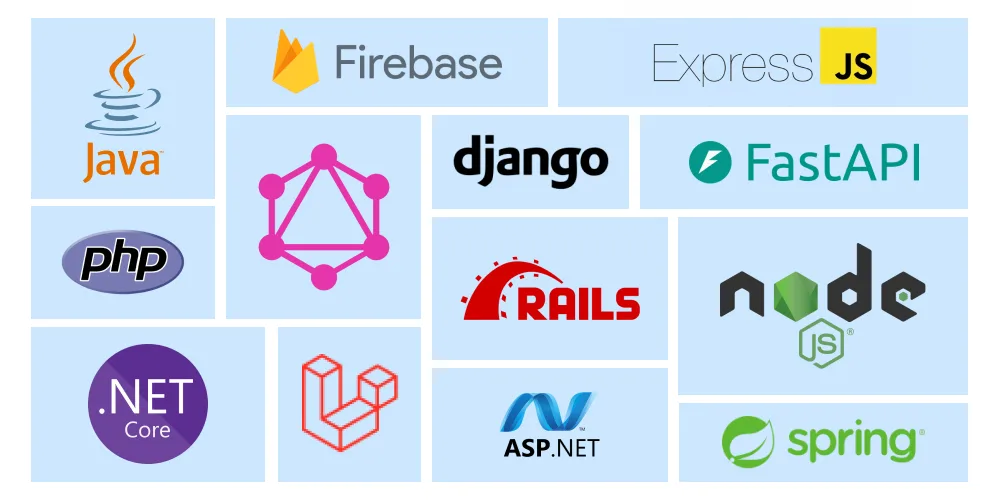
Best Backend Technologies for Mobile Apps
Technology
Best For
Key Advantages
Node.js
Real-time apps Chat apps Collaborative tools
Fast Scalable Non-blocking architecture
Django
Enterprise apps Fintech Healthcare
Secure Scalable Built-in features for rapid development
Open-source BaaS Pre-built authentication & real-time features
Express.js
APIs Microservices Lightweight backends
Minimalist Efficient Works with Node.js
.NET Core
Enterprise-grade apps Cross-platform solutions
Secure Scalable High performance
Strapi
Content-heavy apps Mobile apps needing a CMS
API-first Highly customizable Open-source
Hapi.js
Secure enterprise apps Real-time applications
Secure Plugin-rich Alternative to Express.js
1. Node.js
Node.js is a high-performance, event-driven JavaScript runtime built on Chrome’s V8 engine. It excels in handling asynchronous operations, making it a preferred choice for scalable and real-time applications. Its non-blocking I/O model enables efficient request handling, reducing latency and improving responsiveness.
Use Cases
Real-time applications (chat applications, collaboration tools, live tracking)
Extensive package ecosystem via NPM for rapid development
Optimized for microservices and containerized environments
Cons:
Single-threaded event loop may not be ideal for CPU-intensive tasks
Callback management can lead to increased code complexity
2. Django
Django is a high-level Python web framework designed for rapid development and clean, pragmatic design. It follows the Model-View-Template (MVT) architecture and includes built-in security features, making it a solid choice for enterprise applications. With its "batteries-included" approach, Django provides everything from authentication to database management, reducing the need for third-party dependencies.
Highly secure with built-in protection against common vulnerabilities
Scalable and optimized for handling complex database operations
Rapid development with an extensive set of built-in tools
Cons:
Monolithic structure may not be ideal for lightweight applications
Can be overkill for small-scale projects due to its extensive feature set
3. Firebase
Firebase is a Backend-as-a-Service (BaaS) platform by Google, designed for real-time data synchronization and seamless cloud integration. It eliminates the need for traditional server management by providing a serverless architecture, making it an ideal choice for startups and MVPs. Its real-time NoSQL database and built-in authentication system simplify backend development.
Use Cases
Mobile and web applications requiring real-time data sync
MVPs and startups looking for rapid development
Applications needing built-in authentication and cloud storage
Pros:
Fully managed, serverless backend with real-time database support
Seamless integration with Google Cloud services
Scales automatically with demand
Cons:
Vendor lock-in with limited customization options
Pricing can become expensive as the application scales
4. Ruby on Rails
Ruby on Rails (RoR) is a full-stack web framework built on Ruby, following the Model-View-Controller (MVC) architecture. Known for its "convention over configuration" philosophy, it simplifies development by providing predefined best practices. With built-in ORM (Active Record) and automated testing tools, RoR enables rapid application development while maintaining code quality.
Use Cases
E-commerce platforms and SaaS applications
Content management systems (CMS)
Startups needing quick prototyping and deployment
Pros:
Developer-friendly with a strong emphasis on clean, maintainable code
Built-in security and testing frameworks for reliable applications
Large open-source community with extensive libraries (Gems)
Cons:
Performance limitations compared to compiled languages like Java or Go
Scaling can be challenging for high-traffic applications
5. Spring Boot
Spring Boot is a Java-based framework designed to simplify the development of enterprise-grade, microservices-based applications. Built on the Spring framework, it offers auto-configuration, embedded servers, and production-ready features, making it ideal for scalable and secure applications. Its modular design supports cloud-native architectures, ensuring seamless deployment.
Highly scalable and optimized for distributed systems
Robust security with built-in authentication and authorization
Seamless integration with cloud services and DevOps tools
Cons:
Higher memory consumption compared to lightweight frameworks
Can be complex for beginners due to extensive configurations
6. Laravel
Laravel is a PHP framework known for its elegant syntax, MVC architecture, and built-in security features. It simplifies backend development with tools like Eloquent ORM, Blade templating engine, and an intuitive routing system. Laravel is widely used for web applications, offering a balance between flexibility and structure.
Use Cases
Web applications with complex business logic
E-commerce platforms and SaaS applications
RESTful APIs and backend services
Pros:
Clean and expressive syntax for faster development
Built-in authentication, caching, and task scheduling
Strong ecosystem with tools like Laravel Forge and Nova
Cons:
Can be slower compared to lightweight PHP frameworks
Requires server-side rendering, which may not be ideal for SPAs
ASP.NET is a Microsoft-backed web framework designed for building scalable, high-performance applications. It supports multiple programming languages, including C# and F#, and seamlessly integrates with the .NET ecosystem. With robust security features and enterprise-grade capabilities, ASP.NET is widely used for mission-critical applications.
Use Cases
Enterprise applications requiring high security and scalability
Web APIs and microservices-based architectures
Cloud-native applications with Azure integration
Pros:
Excellent performance with Just-In-Time (JIT) compilation
Strong security features, including built-in authentication and authorization
Seamless integration with Microsoft Azure and enterprise tools
Cons:
Can have a steeper learning curve for beginners
Heavier resource consumption compared to lightweight frameworks
8. PHP
PHP is a server-side scripting language widely used for web development and dynamic content generation. Known for its simplicity and flexibility, PHP powers over 75% of websites, including platforms like WordPress and Facebook. It integrates well with databases like MySQL, PostgreSQL, and MongoDB, making it a popular choice for content-driven applications.
Use Cases
Content management systems (WordPress, Joomla, Drupal)
E-commerce platforms (WooCommerce, Magento)
Web applications with database-driven content
Pros:
Easy to learn with a vast community and extensive documentation
Works well with most web hosting environments and databases
Large ecosystem with frameworks like Laravel and CodeIgniter
Cons:
Performance limitations compared to compiled languages like Java or C#
Security vulnerabilities if not properly managed
9. Java
Java is a versatile, object-oriented programming language widely used for enterprise applications, Android development, and large-scale systems. With its Write Once, Run Anywhere (WORA) capability, Java ensures cross-platform compatibility. It excels in performance, security, and scalability, making it a top choice for backend development in high-traffic applications.
Highly scalable and optimized for large-scale applications
Strong security features with built-in memory management
Platform-independent with extensive libraries and frameworks (Spring, Hibernate)
Cons:
Higher memory consumption compared to lightweight alternatives
Slower startup time due to Just-In-Time (JIT) compilation
10. .NET Core
.NET Core is a cross-platform, open-source framework developed by Microsoft for building high-performance, scalable applications. It supports multiple languages (C#, F#, VB.NET) and is optimized for cloud-native and microservices architectures. Its modular design allows developers to use only necessary components, improving efficiency.
Use Cases
Enterprise-grade web applications and APIs
Cloud-native applications with Azure integration
High-performance microservices architectures
Pros:
Cross-platform support (Windows, Linux, macOS)
High performance with Just-In-Time (JIT) and Ahead-Of-Time (AOT) compilation
Strong security and built-in dependency injection
Cons:
Steeper learning curve compared to other frameworks
Can be resource-heavy for smaller applications
11. Express.js
Express.js is a lightweight and flexible Node.js framework designed for building fast and scalable server-side applications. It provides a minimalist, unopinionated structure, allowing developers to customize their backend architecture. With built-in middleware support, routing, and API handling, Express.js is a go-to choice for JavaScript-based backends.
Use Cases
RESTful APIs and microservices
Single-page applications (SPAs) backend
Real-time applications (e.g., chat apps, live notifications)
Pros:
Simple and easy to learn with minimal setup
Highly flexible and works well with various databases (MongoDB, MySQL, PostgreSQL)
Large community support and extensive middleware options
Cons:
No built-in security features, requiring additional configurations
Not as structured as full-fledged frameworks like Django or Spring Boot
12. GraphQL
GraphQL is a query language and runtime for APIs that allows clients to request exactly the data they need, nothing more, nothing less. Unlike REST, which relies on fixed endpoints, GraphQL enables flexible, efficient data fetching from multiple sources in a single request. This makes it ideal for modern applications that need optimized performance and flexibility.
Use Cases
Real-time applications with dynamic data needs
Mobile and web applications requiring optimized API calls
Microservices-based architectures needing efficient data aggregation
Pros:
Reduces over-fetching and under-fetching of data
Single endpoint simplifies API management
Strongly typed schema improves maintainability
Cons:
Steeper learning curve compared to REST APIs
More complex caching and rate-limiting mechanisms
13. FastAPI
FastAPI is a high-performance web framework for Python designed for building fast, scalable, and asynchronous APIs. Leveraging Python’s type hints and asynchronous capabilities, it offers automatic documentation, validation, and exceptional speed, often rivaling Node.js and Go-based frameworks.
Use Cases
High-performance RESTful APIs and microservices
Data-driven applications and AI/ML model serving
Real-time applications needing async processing
Pros:
Extremely fast due to ASGI (Asynchronous Server Gateway Interface)
Automatic data validation and interactive API docs (Swagger, ReDoc)
Easy integration with modern Python libraries (SQLAlchemy, Pydantic)
Cons:
Smaller community compared to Flask or Django
Asynchronous coding can have a learning curve for beginners
How Does Back-End Technology Work?
Unlike the user-facing frontend, the backend operates behind the scenes, ensuring seamless interactions, security, and efficiency. When a user interacts with an app such as placing an order, logging in, or fetching data, the backend follows a structured workflow:
Request Initiation: The frontend sends a request (e.g., retrieving user data or processing a transaction).
Server Processing: The backend interprets the request, executes business logic, and determines the necessary actions.
Database Interaction: If required, the backend retrieves, updates, or stores data.
Response Handling: The processed data is formatted and sent back to the frontend for display.
Core Components of a Backend System
Server: The execution environment that handles requests, processes logic, and serves responses.
Database: Manages structured or unstructured data storage and retrieval.
APIs: Facilitate communication between the frontend and backend, as well as integrations with external services.
Authentication & Security: Implements access control, encryption, and data protection measures.
Business Logic Layer: Defines application-specific rules, workflows, and computations.
Backend’s Role in Application Performance
An optimized backend directly impacts application speed, scalability, and security. Poorly structured backends lead to slow response times, inefficient data handling, and potential security vulnerabilities. Leveraging modern backend technologies ensures efficient data processing, seamless scalability, and robust security measures for enterprise and consumer applications.
Conclusion
Choosing the right backend technology is critical to building a scalable, secure, and high-performing mobile application. Each backend framework and language comes with its strengths, Node.js for real-time applications, Django for rapid development, .NET for enterprise solutions, and Firebase for seamless integration with mobile platforms.
Ultimately, the ideal backend depends on factors such as application complexity, scalability needs, development speed, and security requirements. A well-architected backend ensures efficient data processing, optimized performance, and seamless frontend interactions.
With advancements in backend technologies, modern applications can handle increasing user demands while maintaining reliability and security. Whether you’re developing a lightweight mobile app or an enterprise-grade solution, selecting the right backend stack will define your app’s success in terms of performance, maintainability, and user experience.
Frequently asked questions
The backend is the server-side of an application that handles data storage, business logic, authentication, and communication between the frontend (user interface) and the database. It ensures smooth functionality by processing requests and delivering responses.
Dinesh Thakur
25+ years of IT software development experience in different domains like Business Automation, Healthcare, Retail, Workflow automation, Transportation and logistics, Compliance, Risk Mitigation, POS, etc. Hands-on experience in dealing with overseas clients and providing them with an apt solution to their business needs.