

Technology3 MIN READ
How Does IoT benefit the Supply Chain?
Discover How IoT benefits the supply chain. Learn how connected devices help improve efficiency, cut costs, offer real time tracking and manage inventory.
Dinesh Thakur
05 Nov 2026

With more than 20 years of experience - I represent a team of professionals that specializes in the healthcare and business and workflow automation domains. The team consists of experienced full-stack developers supported by senior system analysts who have developed multiple bespoke applications for Healthcare, Business Automation, Retail, IOT, Ed-tech domains for startups and Enterprise Level clients

A virtual consultation ends, but the work may continue across several disconnected systems. Staff update the patient record, arrange tests, contact a specialist, and chase the next appointment. If each step needs a phone call or manual entry, what has the organization actually saved?
For hospitals and healthcare service providers, this is the practical question behind telemedicine. Which appointments can move online without creating another visit? Can remote specialist access help teams make timely care decisions? Who takes responsibility when a patient misses a follow-up or reports worsening symptoms?
For HealthTech companies building these platforms, those questions should shape the product. Video access is one component. Scheduling, clinical records, care team tasks, and escalation pathways determine how the service works beyond the consultation.
Understanding how telemedicine reduces costs and improves healthcare outcomes therefore starts with the care workflow: where resources are being spent, where continuity breaks, and what a connected virtual care service can improve.
The cost of care extends beyond the consultation. Time spent waiting for decisions, repeating administrative tasks, and coordinating follow-ups also consumes resources. These costs become easier to identify when we look at what happens between appointments.
Care decisions wait for specialist input. Treatment or discharge planning may remain on hold until a specialist completes a review. Could that assessment happen remotely with access to the relevant records and investigations?
Routine reviews occupy physical appointment slots. Results discussions and suitable follow-ups use clinic space and scheduling capacity. Identifying which appointments can safely move online creates room for visits that require examination.
Staff chase information across separate systems. Referrals arrive by email, records sit elsewhere, and instructions require another phone call. Each handoff adds work, especially when the same information must be entered again.
Follow-up tasks have no clear owner. After a consultation or discharge, it may be unclear who should review symptoms, arrange tests, or contact the patient. The appointment is complete, but the next step remains unresolved.
These gaps provide a practical starting point for assessing telemedicine: where could a remote review remove a delay, and what needs to connect for the work to get done?
DITS helps identify disconnected systems, repeated tasks, and follow-up gaps, then maps the changes needed to improve performance.
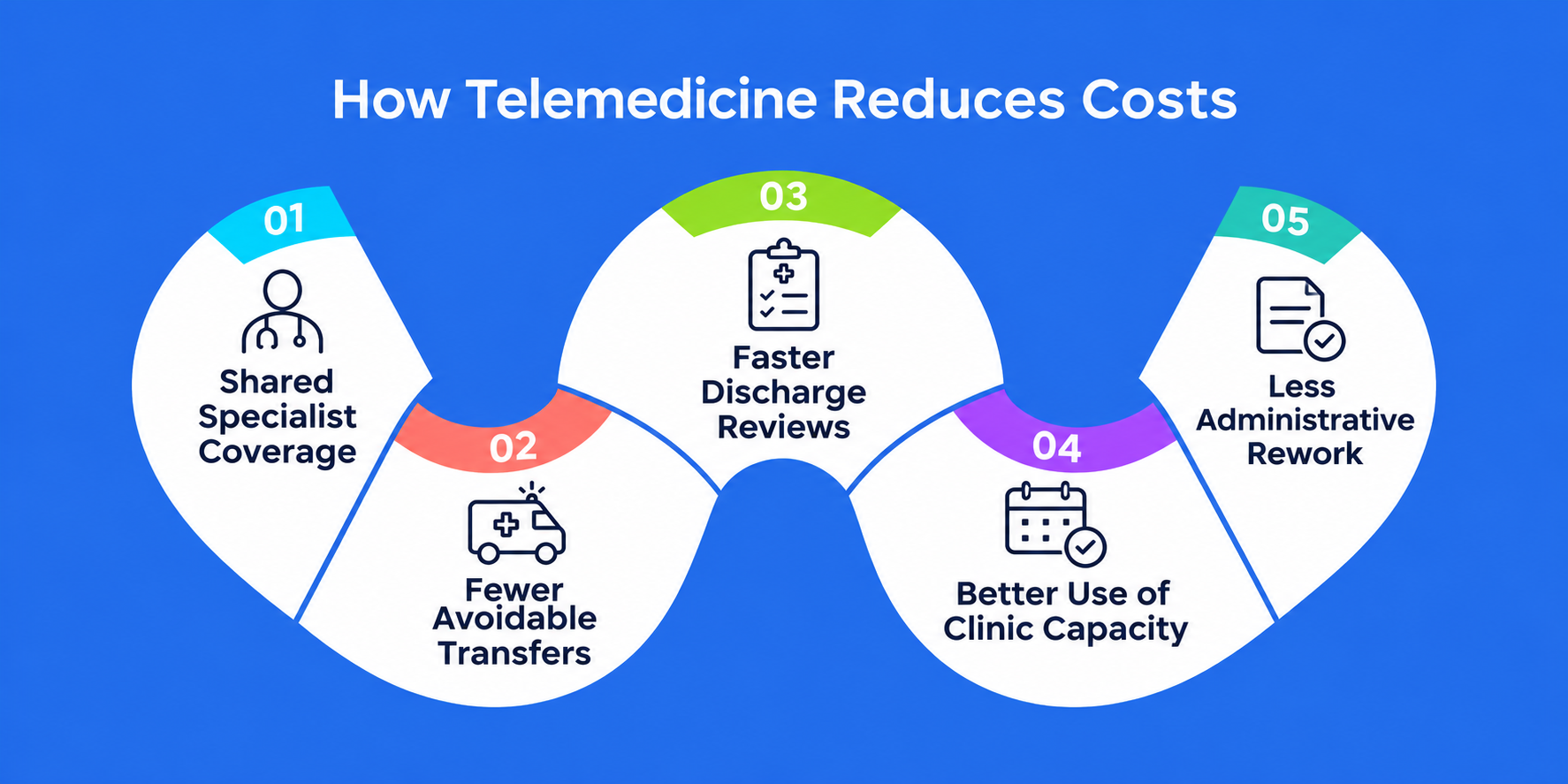
The financial value of telemedicine depends on what changes in the care workflow. A virtual appointment may replace an existing visit, help resolve a pending decision, or introduce another step. Understanding that difference is essential before calculating savings.
Maintaining on-site specialist coverage at every location can be expensive, particularly when demand varies. Remote consultations allow specialist time to be shared across facilities and can reduce dependence on temporary staffing for suitable services.
The opportunity starts with assessing consultation volumes, coverage gaps, and local clinical capabilities. Savings depend on whether the arrangement changes staffing expenditure after remote consultation fees and support costs are included.
Some transfers are considered because specialist input is unavailable locally. A remote consultation can help determine whether the existing team has the resources to continue treatment safely.
Where local care is appropriate, this can avoid transport expenses and the coordination involved in moving a patient between facilities. The decision still depends on the patient’s condition and the services available at the current location.
When discharge depends on a specialist review, remote access may help the team complete that assessment sooner. The practical task is to identify where consultation delays are extending a stay.
The supporting workflow matters: relevant results must be available, recommendations must reach the treating team, and someone must act on them. A faster consultation has limited value if the remaining discharge steps stay unresolved.
Suitable follow-ups and results discussions can move into virtual appointment slots, creating more room for visits that require physical examination or procedures.
This can improve capacity without immediately reducing rent or staffing costs. The financial benefit may come from accommodating demand within existing premises or delaying expansion. Measuring completed appointments and subsequent in-person visits helps establish whether the change improves resource use.
A virtual service should be assessed from booking through to follow-up. If staff must copy records into another platform, contact the patient separately, and manually transfer consultation notes, much of the administrative workload remains.
Connecting scheduling, clinical records, documentation, and assigned follow-up tasks creates an opportunity to remove repeated work. Staff time per completed episode of care provides a more useful measure than consultation length alone.
The starting point is to identify where each workflow loses time and adds cost. Some services need better AI integration between existing systems. Others need redesigned follow-up processes or modernization before virtual care can scale. These decisions determine whether telemedicine reduces the total cost of care or adds another channel to manage.
Lower operating costs tell only part of the story. The clinical value of telemedicine depends on what happens after information is shared: whether a concern is reviewed, treatment is adjusted, and the next step is completed.
Between scheduled appointments, changes in symptoms or treatment response can go unreviewed. Virtual follow-ups provide opportunities to discuss those changes and assess whether the care plan needs adjustment.
The research review shared earlier reports benefits in diabetes management, including improvements in measures such as HbA1c in the studies examined. These findings support specific uses of telemedicine, rather than a promise of better outcomes across every condition.
When remote monitoring is part of the service, readings need to reach a team that can interpret and act on them. Collecting data alone does not complete the care process.
A useful workflow defines which readings require review, who receives the alert, and how the patient will be contacted. It also provides a route to further assessment when a remote review is insufficient. This connects information collected between appointments with a clinical response.
A post-discharge review creates an opportunity to discuss recovery, clarify medication instructions, and check whether planned tests or appointments have been arranged.
For example, a patient may report difficulty following the discharge plan. The consultation should lead to a documented action, an assigned person, and confirmation that the issue was addressed. Any reduction in readmissions should be evaluated within the specific patient group and service.
Remote specialist input can support timely assessment where local access is limited. Its usefulness depends on the specialist receiving enough clinical information and the treating team receiving clear recommendations.
The workflow should carry those recommendations into orders, referrals, or follow-up tasks. Measuring that completion, alongside relevant clinical outcomes, helps establish whether easier specialist access is improving care.
A useful starting point is a specific care pathway with a clear purpose for remote contact. Each appointment should support a decision, resolve a concern, or complete an agreed follow-up.
Chronic care reviews: Scheduled consultations can cover symptom changes, medication concerns, and progress against the care plan. Where monitoring data is available, it should reach the clinician before the review, with responsibility assigned for any action afterward.
Post-discharge follow-ups: A remote review can check whether the patient understands discharge instructions and has arranged the next steps. Questions requiring examination or further investigation need a clear route back into in-person care.
Specialist consultations across locations: A remote specialist can review a defined clinical question with the local treating team. The workflow needs relevant records, access to investigations, and a documented plan that the local team can carry out.
Behavioral health follow-ups: Suitable appointments can support ongoing discussions about symptoms, treatment response, and medication. Service design must account for privacy, patient suitability, and arrangements for urgent escalation.
Medication and test-result reviews: Remote appointments can provide a dedicated discussion of results or treatment questions when physical examination is unnecessary. Documentation should capture the decision, any required tests, and when the patient should be reviewed again.
Before expanding any of these services, map the existing process and identify what the virtual appointment will replace or improve. A focused pilot can then test staff workload, follow-up completion, and relevant clinical measures before wider rollout.
A virtual service can make appointments easier to deliver while leaving the underlying workload unchanged. Before expanding it, assess where additional costs, incomplete handoffs, or access barriers could weaken its value.
Disconnected clinical systems: If consultation notes, test results, and follow-up instructions require manual transfer, staff still have to bridge the gaps. Identify which information needs to move between systems and where integration would remove repeated work.
Additional appointments without a clear purpose: A virtual review followed by an in-person visit may be clinically appropriate. However, frequent repeat visits deserve investigation. Check whether appointment selection, missing information, or service limitations prevent the first consultation from resolving its intended question.
Unclear responsibility after the consultation: Recording a recommendation does not ensure it happens. Tests, referrals, and patient callbacks need an assigned owner, a completion timeframe, and a process for handling overdue tasks.
Technology and access difficulties: Login problems, unreliable connections, inaccessible interfaces, or limited digital confidence can interrupt appointments. Service planning should include practical support and an alternative route to care.
Incomplete cost calculations: Platform fees are only one expense. Integration, equipment, training, technical support, and clinical review time also belong in the assessment. Compare the full cost of completing the care pathway before and after implementation.
These findings should shape the roadmap. An existing service may need better integration or redesigned follow-up processes before it needs more features. Addressing those constraints first provides a stronger basis for expansion.
Appointment volume shows adoption. To understand value, examine what it takes to complete care and whether the intended clinical result improves. Establish a baseline for a defined patient group and care pathway before comparing performance.
Cost per completed care episode: Include preparation, consultation, documentation, follow-up, technology costs, and related repeat visits. This helps reveal whether costs have fallen or moved elsewhere.
Staff time and workload: Measure time spent arranging appointments, gathering records, transferring notes, and resolving outstanding tasks. Check whether virtual care reduces this work or creates another queue to manage.
Follow-up completion: Track whether ordered tests, referrals, medication reviews, and patient callbacks happen within the agreed timeframe. Investigate incomplete actions rather than counting consultation completion alone.
Clinical outcomes: Choose measures suited to the service, such as HbA1c for a diabetes program or symptom scores for a behavioral health pathway. Attendance and satisfaction add context but do not establish clinical improvement.
Subsequent use of care: Review related in-person appointments, emergency visits, admissions, and transfers. Assess whether these reflect appropriate escalation, unresolved concerns, or changes in patient needs.
Compare similar patient groups over a suitable period and account for differences in clinical complexity. Use the findings to decide what to improve, which workflows need redesign, and whether the service is ready to scale.
DITS starts by examining how care moves through the existing service: where information is missing, which tasks require repeated effort, and what prevents follow-up from being completed. That assessment helps determine whether the priority is to improve an existing platform, connect systems, modernize an application, or build new capabilities.
Depending on those findings, the work may include integrating clinical records and scheduling, redesigning referral and follow-up workflows, connecting remote monitoring data, or improving platform reliability as demand grows.
The roadmap should tie each change to a defined measure, such as less documentation time, fewer incomplete handoffs, or better follow-up completion. A focused pilot can validate the approach before wider implementation.
Whether the goal is to build, modernize a system, or scale a telemedicine service, DITS brings consulting and engineering together around the operational problem and the outcome that needs to improve.
Build a practical roadmap for integration, modernization, and platform growth around your care workflows and business priorities.
Telemedicine can reduce costs and support better outcomes when it helps teams complete care with fewer delays and less repeated work. Its value depends on the decisions it enables, the information available, and whether someone acts on the next step.
Start with one care pathway. Establish its current cost, workload, and clinical measures, then identify where remote care could improve the process. Connect the necessary systems, assign follow-up responsibilities, and test the change before expanding.
That gives each investment a clear purpose and a practical way to judge whether it is improving care.
With more than 20 years of experience - I represent a team of professionals that specializes in the healthcare and business and workflow automation domains. The team consists of experienced full-stack developers supported by senior system analysts who have developed multiple bespoke applications for Healthcare, Business Automation, Retail, IOT, Ed-tech domains for startups and Enterprise Level clients
Discover How IoT benefits the supply chain. Learn how connected devices help improve efficiency, cut costs, offer real time tracking and manage inventory.
Dinesh Thakur
05 Nov 2026
IoT is revolutionizing public safety with smart devices. Read the real world IoT public safety use cases, creating a more safe world for people.
Dinesh Thakur
04 Nov 2026

Discover how the future scope of AI in healthcare is transforming patient care, diagnostics, personalizing treatment, and automating healthcare operations for faster healing.
Nidhi Thakur
03 Nov 2026