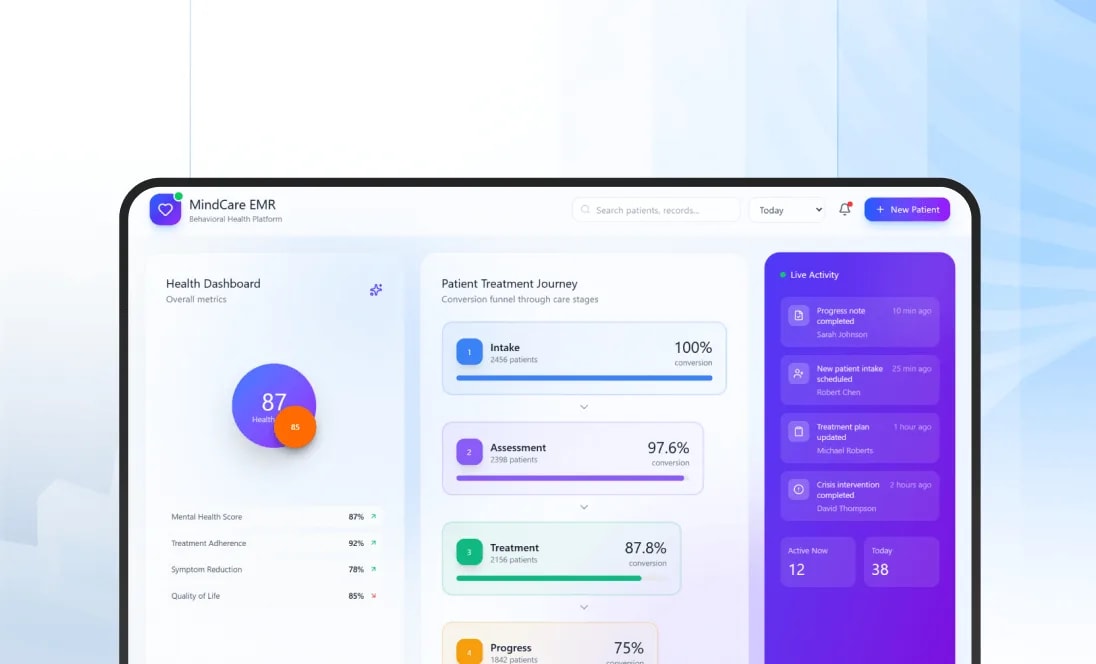


Multi-Tenant Client Hierarchy
Each healthcare organization is modelled as a client with its own sites, care teams, staff, and patients, supporting fully managed, referral, and turnkey contract models.

Remote patient monitoring software that moves post-hospital recovery into the home, pairing connected medical devices with a patient mobile application so assigned nurses monitor vitals remotely and monthly billing stays accurate and defensible.
The platform is a post-acute care hub for health plans and hospital systems, using technology-enabled care models to close the gap between the clinical setting and the home. This remote patient health monitoring system syncs daily vitals from IoT medical devices into a clinical dashboard where nurses review readings against thresholds, raise escalations, and log billable monitoring time. Built on Laravel, VueJS, and React Native across AWS, it serves care coordinators, clinic staff, physicians, patients, and family members through a four-level hierarchy of clients, sites, care teams, and patients.
The client faced fragmented care delivery, unreliable data syncing, compliance risks, and limited scalability—all highlighting the urgent need for a unified, scalable chronic disease management and patient monitoring solution.

The MVP database was designed for exactly one organization. Scaling into SaaS required a multi-client hierarchy, but the existing schema blocked onboarding and forced a separate deployment per customer.

Patient vital history is both the clinical record and the input monthly billing depends on, so a clean schema rebuild would have severed continuity for every patient already monitored.

Compliance could not be a launch checklist. It had to be engineered into the platform as a living culture protecting privacy, security, and integrity of protected health information continuously.

Clinical staff needed real-time audio, video, and text contact with patients, and every additional channel opened another path for protected health information to leave the system.

The monitoring model depended on readings arriving from patient homes without staff intervention, across a mixed population of devices, connectivity conditions, and older users unfamiliar with pairing.

Monthly billing had to evaluate distinct qualifying conditions per CPT code, which manual calculation could not sustain accurately as patient volumes and concurrent care programs grew.
Ditstek architected complete remote patient monitoring solutions, migrating historical records safely into a new multi-tenant hierarchy while embedding compliance controls, device integration, and automated monthly billing directly into the clinical workflow.

A scalable MySQL and Laravel model built around a client, site, care team, and patient hierarchy, opening flexible onboarding without fragmenting the data that already existed.

Legacy records were migrated into the new multi-tenant structure rather than re-created, preserving patient timelines and billing history intact through the transition from MVP to SaaS.

Blood pressure monitors, oximeters, and glucometers were integrated over Bluetooth and cellular networks, so daily vitals travel from the home to the dashboard without either party initiating transfer.

Strict access controls and secure data pipelines were established across every component, with an access log written each time a staff member opens or edits a patient record.

AWS Cloud hosts the staging and production environments, and Amazon S3 provides encrypted storage for clinical documents and generated reports under controlled, logged, and fully auditable access.

Real-time communication was routed through Sendbird for chat and Freeswitch for audio and video, keeping every staff and patient interaction inside controlled, auditable, compliant channels.
The platform covers full patient monitoring solutions, from patient onboarding and device assignment through automated vitals capture, clinical escalation, structured clinical documentation, and automated monthly billing against qualifying care codes.
Each healthcare organization is modelled as a client with its own sites, care teams, staff, and patients, supporting fully managed, referral, and turnkey contract models.

Assigned devices sync daily readings to the patient app over Bluetooth or cellular, and the app transmits them to the server for continuous clinical monitoring.

Each vital is evaluated against configured normal and critical ranges, with per-patient status indicators, trend charts, and roster filters for watchlist, unreviewed readings, and compliance risk.

When vitals stay critical, the assigned nurse raises an escalation flagged urgent or trending, tracked in a separate queue so no flagged patient falls out of view.

Billing calculates monthly against qualifying care codes with distinct conditions evaluated per code, and staff run, review, and approve the generated reports before anything is finalized.

A session timer runs on the patient record with pause and save controls, feeding the monthly calculation and enforcing the cap on billable voice and video minutes.

Built with React Native, the app lets patients view and upload vitals, syncing automatically from assigned devices or accepting manual entry when a device is unavailable.
Staff build custom forms and question sets through a drag-and-drop interface, assign them to individual patients, and the system scores responses automatically against the options configured.
Every authorized account access, manual vital post, vital review, and record change generates a log entry, rendered as a chronological timeline on the patient record.
The platform delivered measurable success—from reducing onboarding time and billing errors to improving clinical coordination and patient engagement—empowering healthcare providers to scale compliant, connected care delivery across programs.

The platform moved from a single-client MVP to multi-tenant SaaS without losing a single patient record or a month of billing history through the schema transition.

The system now serves an active base of 700 users across web and mobile applications, connecting patients, physicians, and care coordinators inside one clinical record.

Automated vital capture removed the burden of daily in-person check-ups for senior patients recovering at home, where travel is hardest and readmission risk is highest.

Escalation workflows keep clinical attention on the patients whose readings actually warrant intervention, rather than spreading nurse review evenly across an entire monitored patient population.

The billing infrastructure captures revenue systematically through monthly device rental, one-time device setup fees, and billable voice and video time up to the monthly per-patient cap.

The multi-client hierarchy and program model give clear architectural headroom to extend beyond remote monitoring into a broader chronic care management platform and a staff-facing mobile application.

Integrated Healthcare Platform | .NET, SQL Server, AWS through a secure, scalable, and connected digital environment across connected operations across connected operations across connected operations across connected operations across connected.
View Project